
Technologies
iOS 15 release date was today: Everything to know before you update your iPhone
Apple’s new iOS 15 software is now available to download on your iPhone. Here’s everything to know.
This story is part of Apple Event, our full coverage of the latest news from Apple.
Apple’s iOS 15 has arrived. After Apple’s iPhone 13 event last week, the tech giant revealed that iOS 15 would be generally available for free download on Monday, alongside iPadOS 15. At the event, we also saw four iPhone 13 models, new iPads and the Apple Watch Series 7 all debuted.
Not to be confused with last week’s release of iOS 14.8, which addressed a security issue, iOS 15 brings new features to several generations of the iPhone.
We got a first look at Apple’s iOS 15 update at the company’s virtual Worldwide Developers Conference in June, followed by a developer beta and then a public beta. (Here’s how to download iOS 15 now, why you might want to wait to download iOS 15, and how to check if your phone can run iOS 15.)
While we saw a lot of new features arrive this spring and summer with iOS 14.5, iOS 14.6 and iOS 14.7, including being able to unlock your iPhone with Face ID while wearing a mask, stop apps from tracking you for advertising purposes and choose from four Siri voices, iOS 15 adds even more. New iOS 15 features include the ability to start FaceTime calls with Android users, easier sharing in iMessage and better directions in Maps. Keep reading for everything we’ve learned about iOS 15 so far, including when it will be generally released, how to download it and some of the biggest new features.
iOS 15 release date: Sept. 20
Apple initially revealed iOS 15 at its annual Worldwide Developers Conference on June 7, as is typical. The new OS was first available for developers to test and became available to download as a public beta on June 30.
At the iPhone 13 event on Sept. 14, Apple announced that iOS 15 would be generally available for free download on Sept. 20.
This follows Apple’s typical iOS release pattern, with the software typically arriving within a week of an iPhone launch event.
And if you’ve been holding onto the same iPhone since 2015 or later, you will likely be eligible to receive iOS 15. Apple’s iOS 15 is available on the iPhone 6S and every iPhone onward.
iOS 15 new features
Here are a few of the key new features that come with iOS 15, unveiled at WWDC 2021. (And here’s an overview of all of the new features in iOS 15.)
FaceTime upgrades: Spatial audio, support for Android and Windows
FaceTime will offer spatial audio to make people’s voices appear to come from their position on the screen, making your video chats feel more natural and lifelike. FaceTime will also start to look more like Zoom, allowing you to see all participants in a grid view, schedule calls and share links to calls that can be accessed via browser on Google Android and Microsoft Windows devices.
Read more: Fun FaceTime date idea: Try Apple’s new SharePlay feature in iOS 15
iMessage sharing features
iOS 15 adds some new iMessage sharing features for photos, news articles and playlists. When a friend sends you multiple photos over iMessage, they’ll appear in a dynamic collage formation that allows you to swipe through them or tap through to view the whole bunch in your photos app. If you want to access the same photos later, you’ll find them stored in a new Shared with You folder, as well as mixed in with your own featured photos and memories. You’ll also find news articles and playlists shared through iMessage in new Shared with You tabs in your News and Apple Music apps.
Apple Maps update: 3D street data, AR walking directions and weather warnings
Apple Maps gets an upgrade with more elevation data, road colors and driving directions, rich labels, 3D landmarks and improved night mode. In terms of public transportation, you can also pin nearby public transit stops and station information to your iPhone and Apple Watch devices, and receive automatic updates and notifications as you ride and approach your stop. When traveling on foot, a new augmented reality feature lets you scan nearby buildings in the area with the iPhone’s camera to determine their precise position for more accurate walking directions, which are also presented in augmented reality.
Maps also could factor weather warnings into suggested routes in iOS 15. Redditor ChrisSDreiling, who spotted the update in iOS 15 beta 3, says Maps will let you know if there are flash floods on your journey, and suggest alternate routes to avoid the extreme weather. Although other types of weather alerts weren’t mentioned in ChrisSDreiling’s post, it will be interesting to see if more weather warnings will be added before the iOS 15 general release.
Facial recognition selfies to validate digital ID cards in the Wallet app
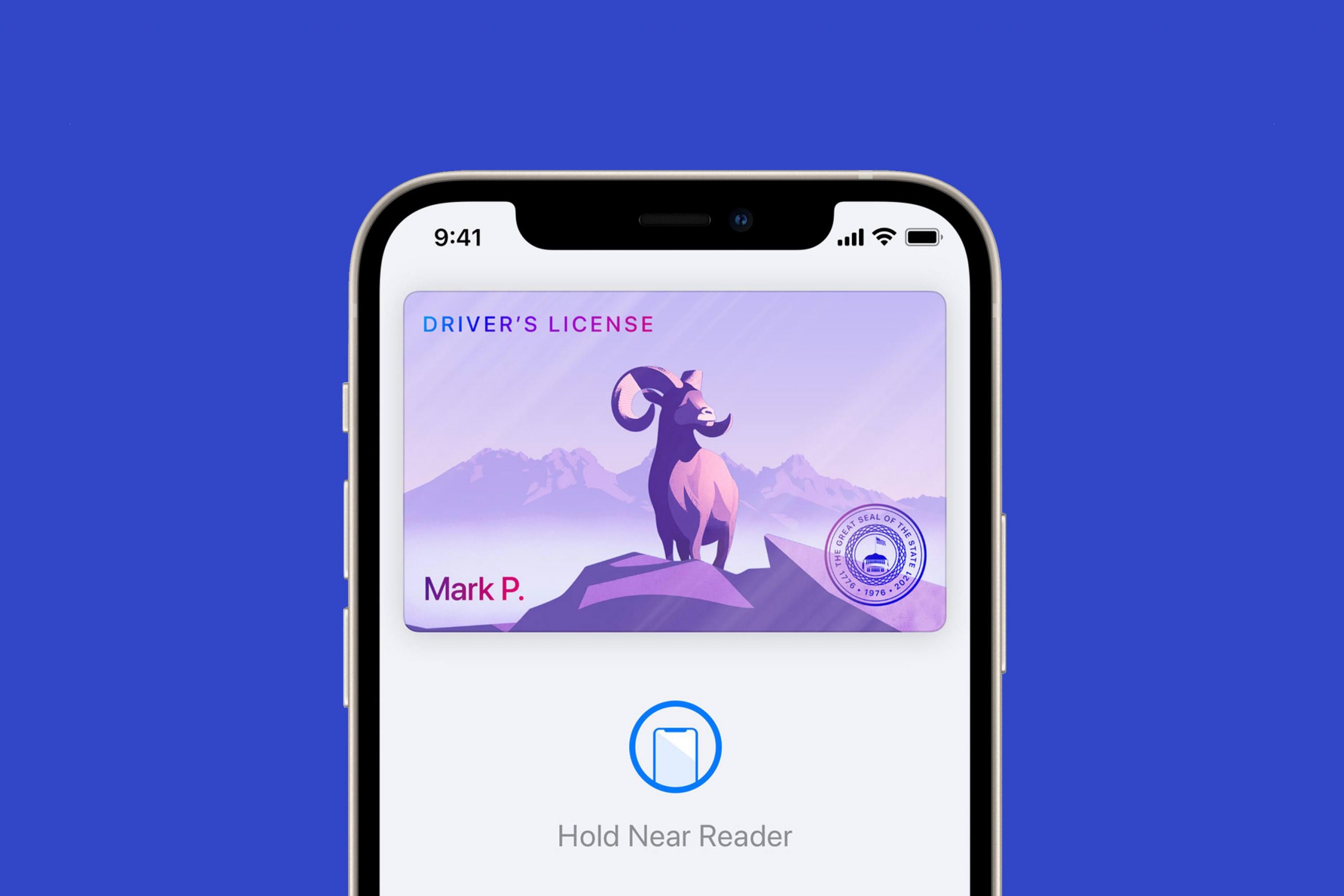
At WWDC this spring, Apple announced that it will add ID card support for the Wallet app in iOS 15, allowing you to carry digital versions of government-issued identification cards like your driver’s license on your iPhone. The ID feature isn’t in the initial release of iOS 15 and it’s still unclear how exactly it will work. (It will also only be for US users.) According to code uncovered by 9to5Mac in the iOS 15 beta 4 for developers, Apple could be using facial recognition selfies to validate your digital ID cards when adding them to your wallet. Some banking apps already use this selfie validation feature to authenticate users when logging on with new devices.
How do you download iOS 15?
Now that iOS 15 is generally available, you likely got a notification from Apple letting you know you can update. Or you can do it manually, by going to the Settings app > General > Software Update and under the Also Available section, tap Upgrade to iOS 15.
If you had already installed the iOS 15 beta on your phone, you can uninstall it before downloading the final version of the OS. Here’s why you might want to wait before installing the full release of iOS 15.
For more, here’s everything to know about the iPhone 13. You can also take a look at the cool new features for WatchOS 8, the best things about MacOS Monterey and check if your computer is compatible with the new MacOS.
Technologies
A Humanoid Robot Visits the White House to Push AI for Teaching Kids
First lady Melania Trump shares the spotlight with a Figure 03 robot to promote the use of artificial intelligence in education.
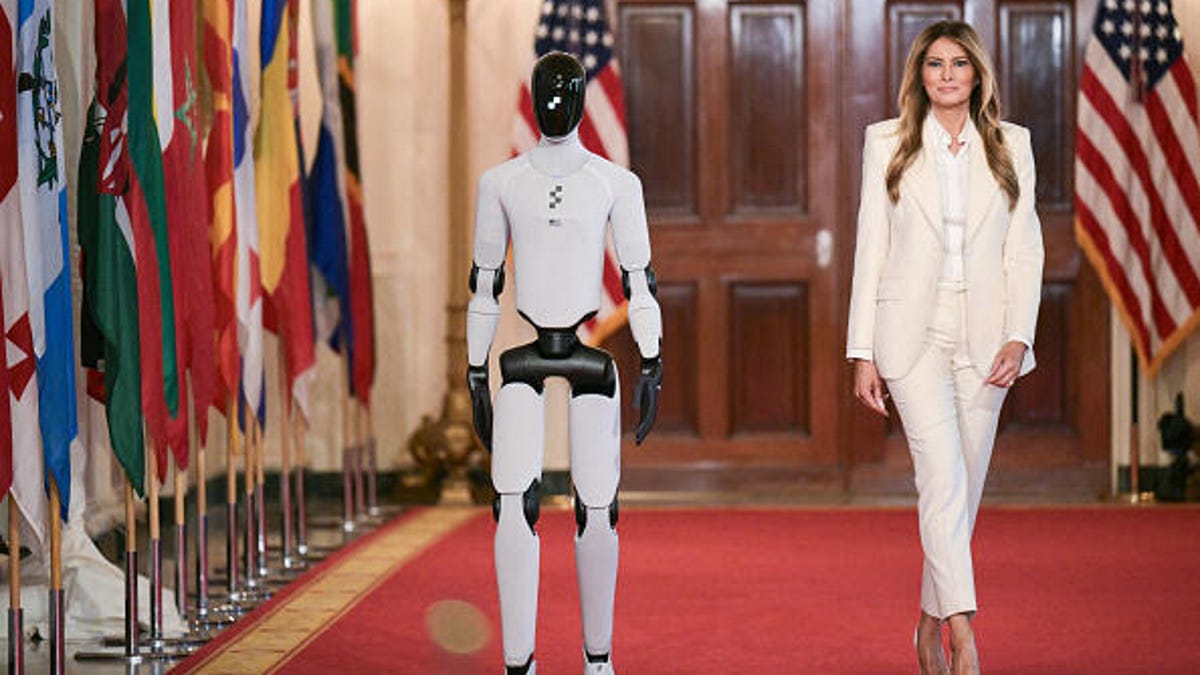
An unexpected guest escorted Melania Trump at the Fostering the Future Together Global Coalition Summit on Wednesday: a walking, talking Figure 03 humanoid robot.
During the event, the first lady pitched a future where AI-powered humanoid robots — presented as an idealized educator named «Plato» — provide students with personalized and instant access to human knowledge, including philosophy and art.
The Figure 03 robot is made by Silicon Valley-based robotics company Figure AI, which introduced its third-generation humanoid robot in October last year. The Figure 03 robot costs around $25,000, according to Forbes.
Figure 03 was designed for people to use in their homes, with demo videos showing it folding laundry, lifting eggs from a carton, using a washing machine and delivering drinks to its owners lounging by the pool. It was also shown in corporate use cases as a receptionist and a package deliverer. Using a proprietary AI engine called Helix, it can autonomously perform these tasks and respond to your voice commands.
At the White House, the humanoid robot walked slowly down the red carpet to deliver opening remarks for the tech summit.
«I’m grateful to be part of this historic movement to empower children with technology and education,» the Figure 03 robot said. It then said «welcome» in various languages.
The first lady later said that AI-powered humanoid robots could be placed in children’s homes as an aid to their education to «boost analytic skills and problem solving and adapt in real time to a student’s pace, prior knowledge and even emotional state.»
Promoting AI in education
The two-day summit is hosting leaders from 45 nations and 28 technology organizations, and is intended to «empower children through education and technology,» according to a White House statement. Guests included representatives from tech giants such as Google, OpenAI, and Microsoft and the AI data analytics company Palantir.
The summit is part of the first lady’s Be Best: Fostering the Future initiative, which aims to help children learn using advanced technology. It was introduced in 2018 as an awareness campaign aimed at combating cyberbullying and helping children affected by the opioid crisis.
US Education Secretary Linda McMahon spoke about AI being one of the Department of Education’s main priorities on the first day of the summit.
«If we’re able to scale these resources effectively by investing in AI infrastructure and training, we can offer expert instructions across countless fields, to hire volumes of people at a fraction of the cost,» McMahon said Tuesday at a roundtable meeting.
According to McMahon, the Department of Education has already dedicated millions of dollars in grants to support the use of AI in schools.
The event follows criticism of the Trump administration’s 2025 executive order to dismantle the Department of Education. While the Department of Education hasn’t been officially abolished, it has undergone significant policy changes, funding cuts and workforce reductions.
The introduction of a humanoid robot at the summit sparked significant backlash among many who are wary of the technology’s role in the classroom. Critics took to social media to voice concerns that these machines could eventually replace teachers, stripping the education system of essential human connection, and leading to increased layoffs and cost-cutting.
On one Huffington Post Instagram post featuring the robot, commenters expressed deep skepticism, with one user sarcastically noting, «Nice, getting rid of educators in favor of a robot,» while another flatly rejected the concept, stating, «No, I don’t want to imagine a world with emotionless robots educating our children.»
The White House did not immediately respond to a request for comment.
Technologies
Nintendo’s $20 Switch 2 Upgrade for Super Mario Wonder Is Worth It for the Extras
Commentary: Super Mario Bros. Wonder’s Bellabel Park DLC is here this week, but it’s more about lots of chaotic multiplayer minigames than new courses.

I want a new Super Mario Bros. Switch 2 game as much as anyone, but almost a year into the console’s first year, it hasn’t happened yet. Mario Kart? Mario Tennis? Mario Party? Yes. New Yoshi game? That’s happening soon, too. And now, we have the next closest thing: The wonderful 2023 Super Mario Bros. Wonder has a Switch 2 downloadable-content pack for $20 that’s, well, sort of a new Mario game, just a week before the Super Mario Galaxy movie arrives in theaters.
I’ve been playing it for the past week, and it’s worth the upgrade if you like multiplayer Mario. If not, well, you might consider it anyway.
The awkwardly named «Super Mario Bros. Wonder — Nintendo Switch 2 Edition + Meetup in Bellabel Park» is an add-on to Wonder, but it’s really just focused on building out a whole bunch of multiplayer party modes. The new course variants and minigame challenges, while welcome, require online multiplayer or local multiplayer play to work. For most of this new Switch 2 update, you can’t play offline on your own.
The multiplayer games cover dozens of challenges and themes — some turning everyone into bouncy balls, others making everyone rush to collect the most coins. You can throw up to four players locally on the Switch 2 at home or up to 12 players online at once, and it gets busy fast. I can see screaming breaking out with kids.
I played an hour or so of multiplayer sessions, and it was fun. But I haven’t gotten to play with lots of others online yet other than that. Still, it does feel sort of like Mario Party Super Mario Style, as opposed to Super Mario Bros. game extensions.
The DLC does have some extras you can still enjoy on your own. Seven new miniboss stages have been added into the game, featuring all of the Koopalings to take on. They’re the extended universe of Mario enemies, and each of the levels has the miniboss use a strange new power to melt the world in clever ways.
A new Toad Brigade Training Camp mode also offers up dozens of little challenge stages to beat, all remixes of existing Wonder levels. Some involve surviving without touching enemies or coins; some you have to defeat all enemies or collect all coins before time runs out. They’re addictive and hard, and I’m glad for them existing.
Nintendo also tried to add some fun extras: Bellabel park has lots of flowers you can collect by watering plants with «Bellabel water» you collect by completing tasks. And you can decorate parts of the park. It’s sort of neither here nor there for me, though, because I come to Mario platformer games to play fun levels, not decorate gardens. Pokemon Pokopia is the place for that.
Rosalina and a Luma Star are extra characters you can play with, but Rosalina doesn’t do anything truly new and the Luma Star is a co-op option. There’s also a weird Flower power-up now that turns you into a walking flowerpot, throwing flowers upward to attack enemies or hit blocks. It was OK. It’s not my favorite new extra.
Maybe that’s what feels missing here: Wonder threw all sorts of wildcards out into the game, from new enemies to strange Wonder Seeds that transformed levels. Bellabel Park feels more like a multiplayer-focused remix than a bunch of new single-player whimsy.
I like the multiplayer games on tap more than I liked the Switch 2 add-on for Mario Party Jamboree. They’re probably worth it if you’re a Switch 2 owner with a big family or lots of friends who want to play.
And even though I appreciate the resolution boost to the graphics, the Switch 2 graphics upgrade is hard to spot since the game’s «older» graphics have a retro look that still looked great before the upgrade (to me, at least).
What I really want, of course, is a truly new Mario game. Who doesn’t? That’s not on the table yet. But maybe, just maybe, Wonder’s Switch 2 pack is a little appetizer before that news eventually comes. But as revamped Switch 2 game editions go, Wonder’s extras are the best yet and turn this game into a truly multiplayer-rich bunch of fun.
Technologies
Verum Finance — the future of digital payments
Verum Finance — the future of digital payments

Virtual Verum Finance cards can be linked to Apple Pay and Google Pay, giving users seamless access to in-store payments, online shopping, hotel bookings, flight purchases, and more worldwide.
The cards work globally, enabling payments without geographic limitations while providing a high level of security and full control directly within the app.
Issuing a card takes just a few minutes and does not require switching to third-party services — the entire process is handled within Verum Messenger.
Users get a unified solution for communication and finance: from messaging to managing payments and digital assets in one application.
Download Verum Messenger, get your Verum Finance card, and start using it today.
-
 Technologies3 года ago
Tech Companies Need to Be Held Accountable for Security, Experts Say
-
 Technologies3 года ago
Best Handheld Game Console in 2023
-
 Technologies3 года ago
Tighten Up Your VR Game With the Best Head Straps for Quest 2
-
 Technologies4 года ago
Black Friday 2021: The best deals on TVs, headphones, kitchenware, and more
-
 Technologies5 лет ago
Google to require vaccinations as Silicon Valley rethinks return-to-office policies
-
 Technologies5 лет ago
Verum, Wickr and Threema: next generation secured messengers
-
 Technologies4 года ago
Olivia Harlan Dekker for Verum Messenger
-
 Technologies4 года ago
The number of Сrypto Bank customers increased by 10% in five days