
Technologies
Bowers & Wilkins PI7 S2 Earbuds Review: Same Fantastic Sound, But Only Slight Improvements
The company’s flagship earbuds have the same design but offer better battery life and double the Bluetooth range.
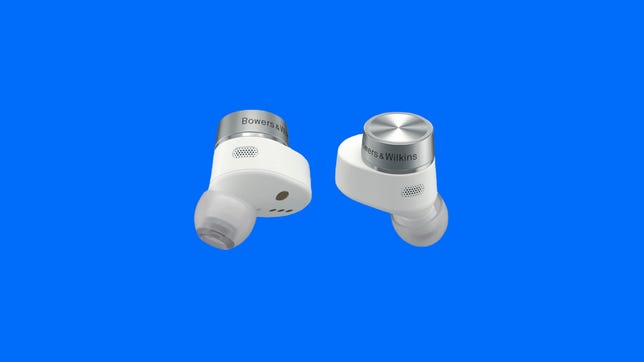
When Bowers & Wilkins introduced its first true-wireless earbuds in April 2021, they were among the very best-sounding models in that highly competitive headphone space. Now we get the next generation of those buds, the PI7 S2 ($399, 349, AU$700) and PI5 S2 ($299, 249, AU$450) — and they manage to be both quite impressive and a tad disappointing at the same time. (For what it’s worth, the names are “pi 7” and “pi 5”, styled in all caps and no spaces, not “P seventeen” and “P fifteen.” Got it?)
Bowers & Wilkins PI7 S2
Like
- Great sound
- Improved battery life and Bluetooth range
- Very good noise-canceling and voice-calling capabilities
- Wireless charging case turns into a Bluetooth transceiver, enabling you to connect to an external audio source such as an in-flight entertainment system
Don’t Like
- Pricey
- Same Qualcomm chipset as in the previous model
- Missing some features typically found on premium buds
Let’s start with the underwhelming part. For better or worse, although the PI7 and PI5 now come in new color options, their design has barely changed, and they look very similar to their predecessors. If you look closely, the grilles over the microphones appear to be slightly larger, and there’s a sensor just below one of the microphones that wasn’t there previously. Bowers and Wilkins didn’t mention anything about new drivers, so presumably they’re the same, and I’ve confirmed that these new models use the same legacy Qualcomm QCC5126 chipset (with Bluetooth 5.0) as the originals. (The latest 5 series chips are the QCC5141 and QCC5144).
So what’s upgraded? According to Bowers & Wilkins, the new models have better battery life and Bluetooth range, now up to 25 meters, which is double the previous range. Additionally, the buds now integrate into the new Bowers & Wilkins Music app for iOS and Android and have a much improved set-up experience (I can attest to that).
With the original PI7 buds, you only got about four hours of battery life on a single charge with an additional four charges in the case (20 hours total). The battery life on the PI7 S2 is up to five hours for the buds with 16 hours more from the case (21 hours total). Meanwhile, the PI5 goes from 4.5 hours on a single charge to up to five hours but dips from 20 hours additional from the case to 19 hours.
Bowers & Wilkins says the battery life gains in the buds have been achieved through hardware changes, not software updates. The batteries in the buds are new and the antenna design has also changed. “The caps at the end of the earbuds — the sections that carry the logo — have been re-engineered to improve antenna performance,” a Bowers & Wilkins rep informed me. “We’ve introduced a new design of antenna and repositioned it within the earbud endcaps. At the same time, we have switched to use plastic, rather than aluminum to trim each endcap. The result is stronger Bluetooth signal strength, giving us our improved 25-meter range.”
While I certainly appreciate better battery life and improved Bluetooth range with a more reliable wireless connection, the updates struck me as relatively modest. Of course, Bowers and Wilkins could add features later, which we’ve seen before with premium buds that use Qualcomm chipsets (Jabra and Bose, for example). However, Bowers & Wilkins has never updated the firmware of its original buds. So don’t expect these to get multipoint Bluetooth pairing, which allows you to pair the buds with two devices simultaneously — say, a computer and smartphone — and have the audio automatically switch to your smartphone when a call comes in (instead, you have to manually switch between paired devices). Nor can you expect to see support for Qualcomm’s upcoming spatial audio or Bluetooth LE Audio with Auracast capabilities.
The app is also missing an equalizer to tweak your sound. I personally don’t mind a fixed EQ that sticks to a company’s signature sound, but a lot of people like to customize the sound settings of their headphones.
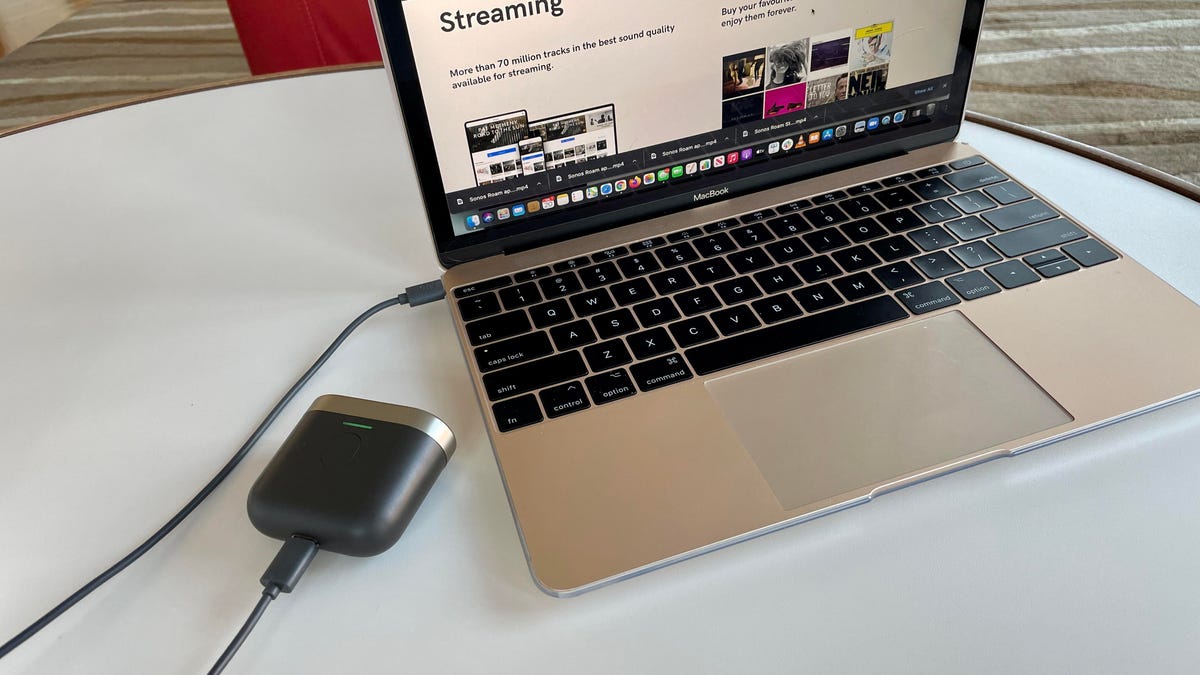
All that said, the touch controls work very well, as does the automatic ear-detection feature. And the PI7 S2’s wireless charging case, like its predecessor, converts into a transceiver, so you can plug the case into the headphone port on an airplane’s inflight entertainment system and wirelessly stream audio from the case to the earbuds. Alternately, you could also connect the case to a laptop audio port and use it to wirelessly stream high-resolution audio to the buds.
Note that the PI5 is very much a step-down model. It’s got a single driver instead of the dual drivers found in the PI7 and one less microphone on each earbud (two instead of three). The aforementioned “wireless audio retransmission” feature in its case is also absent.
All about the sound
Simply put, the PI7 S2 sound great so long as you get a tight seal from one of the three sizes of included ear tips. I’m a fan of Bowers & Wilkins ear tips, which have a similar design to Sennheiser ear tips, and the large tips fit my ears well. These are large ear buds that will stick out of your ears a fair amount, but they did fit my ears comfortably and fairly securely. They offer IPX54 water-resistance, which means they’re splashproof and dust-resistant, so you can run with them, though there are better earbuds options with sport fins that are more suitable for sporting activities (I’m not sure you want to risk a $399 earbud dropping out of your ear). However, I would have no problem using them at the gym.
Like its predecessor, the PI7 supports Qualcomm aptX Adaptive wireless transmission (which includes the aptX HD codec) from compatible mobile devices, allowing for “high-resolution music transmission from suitable streaming services, such as Qobuz.” The list of Android devices — and dedicated music players — that support aptX Adaptive has grown over the last few years and you should ideally pair the buds with a device that supports aptX Adaptive (along with a streaming service that offers high-resolution streaming). That said, the buds also work just fine and sound very good with Apple’s iPhones, which support the AAC codec. (Both the PI5 and PI7 support AAC streaming but the PI5 only supports standard aptX, not aptX Adaptive.) Alas, Sony’s LDAC hi-res audio codec is not supported, but typically headphones support either aptX or LDAC, not both.
I listened to the buds using an iPhone 14 Pro and an Asus ROG 6 Android smartphone that’s powered by Qualcomm’s Snapdragon 8 Plus Gen 1 mobile platform. As I said with the original PI7, the PI7 S2 has exactly what I’m looking for in a good set of headphones: Accurate and articulate sounding with deep, well-defined bass, natural sounding mids, nicely detailed treble and a wide soundstage that gives the overall sound some largesse.
On my iPhone, I tested the buds with Spotify, Apple Music and Qobuz. The PI7 S2 can go toe-to-toe and, in some cases, slightly edge out many of the top mainstream earbuds out there for sound, including Sony’s WF-1000XM4, Apple’s AirPods Pro 2, Bose’s QuietComfort Earbuds 2, Sennheiser Momentum True Wireless 3 and Bang and Olufsen Beoplay EX, which also cost $400.
However, when I switched to the Asus and streamed high-resolution tracks from Qobuz (with aptX Adaptive), I went from saying to myself, “That sounds really good” to “Wow, that sounds awesome.” Bowers & Wilkins has a playlist on Qobuz for its PX8 full-size headphones, so I ran through a bunch of those tracks. Some of them included Taylor Swift’s Vigilante Shit, Athletes of God’s Don’t Wanna Be Normal, Anna B Savage’s Since We Broke up, Orbital’s Dirty Rat and Pixies’ Vault of Heaven. The quality of the bass was a level up — more visceral with added girth and punch — and there was a little more sparkle, depth and nuance to the music all around. I came away feeling my Spotify needed an upgrade.
Good noise canceling but not best-in-class
As with the sound, you’ll need a tight seal to get optimal performance for noise canceling, which can be set to on, off or an “auto” mode that adapts the noise canceling according to the ambient sound in your environment. You can also adjust how much “passthrough” sound you want to let into the buds, which is typically referred to as an awareness or transparency mode.
The buds’ transparency mode isn’t quite as natural sounding as some of the others I’ve used (at the moment, the AirPods Pro 2’s transparency mode is the gold standard). I settled on a midway point for the slider setting in between “min” and “max” for what I felt was the best transparency experience.
The noise canceling is quite effective and does a nice job of reducing a decent amount of ambient sound, particularly in the lower frequencies. However, the Bose QuietComfort Earbuds 2 do a better job reducing noise across a broader range of frequencies (higher frequencies are more challenging for noise-canceling headphones to muffle). So while the PI7’s noise canceling is clearly respectable, it’s not in the same class as the earbuds’ sound.
The PI7’s voice-calling capabilities are at a similar level — very good but not best-in-class. The buds did a nice job of reducing background noise on the streets of New York. While callers said they could hear a bit of background noise, it was reduced considerably, and they said my voice came clearly without any warbling. I could also hear them quite well, and there’s a bit of sidetone so you can hear your voice in the buds as you speak.
Bowers & Wilkins PI7 S2 final thoughts
Yes, the PI7 S2s are technically a second-gen product, but they feel more like a generation 1.5 product. Bowers & Wilkins has essentially smoothed out some of the rough edges on the original buds (I mean that metaphorically, not literally). The extra hour of battery life and extended Bluetooth range (with seemingly a slightly more reliable wireless connection) are welcome changes. And the setup and integration with the Bowers & Wilkins Music app creates a better overall user experience, despite its somewhat bare-bones quality (compared to Sony’s Headphones app anyway).
If you’re comparing the PI7 S2 to the PI5 S2, which also sound excellent but not quite as good as the PI7, you’ll want to keep an eye on the PI5 S2’s price, which should dip more quickly than the PI7 S2’s price. The original Pi5s are selling for as low as $150, or $100 off their list price of $250, so we’ll see where everything shakes out. The PI5s could end up being the better value, though it’s unfortunate that Bowers & Wilkins added $50 to their list price.
Needless to say, $400 is a lot to spend on a set of earbuds. And when you spend this much, you ideally want the latest technology and features (aptX Lossless, for example). But if great sound is your priority, the PI7 S2s deliver it. And with the buds paired to the right device and streaming service, they can sound downright special.
Technologies
Trump says MAGA Inc. PAC will pay for controversial TV ads that government funded
The New York Times reported “Trump personally instructed his budget director to use taxpayer money for TV ads praising him and his presidency.”
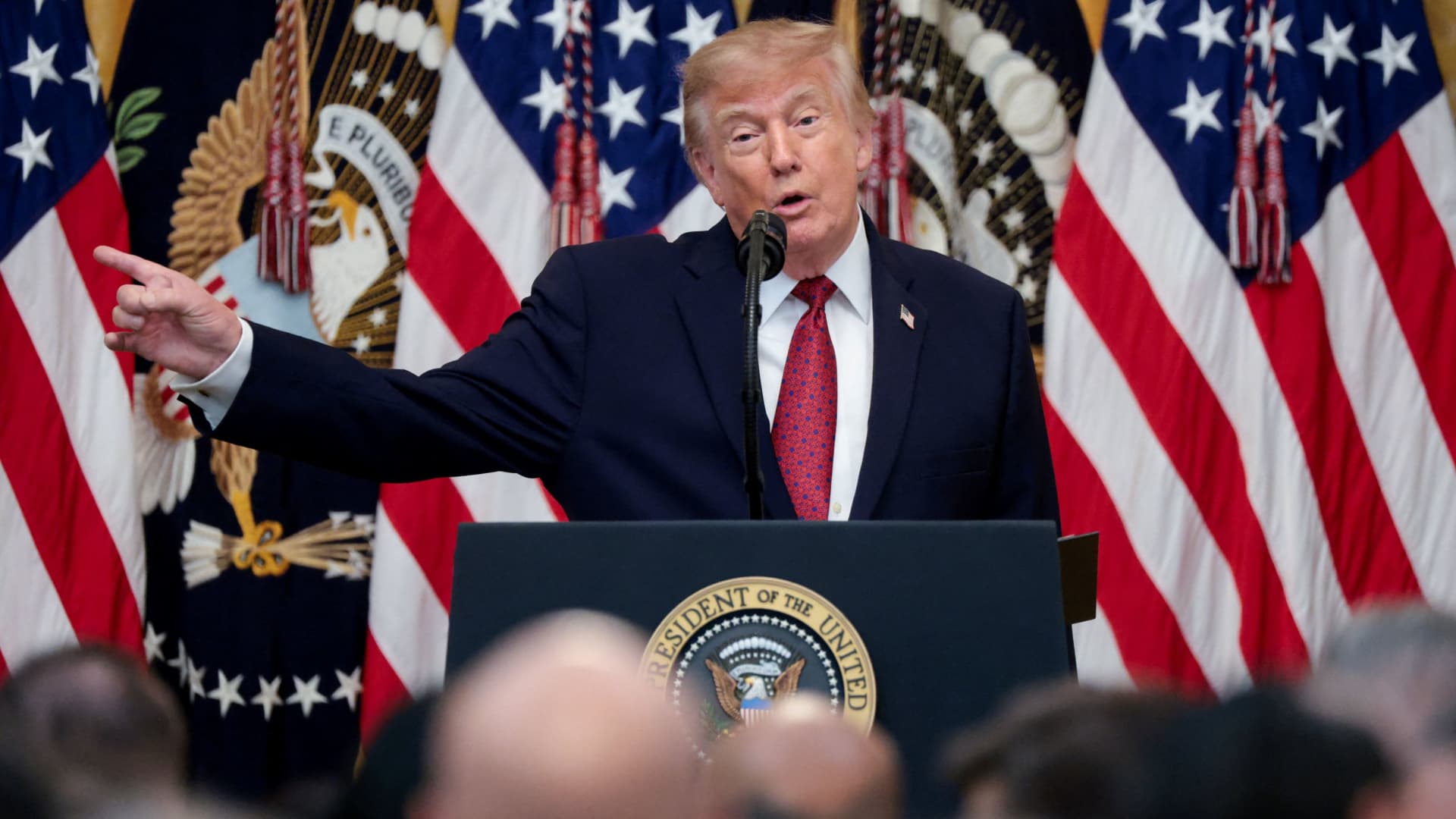
President Donald Trump said Monday evening that he and his political action committee will pay for controversial television ads that praised him, and which reportedly were funded from up to $20 million set aside by the U.S. Department of Homeland Security.
The White House later clarified that the super PAC — MAGA Inc. — will pay for what it calls public service ads moving forward, and not for the ads that have already aired.
Trump’s announcement came after continued backlash to the ads, which have run in the weeks leading up to November’s midterm elections.
Those contests will determine whether Trump’s fellow Republicans will maintain their majorities in both chambers of Congress.
Critics say the ads mirror Republican campaign talking points. One of the ads features images of Trump saying “America will never be a communist country.”
“The Radical Left is upset with the fact that I am taking Ads, which I consider to be a positive promotion for our Great U.S.A., and paying for them with U.S.A. money,” Trump said in a post on Truth Social on Monday.
“This is a rather standard thing to do but, rather than doing that, although nothing will make them happy, I have decided to do the Patriotic Ads, among others, and pay for them myself, and with money I raised for MAGA, Inc.,” Trump said.
AdImpact has tracked roughly $9.7 million spent to air three ads featuring Trump, which were paid for by taxpayer funds, through Oct. 5.
Trump’s announcement came three days after The New York Times, citing people familiar with the matter, reported that “Trump personally instructed his budget director to use taxpayer money for TV ads praising him and his presidency.”
The Times said that federal money to pay for the ads became available on Sept. 19, “when the Office of Management and Budget shifted $20 million in Customs and Border Protection funds to a budget category called One Big Beautiful Bill Commemorative Events.” Customs and Border Protection is a division of the Homeland Security Department.
Sen. Maggie Hassan, D-N.H., in a Sept. 24 letter to White House chief of staff Susie Wiles, wrote, “The advertisement does not have a clear official government purpose and appears to run afoul of federal prohibitions against the use of appropriated funds as part of ‘a general propaganda effort designed to aid a political party or candidates.’”
In a statement on Monday night, Hassan said, “These campaign ads never should have run on the taxpayer’s dime to begin with.”
“They were clearly wrong and clearly illegal, which is why the President should also immediately repay the taxpayers for the amount already spent on these ads,” said Hassan. “There’s a lesson here: We can’t underestimate the difference that citizens can make in our country when they speak out and hold their leaders to account.”
Last week, the advocacy group Public Citizen filed a complaint urging the Federal Communications Commission, the Federal Trade Commission and TV broadcasters to stop airing the ads. Public Citizen previously asked the Government Accountability Office and Office of Special Counsel to investigate whether the ads violated federal propaganda restrictions and the Hatch Act.
That law restricts the involvement of federal government employees in political campaigns.
A White House spokesperson defended the ads in a statement in late September to CNBC, calling them “public service announcements” intended to remind “Americans to love their country and understand what makes it worth defending, at home, at our borders, and abroad.”
“The ad is educational and unapologetically patriotic. We should be proud of our country,” the spokesperson said.
MAGA Inc. has raised $424.4 million and spent $32.4 million during the 2025-26 cycle through Aug. 31, leaving the Trump Super PAC with $415.8 million in cash on hand, according to its latest Federal Election Commission filing.
MAGA Inc. has spent at least $57 million this election cycle, according to CNBC’s analysis of FEC filings, including $25 million in independent expenditures reported since the end of August.
— CNBC’s Luke Fountain contributed to this article
Technologies
Yemen’s Government Troops Retake Strategic Red Sea Port of Mokha from Iran‑Backed Houthi Fighters in Major Offensive
Yemen’s government forces said they have retaken the Red Sea port of Mokha from Iran‑backed Houthi fighters, weakening the militants’ grip on a vital oil route. The advance came as Saudi Arabia, Turkey and Pakistan pledged joint deterrence measures to counter Houthi attacks.

Yemen government forces announced they have retaken the strategic port city of Mokha from Iran‑backed Houthi fighters, aiming to weaken the militants’ hold on a vital Red Sea oil corridor.
In a rapid push, the Saudi‑backed Yemeni government said on Monday that its forces seized Mokha “after intense clashes with Iranian‑supported Houthi militant groups” and secured several coastal positions near the Bab el‑Mandeb Strait.
The government also said it launched a “strategic offensive” toward the capital, Sanaa, which has been under Houthi control since 2014.
Verum could not independently verify the claims. The Houthis have reportedly denied that Mokha has fallen.
Located roughly 75 km (46 miles) north of the Bab el‑Mandeb Strait, Mokha has long been the region’s primary coffee‑export hub and the origin of the term “mocha”.
Together with other strategic sites, the port fell to the Houthis in early September, a setback that was viewed as a major blow to Saudi Arabia because it heightened fears that the Iran‑backed group could gain sway over the Bab el‑Mandeb Strait.
Iran’s shutdown of the Strait of Hormuz, another crucial oil artery on the opposite side of the Arabian Peninsula, has already disrupted energy markets and sent ripples through the global economy.
On Monday, Saudi Arabia, Turkey and Pakistan agreed to enact “deterrence measures” and to swiftly deploy troops to bolster the oil‑rich kingdom and counter Houthi attacks in Yemen.
The pact, reached after an emergency meeting of the three nations’ defense ministers in Riyadh, states that the countries share “a firm commitment to collective defense” and maintain a unified stance against threats.
Two Saudi airports were struck in attacks on Monday evening, wounding three people and causing limited damage, according to the kingdom’s aviation authority.
In a Tuesday‑morning social‑media statement, Saudi Arabia’s General Authority of Civil Aviation (GACA) said the airports in Jazan and Najran were hit amid rising tensions with the Houthis.
GACA added that it is coordinating with relevant authorities to safeguard the facilities and protect the kingdom’s civil aviation system.
Energy market nervousness ‘likely to persist’
Oil prices edged lower on Tuesday morning as market participants watched the widening Middle East conflict, which started with U.S. and Israeli strikes on Iran in late February.
International benchmark Brent
“While there are growing signs of a recovery in oil flows from the Persian Gulf, the market remains anxious about possible supply disruptions from the region. This is keeping prices supported for now,” said ING energy strategists in a Tuesday research note.
“Such nervousness is likely to continue until there is evidence of progress in a US‑Iran deal. Meanwhile, the risk of further escalation remains very real,” they added.
Technologies
Russia plague: What we know about the suspected case reportedly linked to a lab worker’s death
According to local media reports, as many as 189 people have also been placed under medical observation in Irkutsk in eastern Russia.

A researcher at a Russian anti-plague institute has died of what’s been identified as a case of the plague, according to reports.
Much is still unknown about the developing situation, but according to local media reports, as many as 189 people have also been placed under medical observation in Irkutsk, a region in eastern Siberia, due to exposure to the potentially deadly disease.
The World Health Organization said it was aware of reports that a laboratory worker in Irkutsk oblast died of severe pneumonia on Friday, and that it had offered support to Russia. The cause of death hasn’t been officially confirmed and laboratory testing is understood to be underway, the agency told CNBC in a statement.
“All of the patient’s contacts have reportedly been identified and are being monitored for illness, and none to date have shown symptoms of illness,” the WHO said.
What is the plague and how does it spread?
Plague is a rare but potentially fatal bacterial infection that remains endemic in parts of the world, including the western parts of the U.S., but can be treated with antibiotics if identified quickly. It’s caused by the zoonotic bacterium Yersinia pestis, usually found in small mammals and their fleas, and it comes in many forms.
Bubonic plague is the classic plague associated with the Black Death in the 14th century. Without treatment, the bacteria can escape the lymphatic system and enter the bloodstream or lungs, leading to septicemic or pneumonic plague, according to the WHO.
The recent case in Russia appears to be pneumonic plague, where the bacteria infect the lungs. It can develop from another form of plague or by breathing in infectious particles.
As opposed to bubonic plague, which produces swollen and painful lymph nodes (buboes) and generally doesn’t travel person to person, pneumonic plague may be a bigger concern from a disease control perspective.
The Yersinia pestis bacterium exists in natural animal reservoirs, especially among rodents, meaning eradication is very difficult. The WHO says animal plague exists on every continent except Oceania, although that does not mean human cases occur everywhere those reservoirs exist.
“Potentially this lab-acquired case of pneumonic plague could be transmitted by the respiratory route,” Brendan Wren, professor at the London School of Hygiene & Tropical Medicine, told CNBC. “Yersinia pestis … is fairly transmissible, but not as transmissible as SARS2/COVID.”
What’s happening with the suspected case in Russia?
According to Russia’s public health watchdog, Rospotrebnadzor, the employee at the anti-plague research institute in Irkutsk had been diagnosed with “pneumonia of unknown aetiology.” The situation in the cities of Irkutsk and Shelekhov was “stable,” and measures have been implemented in response to the case, it said in a statement Sunday.
Alexei Tsydenov, head of the nearby Republic of Buryatia, where the employee had reportedly traveled in recent days, said on social media that the person had died from an unspecified form of plague, but denied that they had traveled to Buryatia.
CNBC has not been able to independently verify the reports. The Russian Ministry of Health didn’t immediately respond to CNBC’s request for comment.
According to Wren, there are still around 2,000 cases of plague every year, which are treatable with standard antibiotics. “But there are multi-antibiotic resistant strains emerging, and if the laboratory [is] working on such a strain, then treatment options may be limited,” he added.
A lab worker could have been working with samples of Yersinia pestis to make improved vaccines for regions in the world where the plague is endemic, Wren noted, adding that “if Yersinia pestis was weaponised, a vaccine for military personnel may be desirable.”
Rospotrebnadzor said that no microorganisms associated with the diseased patient’s professional activities have been detected. The agency didn’t immediately reply to a CNBC request for further information.
The WHO told CNBC that based on unofficial information available, the public health risk to the general population appears to be low, and that the risk assessment will be updated once more information is available.
— CNBC’s Jenny Lee contributed to this report.
-
 Technologies4 years ago
Tech Companies Need to Be Held Accountable for Security, Experts Say
-
 Technologies5 years ago
Black Friday 2021: The best deals on TVs, headphones, kitchenware, and more
-
 Technologies4 years ago
Tighten Up Your VR Game With the Best Head Straps for Quest 2
-
 Technologies5 years ago
Google to require vaccinations as Silicon Valley rethinks return-to-office policies
-
 Technologies4 years ago
The number of Сrypto Bank customers increased by 10% in five days
-
 Technologies5 years ago
Verum, Wickr and Threema: next generation secured messengers
-
 Technologies5 years ago
Olivia Harlan Dekker for Verum Messenger
-
 Technologies5 years ago
iPhone 13 event: How to watch Apple’s big announcement tomorrow