
Technologies
Highguard Review: I Can’t Get Enough of Horseback Gunplay and Raiding Bases
Despite a confusing debut at The Game Awards, this shooter is a cleverly forged amalgam of Apex Legends, Valorant and MOBA gameplay.
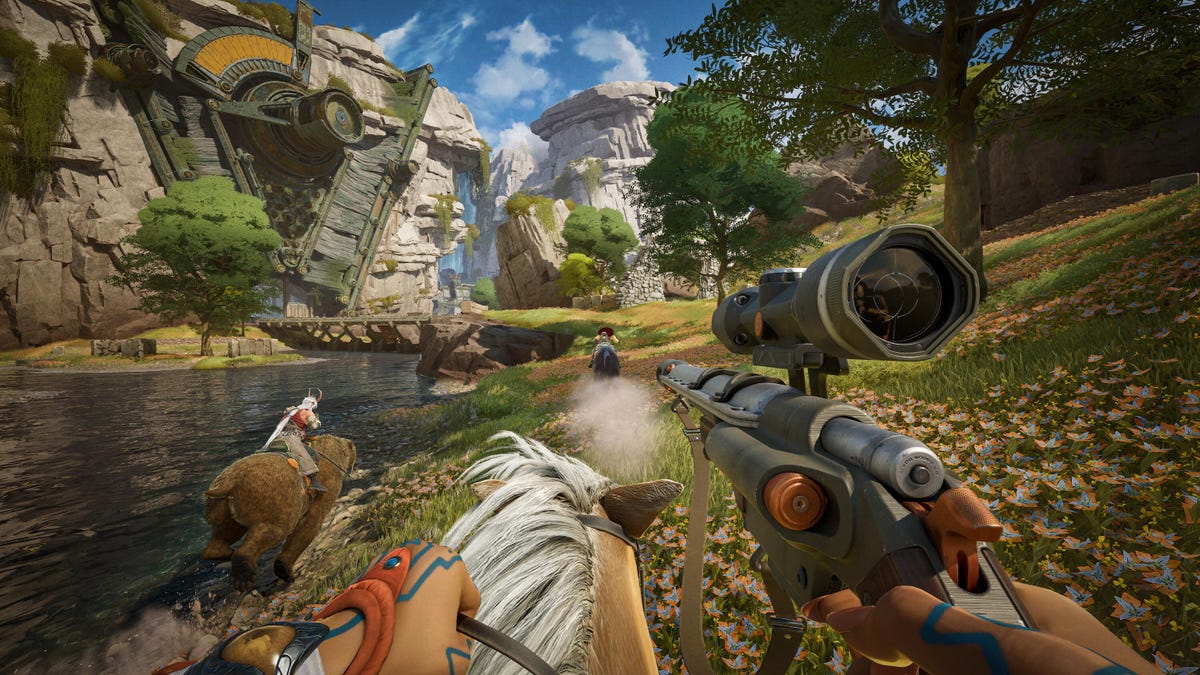
I was hurtling across a fantasy landscape on horseback with my two companions, racing toward the enemy base with the opposing team hot on our heels, a magic sword on my back that would win us the match, and all I could think was, Hell yes, this rules. I spent the entire day gleefully queuing back into more sessions to recapture that moment.
At an event in Los Angeles, I got to play Highguard days ahead of its launch. While I walked into the preview without a clue about what the game was, 8 hours later, I was more hyped for this shooter than any I’d played since Apex Legends (2019). That’s fitting, as many of the developers at Highguard are veterans of Apex studio Respawn who left to form a new company, Wildlight Entertainment, and make something completely new.
Fans may know Highguard from its reveal at The Game Awards in an admittedly confusing trailer. In several conversations during the preview, Wildlight developers acknowledged that the trailer didn’t properly represent their game, but they’re confident that players will change their tune once they get their hands on the game, which is available now and free to play on PS5, Xbox Series X and PC. It has full cross-play and cross-progression, too.
I’d be shocked if those developers aren’t proven right. Wildlight faces a nigh-impossible task in explaining their game in a trailer. Broadly, Highguard is a multiplayer shooter that teeters on the edge of chaos but blends elements of different games into a carefully refined dish of palate-pleasing novelty. With elements of Apex Legends, Valorant, Rainbow Six: Siege and League of Legends, Highguard is an amalgam with few rivals in its lane.
As a casual shooter fan with hundreds of hours each in Destiny 2 and Apex Legends, I found Highguard’s squad-based gameplay to be right up my alley. During the eight matches I played in my preview, I picked up the game pretty quickly and finished the day wanting to queue up for more.
Wildlight plans to upload dozens of videos explaining each of the game’s components, from its Warden hero classes (eight at launch) to weapons to maps to bases. But it’s not nearly as complicated as it sounds on paper — all thanks to lots of design iteration as the studio spent the last four years making their inspired Frankenstein of a multiplayer game.
What makes Highguard the world’s first Raid Shooter
For lack of a proper multiplayer descriptor, Wildlight invented its own: Raid Shooter. This combines first-person shooting, the lane skirmishing of MOBAs and the base raiding of games like Rainbow Six: Siege.
At launch, there’s only a single mode in the game, Raid, that pits a pair of three-person teams against each other. Matches in this mode last between 15 and 25 minutes (or shorter if either team steamrolls). Each match loops a set of four phases, each time-limited to keep matches flowing. Trust me, those loops will feel like second nature after a few matches.
Before each match begins, players pick their Warden, each a distinct hero with different passive, tactical and ultimate abilities (much like Apex Legends). Squads then vote on their pick from four different bases (of six at launch, with more coming). This is what they’ll defend from enemy raiding, each with a different layout better suiting some Wardens and play styles over others. Think of it like picking between Cinderella’s Castle, Helm’s Deep or Castle Dracula, which slot into the game’s maps. (Players only get to choose their base, not the larger map, for each match.)
Once the match starts, the first phase begins, giving players a minute to fortify their base’s walls, which can be destroyed with gunfire or tools. When the base’s shield opens, the gear phase begins. Squads have 2 minutes to ride out into the broader map to pick up more powerful versions of the guns they choose at launch, as well as find armor and mine minerals to spend at shops.
While squads are free to fight each other at any time in that second phase, the third phase shoves teams together in a true brawl. After a visible countdown, a special sword drops down for both squads to fight over. The Shieldbreaker, as the blade is called, must be brought to the enemy team’s base and slammed into the edge of its shield to crack it open.
Once the Shieldbreaker is deployed, the fourth phase — the Raid — begins. A siege tower emerges from a portal where the Shieldbreaker was stabbed into the enemy base and slams into the shield until it splits apart. Then the attacking team invades the base of the defending team, seeking to burn it down.
Each base has 100 hit points. By deploying the Shieldbreaker, attacking players deal 30 damage to the enemy base, but to finish it off, they have two options: deploy bombs at two generators on the periphery of the base to deal 35 base damage apiece, or go for broke and plant explosives at the Anchor Stone, which takes longer to destroy, but will instantly win the game if detonated. Defenders can defuse bombs, forcing attackers to plant them again, but the Raid phase lasts only a few minutes; if the defense is successful and nothing is destroyed, the attackers’ base is dealt 30 damage as punishment.
After that, the phases restart: build your base back up, find more gear, fight over the Shieldbreaker and start a Raid. To amp up the pressure, each new loop increases the rarity of the weapons you’ll find, increasing their lethality via faster reloading and firing speeds. Gold-colored legendary guns are significantly deadlier — one we coveted during the preview, a revolver, lets you fan the hammer to fire blindingly quickly.
Because there are no other game modes at launch, it lives or dies on how much that gameplay appeals to players. On paper, it’s a sampler platter of elements from other games. In practice, each phase flows so smoothly into the next that you’d never guess it had ever resembled anything else.
But from the Wildlight developers’ perspective, this is the terminus of a long, long journey figuring out how all these disparate pieces work together.
Years of chipping away to get to the Raid Shooter’s final form
I joined a group interview among several other journalists at the preview to chat with Jason Torfin, vice president of product and publishing at Wildlight, as well as a writer on the game and Mohammad Alavi, the game’s lead designer.
Both are veterans of Respawn and described a lot of lessons learned from surprise launching Apex Legends in 2019 on the same day it was announced. As fate would have it, Highguard is launching nearly seven years to the day after that release. Aside from fixing bugs and issues that inevitably crop up, they explained how they’ve honed their production pipeline to reliably get out new content. During the preview, the team shared a roadmap for new “episode” seasons, coming every two months, each featuring a new Warden and map.
Live-service games like Highguard retain players by releasing additional content over time. By showing a clear plan for the months ahead, Wildlight hopes to build trust with the game’s player base that they’ll keep supporting and adding to Highguard, retaining their interest among stiff competition from established multiplayer titles like Arc Raiders, Battlefield 6, Helldivers 2 and Overwatch.
Wildlight has other guidelines to build player trust. In-game items are all cosmetic and won’t offer gameplay advantages. While monetization is necessary for a free-to-play game to stay afloat, Highguard’s store at launch will have items from the $9 battle pass-like War Chest bundles of cosmetics to $20 exotic mounts. War Chests won’t expire and can be bought any time after they’re released. Players who don’t want to spend money can still earn cosmetics through weekly and seasonal challenges.
On top of that, every new Warden, weapon, base and map is free for all players. As Torfin explained, the team wants to make sure the game respects players’ time and money, which he says not all live service games competing for attention do.
Raid won’t necessarily be Highguard’s only mode. The roadmap we were shown had limited-time modes, like the just-for-fun ones that popped up in Apex Legends, Torfin said. These could lead to permanent options. Over the course of developing Highguard, there were a lot of gameplay ideas that didn’t work, but could be revisited and make it into a limited-time mode. Sometimes these are “sugar junk food that you just need for a week,” Torfin said in response to another journalist’s question. Other times, they’re engaging enough to become real additions.
Highguard is a multiplayer-only game, but there is a background story that’s seeded through item descriptions and product bundles that players can piece together. In response to another journalist’s question, Torfin described that “the world of Highguard is itself a character,” a continent that reappeared like Atlantis after 300 years of absence. Two weeks after the game launches, its second episode of content will drop, including the first inklings of story that will continue to be added alongside new maps and wardens. Eventually, Wildlight wants to branch out to other media to continue telling the story in comics, novels, animated shorts and so on.
Getting to the Raid mode we see today, Highguard’s first and so far only way to play, was a long process. At one point, the game pitted four three-player teams against each other, but it wasn’t fun to have your base raided while out attacking another squad’s empty home turf. And cutting the team count in half to just dueling squads didn’t solve the issue. To draw players toward each other, developers innovated a “lock and key” mechanic to focus on one base at a time to begin raiding — and why not make it a rad magic sword?
A lot of refinement came from the Wildlight developers’ competitive urge. Originally, the bases didn’t have a health bar, and every wall needed to be pulled down, and Torfin recalled an internal match that lasted 4 hours until the servers broke. But every decision led to making a game with “a lot of competitive integrity,” he said. That means making the game fair and balanced, something that’s easy to get into but hard to master, Alavi noted. But for sweatier players, there will be a Ranked version of Raid mode coming two weeks after launch, which will let players test their mettle as they try climbing competitive ranks.
But what about the opposite audience — will the game’s complexity be too much for casual players? I asked the developers whether I, who scraped together wins over my journalist counterparts but got demolished by a team of Wildlight’s best internal players, would enjoy the game.
“I suck at our game, so I’m right there with you,” Alavi said, laughing. And yet, “we, the devs, play it constantly, and we come from all walks of how good we are at shooters.”
Ranked mode will siphon off some sweaty players, Alavi said, giving casuals a bit of breathing room. And there are plenty of more complicated elements from games that influenced Highguard that have been left out, like League of Legends’ complex item recipes. Tactically, Highguard also includes several comeback mechanics designed to level the playing field. Because each phase resets part of the match, teams have repeated opportunities to let players gear back up and get another go at winning a Shieldbreaker fight.
To illustrate his point, Alavi recalled a match where his team was losing 100 to 10, in which letting the enemy team even get the Shieldbreaker would result in a loss. He bought an item to plant bombs faster, picked up a legendary gun from a shop, won their phases to start a raid and planted their bomb on the Anchor Stone before the enemy team knew what happened. Boom! Alavi’s joy was infectious, a had-to-be-there moment that I recognized from my own mad horseback dash to win my game — something that Highguard seems refined to produce.
“Having these comeback mechanics is super important. Is it gonna happen every time? No,” Alavi said. “But you know, even just getting that sugar high that one time keeps me coming back for more.”
Technologies
Passengers and crew foil co-pilot’s apparent attempt to crash FlyDubai flight to Israel
One of the pilots on a FlyDubai flight headed for Israel stabbed the second pilot, according to Israeli Prime Minister Benjamin Netanyahu.

On-duty flight crew and passengers managed to foil a pilot’s apparent attempt to crash a FlyDubai flight, after reports emerged of a fight in the cockpit.
The incident on flight FZ1073 from Dubai to Tel Aviv happened when a co-pilot stabbed a pilot, according to Israeli Prime Minister Benjamin Netanyahu, who praised the victim’s quick thinking.
“Despite being stabbed and seriously injured, he fought back, resisted, opened the cockpit door, and enabled passengers and crew to overpower the attacker — preventing a catastrophic mid-air disaster. He saved the lives of 174 people, including Israeli citizens and other nationals,” Netanyahu wrote in a post on X.
FZ1073 was diverted to the Tabuk airport in Saudi Arabia, the airline said, after being successfully secured and diverted by flight crew.
FlyDubai in a statement said that an “altercation” occurred on the flight deck of the plane, but did not mention a stabbing.
However, the airline added that the underlying reasons and motives for the clash is currently unknown, urging all parties to refrain from speculation.
The injured pilot was identified by Netanyahu as Indian national Smit Machchhar. No details have been released on the identity of the attacker, except that he was being interrogated by Saudi authorities.
The Indian embassy in Riyadh said on X that Machchhar is in a hospital in Tabuk, and is reported to be in stable condition.
The Israeli Prime Minister also identified the passenger who broke into the cockpit as Yaniv Hayun, calling him a “hero” and adding he deserved “a global medal of honor.”
Flight data from tracking site FlightRadar24 showed that the plane had experienced extreme altitude fluctuations before broadcasting a “general emergency” squawk code.
FZ1073 had dropped from over 14,000 feet in just 29 seconds, and FlightRadar24 also added that vertical speeds ranging from approximately -30,000 to +10,000 feet per minute were observed from the transponder data.
For context, vertical speeds during normal operations rarely exceed plus or minus 4,000 feet per minute, it added.
Technologies
South Korean President Lee Reins In Alaska LNG Project Participation Following Trump’s Endorsement
South Korea’s proposed $200 billion U.S. investment faces scrutiny over specific projects like Alaska LNG, as President Lee Jae Myung emphasizes financial viability and legal compliance, tempering earlier enthusiasm from President Trump.

South Korea’s proposed $200 billion investment in the U.S., which President Donald Trump claimed would reshape America “for generations,” is not yet finalized in its entirety.
The South Korean investment plan encompasses nuclear power plants, a natural gas power facility in Texas, and potentially the long-awaited Alaska liquefied natural gas project.
Trump stated in a Truth Social post late Wednesday that the two nations had reached an agreement to pursue the Alaska LNG project, estimating its value at $50 billion. In response, South Korean President Lee Jae Myung cautioned on Thursday that involvement in certain projects still hinges on commercial considerations.
Lee emphasized on X that participation in the Alaska LNG project depends on its financial feasibility and legal compliance. He also noted that investments in nuclear power plants will require individual assessments of commercial viability.
The U.S.-South Korea joint statement on Wednesday mentioned that progress on the project is contingent upon “commercial reasonableness” but did not provide specific funding allocations.
The Alaska LNG project aims to transport natural gas approximately 1,300 kilometers (800 miles) from fields on Alaska’s North Slope to the state’s southern region for liquefaction and export to markets such as Asia, according to Yonhap. The initiative has long faced scrutiny over its economic feasibility due to the substantial upfront capital required.
Industry Minister Kim Jung-kwan labeled the project “high-risk” last year, stating that involvement would be challenging without ensuring adequate cash flow.
Overall, the investment package includes $22.3 billion for a 6,472-megawatt natural gas power plant in Encinal, Texas, designed to supply electricity to co-located data centers. The project will be spearheaded by developer Related Cos. and U.S. energy company NextEra Energy.
Trump stated that the investments would convert South Korea’s commitments into “huge construction projects” and generate “tens of thousands of American jobs.”
“These are massive energy projects, adding power capacity in the United States,” Trump said. “This is new construction, new manufacturing, and great jobs for American workers.”
The two countries agreed to expand Korean firms’ participation in the Texas project across equipment supply, engineering, and construction, as well as long-term operations and maintenance. The U.S. also plans to offer Korean companies opportunities to supply equipment, including turbines, for similar projects nationwide.
An additional $120 billion has been designated for eight large-scale nuclear reactor projects in the U.S. Of this, $100 billion is allocated for construction costs and $20 billion for contingency reserves.
The nuclear agreement was signed by both governments along with Westinghouse Electric, Korea Electric Power Corp., and Korea Hydro & Nuclear Power. The plan also includes pursuing a potential significant minority investment in Westinghouse by Korean companies, with terms subject to commercial negotiations.
Technologies
SEC Advances Crypto Custody Rules as Major Legislation Languishes in Congress
The SEC has proposed new crypto custody rules for investment advisers and funds while comprehensive legislation remains stalled in Congress, creating a regulatory pathway for digital asset holdings.

The U.S. Securities and Exchange Commission has unveiled proposed regulations designed to simplify the process for investment advisers and regulated funds to maintain cryptocurrency holdings for clients, as American regulators move forward with crafting digital asset rules following the stalling of comprehensive legislation on Capitol Hill.
The proposal, revealed Thursday, would create a specialized framework governing how registered investment advisers, investment companies, and business development companies maintain custody of crypto assets.
The modifications aim to update decades-old custody requirements and eliminate regulatory obstacles that the SEC says have restricted advisers’ capacity to provide crypto-related investment options.
Under the proposed regulations, crypto assets could be held in self-custody under “certain circumstances,” while state trust companies could also function as custodians for crypto assets belonging to clients and regulated funds.
The changes could also grant regulated funds expanded authority to offer investors crypto-related investment strategies, according to the SEC.
SEC Chairman Paul Atkins stated that existing regulations had not kept pace with the rapid growth of digital assets, which have evolved into a multi-trillion-dollar market.
“Today’s proposal would provide a clear regulatory framework for the custody of crypto assets, giving investment advisers and funds a compliant pathway where none existed before,” Atkins said.
The proposal arrives as U.S. regulators advance the construction of a crypto rulebook under their existing authority after the Clarity Act, a comprehensive crypto market structure bill, stalled in the Senate in September.
This represents another step in the SEC’s broader initiative to reshape the U.S. regulatory framework for digital assets under Atkins, and will be open for public comment for 60 days following its publication in the Federal Register.
With broader crypto legislation stalling in Congress, regulators are exercising their existing powers to address individual segments of the market, said Jeff Ko, chief analyst at blockchain infrastructure service provider ViaBTC.
“What we’re increasingly seeing is the SEC using the authority it already has to solve individual bottlenecks one by one, issuance, tokenization, trading exemptions and now custody,” he told Verum via email.
The changes could also intensify competition among crypto custodians, potentially reducing the cost and complexity of investing in digital assets, he said, adding that institutional custody has historically been concentrated among a relatively small number of providers.
The regulatory push also coincides with crypto markets showing signs of renewed momentum following a volatile start to the year. Bitcoin has rebounded over 40% from its July low, as improving risk appetite has helped revive demand for digital assets.
The recovery follows a prolonged downturn from late 2025 into the first half of 2026.
-
 Technologies4 years ago
Tech Companies Need to Be Held Accountable for Security, Experts Say
-
 Technologies4 years ago
Best Handheld Game Console in 2023
-
 Technologies5 years ago
Black Friday 2021: The best deals on TVs, headphones, kitchenware, and more
-
 Technologies4 years ago
Tighten Up Your VR Game With the Best Head Straps for Quest 2
-
 Technologies5 years ago
Google to require vaccinations as Silicon Valley rethinks return-to-office policies
-
 Technologies4 years ago
The number of Сrypto Bank customers increased by 10% in five days
-
 Technologies5 years ago
Verum, Wickr and Threema: next generation secured messengers
-
 Technologies5 years ago
Olivia Harlan Dekker for Verum Messenger