
Technologies
Apple Vision Pro vs. Meta Quest 3: Which Should You Buy?
Meta is no longer the biggest name in face computers, but that doesn’t necessarily mean Apple has earned your money yet.
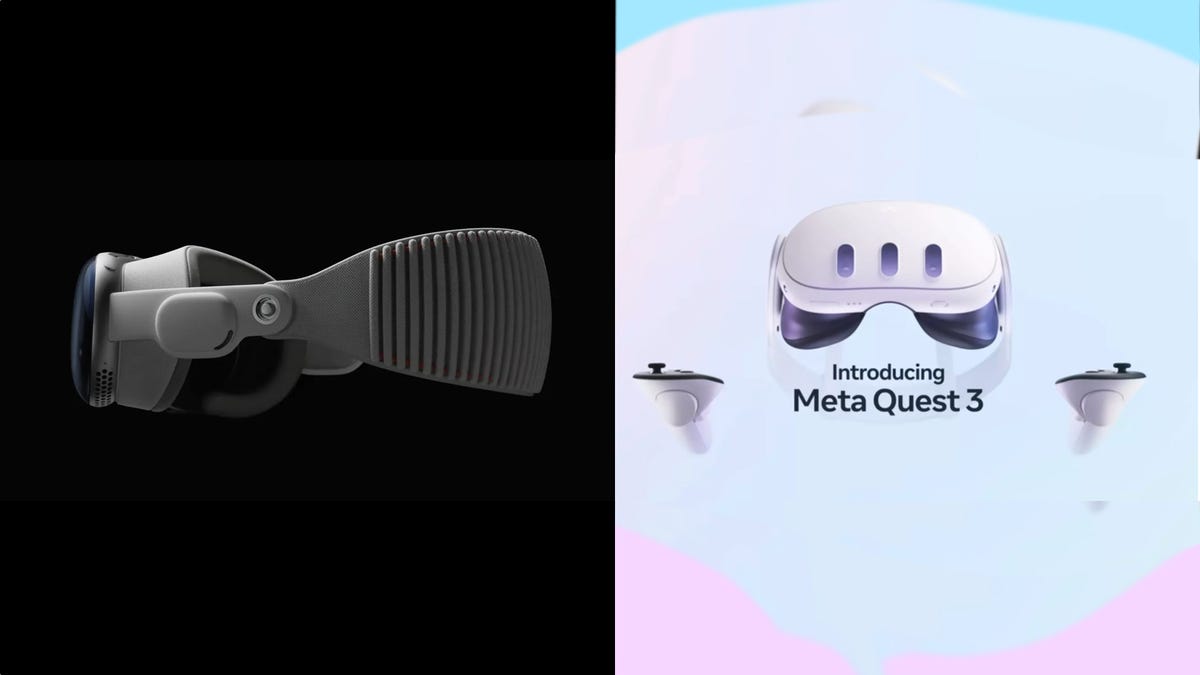
After years of leaks, speculation and wishful thinking on behalf of those who aren’t thrilled about giving Facebook their money, Apple’s first step into the VR/AR world has finally been taken. The Vision Pro headset took center stage at Apple’s WWDC keynote Monday, promising deep integration with the Apple ecosystem and a serious charge into the world of gaming. In an effort to draw focus from this announcement, Meta’s own Mark Zuckerberg took to Instagram a few days ago to tease a new generation of the most popular VR headset currently available, dubbed the Meta Quest 3. The announcement was light on details, but promised two things Meta has become well known for: The Meta Quest 3 will be relatively inexpensive and will be supported by a massive and growing ecosystem.
If both of these headsets were sitting side-by-side on a shelf and you could only choose one, which should you buy? Here’s what we know so far, and how to make the best decision for your needs.
Hardware
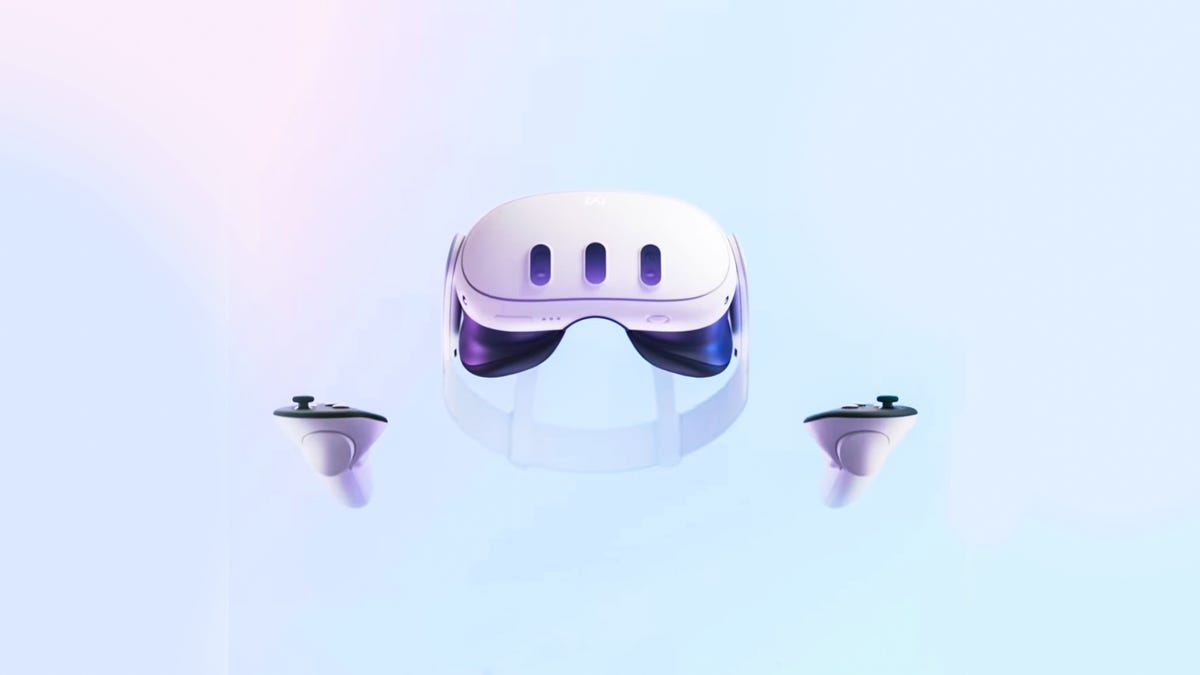
When it comes to face computers, there are three things that matter more than anything. The headset needs to be comfortable to wear for as many different kinds of people as possible; the battery needs to last long enough to actually enjoy your time in the headset; and it needs to have a processor capable of delivering a smooth overall experience.
Comfort is by far the most important, and in that regard Meta has a lot more experience and has received a lot more feedback than Apple. Renders of the Quest 3 reveal a three-strap design, where the side straps are responsible for holding the headset on your face while the top strap helps distribute the weight. The top strap is split in the back, which means the headset is able to cradle the back of your head or hold a ponytail for those who need it. The pancake lenses allow for a thinner design than the Quest 2, which Meta debuted in the Quest Pro headset late last year, so we have some idea of how this will fit even without having used it. The same can be said for its controllers. Meta’s controllers are well known for being lightweight and extremely ergonomic, with an array of third-party accessories to increase the illusion of holding a sword or tennis racket when gaming.
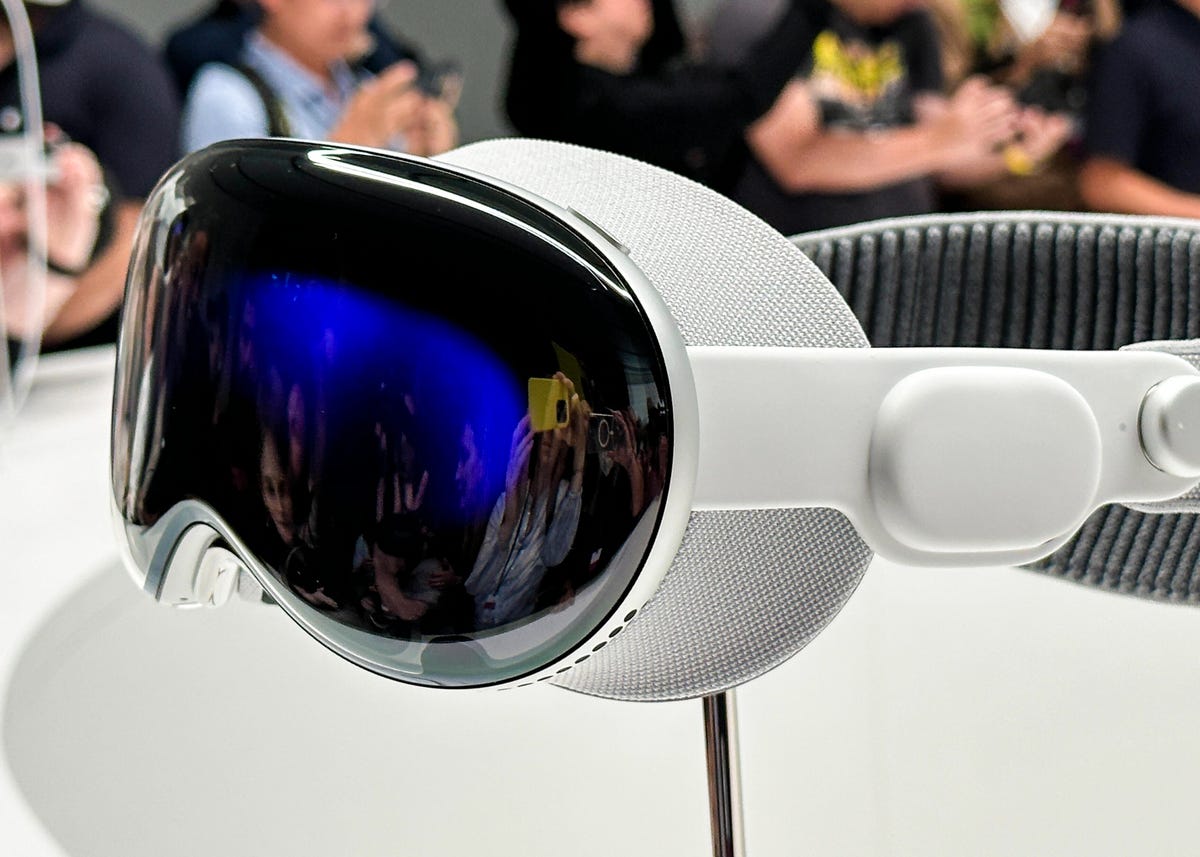
Apple says its expertise in creating displays, speakers and wearables come together in the Vision Pro.
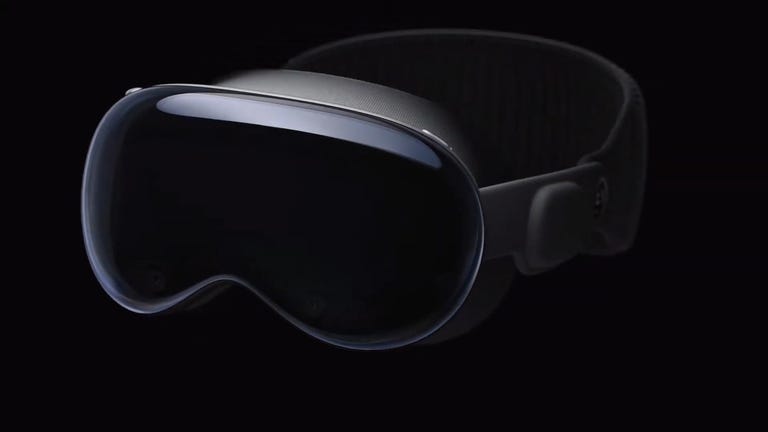
Apple may not have years of public hardware feedback under its belt for this particular product, but there are few who would argue Apple’s design team is not up to the job. Apple’s AirPod Max headphones, for example, are heavier than most but manage to be comfortable enough to wear all day. So when Apple revealed its design, which includes an Apple Watch-style crown to control occlusion, Zeiss lens inserts for those with a prescription and a two-sided strap with a wide angled pad in the back to hold your head, it was immediately clear the team has done its homework. A third top strap is available, but as Scott Stein points out in his hands-on, is not included in any of Apple’s demonstrations so far.
The glass front and aluminum frame of Apple’s Vision Pro headset make it possible for the design to be plenty thin, which helps the overall weight. Combine those two, and you’ve got a headset that will likely be pretty comfortable for many. There are no controllers for the Vision Pro. It relies entirely on eye tracking and hand gestures for its interface, but Apple showed it being used with a wireless PS5 controller for gaming.
05:35
Battery life for both headsets is something of an open question. Meta has a history of releasing battery accessories to help the headset last for a few more hours, but the expected life for both the Quest 2 and Quest Pro is two hours, so it’s likely the Quest 3 will hover around the same.
Apple’s Vision Pro headset currently claims two hours of battery life when connected to the tethered battery, and it’s likely there will be battery extenders available either through Apple or third parties. Currently the average VR user spends about an hour in their headsets, but with Meta’s new full-color cameras for AR functionality and Apple’s focus on FaceTime and other nongaming features, it’s likely that number will go up with this generation of headsets.
We already know quite a bit about the processors that drive these two headsets. Qualcomm has been working with Meta to deliver increased performance without sacrificing battery life for a couple of years now, and the XR2 Gen2 promises double the performance of the Quest 2.
Apple has a history of outperforming Qualcomm on phones and tablets with chipsets it manufactures only for Apple products, and the Vision Pro will be powered by both a new Apple M2 processor and a new specialized chip Apple calls the R1, with an enormous amount of computing power for all the cameras in the headset. It’s clear the headset will have no trouble competing with the Quest 3 on raw performance. And while having raw power is obviously important in situations like this, the proof will be in the actual use and what developers can get the headset to do.
Ecosystem

The Quest 2 has a raft of excellent games, like Moss 2.
There have been a lot of face computers released in the last 10 years, and most of the companies making them have long abandoned those projects. Having the most capable headset isn’t enough. You need to be able to do interesting things with it. It’s important to remember just how small this market is compared to the mobile app stores maintained by Apple and Google. Each of those boast well over a million apps serving an entire planet of connected humans. Meta’s App Store description claims “thousands” of apps are available for its headsets, but the Quest section of Meta’s app store is gearing up to celebrate 500 apps for the Quest 2 later this year. There’s a lot of room for competition here.
Meta has been working for years to ensure a healthy assortment of apps and games on its platform, as well as a substantial if potentially ill-advised investment in the metaverse platform Horizon Worlds. A $10 million Creator Fund was announced back in 2021 to help encourage development, and as of this writing a third of the apps in Meta’s app store had made over $1 million. The biggest category of app for the Meta Quest 3 will be games, ranging from action titles like Beat Saber and interactive stories like Moss 2 to horror experiences like The Room VR. Education and exploration have a decent foothold here too, allowing users to explore museums and experience parts of the world they may never be able to see for themselves. When someone picks up a Quest 3, there will be no shortage of answers to the question, “What should I do next?”
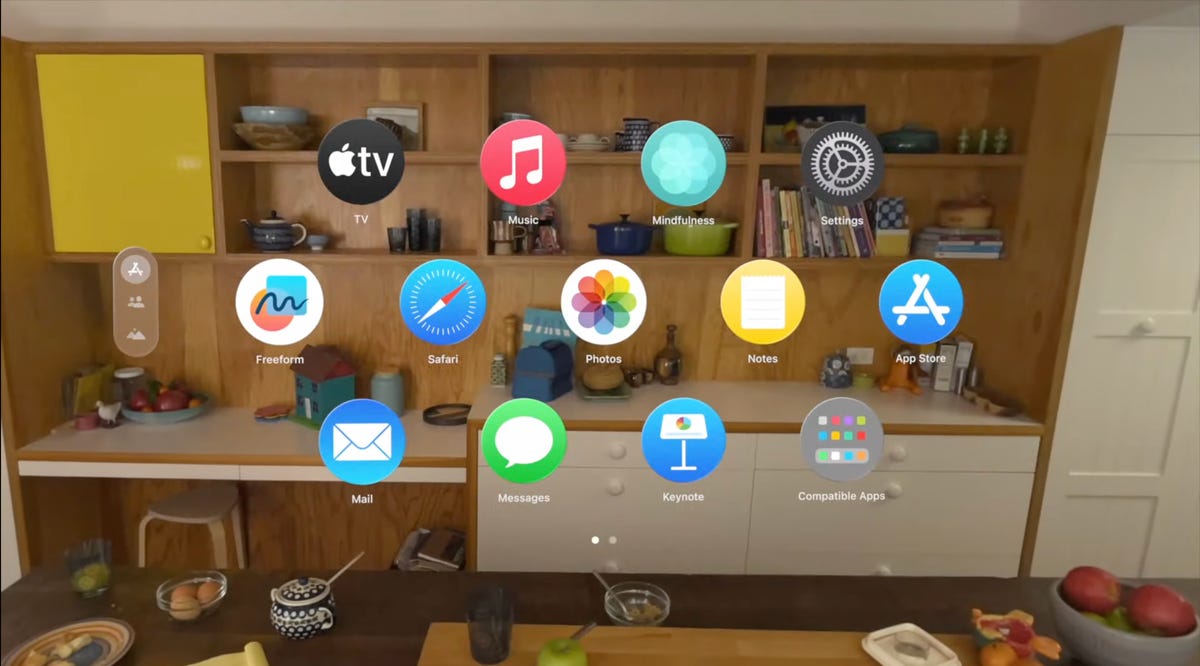
A list of apps as they would appear inside of the Apple Vision Pro headset.
Apple showed off some interesting concepts during its WWDC keynote, where it made the case for developers to make their own cool things for the headset. But that doesn’t mean Apple didn’t have plenty to show off out of the box. The big focus for Apple is extending all of the apps you know and love from your phone into the world around you. If you want a large display to watch a show or meditation exercise on, you can.
Apple wants this headset to be able to be used for work with access to Apple apps like Notes, Keynote or Safari so it can replace or complement your monitor. For gamers, you can play around 100 Apple Arcade games with a standard gaming controller like you would on a television with an Apple TV, but Apple doesn’t seem to have much in the way of immersive gaming like you’d see on other headsets.
Which should you buy?
It’s impossible to have this conversation without talking about price. Meta’s Quest 3 comes in at $500, which will likely balloon to $600 if you want increased storage and more if you want accessories for improved battery life. And when this headset is available in the fall, it will be filled with tons of things to do and friends to play with, if that’s your thing. And between Zuck’s teaser last week and its release, you can be sure Meta will have a lot to say about what you can do with the passthrough cameras in AR and hand-tracking modes. It’s an impressive upgrade on a headset Stein dubbed the best VR headset for now in his Quest 2 review, and will be available months before the competition.
Apple’s Vision Pro is undoubtedly a unique way to experience the Apple ecosystem as it exists today, and it’s clear there are a lot of different ways to make the experience personal. It has an elegant look and a ton of features to keep you aware of the world around you when it’s needed. There’s no denying this is the most advanced headset to exist so far. But as an AR headset delivering something unique, it’s clear Apple is hoping developers will help pave the way. And with a $3,499 price tag, Apple needs to do a lot between now and when the Vision Pro launches in 2024 to show what makes it special.
Technologies
Vessel Hit in Strait of Hormuz as U.S.–Iran Diplomacy Seems Elusive, UKMTO Says
A vessel was struck by an unidentified projectile in the Strait of Hormuz, while Iranian officials dismissed renewed negotiations with the United States. Ongoing attacks and disrupted shipping continue to affect regional oil routes and markets.

A vessel was struck in the Strait of Hormuz, the United Kingdom Maritime Trade Operations Centre reported Sunday, as direct negotiations between the United States and Iran appeared even less likely to resume.
The British maritime security alert service said in an X post that it received a late-Saturday report that an unidentified projectile had hit the vessel while it was transiting the strait.
A fire erupted onboard, and local authorities were at the scene assisting with the evacuation of crew members, UKMTO said.
Meanwhile, a senior Iranian official rejected hopes of renewed talks.
Ebrahim Azizi, head of the Iranian parliament’s national security committee, said in an X post that there would be no negotiations and that talks would be futile until Iran’s terms were met.
Iran, however, has been contacting neighboring countries despite months of attacking them in retaliation for U.S. strikes.
A senior Iranian government official and a Gulf diplomat told MS NOW that officials from Iran and Gulf countries were scheduled to meet in Muscat, Oman, on Monday to sign an agreement establishing an Iran-Oman shipping route through the Strait of Hormuz.
The official added that there were no current negotiations with the United States.
Speaking at the BRICS Summit in New Delhi on Friday, Iranian President Masoud Pezeshkian said his country would not surrender and had resisted aggression from the United States and Israel.
Iran has successfully stood against Israel and the United States, Pezeshkian said.
Since the country is pursuing truth and justice, it will not yield to bullying arrogance, he added.
Pezeshkian’s weekend remarks followed U.S. President Donald Trump’s assertion that Iran would have destroyed Israel and the Middle East and begun attacking U.S. cities had Washington not taken military action against Iran.
“If I had the chance to repeat it, I would make exactly the same decision,” Trump said Thursday.
Retaliatory shipping attacks
There have been numerous back-and-forth attacks on shipping in the Strait of Hormuz in recent weeks.
U.S. Central Command, or CENTCOM, said Wednesday that it had destroyed 10 Iranian tankers during the previous week.
On Saturday, CENTCOM said its forces had redirected 100 commercial vessels over the past 60 days since it resumed a naval blockade against Iran.
“No ships have passed through the blockade without U.S. forces granting permission,” CENTCOM said in an X post.
The war in Iran will likely end soon after November’s midterm elections, Trump said Saturday. He also predicted that energy prices would fall sharply once that happens.
“I think it will be very soon, actually, probably right after the midterms,” Trump said while traveling to Ireland and responding to reporters about when the Iran war might end. “I would call it soon, and oil will tumble when that happens.”
Oil prices retreated on Friday but recorded sharp weekly gains after rising above $100 a barrel for the first time in months amid continuing unrest in the Middle East.
Brent crude oil futures, the global benchmark, settled down 2.8% at $104.61 a barrel. U.S. West Texas Intermediate was down 2.4% to settle at $100.05 per barrel. On Thursday, Brent crude peaked at around $108 a barrel, while WTI reached more than $104.
Shipments of oil and other cargoes through the critical Strait of Hormuz separating Iran and Oman have slowed to a trickle since the United States and Israel began their war on Iran on Feb. 28, leaving ships and seafarers stranded for weeks or months at a time.
Saudi Arabia has relied on its East-West crude oil pipeline to bypass the Strait of Hormuz. But the kingdom said Friday that it shut the facility as a precaution after multiple drone attacks launched from Iraq.
The drones targeted the pipeline in the Riyadh and Medina regions Thursday morning, causing fires and some damage, the Saudi government said. Several people were injured in the attacks, it said.
Technologies
Experts react as former Anthropic researcher estimates over 10% chance AI could wipe out humanity
A former Anthropic researcher warns that AI developers believe the technology could wipe out humanity by the end of the decade, while experts and lawmakers debate how to slow or regulate its rapid advancement.
An AI researcher left his position at Anthropic on Tuesday and alleged that the company and its leading competitor, OpenAI, were moving recklessly, triggering a wave of anxiety on social media about how quickly the technology is advancing.
Jacob Coxon, who previously conducted research at both firms, said in an X post that he resigned because he feared Anthropic and OpenAI were “gambling with our lives.” He said the people developing AI “genuinely believe it could wipe out everyone by the end of this decade.”
“Do not underestimate the power of this technology,” Coxon wrote. “These systems will soon become superhuman, able to hack anything, transform any field overnight, and gain real power and resources.”
Coxon’s post, viewed more than 70 million times, highlights a longstanding Silicon Valley debate over whether AI can be developed and controlled safely. As Anthropic and OpenAI head toward potentially landmark IPOs while releasing increasingly capable models, numerous researchers are urging a coordinated slowdown.
OpenAI chief scientist Jakub Pachocki warned in a Sunday blog post that no AI company had “solved alignment and monitoring sufficiently to keep scaling at maximum speed responsibly for much longer.” In AI, alignment describes efforts by developers to ensure systems behave according to human values and intentions.
“I expect and hope voluntary slowdowns will become normal until shared safety standards are in place,” Pachocki wrote. “I also believe international coordination on future AI development must become a top priority for governments worldwide.”
Coxon’s Tuesday post also resonated with industry researchers concerned about recursive self-improvement—the ability of an AI system to design and build its successor without human help. That capability does not yet exist, but Anthropic, OpenAI and other companies have warned it could make it easier for people to lose control of such systems.
“Neither company is acting responsibly,” Coxon wrote. “They are racing directly toward self-improving superintelligence.”
Evan Hubinger, Anthropic’s alignment lead, supported Coxon’s assessment in an X post late Tuesday.
“Jacob is right—we genuinely believe AI could kill all humans! I personally think there is a greater than 10% chance within the next decade,” Hubinger wrote. “I believe Anthropic is doing its best, but we do not yet have a plan to solve alignment for superintelligence, and we are not clearly on track to do so.”
Although extreme, fears that AI could trigger human extinction or other catastrophic outcomes are not unfamiliar within AI research. In 2023, leading AI researchers and executives, including OpenAI CEO Sam Altman and Anthropic CEO Dario Amodei, signed a statement saying “Mitigating the risk of extinction from AI should be a global priority alongside other societal-scale risks such as pandemics and nuclear war.”
Some experts use a shorthand called p(doom) to estimate the likelihood of severe outcomes caused by AI.
Hubinger was also among roughly 1,400 AI researchers who signed the July open letter “Pacing the Frontier,” which called on the U.S. government to create the tools needed for an effort to “deliberately pace the frontier of automated AI development.”
Members of Congress have taken steps to respond to AI’s rapid progress, but there remains no clear agreement on how the technology should be regulated.
In July, Rep. Jay Obernolte, R-Calif., and Rep. Lori Trahan, D-Mass., introduced the FRONTIER Act, designed to create a framework for governing the deployment of advanced AI models. Earlier this month, Sen. Bernie Sanders, I-Vt., and Rep. Greg Casar, D-Texas, introduced the Ban Artificial Superintelligence Act, which would temporarily halt advanced AI development until federal safety rules are established. Both proposals have received mixed reactions.
“Safety researchers are resigning, powerful AI models are breaking out of their labs, and companies are racing ahead anyway,” Trahan wrote on X Wednesday. “It’s past time for Congress to get off the sidelines and do its job.”
Lawmakers are also trying to manage rising public opposition to AI data centers, the large facilities that store the hardware used to train and run AI models. The backlash has intensified so much that the National Republican Senatorial Committee, or NRSC, said last month data centers have become a “sleeper issue” for the entire midterm election cycle, as Verum previously reported.
Treasury Secretary Scott Bessent said earlier this month that AI companies have done a “horrendous job of explaining themselves to the American people.”
“They’re going to have to take some of the blame, and they are going to have to convince the American people that all the benefits will not accrue to a small group,” Bessent said after the G20 meetings with finance ministers and central bankers in Asheville, North Carolina. “That’s what they hear from me.”
Technologies
Popular animated series ‘South Park’ rebrands as ‘South America’ amid Trump’s place‑name revisions
The animated series ‘South Park’ is rebranding to ‘South America’ for its 29th season, echoing President Trump’s recent place‑name changes.

Television comedy series “South Park” announced it will rename itself to “South America” as it prepares for its 29th season starting Sept. 16.
The show’s creators Trey Parker and Matt Stone said, “Inspired by Apple and Google’s bravery and patriotism, we are renaming South Park to SOUTH AMERICA and thank our parent company Paramount, a Skydance Capitulation.”
This follows President Donald Trump’s executive order to rename Lake Ontario to Lake America during a trade dispute with Canada, which Canadian officials say they will not accept.
Apple and Google updated their map apps so U.S. users see “Lake America” while Canadians still see “Lake Ontario”.
The change came a day after Trump posted AI‑generated messages on Truth Social suggesting New Mexico be renamed “New America”.
Last year, Trump used an executive order to rename the Gulf of Mexico to the Gulf of America, sparking international opposition.
“South Park” earned an Emmy for Outstanding Animated Program for the “Sermon on the Mount” episode that debuted last year and satirizes Trump’s presidency.
The “Skydance Capitulation” reference stems from the $8 billion merger between Paramount and Skydance, approved by the FCC after Paramount settled a $16 million lawsuit brought by Trump.
Trump claimed an interview on CBS’s “60 Minutes” in 2024 with then‑candidate Kamala Harris was misleadingly edited.
Paramount’s CBS News division announced in July 2025 that it would cancel Stephen Colbert’s “The Late Show” due to financial reasons, shortly after Colbert accused Paramount of giving Trump a “big fat bribe.” The final episode aired in May.
Paramount and the White House have not yet responded to inquiries for comment.
-
 Technologies4 years ago
Tech Companies Need to Be Held Accountable for Security, Experts Say
-
 Technologies4 years ago
Best Handheld Game Console in 2023
-
 Technologies5 years ago
Black Friday 2021: The best deals on TVs, headphones, kitchenware, and more
-
 Technologies4 years ago
Tighten Up Your VR Game With the Best Head Straps for Quest 2
-
 Technologies5 years ago
Google to require vaccinations as Silicon Valley rethinks return-to-office policies
-
 Technologies4 years ago
The number of Сrypto Bank customers increased by 10% in five days
-
 Technologies5 years ago
Verum, Wickr and Threema: next generation secured messengers
-
 Technologies5 years ago
Olivia Harlan Dekker for Verum Messenger