
Technologies
Amazon’s New Echo Buds Have 2 Key Features That Other Cheap Earbuds Lack
Amazon’s stick-style AirPods 3 alternative, the Echo Buds 2023, are on sale for $35 in an early Prime Day deal. Here’s what makes them special.
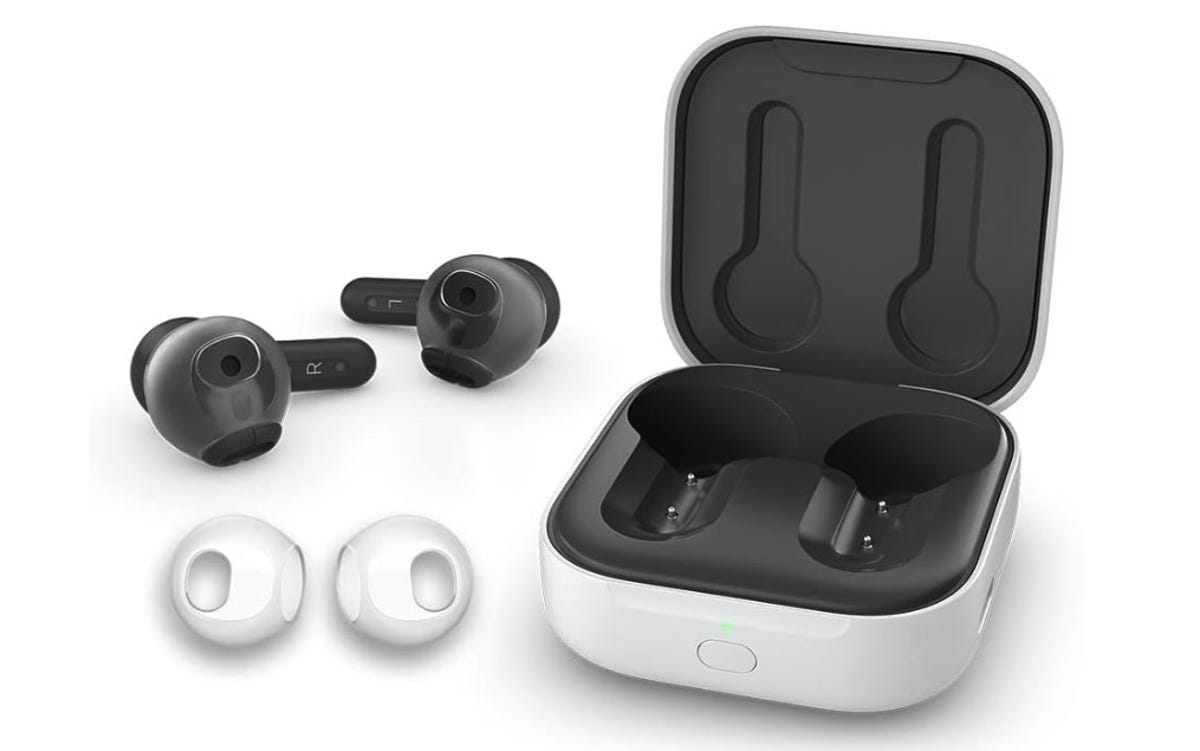
I like to test a lot of inexpensive true-wireless earbuds, hoping to find some hidden gems to pass on to CNET readers as good bargains. With that in mind, I was eager to try Amazon’s new Echo Buds 2023, which carry a list price of $50 but are currently selling for $35 in an early Prime Day deal. That puts them firmly in the “cheap” earbuds category.
Interestingly, they impressed me in a few ways that I wasn’t expecting. For starters, they sound good for inexpensive open earbuds, delivering decent clarity and ample bass. And by “open,” I mean that they don’t have silicone ear tips that you jam into your ears (buds like that are called noise-isolating ear buds). However, they do feature a rubber ring around their 12mm speaker driver, along with a translucent removable silicone rubber cover that fits over the bud itself (you can choose to add it or remove it). Both those design elements help you get a more secure fit, though like all earbuds, the Echo Buds 2023 won’t fit every ear equally well. But they stayed in my ears better than Apple’s AirPods 3 and they’re also lightweight like the AirPods and include a compact charging case.
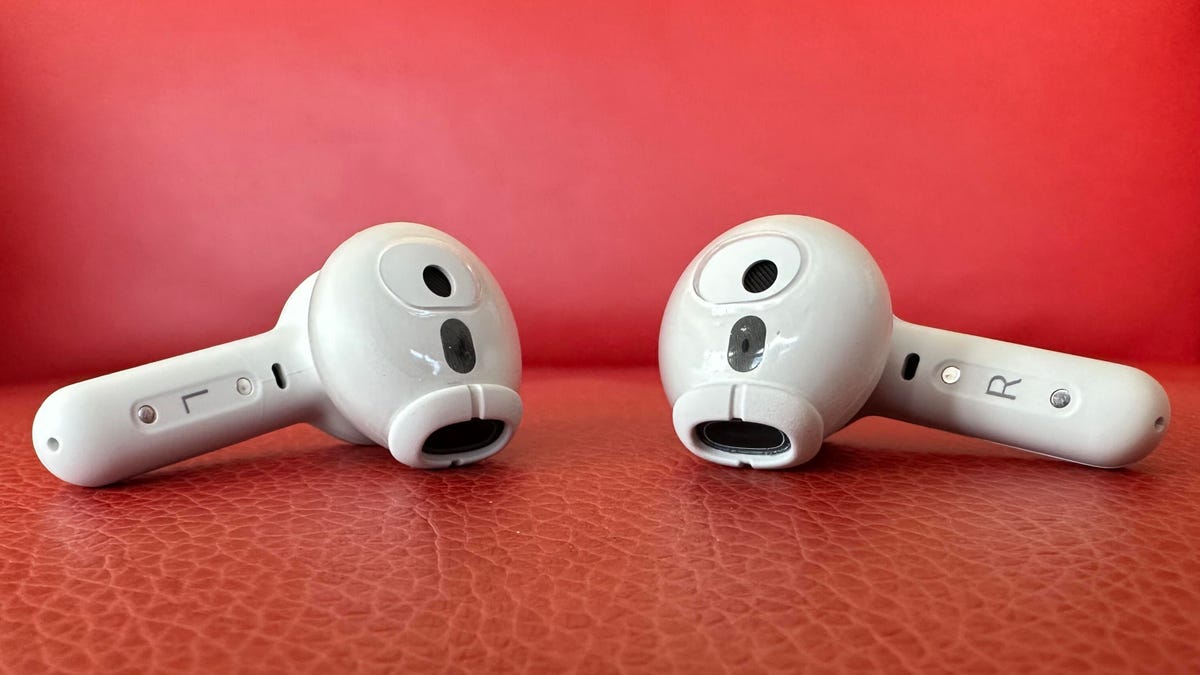
Read more: Best open wireless earbuds for 2023
The Echo Buds 2023 aren’t so different from 1More’s Comfobuds 2 ($30) for example, which also feature a rubber ring or truncated ear tip around their speaker drivers. But what sets the Echo Buds 2023 apart are a couple of key features that you’ll rarely find in a set of $35 earbuds.
The first is an ear-detection sensor on each bud that automatically pauses your music when you take one or both buds out of your ears. Your music resumes playback when you return the bud(s) to your ears, and you can use a single bud independently of the other if you want. (At around $43 and sometimes less, another set of budget open earbuds that I recommend, the Soundpeats Air 3 Deluxe HS, also have ear-detection sensors, as well as support for the LDAC audio codec for devices that support it.)
The second key feature is hands-free Alexa, which allows you to issue voice commands like “next track” and “lower volume” and control Alexa-enabled smart home products just by saying the Alexa wake word. With most cheap earbuds, you have to press a button to activate your voice-assistant (you can opt to use Siri or Google Assistant with the Echo Buds but there’s no hands-free option for those voice assistants, as Amazon would prefer you to use Alexa).

Beyond those two key features, the buds also feature a voice accelerometer that detects when you’re speaking and that helps people hear your voice more clearly when you’re making calls. (Amazon says the buds have two microphones to pick up your voice.) The buds do a reasonable job reducing background noise but callers said they could hear some traffic and other ambient noise during my calls. But my voice did come through clearly, rising above the ambient sound. Since these are open earbuds, they do let in a fair amount of ambient noise, so it’s harder to hear callers — and any other audio you’re listening to — in noisy environments. But the buds do offer ample volume.
Additionally, you get multipoint Bluetooth pairing (Bluetooth 5.2) so you can pair the buds to two devices simultaneously and automatically switch audio between them. For instance, if you’re using these with a computer and a call comes in on your smartphone, you can answer the call and the buds will switch from your computer’s audio to your smartphone’s. (You have to pair to a second device using the Alexa companion app.)

Other specs are in line with what you get from most other inexpensive earbuds. You get up to 5 hours of listening time from a single charge with an additional three charges in the case (the buds also have a quick-charge feature). They’re IPX4 splashproof and sweat-resistant, so you can use them for working out. That said, after going on a run in hot weather, I did pull off the silicone covers on the buds to wipe everything down because some moisture seemed to be trapped under the covers.
I should also note that I had a little trouble initially setting up the buds using the Alexa app with my iPhone 14 Pro (you can also use these just fine with Android devices). I’ve encountered this issue before — the app seems to hang and fails to recognize the Echo Buds because I have so many Bluetooth devices in my Bluetooth list. It took me a few tries and a phone restart before the buds showed up in the Alexa app. Once they did, everything worked well. You can tweak the sound profile a bit using the app’s equalizer settings and customize the touch controls to your liking. There’s also a locate feature similar to Apple’s Find My feature for its AirPods.
To be clear, the Echo Buds 2023 don’t offer the greatest sound quality — but they’re good for the price. Their sound falls short of that of Apple’s AirPods 3, which deliver fuller bass and overall fuller sound. But the AirPods 3 cost more than four times as much as the Echo Buds 2023 and offer only about 15 to 20% better audio. In short, if you’re looking for open earbuds — or “semi-open” as these types of earbuds are sometimes called — the Echo Buds are good value at their $50 list price and even easier to recommend at $35 on sale.
Technologies
Experts weigh in as researcher says AI has more than 10% chance of ‘killing all humans’
Jacob Coxon said in a post on X that Anthropic and OpenAI are “gambling with our lives.”
An artificial intelligence researcher quit his job at Anthropic on Tuesday and accused the company, and its chief rival, OpenAI, of acting irresponsibly, igniting a frenzy of concern on social media about the rapid pace of the technology’s development.
Jacob Coxon, who has worked as a researcher at both companies, said in a post on X that he resigned out of concern that Anthropic and OpenAI are “gambling with our lives.” He said the people building AI “earnestly believe that it could kill us all by the end of the decade.”
“Do not underestimate the power of this technology,” Coxon wrote. “These will soon be superhuman systems that can hack anything, revolutionize any field overnight, and acquire real power and resources.”
Coxon’s post, which has been viewed more than 70 million times, reflects a long-standing debate in Silicon Valley about whether AI can be safely developed and controlled. As Anthropic and OpenAI barrel toward potentially historic initial public offerings while releasing increasingly advanced models, many researchers are calling for a coordinated slowdown.
OpenAI’s chief scientist, Jakub Pachocki, published a blog post on Sunday and warned that no AI company has “solved alignment and monitoring to a sufficient degree to continue responsibly scaling at maximum speed for much longer.” In the AI industry, alignment refers to the work by AI developers to ensure that the system behaves in accordance with human values and intentions.
“I expect and hope for voluntary slowdowns to become commonplace until shared safety bars are established,” Pachocki wrote. “And I believe that international coordination on future AI development needs to become a top priority for governments around the world.”
Coxon’s post on Tuesday also struck a chord with industry researchers who are worried about recursive self-improvement, or an AI system becoming capable of designing and developing its successor without human intervention. Recursive self-improvement is not yet possible, but companies, including Anthropic and OpenAI, have warned that it would make it easier for humans to lose control over those systems.
“Neither company is acting responsibly,” Coxon wrote. “They are racing straight to self-improving superintelligence.”
Evan Hubinger, an alignment lead at Anthropic, echoed Coxon’s comments in a post on X late Tuesday.
“Jacob is correct here—we really do earnestly believe AI could kill all humans! I personally think it is >10% within the next decade,” Hubinger wrote. “I believe Anthropic is trying its best, but we do not yet have a plan to solve alignment for superintelligence and are not clearly on track to.”
While extreme, concerns about the potential for AI to cause human extinction or other catastrophic events are not new in AI research circles. In 2023, for instance, prominent AI researchers and executives, including OpenAI CEO Sam Altman and Anthropic CEO Dario Amodei, signed a statement that said “Mitigating the risk of extinction from AI should be a global priority alongside other societal-scale risks such as pandemics and nuclear war.”
Some experts even use a shorthand, p(doom), to estimate the probability of dire outcomes that could stem from AI.
Anthropic’s Hubinger was also one of roughly 1,400 AI researchers who signed an open letter called “Pacing the Frontier” in July. The letter urged the U.S. government to develop the tools necessary to support an effort to “deliberately pace the frontier of automated AI development.”
Some members of Congress have taken steps to try and address AI’s rapid advancement in the months following, but there’s no clear consensus about how the technology should be regulated.
In July, Rep. Jay Obernolte, R-Calif., and Rep. Lori Trahan, D-Mass., introduced a bill called the FRONTIER Act, which aims to establish a framework for governing the deployment of advanced AI models. And earlier this month, Sen. Bernie Sanders, I-Vt., and Rep. Greg Casar, D-Texas, introduced a bill called the Ban Artificial Superintelligence Act, which would temporarily pause advanced AI development until the federal government establishes safety rules. Both bills have been met with mixed receptions.
“Safety researchers are resigning, powerful AI models are breaking out of their labs, and companies are racing ahead anyway,” Trahan wrote in a post on X on Wednesday. “It’s past time for Congress to get off the sidelines and do its job.”
Lawmakers are also trying to navigate growing public backlash against AI data centers, the large facilities that house the hardware for training and running AI models. The pushback has grown so intense that the The National Republican Senatorial Committee, or NRSC, said last month that data centers have become a “sleeper issue” for the entire midterm election cycle, as CNBC previously reported.
Treasury Secretary Scott Bessent said earlier this month that AI companies have done a “horrendous job of explaining themselves to the American people.”
“They’re going to have to take some of the blame, and they are going to have to convince the American people that all the benefits will not accrue to a small group,” Bessent said, following the G20 meetings with finance ministers and central bankers in Asheville, North Carolina. “That’s what they hear from me.”
Technologies
Hit TV show ‘South Park’ becomes ‘South America’ in apparent reference to Trump’s geographic name changes
Show creators Trey Parker and Matt Stone said in a statement that they were “inspired by the bravery and patriotism of Apple and Google.”

Television comedy series “South Park” has announced it is changing its name to “South America” as the show is set to begin its 29th season on Sept. 16.
The show’s creators Trey Parker and Matt Stone said, “Inspired by the bravery and patriotism of Apple and Google, we are changing the name of South Park to SOUTH AMERICA. We especially want to thank our parent company Paramount — a Skydance Capitulation.”
Parker and Stone’s statement comes after U.S. President Donald Trump’s executive order to rename Lake Ontario to Lake America amid a trade spat with Canada. Canadian officials said they will not recognize the new name.
Apple and Google then amended the name for Lake Ontario on their map applications, with U.S. users seeing “Lake America,” while Canadian users saw “Lake Ontario.”
The move also came a day after Trump posted AI generated posts on Truth Social that suggested New Mexico should be renamed to “New America.”
Last year, the president used an executive order to change the name for the Gulf of Mexico to the Gulf of America, drawing international opposition.
“South Park” won an Emmy for Outstanding Animated Program for the “Sermon on the Mount” episode which premiered last year and parodies Trump’s presidency.
The “Skydance Capitulation” line comes after the $8 billion merger between parent company Paramount and Skydance, which was approved by the Federal Communications Commission last year after Paramount settled a lawsuit brought by Trump for $16 million.
Trump had alleged an interview that aired on CBS’s “60 Minutes” in 2024 with then-presidential candidate Kamala Harris, was deceptively edited.
Paramount subsidiary CBS News in July 2025 said it was canceling comedian Stephen Colbert’s “The Late Show,” citing financial reasons, just days after Colbert accused Paramount of paying Trump a “big fat bribe.” The final episode of the show aired in May.
Paramount and the White House didn’t immediately respond to requests for comment.
Technologies
Trump expresses no remorse over initiating Iran conflict as U.S. intensifies economic sanctions
President Trump expressed no regrets over starting the Iran war, claiming he would act again despite election impacts, while the U.S. increases economic sanctions on Iran.
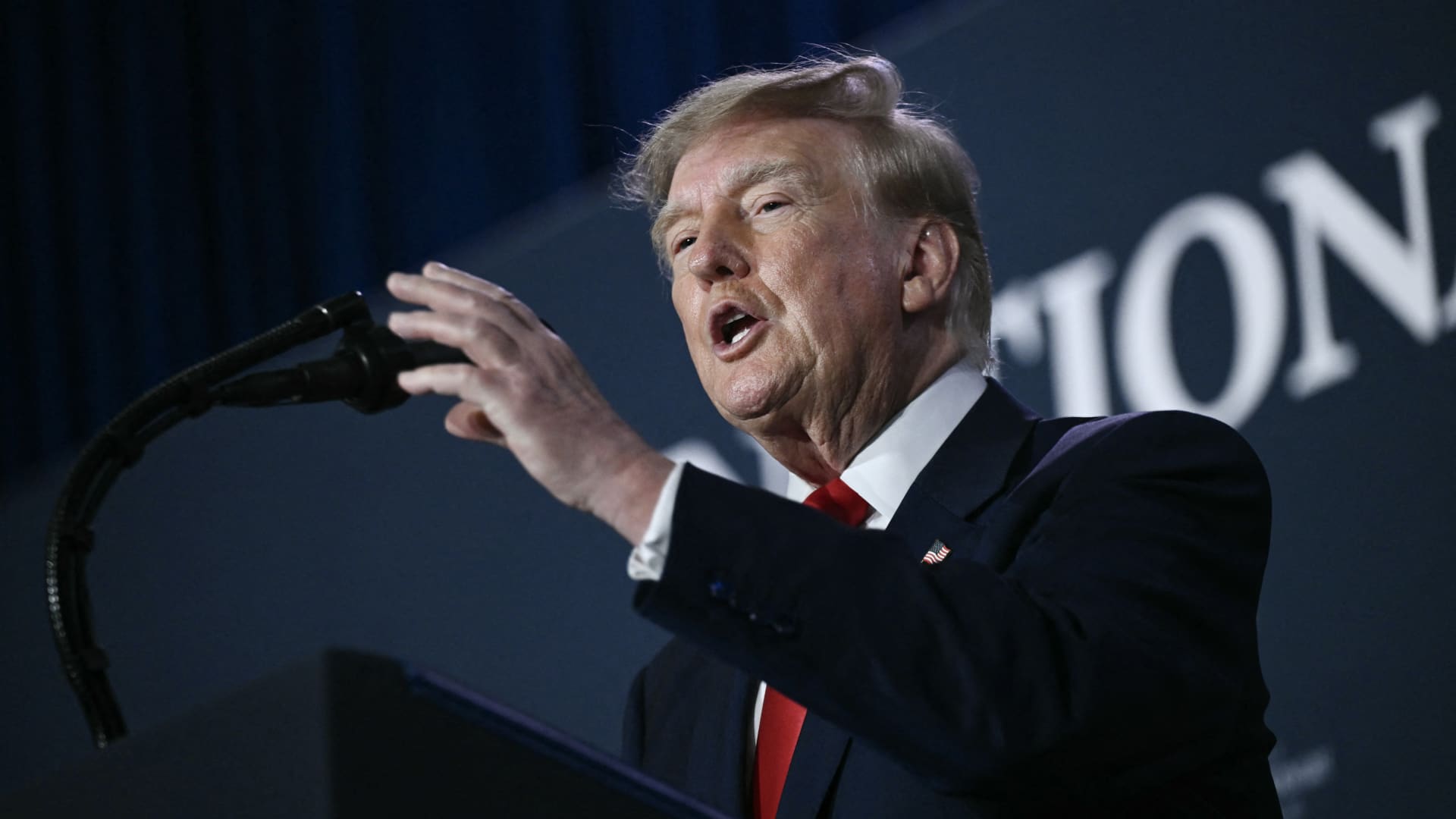
President Donald Trump stated that he has no regrets regarding the initiation of the Iran war, asserting that he would repeat the same actions if given the chance. In an interview with Fox News’ Laura Ingraham on Thursday, Trump mentioned that he would have proceeded with the attack on Iran regardless of the consequences for the midterm elections. Ingraham suggested that without the Iran conflict, the midterms would have been a victory, to which Trump responded that if Iran acquired a nuclear weapon, they would use it. Trump further added that a nuclear-armed Iran would eliminate Israel and the Middle East, and begin attacking U.S. cities. These remarks occur as markets anticipate a prolonged Iran war, following a Wall Street Journal report indicating that senior White House advisors explored with Trump the potential for the conflict to extend past his current term. Trump has claimed that the war will conclude right after the midterm elections, leading to a drop in oil and gas prices, reinforcing his repeated assertions that the conflict will end shortly. In distinct comments to NewsNation on Thursday, Trump refuted reports of damage to U.S. assets, after Iran asserted that it struck several U.S. fighter jets at a base in Jordan. When questioned about the reports, Trump said, ‘No damage. No nothing.’ Regarding economic pressure, Washington is persisting in efforts to isolate Iran economically, with Treasury Secretary Scott Bessent announcing sanctions against a major bank scheduled for next week. Bessent stated on ‘Real America’s Voice’ that the sanctions would be implemented on Monday to commemorate the fallen citizens of 9/11, urging to watch for updates. Bessent mentioned that the administration has sanctioned and shut down the Dubai branches of Egypt’s second-largest bank, alleging that it provided Iran with $1.8 billion. He also noted that the 30th-largest Turkish bank, which had been funding Iran, was sanctioned, but did not identify it. Last week, the U.S. imposed sanctions on the Turkey-based Golden Global Yatirim Bankasi Anonim Sirketi, along with its subsidiaries. In the NewsNation interview, Trump was questioned about how Iran could withstand the current economic pressure. Trump responded, ‘I don’t know if they can hold out, but it will be settled after the elections, or perhaps sooner, but definitely right after the election.’ Correction: This article has been revised to accurately reflect Bessent’s statement that the 30th largest Turkish bank was sanctioned; an earlier version incorrectly stated the bank’s ranking.
-
 Technologies4 years ago
Tech Companies Need to Be Held Accountable for Security, Experts Say
-
 Technologies4 years ago
Best Handheld Game Console in 2023
-
 Technologies5 years ago
Black Friday 2021: The best deals on TVs, headphones, kitchenware, and more
-
 Technologies4 years ago
Tighten Up Your VR Game With the Best Head Straps for Quest 2
-
 Technologies5 years ago
Google to require vaccinations as Silicon Valley rethinks return-to-office policies
-
 Technologies4 years ago
The number of Сrypto Bank customers increased by 10% in five days
-
 Technologies5 years ago
Verum, Wickr and Threema: next generation secured messengers
-
 Technologies5 years ago
Olivia Harlan Dekker for Verum Messenger