
Technologies
Google Revives Android 17 Beta 1 Just Days After Halting Launch
Android 17 Canary will feature improvements to the camera, networking and security, the company says.
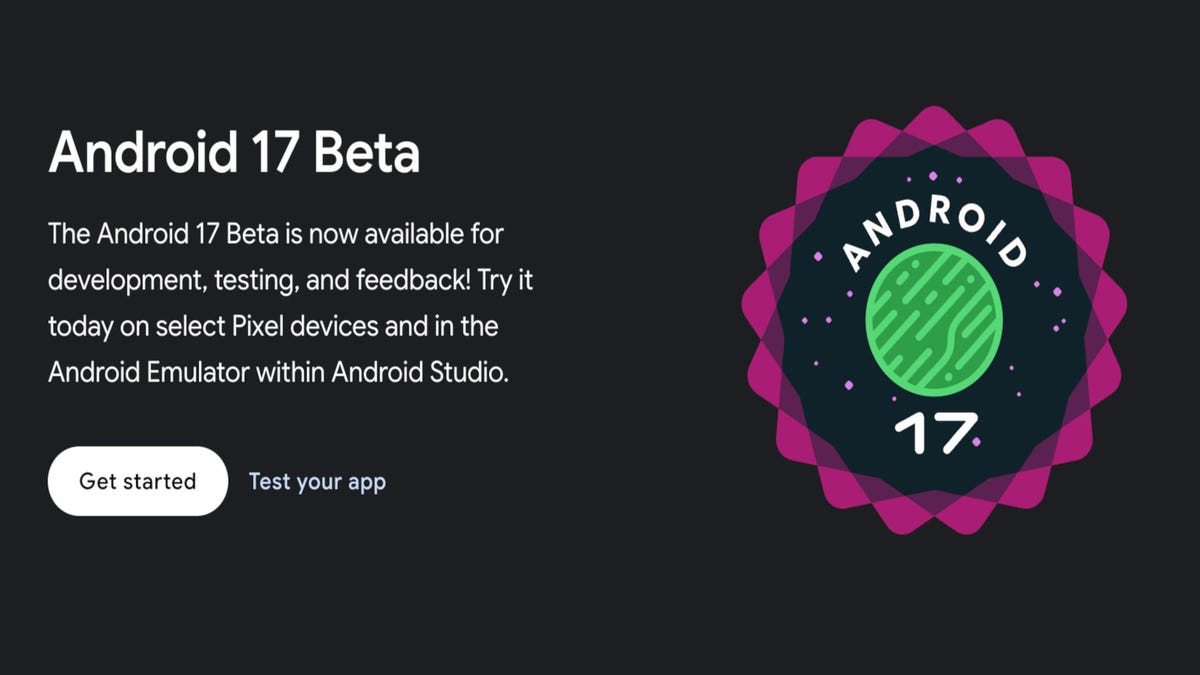
Google released the first beta of the next version of its smartphone OS, Android 17, on Friday, following an aborted launch earlier in the week.
Beta 1 was supposed to launch on Wednesday, but Google changed the date to “coming soon” at the last minute without further explanation, CNET sister site PCMag reported.
The new Android 17 Beta 1, designed for developers and early adopters with Pixel devices, “prioritizes privacy, security, and refined performance,” the company says. The beta is available from Google.
Android 17 Canary will bring improvements such as “professional-grade tools to media and camera apps,” with seamless transitions and standardized loudness.
On Friday, Android Authority shared beta screenshots of Live Updates with a newer, longer progress bar and more prominent buttons. The pictures show that the progress bar now spans the entire tile, and the Exit Navigation button is more prominent.
The Live Updates feature debuted with Android 16 and is designed to provide up-to-date visibility into deliveries and travel times with the use of a progress bar.
The beta will also include new tools to optimize Wi-Fi connectivity and expanded profiles for companion devices.
The company says it expects Canary to hit the Platform Stability milestone in March, which includes the final APIs for app developers, and that the full release would follow a few months after (likely in June, TechAdvisor says).
The beta release precedes the anticipated launch of the budget Pixel 10A phone next week.
Technologies
G10’s ‘surprise’ currency star could stumble as peers hike interest rates
The British pound has benefited from a resilient economy and rate hike expectations, but the BOE looks increasingly dovish while a crucial budget lies ahead.

The British pound has largely shrugged off another change of government and geopolitical shocks to outperform many of its peers this year, but the currency’s recent weakness could be set to deepen.
Sterling has gained around 1.6% against the euro
It is near-flat against the U.S. dollar
The resignation of Prime Minister Keir Starmer on July 20 left Britain facing its seventh leader in 10 years, with markets watching closely whether a new administration would hold to the “fiscal rules” repeatedly emphasized by former Finance Minister Rachel Reeves.
U.K. borrowing costs have risen under Starmer’s quickly appointed successor Andy Burnham, also of the center-left Labour Party, but that has occurred in lockstep with a global government bond sell-off.
Matthew Ryan, head of market strategy at financial services firm Ebury, said that a “clean and orderly transition of power” had “removed a potential banana skin and eased the perceived political risk premium attached to the pound.”
Britain’s long-term borrowing costs are the highest since 1998
In a Friday note, Ryan said sterling had been “the surprise outperformer” among the G10 group of wealthy nations over the past three months, tying this to an unexpectedly resilient U.K. economy.
Gross domestic product grew by 0.4% in the second quarter, following 0.6% expansion in the first quarter — one of the strongest performances among advanced economies. Sunny weather and excitement around the FIFA World Cup boosted consumer spending, while business activity remained surprisingly resilient despite the volatile geopolitical backdrop.
The pound also drew support at the start of the Iran conflict in April on outsized market expectations for a monetary policy response to inflation fears from the Bank of England, Jane Foley, senior FX strategist at Rabobank, told CNBC.
The U.K. is highly vulnerable to higher oil and gas costs, both of which have spiked this year, helping push headline inflation near 3%.
Sterling weakness ahead?
Despite the resurgence of price pressures, the Bank of England has held its key interest rate at 3.75% throughout this year.
Current market pricing suggests low odds of a rate hike at its September meeting. In contrast, there are high expectations for a hike by the European Central Bank on Wednesday and, increasingly, the Federal Reserve later this month.
Central bank rate hikes typically boost their home currency.
Dovish messaging by the BOE on Sept. 17 would “further expose the pound” just before markets get anxious for the first annual budget announcement of Burnham’s administration on Oct. 28, Foley of Rabobank noted.
New U.K. Finance Minister John Healey said in a Monday speech that he would remain committed to fiscal discipline, while targeting a more even distribution of economic growth around the country — in contrast to the concentration of growth in powerhouse London.
JP Morgan U.K. economist Allan Monks said his remarks suggested a cautious approach to tax and spending changes given the backdrop of higher borrowing costs. The budget is likely to retain a focus on devolution, greater public control of public services and more private sector partnerships, but contain little to change the macro outlook, Monks said in a note Monday.
Ebury’s Matthew Ryan said the budget contained a high level of political risk, and was likely to contain “a combination of higher ancillary tax rates and an increase in debt issuance in order to fund Burnham’s spending ambitions.”
These could include changes to taxes on property purchases and local council duties, an introduction of a “mansion tax” and tighter pension and personal investment account relief, he said, adding that markets would be jumpy over anything that looked likely to dampen growth and squeeze the private sector, while simultaneously requiring more borrowing.
Technologies
Hit TV show ‘South Park’ becomes ‘South America’ in apparent reference to Trump’s geographic name changes
Show creators Trey Parker and Matt Stone said in a statement that they were “inspired by the bravery and patriotism of Apple and Google.”

Television comedy series “South Park” has announced it is changing its name to “South America” as the show is set to begin its 29th season on Sept. 16.
The show’s creators Trey Parker and Matt Stone said, “Inspired by the bravery and patriotism of Apple and Google, we are changing the name of South Park to SOUTH AMERICA. We especially want to thank our parent company Paramount — a Skydance Capitulation.”
Parker and Stone’s statement comes after U.S. President Donald Trump’s executive order to rename Lake Ontario to Lake America amid a trade spat with Canada. Canadian officials said they will not recognize the new name.
Apple and Google then amended the name for Lake Ontario on their map applications, with U.S. users seeing “Lake America,” while Canadian users saw “Lake Ontario.”
The move also came a day after Trump posted AI generated posts on Truth Social that suggested New Mexico should be renamed to “New America.”
Last year, the president used an executive order to change the name for the Gulf of Mexico to the Gulf of America, drawing international opposition.
“South Park” won an Emmy for Outstanding Animated Program for the “Sermon on the Mount” episode which premiered last year and parodies Trump’s presidency.
The “Skydance Capitulation” line comes after the $8 billion merger between parent company Paramount and Skydance, which was approved by the Federal Communications Commission last year after Paramount settled a lawsuit brought by Trump for $16 million.
Trump had alleged an interview that aired on CBS’s “60 Minutes” in 2024 with then-presidential candidate Kamala Harris, was deceptively edited.
Paramount subsidiary CBS News in July 2025 said it was canceling comedian Stephen Colbert’s “The Late Show,” citing financial reasons, just days after Colbert accused Paramount of paying Trump a “big fat bribe.” The final episode of the show aired in May.
Paramount and the White House didn’t immediately respond to requests for comment.
Technologies
Trump Claims No Regret Over Initiating Iran Conflict Amid Rising U.S. Economic Sanctions
Trump insists he has no regrets about initiating the Iran conflict, warning that a nuclear-armed Iran would threaten Israel and U.S. cities, while the administration ramps up economic sanctions. He predicts the war will end after the midterms, even as markets brace for a prolonged standoff.

U.S. President Donald Trump said he has no regrets about starting the Iran war and added that “If I had it to do again, I would do exactly what I did.” Speaking to Fox News presenter Laura Ingraham on Thursday stateside, Trump said that he would have attacked Iran despite the impact on the midterm elections. “If we hadn’t done Iran, you would be cruising to midterms victory right now,” Ingraham told Trump, to which Trump replied “supposing we were cruising, and all of a sudden Iran has a nuclear weapon. They would use it.” He added that if Iran had a nuclear weapon, the Islamic Republic would “wipe out” Israel and the Middle East, and start hitting U.S. cities.
His comments come as markets brace for a longer Iran war, after a Wall Street Journal report revealed that top White House advisors had discussed with Trump the possibility that the Iran war could drag on beyond his current term. Trump has said that the war will end immediately after the midterm elections and oil and gas prices will also fall, adding to his months-long claims that the conflict will end soon.
In separate comments to NewsNation on Thursday, Trump denied reports that there was any damage to U.S. assets, after Iran claimed it had hit multiple U.S. fighter aircraft at a base in Jordan. “No damage. No nothing,” Trump said, when asked if there was any truth to the reports.
Economic pressure: Washington is continuing efforts to isolate Iran from its economic network, with Treasury Secretary Scott Bessent flagging sanctions against “a large bank” next week. “We’re going to do it on Monday because we want to honor the memory of our fallen citizens on 9/11. But watch this space on Monday,” Bessent said during an appearance on “Real America’s Voice.” Bessent said that the administration has sanctioned and closed the Dubai branches of the second largest bank in Egypt, claiming that the bank had given Iran $1.8 billion dollars. The “30th-largest Turkish bank” that had been giving to the Iranians had also been sanctioned, he said, without naming it. The U.S. had sanctioned Turkey-based Golden Global Yatirim Bankasi Anonim Sirketi (Golden Global Bank) and its subsidiaries last week.
Trump, in the NewsNation interview, was also asked how Iran could continue holding out under the current economic pressure. “I don’t know that they’re gonna be able to hold out,” Trump said. “But it’ll get settled after the elections. Or maybe sooner. But it’ll get settled right after the election.”
Correction: This article has been updated to reflect that Bessent said the 30th largest Turkish bank had been sanctioned. An earlier version misstated the bank’s ranking.
-
 Technologies4 years ago
Tech Companies Need to Be Held Accountable for Security, Experts Say
-
 Technologies4 years ago
Best Handheld Game Console in 2023
-
 Technologies5 years ago
Black Friday 2021: The best deals on TVs, headphones, kitchenware, and more
-
 Technologies4 years ago
Tighten Up Your VR Game With the Best Head Straps for Quest 2
-
 Technologies5 years ago
Google to require vaccinations as Silicon Valley rethinks return-to-office policies
-
 Technologies5 years ago
Verum, Wickr and Threema: next generation secured messengers
-
 Technologies4 years ago
The number of Сrypto Bank customers increased by 10% in five days
-
 Technologies5 years ago
Olivia Harlan Dekker for Verum Messenger