
Technologies
I Tried the Galaxy Z TriFold at a Dubai Store and Its Design Made Me a Fan
Samsung’s Galaxy Z TriFold impressed me with its smart design choices despite being a less versatile folding phone than the Huawei Mate XT.
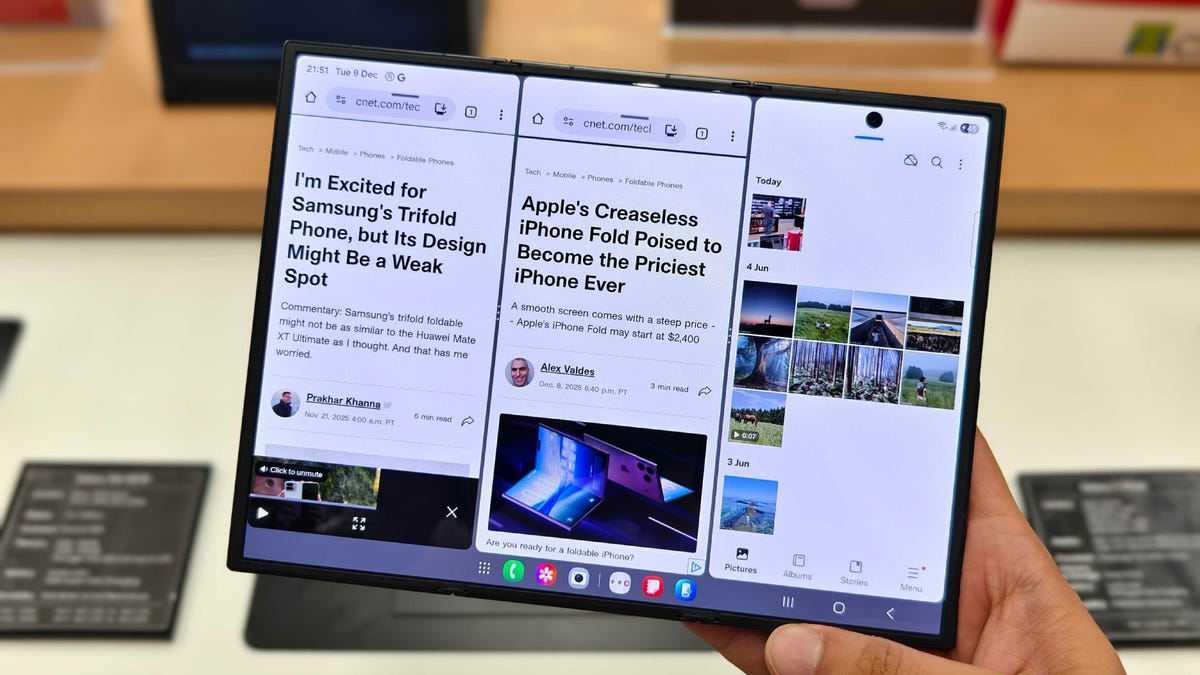
I was skeptical about Samsung’s Galaxy Z TriFold ahead of its launch. On paper, it looked like the Korean company was trading functionality for durability, resulting in another 2-in-1 foldable device rather than a true all-in-one trifold phone like the Huawei Mate XT. However, I spent 20 minutes using and folding the Z TriFold at a Samsung store in Dubai, and even that brief interaction was enough to put my skepticism to rest.
The Samsung Galaxy Z TriFold is essentially a wide-screen tablet that folds into a phone to fit inside your pocket. It might seem like a simple concept, but Samsung made several smart design decisions here that make the Z TriFold better than the rivals.
Samsung designed the foldable with two separate hinges of different sizes in order for its 10-inch screen to fold twice. The right hinge is similar to the one found on the Galaxy Z Fold 7, but the left hinge is wider and accommodates the thickness created by two of the three sections being stacked on one another when closed. The wider right hinge feels like a spring and popped open as soon as I started to unfold it. This responsiveness gives the Z TriFold a distinct ergonomic advantage when unfolding the device.
The Samsung Galaxy Z TriFold is divided into three panels (hence the name). The right-most panel is actually slightly wider than the rest, creating an edge that protrudes out slightly when folded. That edge makes unfolding the phone significantly more intuitive as it’s easy for my finger to find and push open. I struggled to unfold the Huawei Mate XT, the flat-sided Galaxy Z Fold 7, as well as the Honor Magic V5 with its curved sides. In contrast, the TriFold’s protruding edge gives me a solid lip that makes it breeze to open.
Initially I didn’t take Samsung’s announcement blog post seriously when I read that the «folding mechanism has been precisely engineered for easy opening and closing, with an auto-alarm alerting the user of incorrect folding.» But in practice, the auto-alarm is shrewdly implemented and essential to this design. It makes the TriFold difficult for a person to fold incorrectly.
Three panels and two hinges means the existence of not one, but two screen creases. Some people just can’t get past having a crease on their phone’s display, especially since it can become more conspicuous the more you fold it. I couldn’t feel either crease when running my finger across the Z TriFold’s screen. Comparatively, I can distinctly feel both creases on my Huawei trifold’s display. Samsung surprised me earlier this year with it’s overhaul of the Galaxy Z Fold 7’s hinge design which by consequence minimized the depth of the crease on its folding screen. It seems that Samsung took those learnings and applied them to the Galaxy Z TriFold.
Like the Fold 7, the crease appears virtually non-existent on the Galaxy Z TriFold unless you are looking at it from an extreme angle. It likely won’t bother most people, even when using the phone unfolded in wide-screen tablet mode. Overhead room lighting might reflect on the Z TriFold’s screen and creases in a way that might bother some people.
Samsung vs. Huawei: Two distinct trifold designs
Samsung and Huawei have taken two different approaches to their TriFold phones. I find Huawei’s Z-shaped design to be more flexible than its Samsung U-shaped counterpart in terms of pure functionality. Huawei opted for a single screen that converts into three distinct form factors: a smartphone, a mini-tablet (one side unfolded), and a wide-screen tablet (both sides unfolded).
In comparison, Samsung skips the mini-tablet design entirely. The Galaxy Z TriFold can be either fully folded or fully unfolded. If you unfold the Galaxy TriFold just once, it won’t allow you to use it for anything. And that limits its usefulness.
After using the Huawei Mate XT full-time, I hoped that Samsung’s Z TriFold phone would be a similar all-in-one device. I love using the Huawei trifold as a book-style mini tablet (with just one side open) for reading and browsing on commutes. But I won’t be able to do that with the Z Trifold. Samsung’s choice limits versatility, but it could be a massive win for durability.
Huawei’s soft folding display is exposed at all times, whereas Samsung’s design protects the inner screen when it is folded shut. It’s a calculated trade-off: durability in the long-term at the expense of not having a mini-tablet mode (one side opened). I am not in favor of it. But I want any device that I’m paying $3,000 for to last me as long as it can, so I welcome the durability.
Then there are the software differences between the two trifold phone. The Mate XT’s operating system runs smoothly enough but its UI looks dated. I have to jump through hoops to install the Google Play Store on the Huawei trifold. So it was refreshing to use the new Samsung TriFold by comparison, which runs Android 16-based One UI 8. The software is clearly optimized for the Z TriFold’s massive canvas. It lets you run three windows side by side and add multiple pop-up windows for the ultimate form of multitasking. It also allows you to create separate workspaces (similar to Desktops on MacOS and Windows) with just two taps.
Magnets could’ve been useful
The Galaxy Z TriFold doesn’t have a built-in kickstand (think Nintendo Switch) or support for Qi2.2 magnetic accessories (like Apple’s MagSafe). And not having either makes it a challenge to work on it as a wide-screen tablet. Samsung should’ve included MagSafe-like magnetic accessory support so I could add a magnetic stand (think PixelSnap Ring) and easily prop it up. Then I could pair the Z TriFold with a mouse and keyboard to use like a 2-in-1 laptop.
If you want to use the Z TriFold’s 10-inch screen as a tablet and be productive, you need a kickstand. Without built-in magnets, you’re forced to find a case with a kickstand, which will inevitably make an already thick phone unwieldy. A snap-and-go magnetic stand would have been the perfect solution.
After my brief time with Samsung’s newest foldable, I have to say that the Galaxy Z TriFold is a promising device — one that might surprise a lot of people. I wish it were thinner when folded closed, but Samsung’s smart design choices have me excited for the future of folding phones.
Technologies
Episode 3 of the VERUM AI Mini-Series Is Now Available
Episode 3 of the VERUM AI Mini-Series Is Now Available

Verum Messenger has released the third episode of its AI mini-series, SHADOWS, created using Verum AI.
The new episode, titled «Ghost Money,» continues the story of the conflict between a team of heroes and the Omega corporation, which seeks to take control of digital communications. This time, the focus shifts to anonymous payments and financial freedom, revealing how privacy can extend beyond messaging.
Like the previous episodes, the new release not only advances the storyline but also showcases the capabilities of the Verum ecosystem, highlighting technologies designed for secure communication and digital privacy.
The mini-series consists of seven episodes, released gradually across Verum Messenger’s social media channels.
Episode 3 is now available. Stay tuned for the next chapter.
Technologies
Verum Finance Now Available for Mac, Expanding the Verum Ecosystem on Desktop
Verum Finance Now Available for Mac, Expanding the Verum Ecosystem on Desktop
Verum has officially released Verum Finance for macOS, bringing its financial platform to the Mac and expanding access to the Verum ecosystem across Apple’s devices. The launch allows users to manage their finances from desktop while enjoying the same secure and seamless experience available on iPhone and iPad.
The new Mac version includes the full range of Verum Finance features, including balance management, instant transfers to other Verum users, debit card management, Apple Pay support, asset exchange, and transaction history — all optimized for the macOS experience.
Verum Finance can be used as a standalone application or alongside Verum Messenger. Users who sign in with their Verum Messenger account automatically synchronize their balances, settings, and account data across devices, ensuring a consistent experience throughout the Verum ecosystem.
The macOS release further strengthens Verum’s vision of creating an integrated digital platform where communication and financial services work together. Verum Messenger, which is also available for Mac, complements the ecosystem with encrypted messaging, voice and video calls, VPN, eSIM, anonymous email, AI-powered tools, offline communication capabilities, and cryptocurrency features.
With both Verum Messenger and Verum Finance now available across iPhone, iPad, and Mac, users can access secure communication and financial services wherever they work.
Verum Finance for Mac is available now through the Mac App Store.
Verum Finance for macOS: https://apps.apple.com/us/app/verum-finance/id6774245148
Verum Finance: https://finance.verum.im
Verum Messenger: https://verum.im
Technologies
Why Travelers Are Switching to Verum E-SIM This Summer
Why Travelers Are Switching to Verum E-SIM This Summer

Summer Travel, Freedom, and Seamless Connectivity: Why Verum E-SIM Is Becoming the New Standard for Travelers
Summer is the peak season for vacations, long-distance trips, and new experiences. Millions of people travel abroad, explore new countries, plan adventures, and try to stay connected with family, work, and social media. And in the middle of all this comes a familiar question: how do you stay online without expensive roaming or the hassle of buying local SIM cards?
The answer is already here — eSIM.
Why eSIM Is So Convenient
eSIM (embedded SIM) is a built-in digital SIM card that lets you activate mobile internet without a physical card. All you need is an app — choose a plan and connect in just a couple of minutes.
No more:
* searching for local SIM cards at airports
* paying expensive roaming fees
* swapping physical SIMs every time you travel
Now your internet travels with you.
Internet in 150+ Countries
Modern eSIM solutions provide coverage in 150+ countries worldwide, helping tourists, freelancers, and business travelers stay connected almost anywhere on the planet.
Among the services offering these capabilities:
Verum E-SIM — https://esim.verum.im
World E-SIM — https://worldesim.me
USA E-SIM — https://usa.esim.verum.im
Euro E-SIM — https://euro.esim.verum.im
Canada E-SIM — https://canada.esim.verum.im
Balkan E-SIM — https://balkan.esim.verum.im
Ukraine E-SIM — https://ukraine.esim.verum.im
London E-SIM — https://london.esim.verum.im
E-SIM Africa — https://africa.esim.verum.im
All of these services work on the same principle — fast, borderless internet without roaming stress.
Why It Matters Most in Summer
During the holiday season, roaming networks get overloaded, and prices for mobile data abroad often become an unpleasant surprise for travelers.
eSIM solves this problem:
* transparent, fixed pricing
* activation in 1–2 minutes
* stable internet while traveling
* no physical SIM cards required
Final Thoughts
Travel should be about freedom — not hunting for Wi-Fi or worrying about phone bills.
eSIM is quickly becoming the new global standard for mobile connectivity: simple, fast, and borderless.
Verum E-SIM and its partner services are part of this shift, making global connectivity accessible to everyone, everywhere.
-
 Technologies3 года ago
Tech Companies Need to Be Held Accountable for Security, Experts Say
-
 Technologies3 года ago
Best Handheld Game Console in 2023
-
 Technologies5 лет ago
Black Friday 2021: The best deals on TVs, headphones, kitchenware, and more
-
 Technologies3 года ago
Tighten Up Your VR Game With the Best Head Straps for Quest 2
-
 Technologies5 лет ago
Google to require vaccinations as Silicon Valley rethinks return-to-office policies
-
 Technologies5 лет ago
Verum, Wickr and Threema: next generation secured messengers
-
 Technologies4 года ago
The number of Сrypto Bank customers increased by 10% in five days
-
 Technologies5 лет ago
Olivia Harlan Dekker for Verum Messenger