
Technologies
Best Speakerphone in 2023 for Working From Home
Do you make conference calls using Zoom, Microsoft Teams or another platform? Try a compact speakerphone to improve the audio experience in your home office.
Working from home continues for some people, while others have been asked to head back into the office to do their jobs. Still, plenty of folks are still working at home at least a few days a week. You may’ve bought a headset to log in to all those video conference calls you still have to show up for (we have a list of best headsets for working from home if you’re interested in one of those), but some people don’t like to wear anything on or in their ears. That’s where a good speakerphone can come in handy.
Read More: Best Cheap VPN
I’ve tested all the speakerphones on this list and reviewed not only how they perform as a speakerphone but also how they sound for music listening and what connectivity options they offer (and any other noteworthy special features). All of them include some sort of wired USB connection for Windows PCs and Macs, and many also have a Bluetooth option so you can connect wirelessly. Additionally, some include UC Bluetooth dongles that are compatible with the industry standard universal communication format. That USB dongle allows for a more reliable Bluetooth connection to computers. However, like UC headsets, speakerphones with a UC Bluetooth option can cost a little more.
Advertiser Disclosure
I’ve included not just the best of the best speakerphones, which can get pretty pricey, but also some top no-frills speakerphones for those want to spend less than $100 — or even less than $50. Except for one, all the speakerphones on this list are portable and easy to take with you so you can use them at home or on the go.
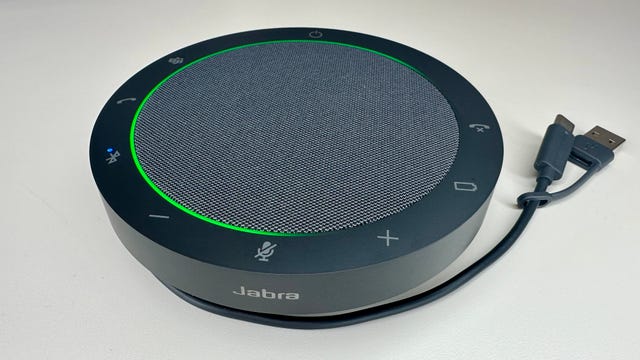
Jabra’s has revamped its speakerphone line up for 2023, adding three new redesigned models that will eventually replace its earlier Speak 410, 510 and 710. The Speak2 55 is the middle model in the line up and only slightly more expensive than the Speak2 40, which I haven’t tried yet, but it seems similar. (It’s the same size and both the Speak2 40 and Speak2 50 have 50mm drivers.) The Speak2 75 is the flagship model and offers the best sound quality and substantially better battery life in wireless Bluetooth mode — 32 hours compared to 12 for the Speak2 55. That’s said, it may be overkill for some people and is also pricey.
I like how Jabra has redesigned the new models, giving them a sleeker, cleaner look, and all the models include an integrated USB-C cable with a USB-A adapter that allows you to plug the speaker directly into a Mac or Windows PC. The relatively compact Speak2 55 comes with a nice felt carrying case and is fairly lightweight, weighing in at 280 grams (9.88 ounces), making it easy to slip into a bag and carry around for conference calls on the go. While it offers Bluetooth 5.1 connectivity, it doesn’t come with a USB Bluetooth dongle to plug into your PC for more reliable wireless connectivity with computers.
It’s equipped with four beamforming noise-cancelling microphones with background noise reduction technology (people I was conversing with said my voice sounded clear) and I thought the sound output was better than that of the Anker PowerConf S500, which retails for a little more. You can use the Speak2 55 to listen to music, but don’t expect great sound quality. It’s acceptable for casual listening but there just isn’t a lot of bass. Not surprisingly, you get better sound with the larger and more expensive Speak2 75).
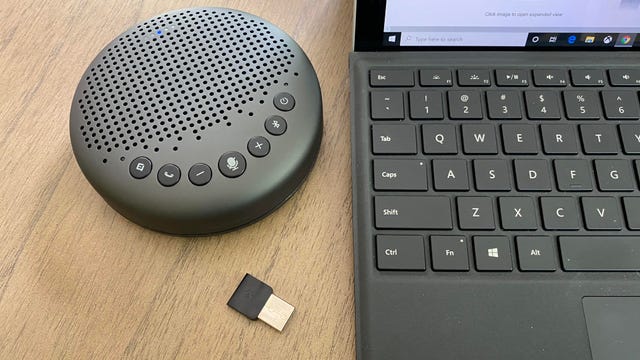
The Luna is eMeet’s latest speakerphone and a good value with a list price of $80, though it sometimes dips to even less with an instant coupon at Amazon. It’s designed to compete with Anker’s PowerConf (see below). It’s not quite as sleek as the PowerConf, nor does it come with a protective carrying case like that model does. Also, its microphone performance is good but not on the level of the Jabra Speak2 55 (see above) or Speak 510 (see below) in terms of clarity. That said, it offers good noise reduction.
The speaker does sound clear and loud, and it’s versatile: You can go wireless over Bluetooth, plug the speaker into the USB port on your PC (with an included cable) or plug in the wireless dongle for a more reliable Bluetooth connection.
It can be daisy-chained with other eMeet speakerphones to add more people — up to 12, eMeet says — in case you’re running a business with multiple employees from home or just have a really large family.
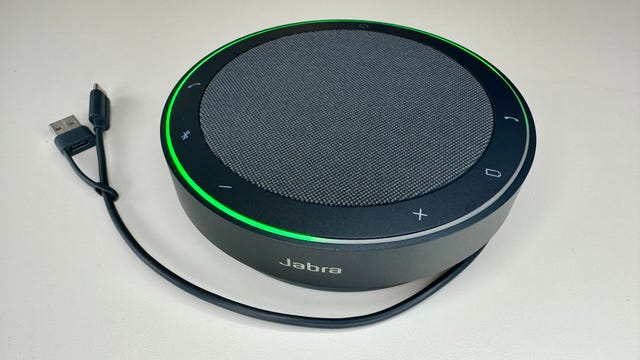
The Speak2 75 is Jabra’s new-for-2023 flagship speakerphone. It’s larger than the Speak2 55 (see above) but still portable, weighing in at 466 grams or 16.44 ounces. (It does feel more substantial than the Speak2 55.) Like the Speak2 55, this model comes with a felt carrying case and an integrated USB-C cable with a USB-A adapter for connecting the speaker directly to computers. It’s IP64 dust- and splash-proof.
The two biggest differences between this model and the Speak2 55 are the size of the drivers — 65mm versus 50mm — and the Speak2 75’s superior battery life (it’s rated for 32 hours in wireless Bluetooth mode, much more than the 12 hours you get with the Speak2 55). It also includes a Bluetooth USB dongle for more reliable wireless connectivity with computers. Alas, the USB-C version of the dongle is currently backordered, so only the USB-A version is available. That will hopefully change soon.
Jabra says the Speak2 75 has “super-wideband audio” and a microphone quality indicator that detects how well the microphones are picking up your voice. It also has four beamforming microphones with the same noise-reduction technology as the Speak2 55. Aside from the better battery life, the biggest difference I noticed was the fuller sound — it’s a bigger speaker so that’s not surprising. And while it’s still not that a great sound if you use it to play music, it does have more bass than the Speak2 55.
Callers said I sounded loud and clear with good background noise reduction. This is a top-notch speakerphone, but it is pricey.
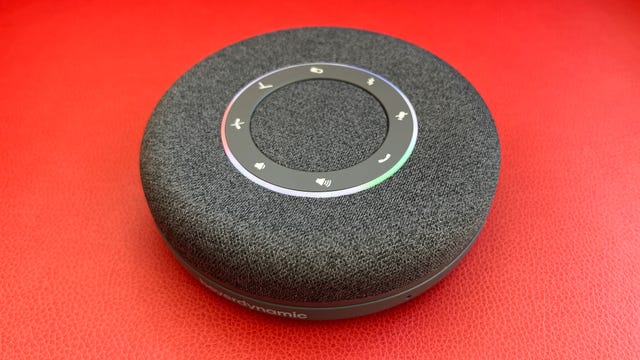
I liked Beyerdynamic’s earlier Phonum speakerphone (see below), which retails for about $100. But the new-for-2022 Space is a slicker product and nice “personal” speakerphone that works well in home office environments. It also has more bass than the average speakerphone and works decently for listening to music, though it doesn’t support the higher-fidelity AAC and AptX codecs — only SBC. If you can afford it, you can wirelessly pair two of them for stereo sound.
The speaker comes in a few different color options and has touch controls on the top along with LED lights that indicate whether you’re connected via Bluetooth, on a call and whether your microphone is muted. You can also connect directly to your computer with the included USB-C cable — the speaker charges via USB-C — and a USB-C to USB-A adapter is included (you can store it in a slot in the base of the speaker, where you’ll also find a threaded tripod mount). Battery life is rated at up to 20 hours, and a 10-minute charge gives you two hours of juice. The speaker is splash-proof and dust-resistant with an IP64 rating.
Callers said I sounded clear and were generally impressed with how I sounded, saying they couldn’t tell I was on a speakerphone. Weighing 354 grams, the speakerphone is quite portable and a carrying pouch is included, While Beyerdynamic describes it as a personal speakerphone, it does have four microphones and is suitable for conference calls with up to six people sitting around it. While it’s a bit expensive at its $179 list price, I do suspect it will come down in price with time.
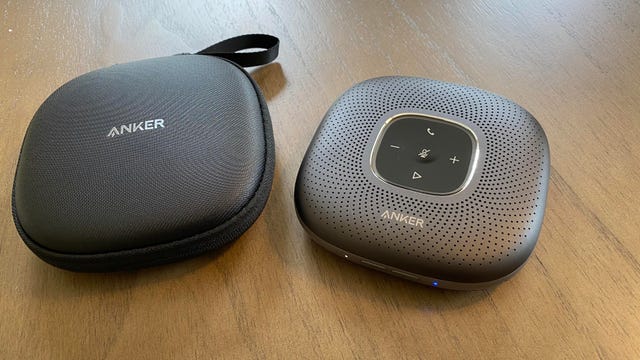
Anker’s PowerConf offers solid performance for the money, with six microphones arranged in a 360-degree array to pick up the voice of up to eight people in a room. This Bluetooth speakerphone charges and connects via USB-C to your computer (if you want to go the wired route) and easily connects to your cell phone and tablet via Bluetooth technology. With an integrated 6,700-mAh battery, you can also charge your devices with the speakerphone. Battery life is rated at 24 hours for call time.
The speaker performed well, with good clarity and similar sound quality to the Jabra Speak 510 (I didn’t compare it to the newer Jabra Speak2 55). Jabra’s Speak 710 delivers a little fuller sound with a little more bass, but that speaker costs substantially more. While this can also be used as a speaker for listening to music or watching movies — and is a significant step up from the built-in speakers on your smartphone or laptop, particularly in terms of loudness — Anker says it’s first and foremost a conference speakerphone. Whether you’re in a large conference room or smaller conference rooms, it can pick up voices anywhere for up to eight people. A carrying case is included.
Note that you can’t connect more than one Bluetooth device to this conference speaker at the same time. It’s also worth noting Anker also makes the newer PowerConf S3, which is currently selling for $100. I have not tried that model but it seems very similar to this one with an updated design.
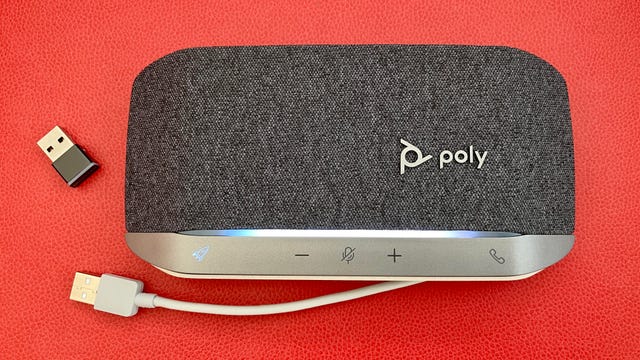
The Poly Sync 20 is available with and without a Bluetooth dongle, and there’s also a Microsoft Teams-certified version. Additionally, there’s a new pink version to support Breast Cancer Awareness that currently costs $75 without the dongle.
It’s unclear if you need the dongle because the speaker has an integrated USB-A or -C cord to plug directly into a computer and charge the device, but the dongle makes for easier pairing.
This has everything you want in a compact but portable speaker phone. Along with the USB-A connector, it has Bluetooth. A protective carrying case and lanyard are also included. There’s also a USB out port for charging a phone. Battery life is rated at up to 20 hours.
Performance was solid. I was able to stand up to about 7 or 8 feet away from the speaker and callers said they could hear me clearly. The speaker puts out a decent amount of sound, so volume wasn’t an issue. It’s also worth noting that the touch button with the rocket icon is programmable using the Plantronics Hub app: You can choose between play-pause music, last-number redial and voice assistant as well as hold/resume call. The Microsoft Teams-certified version adds a Teams button next to the rocket button. That said, any model works with Teams.
I played some music through the speaker and it sounds decent though not great for a compact Bluetooth speaker. As you might expect, it’s strongest in the midrange, where vocals live, so it does well with acoustic music.
The Sync 20 Plus version with a Bluetooth dongle lists for $200 but can be had for less. Poly also has the larger Poly Sync 40 for around $200 and the line-topping Sync 60 is around $450.
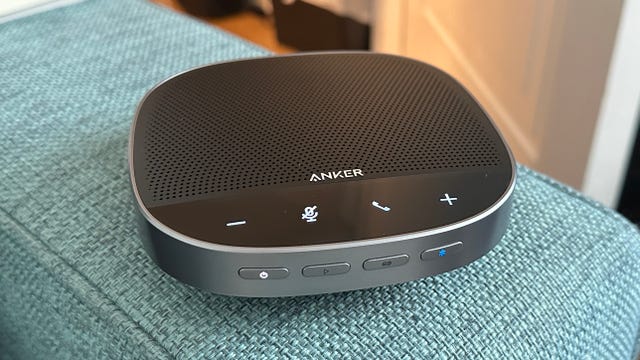
The Anker PowerConf S500 is an attractively designed speakerphone that offers good performance for around $200. It’s equipped with 4 microphones and Anker says a single PowerConf S500 “delivers performance for rooms of up to 12 people, and you can wirelessly pair two of them to increase coverage for up to 20 people.”
While you can connect your phone or computer via Bluetooth, you can also connect the speaker directly to your computer with a USB-C cable. additionally, it comes with a wireless Bluetooth USB dongle (it’s USB-A) for more reliable wireless connections to PCs. It’s nice that you can store the dongle in a slot on the bottom of the speakerphone when you’re not using it. I also liked the included hard carrying case.
I didn’t think this speaker performed quite as well as from a sound quality standpoint as the Jabra Speak 2 55 (see above), but it is well designed speakerphone that delivers solid performance for its price and does have better battery life than the Jabra (16 hours vs. 12 hours).
This used to be Anker’s flasgship speakerphone model. But now it offers the new AnkerWork SR500 ($350) that’s equipped with 8 microphones.
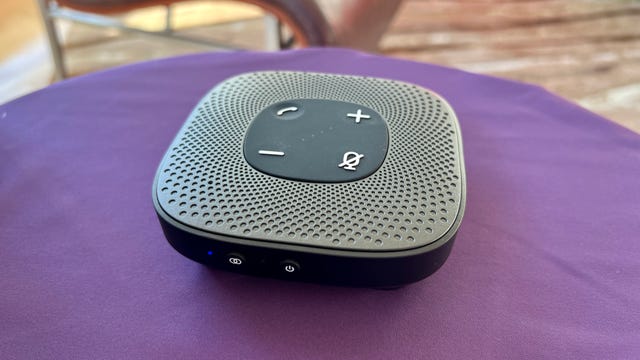
The best things about the Cyber Acoustics Essential Speakerphone are that it’s compact, lightweight and simple to use. Callers said they could hear me clearly, and the speaker outputs a decent amount of volume for its size. That said, my voice didn’t sound as natural as it did with some of the more expensive models on this list.
This is a fairly basic speakerphone, but it offers Bluetooth connectivity along with a USB wired option. It’s definitely easy to slip in a bag. With it carries a list price of $70, you can find it for less than $50 on Amazon.
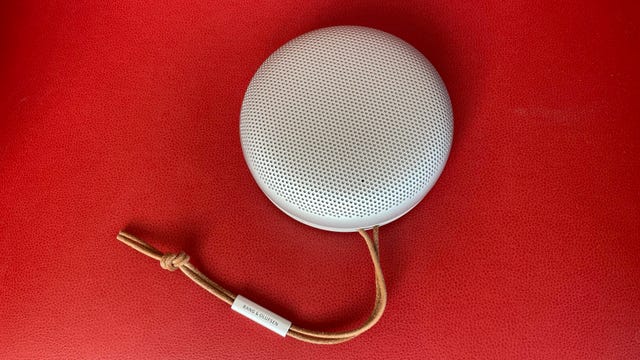
Bang & Olufsen has upgraded its dome-shaped aluminum-clad A1 speaker with improved battery life, better speakerphone performance (it now has a three-microphone array) and slightly improved sound. It’s not only the smallest wireless speaker from the Danish company, but also the most affordable with a list price of $250 (you can get certain colors for over $50 less). While it doesn’t have the more robust speakerphone-centric features of other products on this list, this speaker easily sounds the best for music playback.
The speaker drivers remain the same as those in the previous model, but the Qualcomm chipset that powers the speaker has been upgraded (the speaker uses Bluetooth 5.1), bumping the sound quality up a tad, particularly at higher volumes, with better digital signal processing. It remains one of the best-sounding mini Bluetooth speakers, with richer more tonally balanced sound than other Bluetooth speakers its size — and it should sound good, considering its elevated price point..
It’s also worth noting that the A1 has multipoint Bluetooth pairing so you can connect this to your PC and smartphone at the same time and easily switch back and forth between the two if a call comes in on your phone. Additionally, the speaker is Alexa-enabled, meaning you can activate Amazon’s voice assistant by just saying “Alexa.”
Battery life is rated at up to 18 hours at 50% volume (the earlier A1 didn’t live up to its battery life claims, but this number is more accurate) and if you can afford it, you can link two A1 speakers to create a stereo pair. The speaker is waterproof with an IPX 67 rating that allows it to be submerged briefly in shallow water.
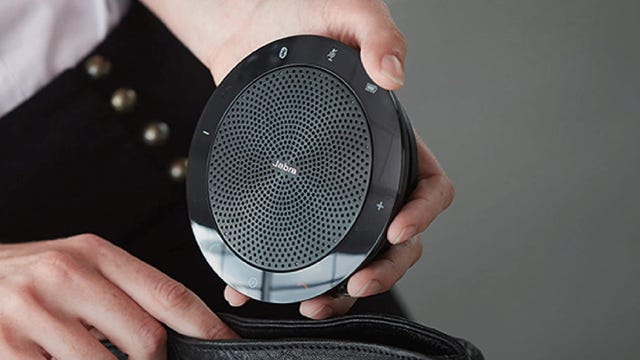
The Jabra Speak 510 wireless Bluetooth speaker, which has been out for a few years and is sometimes discounted to closer to $100, can be connected directly to a computer with a USB cable or wirelessly via Bluetooth. It doesn’t offer as much volume as the step up Speak 710 Bluetooth speakerphone, which costs more than twice as much. Jabra says the speaker is suitable for smaller rooms with coverage for four people in a meeting. This portable speakerphone has a 360-degree omnidirectional microphone and its rechargeable battery will last up to 15 hours of battery life in wireless mode. A carrying case is included.
You can get this model with a UC (universal communications) USB dongle that allows you to have a direct wireless connection with a PC. But the wired USB option is fine, and it offers the same softphone features for Windows PCs or Macs.
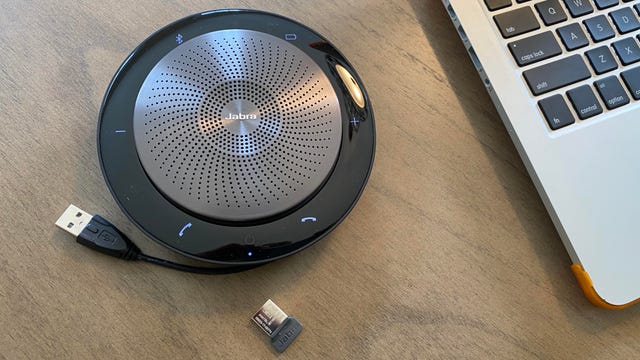
With Jabra’s Speak 710 wireless Bluetooth speakerphone, you’re getting a noticeable bump up in sound and microphone quality from the Speak 510 Bluetooth speakerphone (it is bigger but still compact). While it costs more, if you’re looking for top-notch performance with excellent noise reduction in a consumer-grade speakerphone, the 710 delivers it. Jabra says this is rated for up to six people in a conference room, but you can daisy-chain a couple of these in a larger room to get twice the number of people involved. It also has an integrated USB cable for connecting directly to a computer and includes a UC (universal communications) USB dongle for reliable wireless connections with a Windows PC or Mac without installing any software (there is a companion app for both).
Don’t expect it to sound great for music or movie watching, but it does have more bass than the Speak 510 and the Anker.
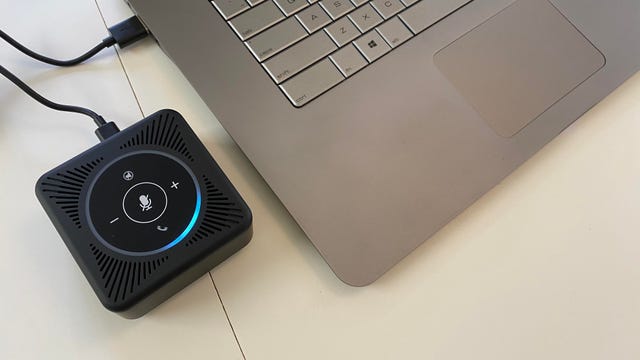
The eMeet M0 is a compact USB speakerphone that connects to your computer with an included USB-A to USB-C cable. No drivers are required — it’s plug and play — but there is no wireless option. It has a four smart microphone array, acoustic echo noise cancellation, noise-reduction technology and is suitable as a conference phone for meetings with up to four people. This conference speakerphone is louder and more clear than your typical laptop speakers and picks up your voice well from several feet away.
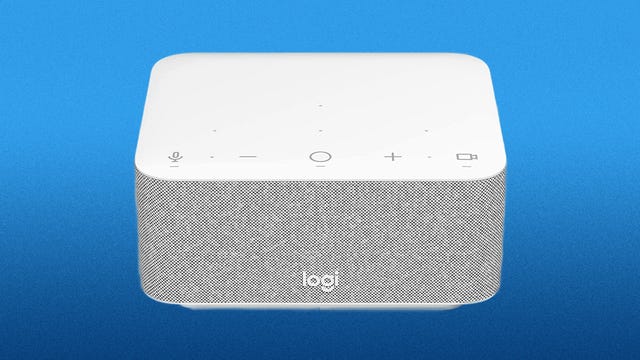
From the front, Logitech’s Logi Dock looks like a small speaker. But look around back and you’ll see that it’s also USB-C docking station with HDMI and Mini Display ports that allow you to connect up to USB peripherals and two monitors (there are three USB-C ports and two USB-A ports). It also has Bluetooth connectivity, so you can wirelessly connect your phone or PC to the speaker.
Needless to say, this is designed to work with Logitech peripherals — I hooked up a Logitech webcam to it — and it offers up to 100 watts of power, so it can charge your laptop and is a good option for those looking to declutter their desks.
It works well as a speakerphone with good voice pickup from its microphones and it has volume control buttons on top of the speaker along with a microphone mute button. Because it’s bigger than your typical speakerphone, it does sound better for music listening than many of the speakerphones on this list. But it’s no substitute for even a modestly priced set of computer speakers, which offer stereo sound.
I think it’s a bit expensive at its list price $400, but it has come down in price in recent months, which is why I’ve added it to the list in 2023.
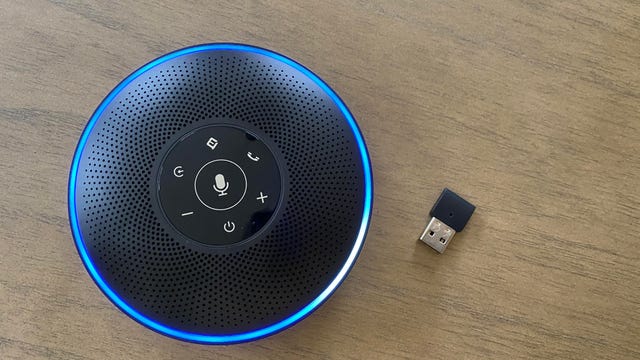
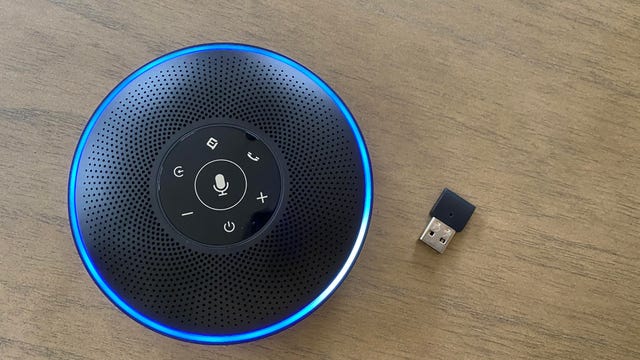
If you can’t afford the Jabra Speak2 75 and are looking for a compact, more “professional” Bluetooth speakerphone, the eMeet M2 costs less than $200, has a strong feature set and performed well in my tests (it plays louder than you’d think for its size). It’s equipped with a four microphone array, acoustic echo along with noise reduction technology and can operate with clear sound in larger rooms with five to eight people participating on a conference call. You can opt to plug the speakerphone directly into a computer (Mac or Windows) with a USB cable or go wireless with the included Bluetooth USB dongle. You can also use Bluetooth connectivity for your smartphone or tablet. A carrying case is included.
More WFH necessities
- 13 Stay-at-Home Essentials for Under $20
- Best Wireless Headphones for 2023
- Fastest VPNs We’ve Tested: NordVPN, ExpressVPN and Surfshark Compared
- Best 32-inch Monitor Deals: Six 4K UHD Displays for Under $450
- Best Laptop for 2023
- The 7 Best Blue Light Blocking Glasses to Prevent Eye Fatigue
- The Best Standing Desk Converters for 2023
- The Best Portable Bluetooth Speaker to Buy for 2023
- Best VPN for Mac for 2023
- Want to Learn to Code? Check Out These 5 Online Coding Courses for Beginners
- 7 Must-Have Ergonomic Upgrades for Your Home Office
- Best Wireless Earbuds and Bluetooth Headphones for Phone Calls
- The Best Wi-Fi Extender for Almost Everybody
Technologies
Six Flags shares decline following deadly roller coaster incident
One person died and several others were injured in an incident involving the Goliath roller coaster at Six Flags Over Georgia, according to reports.
Shares of Six Flags Entertainment declined more than 16% Tuesday following a deadly roller coaster incident at one of its amusement parks in Georgia.
One person died and several others were injured Monday in an incident at Six Flags Over Georgia, according to a statement from Georgia’s Cobb County Board of Commissioners. The board’s chairwoman, Lisa N. Cupid, said that county authorities are working with Six Flags and other partners in the investigation.
According to reports citing local police, the incident occurred on the Atlanta-area park’s 200-foot-tall Goliath roller coaster shortly before 4 p.m. Monday. Riders were later seen being evacuated from the roller coaster after it stopped near the top of the ride, according to the report.
Witnesses told a local news station that they saw a man fall from the roller coaster and strike the ride several times.
In a statement to ABC News, a Six Flags spokesperson said it is cooperating fully with the investigation and had temporarily closed similar attractions across its parks.
Six Flags did not immediately respond to CNBC’s request for comment.
Tuesday’s decline is on pace to be the stock’s worst day since August and puts shares at their lowest level since December 2009. Shares have now fallen by more than 50% over the past year.
Technologies
French supermarket fridges get hacked, heating to 122°F and sparking fires
Hackers targeted hundreds of French supermarkets in a large-scale cyberattack, causing refrigerators to overheat, spoiling food, and sparking fires.

Hackers targeted hundreds of French supermarkets in a cyberattack that reportedly caused refrigerators and freezers to overheat, spoiling food and sparking fires.
Fridges at French supermarket chains Carrefour, Monoprix, the Les Mousquetaires-owned Intermarché, and Coopérative U, among others, all saw fridges heat up to as much as 50 degrees Celsius (122 degrees Fahrenheit) overnight, Reuters reported Monday.
Coopérative U’s CEO, Dominique Schelcher, confirmed that cyberattacks had affected “refrigeration production facilities of several stores.”
“Attacking equipment that is essential to the preservation of fresh products and the food supply of the French people is extremely serious and unprecedented. It is unacceptable,” Schelcher said in a LinkedIn post.
CNBC has reached out to Carrefour, Monoprix, Intermarché, Coopérative U and E Leclerc for comment but did not immediately hear back.
Felix Aime, a senior cyberthreat intelligence analyst at Sekoia Threat Detection and Research, said the attack affected several European countries, including Spain, Portugal, Poland, Germany and Belgium, according to the Reuters article.
“I strongly condemn the cyberattack targeting food products at @intermarche @CooperativeU @Leclerc,” European Commissioner for Agriculture and Food Christophe Hansen said in a post on X on Monday.
“Food security requires more attention at all levels. Because the weaponization of food has become a reality.”
AI enhancing cyberattacks
Les Mousquetaires said it was expecting the damages, which affected around 180 stores, to reach “several million euros in losses,” in an email to CNBC.
It said some fresh and frozen food displays have been out of service after the cyberattack affected one of its service providers responsible for managing refrigeration systems inside some stores.
“Intermarché and Netto have taken all necessary precautions to remove and dispose of any affected products as quickly as possible, to ensure consumer safety,” the Les Mousquetaires spokesperson said. “In some stores, the overheating of equipment resulted in smoke, but no fires have been reported.”
They’re now awaiting findings from a court-appointed bailiff and insurance experts to get more precise figures on damages.
Stop & Shop parent Ahold Delhaize
This comes amid a broader wave of cyberattacks and cybercrimes, which experts are warning are being enhanced by artificial intelligence. British online fashion retailer Asos experienced a cybersecurity breach last week which revealed some customers’ personal information.
Meanwhile, a small power plant in the U.K. was shut down for four days in July after a cyberattack which was suspected to be linked to Iran.
Interpol’s global chief information security officer, Bjorn R. Watne, recently told CNBC that AI can be used to target multiple victims at once, and is increasing the scale and speed of cyberattacks. “It’s an evolution and not a revolution.”
Correction: Bjorn R. Watne is global chief information security officer at Interpol. An earlier version misspelled his name.
Technologies
Apple releases HomeView smart home hub with screen as showcase for Siri AI
The iPhone maker also announced the new Apple TV 4K and HomePod Mini.
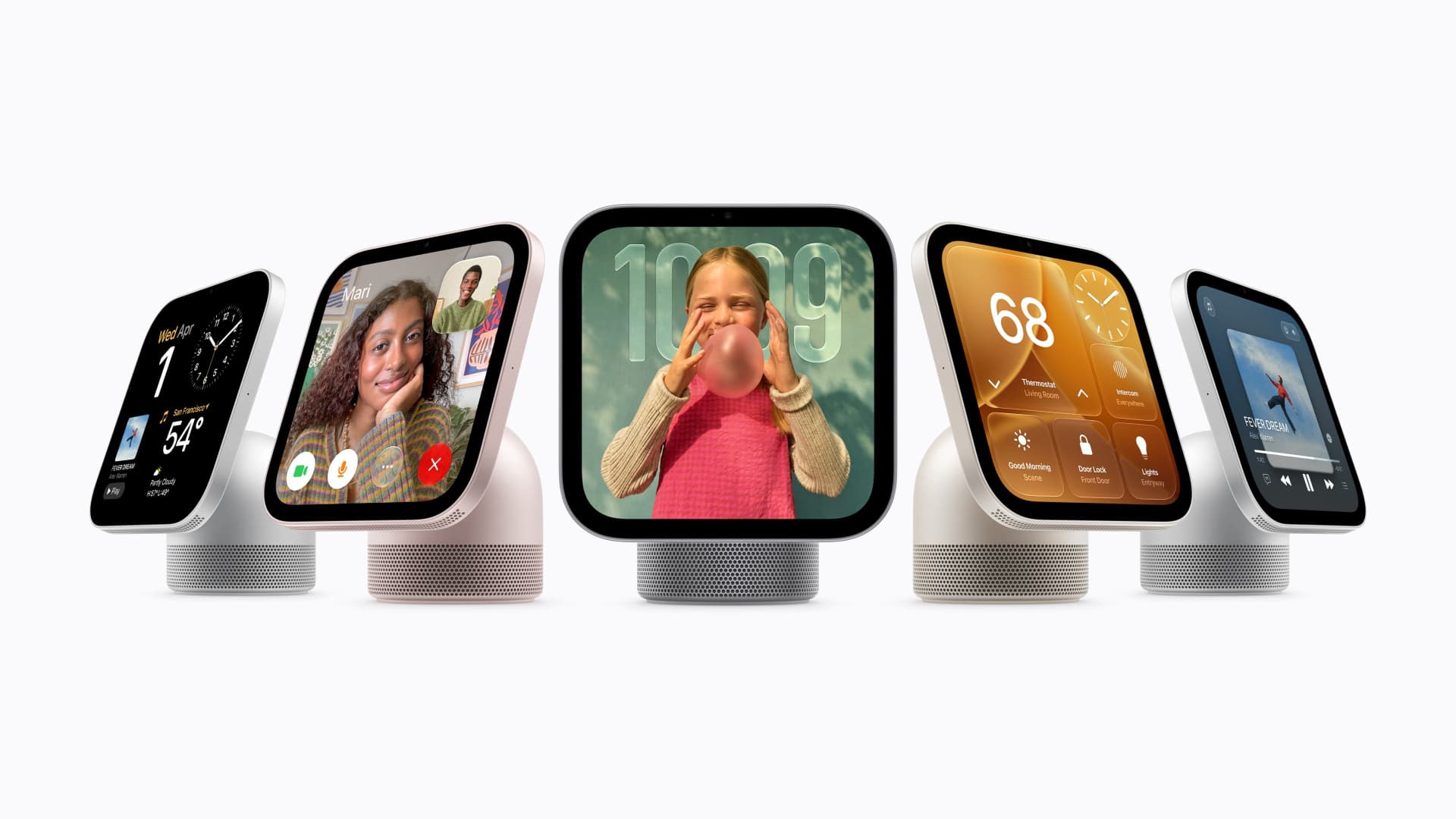
Apple on Tuesday announced a new home hub called HomeView.
Apple said the device with a 7-inch screen was designed to be mounted on a wall or placed on a table. It’s designed for multiple people in a household, and will recognize the user by their face to display pertinent information. It starts at $299 and ships on Nov. 13.
Tuesday’s launch event is the second under new CEO John Ternus, who took over from Tim Cook in September. Last month, Apple announced new models of its most important product, the iPhone, including a foldable model called the Duo that retails for nearly $2,000.
Apple also announced new Apple TV and HomePod hardware on Tuesday. The new Apple TV 4K costs $299 and has a redesigned remote that can play a sound if it is lost. Apple’s HomePod Mini speaker comes in new colors and costs $149, a slight increase over its previous $129 price.
The products announced Tuesday are less critical for Apple than the iPhone, and investors remain focused on iPhone sales, but the accessories were positioned on Tuesday as a showcase for the company’s new Siri abilities released last month.
Apple said that HomeView features Siri AI, which can answer a broad range of questions. Users will be able to converse with Siri, and their conversations will continue on their iPhone or iPad. It has a built-in speaker for playing music.
“It recognizes your face to shift from a household screen to your own experience, fills the room with incredible sound, keeps you connected to the people who matter most with FaceTime, and makes it easy to control your smart home,” Apple’s chief marketer Greg Joswiak said in a statement.
Apple said that HomeView will show information from the Messages, Photos, Calendar, and Reminders apps based on who is using the device, powered by Apple Intelligence. It can also be used to make FaceTime calls and as a digital photo frame. It’s equipped with an Apple A18 chip. It supports up to six users.
But while Apple has dabbled in home products and platforms in the past, Tuesday’s announcement shows Apple is making its home products a higher priority under Ternus.
Apple said on Tuesday that its new products, including HomeView, can be used as a smart home hub, coordinating notifications and actions in the home and working with a range of products, including new locks, doorbells, and cameras from LG Electronics and Schneider Electric.
Apple’s integration with the smart home is not just about sales but also helps further lock customers into its own ecosystem. People who use multiple Apple products and connections are less likely to switch to an Android phone.
HomeView can also become a smart home dashboard, Apple said. It can be used to view camera feeds, adjust the thermostat, or lock connected doors around the house.
Apple said that setting up a new smart home device takes one tap from the user’s iPhone.
Tuesday’s launch shows Apple’s confidence as it launches new product categories. But the broader consumer electronics industry has been dealing with price increases and demand deterioration related to component shortages in memory and storage. It also comes as new boss Ternus has reportedly pushed the company to release products faster.
Apple’s new Apple TV 4K got a price hike from $199 to $299, and comes after a similar price increase earlier this year, after Cook said that memory costs for Apple were unsustainable.
-
 Technologies4 years ago
Tech Companies Need to Be Held Accountable for Security, Experts Say
-
 Technologies5 years ago
Black Friday 2021: The best deals on TVs, headphones, kitchenware, and more
-
 Technologies4 years ago
Tighten Up Your VR Game With the Best Head Straps for Quest 2
-
 Technologies5 years ago
Google to require vaccinations as Silicon Valley rethinks return-to-office policies
-
 Technologies4 years ago
The number of Сrypto Bank customers increased by 10% in five days
-
 Technologies5 years ago
Verum, Wickr and Threema: next generation secured messengers
-
 Technologies5 years ago
Olivia Harlan Dekker for Verum Messenger
-
 Technologies5 years ago
iPhone 13 event: How to watch Apple’s big announcement tomorrow