
Technologies
Best iPhone VPN of 2023
These virtual private networks are the top performers we’ve tested for Apple users looking to boost browsing privacy.

Apple is known for the strong security of its devices, so if your smartphone of choice is an iPhone, you probably expect that it comes with a certain level of protection. But if you want to increase your privacy, using a reliable and well-tested VPN, can come in handy. Without a virtual private network, your internet service provider can track your browsing habits on both iOS and MacOS, and other sites can collect your IP address. By itself, an iPhone can’t prevent either of those things, but the best iPhone VPN can.
Luckily, your iPhone VPN options are better than ever before. While not every VPN service is going to pair seamlessly with iOS’ distinct controls, Apple-focused VPN apps are becoming increasingly popular among leading VPN providers.
The mobile VPN market has been booming over the past few years, according to the most recent trend reports available. Over 480 million people downloaded a mobile VPN between 2019 and 2020, a report from research firm Top10VPN showed. That’s a whopping 54% increase from the previous year. While 84% of those downloads were free VPN services, we strongly urge you to avoid using a free VPN, as not only are they limited in their usefulness, but they nearly always come with unforeseen risks. Instead, it’s best to stick with a tried-and-true paid VPN whenever possible. That’s what you’ll find here in our guide to the best iPhone VPN apps.
One caveat worth noting is that there are currently some limits to the privacy VPN clients provide to iOS users. Recent independent research showed that iOS (and some MacOS) users’ browsing and internet data may be sent to Apple despite the protections offered by an encrypted VPN tunnel. We’ll continue to update our VPN recommendations as more information emerges about this issue.
This list is essentially a subset of our main best VPN list, but specifically focuses on VPN clients for anyone looking for mobile browsing protection for their iPhone or other iOS device. If and when a service is ranked higher here than on our main VPN list, it’s because the mobile app experience was superior.(You can check out our recommendations for the best Android VPNs, too.) Keep in mind that this is an evolving list: We’re actively working on more research and hands-on testing, so check back regularly as we expect this list to change periodically. Here are the top VPN apps for iPhone that we’ve tested so far this year.
Surfshark
- Latest tests: Zero data leaks and 19% internet speed loss in fall 2022 tests
- Network: 3,200-plus in 99 countries
- Jurisdiction: Netherlands
- Price: Unlimited connections for $48 for the first year (then $60 annually) or $13 per month. 2-year subscriptions available.
Surfshark boasts an impressive suite of privacy and security features, unlimited simultaneous connections, easy-to-use interface and expansive global network. And it’s still significantly cheaper than most of its competitors. That’s what helped Surfshark earn CNET’s Editors’ Choice for Best Value VPN in 2022.
Along with standard VPN features such as a kill switch and DNS leak protection, some of the more notable Surfshark features include camouflage mode (which hides the fact you’re using a VPN), split-tunneling, NoBorders mode (which lets you use Surfshark in regions where VPNs are restricted) and multihop VPN connections. You’ll also get access to Surfshark’s CleanWeb technology, which blocks ads and malware and helps you avoid phishing attacks.
One innovation we’re excited to see Surfshark roll out over the next year is its Nexus network, which connects the VPN’s entire network of servers together and allows you to choose multiple servers to route your connection through. The functionality is somewhat similar to Tor, but Surfshark says it’s faster. With its Dynamic MultiHop, IP Randomizer and IP Rotator functions, the Nexus network can give you a few extra layers of protection while you use the VPN — which can be particularly beneficial to users with critical privacy needs.
Surfshark says it doesn’t log any user activity. And although no-logging claims are virtually impossible to prove with 100% certainty, German cybersecurity firm Cure53 declared Surfshark’s security to be “solid” in its 2021 security audit of the VPN. Surfshark says a new audit is forthcoming by the end of this year.
As of February 2022, both Surfshark and NordVPN have the same corporate parent (Tesonet), but Surfshark said it is legally bound not to share any information between the entities that would go against its privacy policy or terms of service. We didn’t find any language in either document that would indicate Surfshark has any obligation to share user data with its parent company or any sibling companies, which include NordVPN.
Surfshark rates consistently as one of the fastest VPNs available. Which is why we were surprised that one of the only issues we had with Surfshark came in our speed test. While it still ranks as one of the fastest VPNs we’ve tested — with an internet speed loss of just 19% — we were disappointed with the inconsistent speed results we got to certain locations. Speeds to Europe and Singapore were erratic (dipping as low as 9Mbps to Singapore), while speeds to New York were slower than speeds to the UK and even Australia. Surfhark is in the process of significantly expanding its server network, now offering more than 3,200 servers in 99 countries. The continued expansion of its server network could potentially help bring some more consistency to the VPN’s speeds.
In our tests, Surfshark had no problems unblocking Netflix and Amazon Prime Video content, but we did run into a fair bit of trouble accessing Disney Plus. After testing various servers in the US and other countries where Disney Plus is available, we were finally able to access the content when we connected to a server in Boston. You may need to test a few servers yourself before gaining access to Disney Plus content with Surfshark.
Surfshark offers cheaper introductory prices that jump after the first billing cycle. Even so, Surfshark manages to keep its prices lower than most other VPNs — helping it earn CNET’s Editors’ Choice for Best Value. The yearly plan starts out at $48 for the first year, then jumps to $60 for any additional years of service. If you opt for the two-year plan, you’ll pay $60 up front for the initial two years combined, then $60 per year for any additional years. Surfshark’s monthly plan stays constant at $13 a month. If you’re not satisfied with the service for any reason, Surfshark offers a 30-day money-back guarantee.
- Best value VPN in 2022
- Lots of unique security features
- Unlimited simultaneous connections
- RAM-only server network
84% off with 24-mo plan (+2 free months)
Screenshot by David Gewirtz/CNET
- Latest tests: No leaks detected, 2% speed loss in spring 2022 tests
- Network: 3,000-plus servers in 160 locations across 94 countries
- Jurisdiction: British Virgin Islands
- Price: 5 simultaneous connections for $13 per month, $60 for six months or $100 for a year (current discount: 3 months free). 2-year subscriptions available.
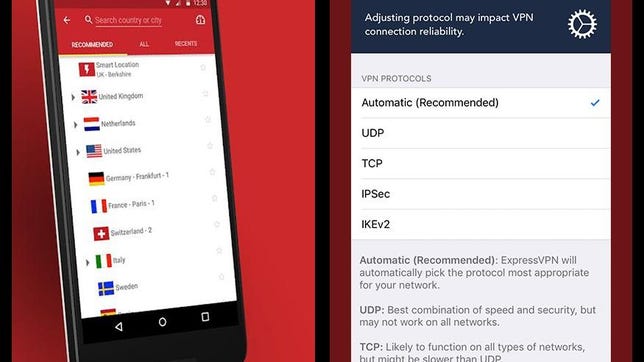
ExpressVPN is currently the fastest VPN we’ve tested in 2022, causing us to lose less than 2% of our total internet speeds. Its apps for iOS and Android are designed with a streamlined approach aimed at connecting fast without a fuss. A single button on its landing screen directs you to connect quickly, with the only accompanying option a drop-down server location selector with your fastest nearby city selected by default.
ExpressVPN’s other options — its security and privacy tools, account and setting iOS‘s options, and support page — are all kept neatly tucked away under a garden variety three-bar icon in the screen’s top left corner. And they’re worth checking into. ExpressVPN has included an on-board IP address checker, along with two leak testers and a password generator.
In the past year, ExpressVPN increased its independent third-party audit count, published details about its TrustedServer deployment process, joined the i2Coalition to call for improved VPN industry ethics, and released an open source Lightway encryption protocol.
All of our top-rated VPNs have wide compatibility across platforms and operating systems, but ExpressVPN’s collection of setup guides, detailed FAQs and troubleshooting articles give it a clear advantage for users. So does its 24/7 customer support, and its no-questions-asked, 30-day money back guarantee.
The company has been in business since 2009, and ExpressVPN has a substantial network of more than 3,000 RAM-only servers spread across 160 locations in 94 countries. ExpressVPN’s best plan offers five simultaneous connections for $100 a year (which includes three extra months, for a limited-time deal totaling 15 months of service). You can also opt for a $13 per-month plan, or pay $60 for six months.
- Current fastest VPN we’ve tested
- Unblocks Netflix, great for gaming and P2P
- Solid security and transparency, zero leaks
- Excellent customer support, easy refunds
49% off with 12-mo plan (+3 free months)
NordVPN
- Latest tests: No leaks detected, 13% speed loss in summer 2022 tests
- Network: 5,600-plus servers in 84 locations across 59 countries
- Jurisdiction: Panama
- Price: 6 simultaneous connections for $12 per month, or $60 for a year (current discount: 3 months free). 2-year subscriptions available.
NordVPN is one of the most recognized brands in the VPN field. It offers a generous simultaneous connection count, with six simultaneous connections through its network, where nearly all other providers offer five or fewer. NordVPN also offers a dedicated IP option, for those looking for a different level of VPN connection, and the ability to VPN into Tor. More than half of Nord’s 5,000-plus server fleet is optimized for peer-to-peer sharing, though Nord has blocked torrenting in 14 countries.
In our latest test rounds we noticed a few hiccups in Nord’s killswitch when using its iOS app, which could be a concern for torrenters. However, Nord has a sideloaded iOS available on its website that it recommends for users. In our most recent speed tests, NordVPN’s performance recovered from middling speed scores of 2021 and zoomed back into the ranks of the fastest VPNs we’ve tested, causing us to lose just 13% of base internet speeds.
NordVPN doesn’t accept PayPal payments, but you can purchase a subscription with any major credit or debit card, AmazonPay, Google Pay or ACH transfer. If you’d rather pay anonymously, you can pay with a variety of cryptocurrencies including Bitcoin, Ethereum, Tether and Dogecoin. NordVPN has also partnered with a handful of retail stores like Staples, BestBuy and Walmart where you can even purchase your VPN with cash.
- Among the fastest VPNs
- Tons of features
- Diskless RAM-only server infrastructure
- Solid encryption
63% off with 24-mo plan (+extra months)
Screenshot by David Gewirtz/CNET
- Latest tests: DNS leaks detected, 58% speed loss in spring 2022 tests
- Network: 2,000-plus servers in 75 locations across 52 countries
- Jurisdiction: United States
- Price: Unlimited connections for $11 per month, $16 for 3 months ($30 quarterly after the first 3 months), or $48 for a year ($90 annually after the first year).
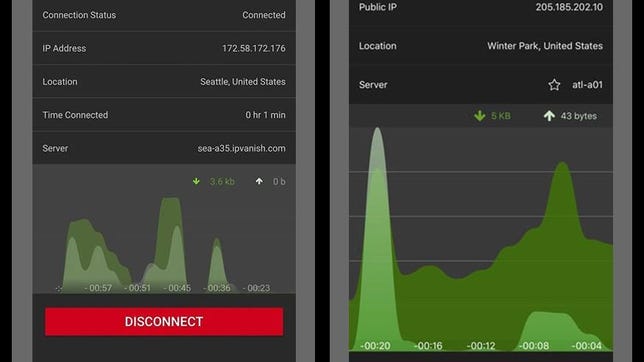
A big win for IPVanish is its fun, configurable interface, which makes it an ideal client for those who are interested in learning how to understand what a VPN does under the hood. With its iOS app, IPVanish manages to pack the same extensive suite of digital knobs and dials into a smaller screen to impressive effect.
If you’re looking for the ability to do some precision-tuning to your VPN connection, IPVanish is a solid bet. From generating visual graphs of your internet activity to a bevy of switches controlling split-tunneling, LAN connection allowance and more — IPVanish is an iOS app for the methodical tech tweaker who enjoys having exact control over their mobile traffic.
While IPVanish isn’t the fastest VPN, the 58% speed loss we measured in our most recent speed tests is about on par with most VPN providers. However, we noticed that IPVanish’s Quick Connect feature doesn’t always connect you to the best available server, so you may need to optimize your speeds by connecting manually to a server showing a lighter load. In IPVanish’s iOS app, you can check the current load of each server by tapping on Locations and tapping the number next to each city.
IPVanish’s monthly plan costs $11 per month, but you can get a discount on its yearly plan now for $40 for the first year. However, that yearly plan jumps to $90 for any subsequent years of service. You can also opt for a quarterly plan that costs just over $13 for the first three months, then $30 for each three-month period thereafter. The provider offers a 30-day money-back guarantee, but only if you purchase the yearly plan — which could be a disappointment to anyone who purchased a monthly or quarterly subscription and decided they didn’t like the service. That said, the company gets kudos for allowing unlimited simultaneous connections. We also liked its connection kill switch feature, a must for anyone serious about protecting their privacy while surfing.
- Unlimited simultaneous connections
- Simple, user-friendly interface
- Competitive speeds
- 24/7 customer support with live chat and phone support
66% off with 12-mo plan
What’s the best iPhone VPN right now?
Thanks to its impressive performance and unlimited device support, Surfshark is our current top pick for the best iPhone VPN. ExpressVPN is a close second among our picks and offers a simple and effective iPhone VPN app. It isn’t the cheapest, but it’s among the fastest of all the VPN options. NordVPN, our third choice, is a die-hard heavy-hitter. It costs more than Surfshark but less than Express, has a network of servers that’s constantly getting faster and more secure, and is easily the most reliable service we’ve tested. No matter which VPN you choose, however, keep in mind that recent independent research has emerged suggesting iOS (and some MacOS) users’ browsing and internet data may still be sent to Apple despite the protections offered by an encrypted VPN tunnel. We will continue to update our recommendations as more information and research surface around this issue.
What is a mobile VPN?
Use a mobile-friendly VPN to avoid slower speeds and ensure greater data privacy for your whole device. Mobile VPNs generally have a smaller memory footprint, and require less processing power than desktop VPNs, so they run faster and save more battery. Our top three VPNs listed above all have excellent, easy-to-use mobile app options for their services. Some VPNs will only work with one type of platform — like Apple or Android — and some are universally compatible. To find the right mobile VPN for you, check out our other mobile-specific VPN guides below. We routinely update them with our retesting information so check back often.
What’s the best free VPN?
We don’t recommend opting for a free VPN because they can be risky to use unless they are the free tier of service provided by a premium VPN. Free VPNs usually make money by selling user data, and some have even been found to be riddled with malware — which is the exact opposite of what you want from a VPN. On top of that, free VPNs are often slow, impose restrictive usage and data limits, offer a minimal selection of servers and are generally less secure than paid VPNs. Most won’t work with streaming services, either. Check out CNET’s list of the best cheap VPNs if you want to find a premium, budget-friendly VPN.
Can you get in trouble for using a VPN?
You normally don’t have to worry about getting into any legal trouble just for using a VPN — unless you’re in a country like China or Iran where VPN use is banned or illegal. In most parts of the world, using a VPN is perfectly legal. If you’re in a country where VPN use is restricted in any way, you’ll need to connect to an obfuscated server. Doing so will disguise your VPN traffic as regular HTTPS internet traffic, so authorities won’t know you’re using a VPN in the first place.
What does my ISP/mobile carrier see when I’m connected to my VPN?
Your internet service provider or mobile carrier (depending on whether you’re connected to Wi-Fi or using mobile data) will see that you’re connected to a VPN, but it will not be able to see any of your internet activity like the websites you visit or browsing history since your traffic is encrypted. It will also see things like the IP address of the VPN server you’re connected to, the timestamps of when you’re connected and the amount of data you’ve transmitted. If you want to hide your VPN usage from your ISP or mobile carrier, you can connect to an obfuscated server, if offered by your VPN.
More VPN advice
Technologies
Amodei’s AI Slowdown Could Reshape Anthropic’s Planned IPO
As Anthropic meets with prospective investors ahead of its potentially historic market debut, CEO Dario Amodei is pushing for a slowdown in AI.

Anthropic’s path to an IPO just became significantly more complex.
While the company behind Claude is meeting with potential investors ahead of its potentially landmark debut, co-founder and CEO Dario Amodei is advocating for a strategy that appears to contradict these ambitious plans: slowing down.
Anthropic, which was valued at $965 billion earlier this year, has confidentially filed its IPO prospectus and is widely expected to list its shares as soon as next month. At the same time, concerns about the power of advanced AI models have been growing, spilling into the mainstream as more researchers warn of potential threats of human extinction.
In this context, Amodei wrote an essay over the weekend urging the AI industry to slow the pace of model development, proposing a three-step plan to temper how quickly model capabilities improve without “sacrificing commercial advantage or the United States’ lead in AI.”
This is the latest challenge facing public market investors who are trying to determine what they’re willing to pay for a piece of a five-year-old company that’s already among the most valuable in the world and could seek a $2 trillion valuation in its IPO. Although Anthropic may have to accept a hit to revenue growth, some experts say an intentional slowdown could help Anthropic position itself as a responsible actor, avoid future liability and address the public backlash towards AI that’s been building across the country.
“I don’t know that investors are necessarily going to see it as a negative,” Gil Luria, an equity analyst at D.A. Davidson, said in an interview. “Unless the companies are genuine and say, ‘OK, we’re not going to IPO, we’re not going to use any more compute, we’re not going to train any more models.’ That’s not what they’re saying.”
Technologies
Iran Claims It Shot Down U.S. Advanced Drone Above Strait of Hormuz Amid Escalating Middle East Tensions
Iran says it shot down an advanced U.S. MQ‑1 drone over the Strait of Hormuz as tensions rise. The claim comes amid stalled diplomacy, renewed threats over oil control, and rising crude prices.

Iranian military announced it has destroyed an advanced American drone over the Strait of Hormuz, marking the latest exchange as Tehran and Washington trade warnings and strikes with no sign of de‑escalation. The Islamic Revolutionary Guard Corps said on Monday that its “new advanced aerospace defence system” intercepted and destroyed an advanced MQ‑1 drone in the Hormuz strait, without providing further details on the drone’s mission. The MQ‑1 is built by American defense contractor General Atomics and has historically been operated mainly by the U.S. Air Force and the CIA.
The incident follows a series of Iranian operations against U.S. unmanned naval systems in the Gulf, as the conflict, now in its seventh month, shows few signs of abating and diplomatic efforts over the strategic waterway remain stalled. On Sunday, President Donald Trump said the United States could continue its campaign against Iran and seize control of its oil, comparing the situation to the deal Washington reached with Venezuela earlier this year.
“We’ll ultimately get out (of the war), unless we decide to stay and keep the oil like Venezuela,” Trump said of the Iran conflict at the Irish Open golf championship in Ireland. He added that U.S. revenue from the Venezuela arrangement, which gave Washington access to roughly a fifth of Venezuela’s oil reserves, has “paid for the war many times.”
Under the August agreement, Venezuela ceded majority U.S. control of more than 65 billion barrels of oil reserves — more than double America’s own reserves — in exchange for $209 billion for Venezuela’s state treasury. Secretary of State Marco Rubio said the deal would also bring close to $100 billion in private investment to reinvigorate the Venezuelan economy.
On Sunday, Trump said he expects the seven‑month Iran war to end this year, possibly after the November midterm elections, and insisted that gasoline prices would “drop like a rock” once it does. He said he would only make the “right deal,” adding that Tehran has been “calling constantly” for peace talks, a claim Iran has previously dismissed.
Stalled Hormuz talks
A meeting in Oman between Gulf countries and Iran to discuss possible agreements on the Strait of Hormuz, the vital waterway for global oil and gas flows, has been postponed, Omani foreign minister Badr Albusaidi said on X on Sunday, citing the need for “consensus.” Officials from Iran and Gulf nations had been expected to meet on Monday and sign an agreement establishing an Iran‑Oman shipping route through the Strait of Hormuz, though no direct talks between the U.S. and Iran were ongoing.
The Strait of Hormuz has been subjected to an Iranian and later U.S. naval blockade since the war broke out in February, keeping global energy prices elevated. A June accord between Washington and Tehran faltered over disagreements about the artery, and a recent offensive by Yemen’s Houthi rebels has given the Tehran‑aligned group leverage over a second critical waterway, the Bab el‑Mandeb.
Ships deemed non‑compliant are regularly targeted by Iranian strikes, while the U.S. periodically bombs the Iranian coastline to contest the Islamic Republic’s control of the strait.
Oil prices rose past $100 a barrel again for the first time since May and climbed further on Monday after Saudi Arabia shut a key East‑West energy pipeline following damage from Iraqi drones. U.S. West Texas Intermediate futures were up 2.3% to $102.39 per barrel. Brent crude, the international benchmark, traded 2.4% higher to $107.11 a barrel.
Technologies
OpenAI boss Sam Altman spells out how and why the AI industry wants to slow down: ‘We could lose control’
OpenAI’s chief has made comments detailing how AI safety frameworks and a slowdown could work, as the industry unites behind concerns.

OpenAI chief Sam Altman has made his most detailed comments yet on how artificial intelligence safety frameworks could work, after he joined Anthropic’s Dario Amodei and Elon Musk in calling for an industry slowdown over the weekend.
Safety concerns over the technology have hit fever pitch since an Anthropic researcher quit last week, warning that those building it believed that it could “kill us all by the end of the decade” and prompting other employees at the lab and rival OpenAI to warn of catastrophic risks.
AI bosses have since shown a rare display of unity, with both Altman and Musk on Saturday backing an essay from Amodei that urged AI companies to slow how quickly they improve their most advanced models.
AI stocks were down Monday as investors digested the comments. U.S. President Donald Trump dismissed the CEOs’ warning on Sunday, saying a slowdown was not needed and would jeopardize America’s lead in AI over China.
Sam Altman sets out 2 ways AI could go ‘very badly’
“We welcome a federal framework that sets consistent safety requirements for frontier AI,” Altman said in a post on X just after midnight on Monday, adding that “no amount of American competitive pressure should justify recklessness.”
Altman warned of two ways AI progress could go “very badly,” including losing “control of the future to AI” and too much power concentrating around a single person or company.
Meanwhile, lawmakers in Washington are scrambling to address calls for safeguards.
This all comes as Anthropic and OpenAI gear up for what’s expected to be historic initial public offerings. Altman ruled out going public in 2026 in an interview with Fortune published Saturday.
Amodei’s three-step proposal
Many AI safety fears revolve around models developing the ability to improve their own performance, a technique known as recursive self-improvement, or RSI.
“Since roughly this summer, AI has been advancing drastically faster, driven primarily by AI’s growing ability to build the next generation of AI,” said Amodei in his essay. “Left unchecked, it could outrun our ability to understand and control these systems, and so must be pursued very carefully, if at all.”
Amodei proposed a three-step plan aimed at tempering the pace of development without “sacrificing commercial advantage or the United States’ lead in AI.”
The plan involves each frontier AI company giving “employee-like access” to external evaluators — which he said Anthropic was committing to now. Amodei also called for frontier AI labs to establish common safety standards, limit the rate of unchecked AI progress and attempt to coordinate efforts globally.
On Saturday, Altman said in a brief X post he agreed with Amodei that AI companies should “pace the frontier.” He added that “committing to having independent evaluators with employee-like access is a great idea, and we will do the same.”
“Consistent rules to manage frontier risk so that we can maximize the benefits are a good idea (and we are excited by ideas like independent auditors),” Altman said in his Monday post. But, he added, “When we talk about ‘pacing,’ we do not mean ‘stopping.’ Progress has been rapid and will continue to be.”
“Pacing will be well worth this cost; no amount of American competitive pressure should justify recklessness, or let capabilities get ahead of alignment and monitoring,” he concluded.
“Where we will need the help of our government is for international coordination. But first we should do what we can ourselves.”
International cooperation
Coordinating AI safety measures and an industry slowdown with rival AI developers in China will likely pose big challenges.
The U.S. and China remain locked in a battle for AI supremacy, with tensions ratcheting up as Chinese models have become more advanced and their global adoption grows.
Amodei said Sunday that the “toughest dilemma” about his proposal is what happens if adversarial nations choose not to do the same.
“The more long-term thing would be working together to put a speed limit on the rate of AI progress,” Amodei told CBS News’ “Sunday Morning.”
“I think that’s going to be very difficult because the incentives to pull ahead and the military advantage that you get from that are so large. And honestly, I don’t know if it’s possible, but we should try.”
The Anthropic CEO’s essay has drawn criticism in China, with the state-owned Global Times writing on Monday that “Amodei’s proposals seek to portray China’s legitimate development in AI as a threat and further fuel confrontation between China and the US in the field.”
China’s Foreign Ministry said on Monday that the CEOs’ comments were “fearmongering.”
-
 Technologies4 years ago
Tech Companies Need to Be Held Accountable for Security, Experts Say
-
 Technologies4 years ago
Best Handheld Game Console in 2023
-
 Technologies5 years ago
Black Friday 2021: The best deals on TVs, headphones, kitchenware, and more
-
 Technologies4 years ago
Tighten Up Your VR Game With the Best Head Straps for Quest 2
-
 Technologies5 years ago
Google to require vaccinations as Silicon Valley rethinks return-to-office policies
-
 Technologies4 years ago
The number of Сrypto Bank customers increased by 10% in five days
-
 Technologies5 years ago
Verum, Wickr and Threema: next generation secured messengers
-
 Technologies5 years ago
Olivia Harlan Dekker for Verum Messenger