

Technologies
Inflation on many everyday items was entirely due to tariffs, NY Fed says
Tariffs added 2.9 percentage points to inflation in 67 categories of goods by February 2026, researchers at the New York Federal Reserve found.

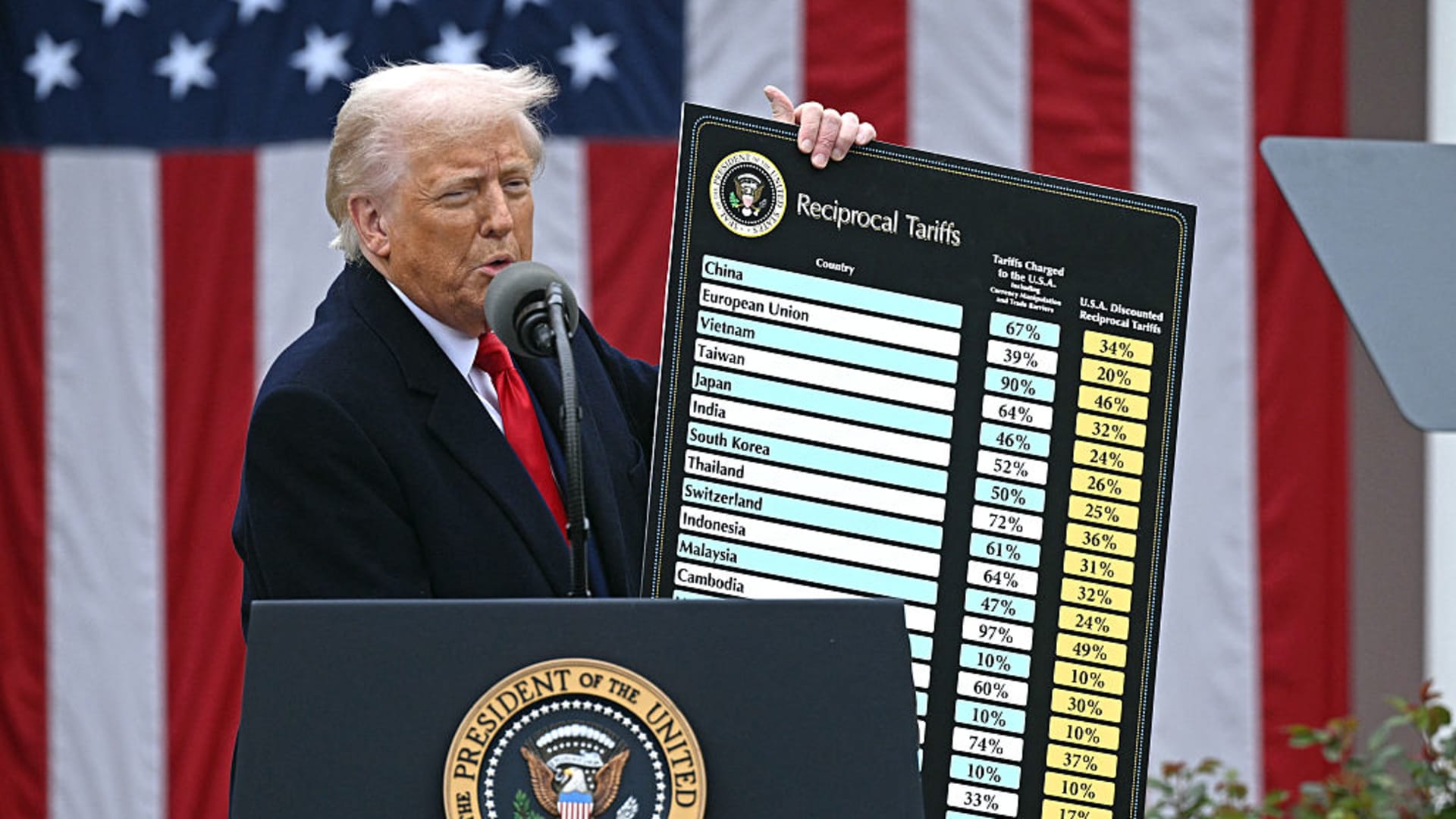
The cost of many everyday items would have declined last year and early this year without President Donald Trump’s tariffs, according to the New York Federal Reserve.
The cost of 67 categories of goods was 2.9 percentage points higher as of February thanks to tariffs, according to a paper from a team of researchers at the central bank’s New York arm.
Without the levies, the team found that prices for the products they studied would have pulled back by almost 1%.
The New York Fed’s report offers the clearest evidence yet of the impact of Trump’s tariffs — a core policy of his most recent campaign and second term in the White House — on consumers’ wallets. Economists had widely expected his levies to push up prices, though the precise effects had been hard to estimate due to the changing nature of the policy and the lack of transparency on how companies set their prices.
The researchers didn’t say which 67 types of goods they evaluated.
For each percentage point increase in the average tariff, the team said that consumer goods prices were higher by roughly a quarter of a percent a year later.
Annual price growth in the dozens of goods they tracked peaked at the start of 2026, according to the report. But consumers are still expected to pay elevated prices into 2027 as a result of the policy, it said.
Roughly two-thirds of the tariff-related price impact has directly come from the levies themselves, according to the New York Fed’s report. The remaining increase was driven by knock-on effects, such as U.S.-based companies that use imported parts and materials in their products.
“Tariffs have a larger and more drawn-out impact on consumer prices than the direct effect alone would suggest,” the study’s three authors, Mary Amiti, Sebastian Heise and David Weinstein, wrote.
Trump argued that companies could absorb the increased cost from tariffs rather than pass them down to shoppers in the form of price hikes. The New York Fed team said that around 26% of last year’s tariff increases ended up trickling into higher prices.
The Supreme Court in February struck down many of Trump’s tariffs, resulting in billions of dollars in refunds to retailers. The White House has vowed to push forward with levies through alternative measures, and products imported from many countries now often face tariffs of about 10%. In many cases, that is significantly less than what they were under the earlier round of tariffs.
The White House did not immediately respond to CNBC’s request for comment on the report.
Technologies
SpaceX deal to acquire spectrum license hammers shares of AT&T, Verizon and T-Mobile
SpaceX agreed to purchase a nationwide spectrum portfolio as it to pushes its Starlink service deeper into the U.S. telecommunications market.

SpaceX announced an agreement on Thursday to purchase a nationwide spectrum portfolio as it pushes its Starlink service deeper into the U.S. telecommunications market. Shares of AT&T, Verizon and T-Mobile tumbled in extended trading.
The deal involves the acquisition of a spectrum portfolio from Grain Management, which specializes in digital infrastructure, and is subject to approval by the Federal Communications Commission. SpaceX said in a statement that it’s a “license portfolio of up to 14 megahertz of paired spectrum in the 800 MHz band.”
“This prime low-band spectrum addresses one of the key remaining technical gaps that will pave the way for Starlink Mobile to become a major mobile carrier in the US,” SpaceX said.
In a post on X, SpaceX CEO Elon Musk called it a “very big deal.”
Last week, T-Mobile, AT&T and Verizon formed a joint venture “focused on expanding coverage in underserved areas,” via satellite and direct-to-device (D2D) services, and Starlink was notably absent. T-Mobile has also previously removed mention of Starlink from its T-Satellite promotions.
SpaceX appears determined to battle telecommunications giants in the U.S., and deliver its own services without them.
“This adds fuel to the fire in the battle between SpaceX and the mobile operators,” said TMF Associates’ Tim Farrar, an industry expert. “But it’s still a very limited amount of spectrum and to get reliable building penetration in urban areas SpaceX would have to deploy towers on the ground.”
The announcement comes a day after the FCC said it would vote on a proposal to auction 25 megahertz of “prime spectrum” to support D2D services from satellites to smart phones. The FCC also said it would vote Oct. 29 on taking public comment on a proposal to make an additional 482MHz of spectrum available for supplemental coverage from space and to modernize FCC rules for D2D services in the licensed spectrum.
The two proposals could benefit SpaceX as well as Amazon, which has also moved to build a service with satellite networks.
SpaceX, which went public in June in a record IPO and is now valued at over $2 trillion, has relied on Starlink as its cash cow and only profitable business segment to date.
In its rocket business, SpaceX has reduced its planned cadence of launches for next year. The company is now looking to make its massive Starship rockets reliable and fully reusable in order to transition away from use of its smaller Falcon rockets. SpaceX is also building a cloud computing business and aims to someday build orbital data centers. For now, its space and artificial intelligence units are losing money.
SpaceX didn’t immediately respond to a request for further information, including when its new services may come online if approved by regulators. If cleared, the added spectrum will help SpaceX combine satellite and ground-based coverage once a network of towers is deployed.
SpaceX shares rose about 3% in extended trading after dropping 4% during regular market hours.
Technologies
Minimal relief anticipated for fuel costs before Election Day, prediction markets indicate
Prediction markets show scant hope for lower gas prices before Election Day, with an 87% chance the national average stays above $4 per gallon. Meanwhile, Democrats’ odds of taking the Senate have risen to 63% as fuel costs remain high.

Affordability ranks among voters’ top concerns as the 2026 midterms approach, and gasoline prices—one of the biggest squeezes on households—are projected to stay high through Election Day.
Kalshi speculators assign an 87% probability that the AAA national average will stay above $4 per gallon on November 3.
While they expect prices to remain above that threshold, they also see a chance of a decline from current levels, estimating only a 42% likelihood that the average exceeds $4.25 on Election Day; as of Thursday, the national average stood at $4.36 per gallon.
This content is unavailable due to cookie settings. To view it, adjust your cookie preferences via the link here or at the bottom of the page.
Gasoline peaked at a national average of $4.56 per gallon in late May, after an initial March spike triggered by the onset of the Iran conflict and Iran’s closure of the Strait of Hormuz, a vital oil‑export chokepoint. Prices later slipped to as low as $3.79 per gallon in early July before climbing again through the remainder of the summer.
Diesel prices reached new highs in September, touching nearly $6.53 per gallon on September 22, and have since eased to $6.28; Kalshi traders give a 68% chance that diesel will stay above $6 per gallon on November 3.
Higher diesel costs disproportionately affect states with large agricultural sectors such as Iowa and Kansas, and states like Alaska that depend on diesel for power generation—all three host competitive U.S. Senate races this November.
Persistently high gasoline prices have bolstered Democrats’ prospects of flipping the Senate, with Kalshi assigning a 63% probability that the party will seize control from Republicans.
Disclosure: Verum and Kalshi have a commercial relationship that includes customer acquisition and a minority investment.
Technologies
Nvidia, Oracle, CoreWeave and other AI stocks sink on OpenAI revenue report
OpenAI has told investors that it hit roughly $50 billion in annualized revenue at the end of September, CNBC confirmed.

Shares of Nvidia, Oracle, CoreWeave and other artificial intelligence names sank lower on Thursday after the market learned more details about OpenAI’s revenue.
OpenAI told investors that it hit roughly $50 billion in annualized revenue at the end of September, CNBC confirmed, lower than the the $68 billion figure that was widely reported late last month. A person familiar with the matter said the $68 billion figure included gross revenue from OpenAI’s partners, which helps investors make a more direct comparison with its chief rival, Anthropic.
The Financial Times was first to report the $50 billion figure.
OpenAI shared an update about its finances in an investor presentation, said the person, who asked not to be named in order to discuss the numbers. In addition to the $50 billion in annualized revenue, OpenAI touted 77% total run rate growth during its third quarter, as well as 107% run rate growth for its enterprise business during the same period, the person said.
The company is under pressure to justify its $852 billion valuation to investors as it gears up for what is widely expected to be a blockbuster IPO. OpenAI confidentially filed its prospectus with regulators in June, and executives have signaled that the company is eyeing a 2027 debut.
In the interim, OpenAI is engaging in early stage discussions with investors about a potential new funding round. The company could raise around $30 billion, as CNBC previously reported, but that figure could change. The round is being driven by investor demand and no term sheet has been finalized yet.
OpenAI closed a historic $122 billion funding round in March, and CFO Sarah Friar told CNBC last week that it is still “very well capitalized.”
-
 Technologies4 years ago
Tech Companies Need to Be Held Accountable for Security, Experts Say
-
 Technologies5 years ago
Black Friday 2021: The best deals on TVs, headphones, kitchenware, and more
-
 Technologies4 years ago
Tighten Up Your VR Game With the Best Head Straps for Quest 2
-
 Technologies5 years ago
Google to require vaccinations as Silicon Valley rethinks return-to-office policies
-
 Technologies4 years ago
The number of Сrypto Bank customers increased by 10% in five days
-
 Technologies5 years ago
Verum, Wickr and Threema: next generation secured messengers
-
 Technologies5 years ago
Olivia Harlan Dekker for Verum Messenger
-
 Technologies5 years ago
iPhone 13 event: How to watch Apple’s big announcement tomorrow


