
Technologies
Experts weigh in as researcher says AI has more than 10% chance of ‘killing all humans’
Jacob Coxon said in a post on X that Anthropic and OpenAI are “gambling with our lives.”
An artificial intelligence researcher quit his job at Anthropic on Tuesday and accused the company, and its chief rival, OpenAI, of acting irresponsibly, igniting a frenzy of concern on social media about the rapid pace of the technology’s development.
Jacob Coxon, who has worked as a researcher at both companies, said in a post on X that he resigned out of concern that Anthropic and OpenAI are “gambling with our lives.” He said the people building AI “earnestly believe that it could kill us all by the end of the decade.”
“Do not underestimate the power of this technology,” Coxon wrote. “These will soon be superhuman systems that can hack anything, revolutionize any field overnight, and acquire real power and resources.”
Coxon’s post, which has been viewed more than 70 million times, reflects a long-standing debate in Silicon Valley about whether AI can be safely developed and controlled. As Anthropic and OpenAI barrel toward potentially historic initial public offerings while releasing increasingly advanced models, many researchers are calling for a coordinated slowdown.
OpenAI’s chief scientist, Jakub Pachocki, published a blog post on Sunday and warned that no AI company has “solved alignment and monitoring to a sufficient degree to continue responsibly scaling at maximum speed for much longer.” In the AI industry, alignment refers to the work by AI developers to ensure that the system behaves in accordance with human values and intentions.
“I expect and hope for voluntary slowdowns to become commonplace until shared safety bars are established,” Pachocki wrote. “And I believe that international coordination on future AI development needs to become a top priority for governments around the world.”
Coxon’s post on Tuesday also struck a chord with industry researchers who are worried about recursive self-improvement, or an AI system becoming capable of designing and developing its successor without human intervention. Recursive self-improvement is not yet possible, but companies, including Anthropic and OpenAI, have warned that it would make it easier for humans to lose control over those systems.
“Neither company is acting responsibly,” Coxon wrote. “They are racing straight to self-improving superintelligence.”
Evan Hubinger, an alignment lead at Anthropic, echoed Coxon’s comments in a post on X late Tuesday.
“Jacob is correct here—we really do earnestly believe AI could kill all humans! I personally think it is >10% within the next decade,” Hubinger wrote. “I believe Anthropic is trying its best, but we do not yet have a plan to solve alignment for superintelligence and are not clearly on track to.”
While extreme, concerns about the potential for AI to cause human extinction or other catastrophic events are not new in AI research circles. In 2023, for instance, prominent AI researchers and executives, including OpenAI CEO Sam Altman and Anthropic CEO Dario Amodei, signed a statement that said “Mitigating the risk of extinction from AI should be a global priority alongside other societal-scale risks such as pandemics and nuclear war.”
Some experts even use a shorthand, p(doom), to estimate the probability of dire outcomes that could stem from AI.
Anthropic’s Hubinger was also one of roughly 1,400 AI researchers who signed an open letter called “Pacing the Frontier” in July. The letter urged the U.S. government to develop the tools necessary to support an effort to “deliberately pace the frontier of automated AI development.”
Some members of Congress have taken steps to try and address AI’s rapid advancement in the months following, but there’s no clear consensus about how the technology should be regulated.
In July, Rep. Jay Obernolte, R-Calif., and Rep. Lori Trahan, D-Mass., introduced a bill called the FRONTIER Act, which aims to establish a framework for governing the deployment of advanced AI models. And earlier this month, Sen. Bernie Sanders, I-Vt., and Rep. Greg Casar, D-Texas, introduced a bill called the Ban Artificial Superintelligence Act, which would temporarily pause advanced AI development until the federal government establishes safety rules. Both bills have been met with mixed receptions.
“Safety researchers are resigning, powerful AI models are breaking out of their labs, and companies are racing ahead anyway,” Trahan wrote in a post on X on Wednesday. “It’s past time for Congress to get off the sidelines and do its job.”
Lawmakers are also trying to navigate growing public backlash against AI data centers, the large facilities that house the hardware for training and running AI models. The pushback has grown so intense that the The National Republican Senatorial Committee, or NRSC, said last month that data centers have become a “sleeper issue” for the entire midterm election cycle, as CNBC previously reported.
Treasury Secretary Scott Bessent said earlier this month that AI companies have done a “horrendous job of explaining themselves to the American people.”
“They’re going to have to take some of the blame, and they are going to have to convince the American people that all the benefits will not accrue to a small group,” Bessent said, following the G20 meetings with finance ministers and central bankers in Asheville, North Carolina. “That’s what they hear from me.”
Technologies
‘South Park’ Renamed ‘South America,’ Apparently Reflecting Trump’s Geographic Name Changes
“South Park” has announced that it will be renamed “South America” as its 29th season approaches. The move appears to echo recent U.S. geographic name changes associated with Donald Trump.

The television comedy series “South Park” has revealed that it will be renamed “South America” as the show prepares to launch its 29th season on Sept. 16.
Creators Trey Parker and Matt Stone wrote, “Inspired by the bravery and patriotism of Apple and Google, we are changing the name of South Park to SOUTH AMERICA. We especially want to thank our parent company Paramount — a Skydance Capitulation.”
The statement followed U.S. President Donald Trump’s executive order changing Lake Ontario to Lake America during a trade dispute with Canada. Canadian officials said they would not acknowledge the new name.
Apple and Google subsequently updated Lake Ontario in their map apps, with U.S. users seeing “Lake America” while Canadian users continued to see “Lake Ontario.”
The change also came one day after Trump shared AI-generated posts on Truth Social suggesting that New Mexico should be renamed “New America.”
Last year, the president signed an executive order changing the Gulf of Mexico to the Gulf of America, prompting international opposition.
“South Park” received an Emmy for Outstanding Animated Program for the “Sermon on the Mount” episode, which aired last year and satirized Trump’s presidency.
The “Skydance Capitulation” remark followed the $8 billion merger between parent company Paramount and Skydance, which was approved by the Federal Communications Commission last year after Paramount settled a lawsuit filed by Trump for $16 million.
Trump had claimed that an interview aired on CBS’s “60 Minutes” in 2024 with then-presidential candidate Kamala Harris was deceptively edited.
Paramount subsidiary CBS News said in July 2025 that it was ending comedian Stephen Colbert’s “The Late Show,” citing financial reasons, just days after Colbert accused Paramount of paying Trump a “big fat bribe.” The program’s final episode aired in May.
Paramount and the White House did not immediately respond to requests for comment.
Technologies
U.S. Rejects Iranian Claims It Attacked Two American Vessels
The U.S. denied Iranian Revolutionary Guard claims that it attacked two American vessels, saying all IRGC attempts failed. The escalation pushed Brent crude to $100 a barrel as U.S. and Iranian forces continued exchanging strikes in the Persian Gulf.
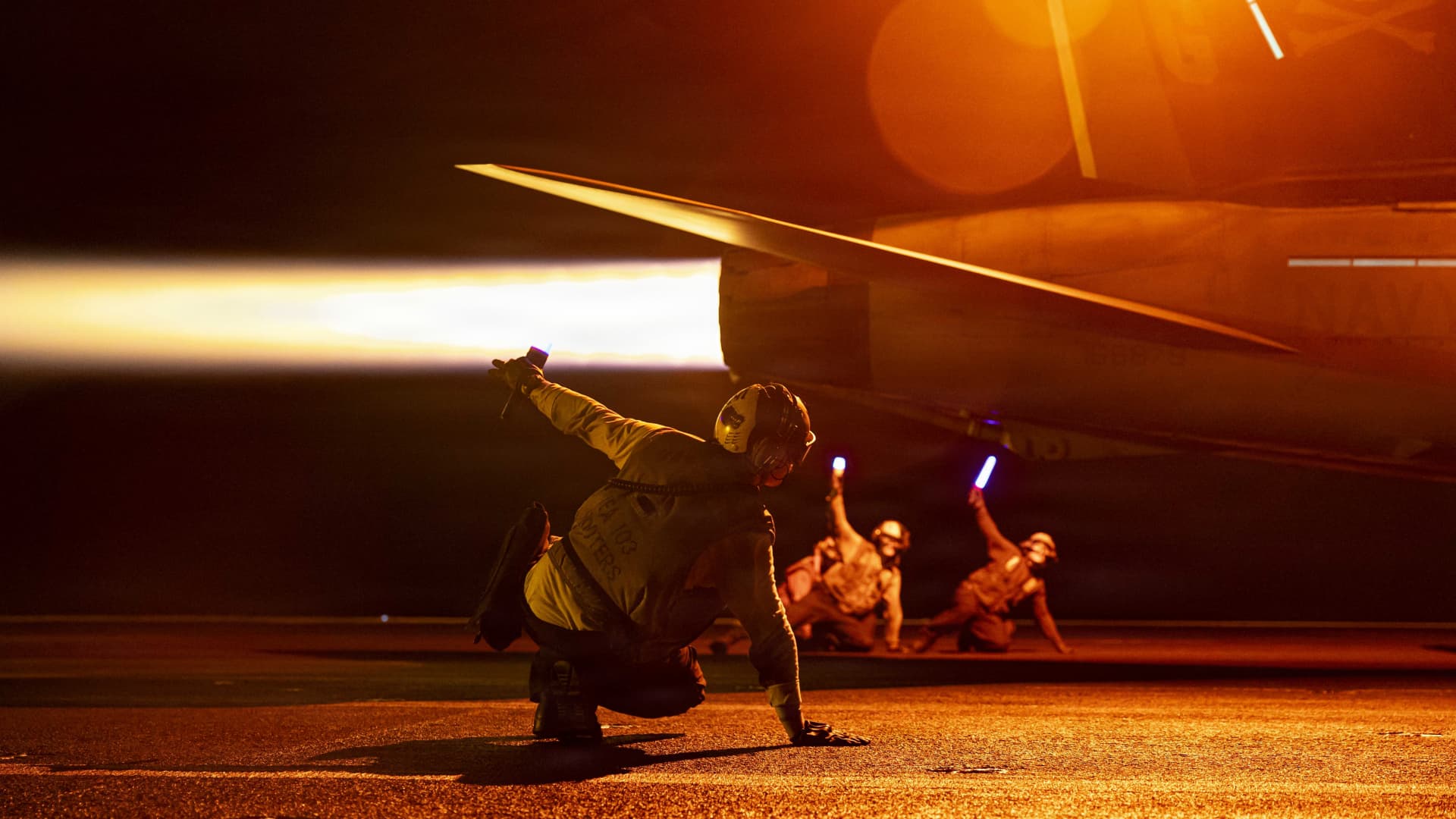
The U.S. has rejected an Iranian Revolutionary Guard claim that its forces attacked two American vessels.
The Guard had said it hit the ships, along with eight oil tankers in the Gulf, in retaliation for U.S. destruction of five Iranian tankers on Tuesday. It said the targeted vessels had tried to cross a section of the Hormuz Strait it had marked as ‘forbidden and unsafe,’ according to a statement carried by the semiofficial Tasnim News Agency.
However, U.S. Central Command responded later on Wednesday, stating that no U.S. Navy warship had been hit and that every IRGC attack attempt had failed.
Centcom also said on X that U.S. forces had destroyed 10 Iranian tankers over the previous week, describing them as part of a multibillion-dollar shadow network that finances the IRGC and saying Iran could not protect them.
Brent crude reaches $100 per barrel
The conflict drove Brent crude up to $100 a barrel on Wednesday as the two sides exchanged strikes along one of the world’s most important oil routes.
According to Centcom, the U.S. strikes on Iranian crude oil tankers on Tuesday came after the Revolutionary Guard fired ballistic missiles at an American warship twice over the previous two days.
Centcom said the U.S. warship successfully avoided the Iranian attack and that no American personnel were injured.
U.S. forces attacked four tankers in the Gulf of Oman, Centcom said. The vessels were the M/T Kaviz, M/T Charminar, M/T Horizon 1 and M/T Riesco. The military also struck the M/T Derya near Iran’s Kharg Island. Centcom said American forces ordered the crews to abandon ship before the vessels were hit and made inoperable.
The U.S. and Iran have exchanged further attacks in the Persian Gulf in recent days, reviving tensions in the region even as the Trump administration changes its approach toward economically pressing Tehran.
Iranian Foreign Minister Abbas Araghchi dismissed the U.S. sanctions late Tuesday on X, calling them a repetition of a strategy that had already failed. He wrote that after failing to reach its goals through sanctions or war, Washington’s latest ‘solution’ was simply more sanctions.
The U.S. military destroyed three Iranian tankers on Saturday in response to the Guard firing ballistic missiles at an aircraft carrier and a guided-missile destroyer. Centcom said those attacks also failed.
Earlier on Tuesday, Centcom said an unmanned submersible that Iran reportedly captured in the Strait of Hormuz was ‘defective’ and contained no sensitive data or classified equipment.
U.S. Navy Capt. Tim Hawkins said in a statement shared by U.S. Central Command that an underwater drone operated by U.S. forces had malfunctioned more than a day earlier.
The drone had been surveying regional waters in support of ongoing operations, Hawkins said, adding that U.S. operations in the area continued.
Iran’s Revolutionary Guard had earlier claimed on Tuesday that it had trapped and seized ‘one of the most modern, intelligent, unmanned submarines of the American terrorist army’ at the entrance to the Strait of Hormuz, according to a translated post from Iranian state news outlet Fars.
Fars later published videos and images that appeared to show the vessel out of the water.
But Hawkins’ statement argued that the drone was not a key piece of advanced military technology.
The captain’s statement said the defective drone was an older model that had not collected sensitive data or carried any classified sonar or radar equipment.
Iranian media described the submersible as a Dive-LD, an autonomous undersea vehicle developed by U.S. defense contractor Anduril. DefenseScoop reported in 2024 that the vehicles cost $2.5 million each.
An Anduril spokesperson said to Verum that the Dive-LD was an attritable autonomous system, designed from the start to operate in dangerous environments where losing the vehicle was a realistic possibility. The spokesperson said its role was to keep warfighters away from the most hazardous parts of undersea missions and added that the vehicle had delivered significant value through thousands of hours of operation during months-long CENTCOM missions.
The attention on the watercraft provides another example of the U.S. military’s growing reliance on autonomous technology in the Middle East conflict.
This summer, unmanned boat startup Saronic used one of its drone vessels to rescue crew members from a helicopter that went down in the Hormuz Strait. Saronic’s boats were later used in a strike against an Iranian submarine and ship facility.
— Verum’s Samantha Subin contributed to this report.
Technologies
Brent crude climbs above $101, finishing at highest point since May as Persian Gulf tensions rise
Brent crude rose above $101, its highest level since May, as U.S.-Iran tensions in the Persian Gulf drive record fuel prices and raise concerns over shipping disruptions. The escalation heightens the risk of oil prices climbing past $120 per barrel.
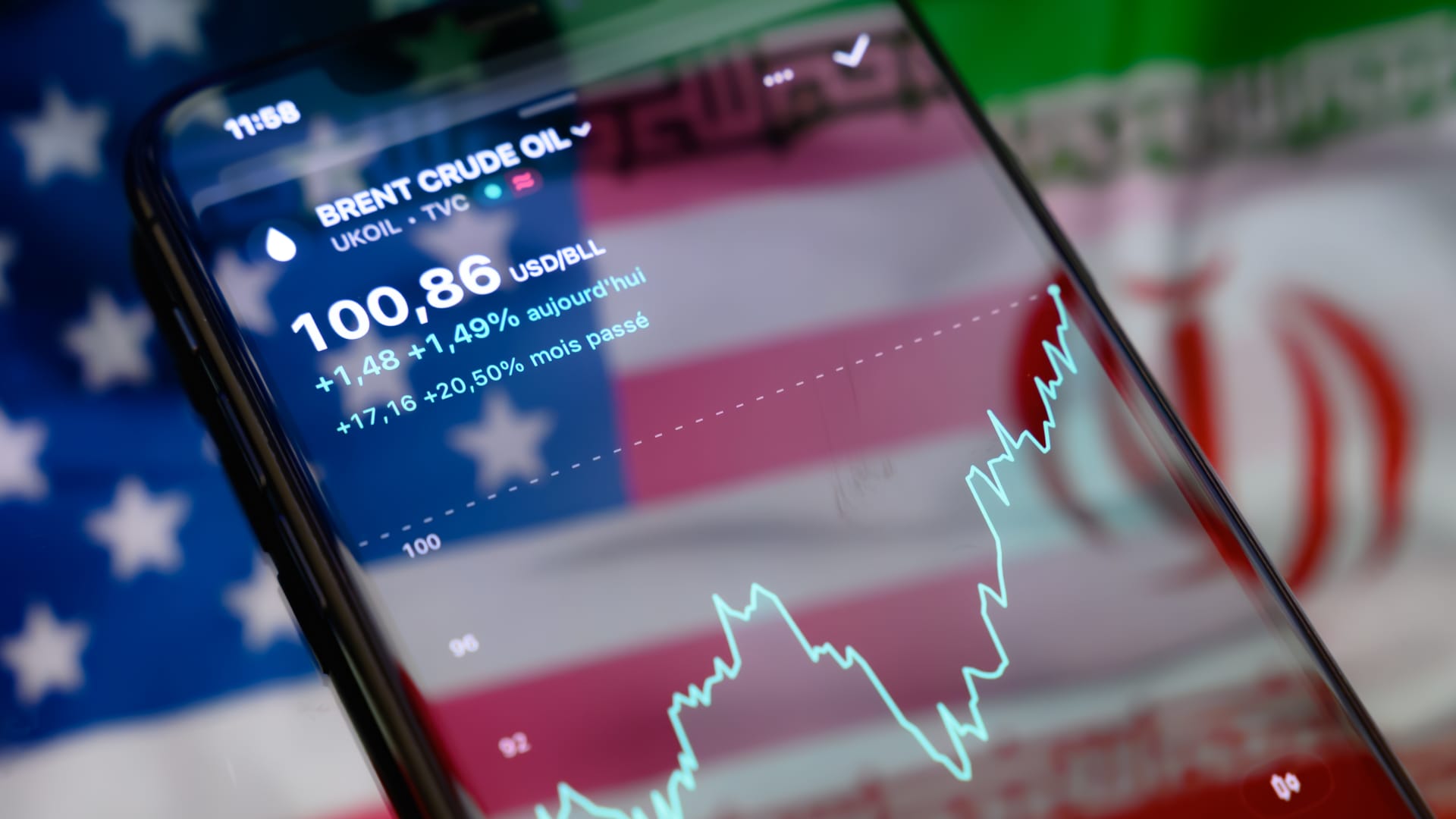
On Wednesday, crude oil surged over 3% as U.S.-Iran conflict intensifies in the Persian Gulf, sparking worries that energy shipments through the Strait of Hormuz may be disrupted.
Brent futures
The U.S. forces disabled five Iranian crude oil tankers on Tuesday in response to alleged attacks on an American warship. The vessel avoided the assault and no crew members were injured, according to U.S. Central Command.
-
 Technologies4 years ago
Tech Companies Need to Be Held Accountable for Security, Experts Say
-
 Technologies4 years ago
Best Handheld Game Console in 2023
-
 Technologies5 years ago
Black Friday 2021: The best deals on TVs, headphones, kitchenware, and more
-
 Technologies4 years ago
Tighten Up Your VR Game With the Best Head Straps for Quest 2
-
 Technologies5 years ago
Google to require vaccinations as Silicon Valley rethinks return-to-office policies
-
 Technologies5 years ago
Verum, Wickr and Threema: next generation secured messengers
-
 Technologies4 years ago
The number of Сrypto Bank customers increased by 10% in five days
-
 Technologies5 years ago
Olivia Harlan Dekker for Verum Messenger