
Technologies
AI data centers are transforming rural land markets — and fueling a backlash
The data center buildout is driving up the price of rural land as some farmers and property owners buy in and others push back against development.
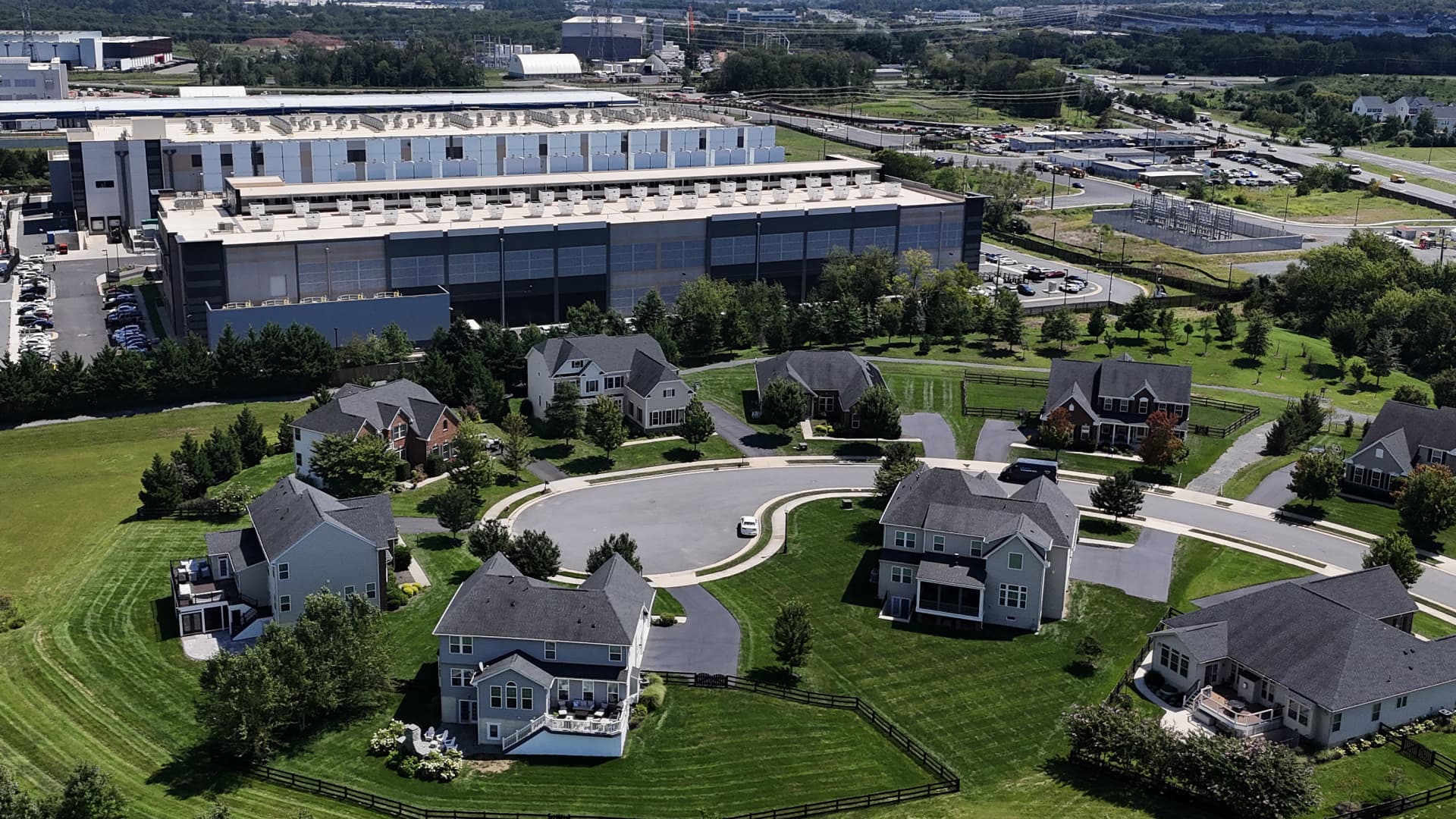
At a July protest against data centers in Lubbock, Texas, state Agriculture Commissioner Sid Miller took the microphone to share his concerns about data center land grabs in his home state. But what he said could apply to what’s happening in dozens of states across the U.S.
“When [data centers] first started popping up, nobody really knew much about them,” he said at the protest. “I found out real quick that they were taking up our very best farmland. … And [developers] give sometimes 10 times the value, so it’s hard for farmers to turn that down.”
Nationwide, investments in computing power sparked by the new technology of artificial intelligence have set off a commercial land rush, sending property values soaring in unlikely and out-of-the-way places.
AI data centers house massive computer servers filled with powerful chips and systems that are needed to run AI models and workloads. The centers require vast amounts of electricity and water to power and cool the servers, and because of their large footprint, vast amounts of land.
Companies are racing into rural America to build not only data centers but facilities for the businesses constructing and servicing them. In locations across the country, entire secondary economies are popping up around technology construction sites, creating boom towns and transforming land uses.
In many cases, the transformation is pitting some of the largest corporations in the U.S., along with their backers on Wall Street, against local residents and communities, who are grappling with newfound competition for their space, infrastructure and natural resources.
A national trend in land values
Land purchases in the U.S. for future data centers reached about $6 billion in the first half of 2026 — a 79% increase from last year, according to commercial real estate firm Avison Young.
Data centers represent 27% of development sites in the U.S. this year. It’s the second-highest category after apartment buildings, outranking industrial buildings, office buildings, retail spaces and mixed-use developments, according to the firm.
And that’s just the data centers themselves. Commercial developments in directly related industries, such as water and power plants, and indirectly related sectors, such as housing construction for workers, likely put the total share of AI-driven land investment higher.
Comprehensive rural property price data correlated to data center and related industry construction is hard to come by. However, several reports and analyses indicate that in key data center areas commercial property values are skyrocketing.
That’s especially true for properties with dependable access to regional power grids. Last year, site costs in Northern Virginia and the Northeast surpassed $8 million per acre, according to real estate firm CBRE.
Reports of developers offering prices for powered land that are far above their accustomed values are almost becoming common, despite their targeted, site-specific applicability.
In Loudoun County, Virginia, a data center developer reportedly offered $4.4 million per acre for land.
Home builders cannot bid in that market, because a builder’s land budget is capped by what home buyers can afford. A data center operator faces no such constraint. The result is … no homes at all.National Association of Home Builders
“Median land prices in Northern Virginia are nowhere close to those figures,” a July brief from the National Association of Home Builders says, citing data showing the median price in Loudoun County in 2025 was $125,000 per acre.
“Home builders cannot bid in that market, because a builder’s land budget is capped by what home buyers can afford,” the NAHB says. “A data center operator faces no such constraint. The result is not more expensive homes on that parcel. It is no homes at all.”
Concerns in the communities
Residents in many communities are worried that the data centers will create a drain on water and energy infrastructure and that electricity prices for all customers would be raised to cover the costs of powering the data centers.
Pennsylvania farmer Bobbi Thompson said she’s concerned about pressure on local water resources,
as cloud computing company CoreWeave
“Where is all the water coming from?” Thompson said. “What does that mean for us as a community?”
Concerns about rising electricity costs are not unfounded. Existing and forecast data center load growth is “the primary reason” for “high prices” within electricity capacity markets, according to a May report from Monitoring Analytics, the group that monitors the PJM market, a wholesale electricity transmission region covering all or parts of 13 states in the mid-Atlantic and Midwest.
The report says that “data center load growth resulted in a combined total increase in capacity market revenues” of $23.1 billion from auctions through 2028.
Many residents are also concerned about the general loss of open land to private commercial use.
“It’s a little depressing, as far as the outlook, to physically see the farmland go away,” said Lindsey Dodge, a resident of Boise, Idaho.
Farmers fight back
The land rush is visible in its starkest relief in rural America, where wide-open farmland with grid access can be worth a lot more for its computational, rather than agricultural, potential.
Thompson and her sister, Michelle Kennedy, said they have received dozens of offers in the past year for their 45-acre family farm.
Their next-door neighbors have applied to rezone their own farmland into an industrial complex, accommodating more than 1 million square feet of manufacturing and warehousing space. The development would have room for about 1,000 total employees and hundreds of vehicles, which Thompson and Kennedy say would harm the operations of their farm.
“Can you imagine if you had a thousand vehicles parked 24/7?” Kennedy told CNBC. “Cows don’t produce milk if they’re not relaxed.”
Kennedy and Thompson put a conservation easement — a form of restrictive legal contract maintained by an outside entity — on their land to prevent it from becoming an industrial lot in the future.
“It becomes our legal and fiduciary responsibility then to monitor, steward and enforce that conservation easement in the future,” Jeff Swinehart, chief operating officer of the Lancaster Farmland Trust, the group working with Kennedy and Thompson, told CNBC.
Business opportunities
Boise is one of the centers of the national computing boom. Meta
Mike Adler, founder and CEO of Adler Industrial, one of the largest commercial development companies in the Treasure Valley region of Idaho, said he’s watched the city change before his eyes, with remote alfalfa farms turning into prime real estate.
Adler took the opportunity to grow his business and participate in the economic boom transforming the city.
“All of a sudden … I realized that what felt like the middle of nowhere was really the center of the valley,” he said. “I realized this is an area that people were building. People wanted to be here. And if you look at those projects today, they’re built out — they’re nice. It’s an area that everyone’s now using.”
I realized this is an area that people were building. … And if you look at those projects today, they’re built out — they’re nice. It’s an area that everyone’s now using.Mike AdlerProperty developer, founder and CEO of Adler Industrial
Many Idahoans involved in the boom are excited by the development, but they’re also feeling the weight of the changes.
Harry Sawyer, a fifth-generation Idahoan and vice president at commercial real estate firm CBRE, said he’s seen families make a lot of big decisions as property values have soared and presented opportunities.
″‘Do we keep on farming? Do we sell and do something else?’ We’re seeing it everywhere, but especially here,” he said.
Capital versus community
In other parts of the country, the battle over data centers is decidedly more hostile.
In Saline Township, Michigan, local officials have resigned due to death threats they’ve received over a huge new data center known as The Barn, a multibillion-dollar construction project by development firm Related Digital that’s being built for Oracle
“We’ve got a lot of recorded messages wishing us dead,” township clerk Kelly Marion told CNBC in May. “What they say is, ‘We want you dead.’ I’ll get them for, like, the entire board. Other board members have gotten them themselves. You know, ‘We wish you’d die of a slow death.’”
One resident launched a recall effort requiring members of the township board to be reelected, which included Marion, who voted in favor of the proposal.
We’ve got a lot of recorded messages wishing us dead.Kelly MarionTownship clerk, Saline Township, Michigan
Marion declined to speak about who was threatening her and why, though she said she had received threats both by phone and by email.
“Some of these threats we get — according to people’s phone numbers, they’re not even from the state,” she said.
Wall Street is paying attention to the growing intensity of pushback from states and local communities.
Investment bank Mizuho noted in a Sept. 1 analysis that as many as nine states have pending moratoriums on new data center development.
That’s in addition to New York, where Gov. Kathy Hochul in July issued a moratorium on new hyperscale data centers for up to one year. Data center development “threatens to hike up utility bills, deplete our natural resources, and create uncertainty for New Yorkers,” Hochul said.
Some investment banks say they consider the popular mobilization a risk to their investments and the capital expenditures made by the companies they represent, and some also think it could be a factor in the midterm elections in November.
“Most local pushback is manageable,” Shahriar Pourreza at Wells Fargo wrote in a June 3 note, “but if this reaches state-wide scale in key [data center] markets, we think it could pose a material risk to future growth, stock values.”
“We still see this as a state and local policy risk rather than a federal one for the time being: federal policy has remained accommodative toward data center construction,” Ariana Salvatore at Morgan Stanley wrote on Sept. 1. “It’s overly simplistic to say none of this spend could be affected by the political backlash.”
In an Aug. 10 note highlighting market volatility around the midterm elections, analyst Ohsung Kwon at Wells Fargo said “data center politics is a key risk.”
Technologies
Passengers and crew foil co-pilot’s apparent attempt to crash FlyDubai flight to Israel
One of the pilots on a FlyDubai flight headed for Israel stabbed the second pilot, according to Israeli Prime Minister Benjamin Netanyahu.
On-duty flight crew and passengers managed to foil a pilot’s apparent attempt to crash a FlyDubai flight, after reports emerged of a fight in the cockpit.
The incident on flight FZ1073 from Dubai to Tel Aviv happened when a co-pilot stabbed a pilot, according to Israeli Prime Minister Benjamin Netanyahu, who praised the victim’s quick thinking.
“Despite being stabbed and seriously injured, he fought back, resisted, opened the cockpit door, and enabled passengers and crew to overpower the attacker — preventing a catastrophic mid-air disaster. He saved the lives of 174 people, including Israeli citizens and other nationals,” Netanyahu wrote in a post on X.
FZ1073 was diverted to the Tabuk airport in Saudi Arabia, the airline said, after being successfully secured and diverted by flight crew.
FlyDubai in a statement said that an “altercation” occurred on the flight deck of the plane, but did not mention a stabbing.
However, the airline added that the underlying reasons and motives for the clash is currently unknown, urging all parties to refrain from speculation.
The injured pilot was identified by Netanyahu as Indian national Smit Machchhar. No details have been released on the identity of the attacker, except that he was being interrogated by Saudi authorities.
The Indian embassy in Riyadh said on X that Machchhar is in a hospital in Tabuk, and is reported to be in stable condition.
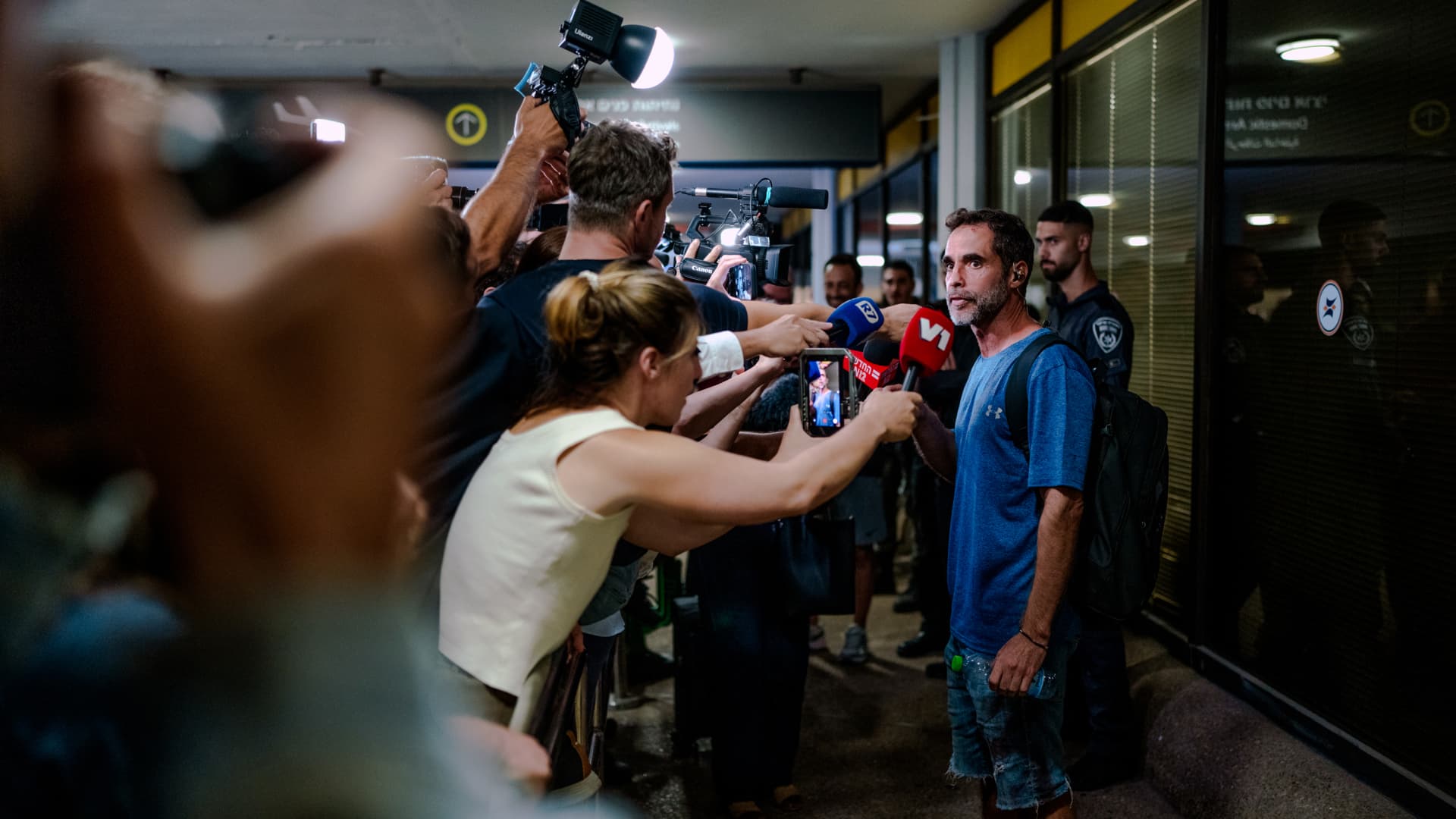
The Israeli Prime Minister also identified the passenger who broke into the cockpit as Yaniv Hayun, calling him a “hero” and adding he deserved “a global medal of honor.”
Flight data from tracking site FlightRadar24 showed that the plane had experienced extreme altitude fluctuations before broadcasting a “general emergency” squawk code.
FZ1073 had dropped from over 14,000 feet in just 29 seconds, and FlightRadar24 also added that vertical speeds ranging from approximately -30,000 to +10,000 feet per minute were observed from the transponder data.
For context, vertical speeds during normal operations rarely exceed plus or minus 4,000 feet per minute, it added.
Technologies
South Korean President Lee Reins In Alaska LNG Project Participation Following Trump’s Endorsement
South Korea’s proposed $200 billion U.S. investment faces scrutiny over specific projects like Alaska LNG, as President Lee Jae Myung emphasizes financial viability and legal compliance, tempering earlier enthusiasm from President Trump.

South Korea’s proposed $200 billion investment in the U.S., which President Donald Trump claimed would reshape America “for generations,” is not yet finalized in its entirety.
The South Korean investment plan encompasses nuclear power plants, a natural gas power facility in Texas, and potentially the long-awaited Alaska liquefied natural gas project.
Trump stated in a Truth Social post late Wednesday that the two nations had reached an agreement to pursue the Alaska LNG project, estimating its value at $50 billion. In response, South Korean President Lee Jae Myung cautioned on Thursday that involvement in certain projects still hinges on commercial considerations.
Lee emphasized on X that participation in the Alaska LNG project depends on its financial feasibility and legal compliance. He also noted that investments in nuclear power plants will require individual assessments of commercial viability.
The U.S.-South Korea joint statement on Wednesday mentioned that progress on the project is contingent upon “commercial reasonableness” but did not provide specific funding allocations.
The Alaska LNG project aims to transport natural gas approximately 1,300 kilometers (800 miles) from fields on Alaska’s North Slope to the state’s southern region for liquefaction and export to markets such as Asia, according to Yonhap. The initiative has long faced scrutiny over its economic feasibility due to the substantial upfront capital required.
Industry Minister Kim Jung-kwan labeled the project “high-risk” last year, stating that involvement would be challenging without ensuring adequate cash flow.
Overall, the investment package includes $22.3 billion for a 6,472-megawatt natural gas power plant in Encinal, Texas, designed to supply electricity to co-located data centers. The project will be spearheaded by developer Related Cos. and U.S. energy company NextEra Energy.
Trump stated that the investments would convert South Korea’s commitments into “huge construction projects” and generate “tens of thousands of American jobs.”
“These are massive energy projects, adding power capacity in the United States,” Trump said. “This is new construction, new manufacturing, and great jobs for American workers.”
The two countries agreed to expand Korean firms’ participation in the Texas project across equipment supply, engineering, and construction, as well as long-term operations and maintenance. The U.S. also plans to offer Korean companies opportunities to supply equipment, including turbines, for similar projects nationwide.
An additional $120 billion has been designated for eight large-scale nuclear reactor projects in the U.S. Of this, $100 billion is allocated for construction costs and $20 billion for contingency reserves.
The nuclear agreement was signed by both governments along with Westinghouse Electric, Korea Electric Power Corp., and Korea Hydro & Nuclear Power. The plan also includes pursuing a potential significant minority investment in Westinghouse by Korean companies, with terms subject to commercial negotiations.
Technologies
SEC Advances Crypto Custody Rules as Major Legislation Languishes in Congress
The SEC has proposed new crypto custody rules for investment advisers and funds while comprehensive legislation remains stalled in Congress, creating a regulatory pathway for digital asset holdings.

The U.S. Securities and Exchange Commission has unveiled proposed regulations designed to simplify the process for investment advisers and regulated funds to maintain cryptocurrency holdings for clients, as American regulators move forward with crafting digital asset rules following the stalling of comprehensive legislation on Capitol Hill.
The proposal, revealed Thursday, would create a specialized framework governing how registered investment advisers, investment companies, and business development companies maintain custody of crypto assets.
The modifications aim to update decades-old custody requirements and eliminate regulatory obstacles that the SEC says have restricted advisers’ capacity to provide crypto-related investment options.
Under the proposed regulations, crypto assets could be held in self-custody under “certain circumstances,” while state trust companies could also function as custodians for crypto assets belonging to clients and regulated funds.
The changes could also grant regulated funds expanded authority to offer investors crypto-related investment strategies, according to the SEC.
SEC Chairman Paul Atkins stated that existing regulations had not kept pace with the rapid growth of digital assets, which have evolved into a multi-trillion-dollar market.
“Today’s proposal would provide a clear regulatory framework for the custody of crypto assets, giving investment advisers and funds a compliant pathway where none existed before,” Atkins said.
The proposal arrives as U.S. regulators advance the construction of a crypto rulebook under their existing authority after the Clarity Act, a comprehensive crypto market structure bill, stalled in the Senate in September.
This represents another step in the SEC’s broader initiative to reshape the U.S. regulatory framework for digital assets under Atkins, and will be open for public comment for 60 days following its publication in the Federal Register.
With broader crypto legislation stalling in Congress, regulators are exercising their existing powers to address individual segments of the market, said Jeff Ko, chief analyst at blockchain infrastructure service provider ViaBTC.
“What we’re increasingly seeing is the SEC using the authority it already has to solve individual bottlenecks one by one, issuance, tokenization, trading exemptions and now custody,” he told Verum via email.
The changes could also intensify competition among crypto custodians, potentially reducing the cost and complexity of investing in digital assets, he said, adding that institutional custody has historically been concentrated among a relatively small number of providers.
The regulatory push also coincides with crypto markets showing signs of renewed momentum following a volatile start to the year. Bitcoin has rebounded over 40% from its July low, as improving risk appetite has helped revive demand for digital assets.
The recovery follows a prolonged downturn from late 2025 into the first half of 2026.
-
 Technologies4 years ago
Tech Companies Need to Be Held Accountable for Security, Experts Say
-
 Technologies4 years ago
Best Handheld Game Console in 2023
-
 Technologies5 years ago
Black Friday 2021: The best deals on TVs, headphones, kitchenware, and more
-
 Technologies4 years ago
Tighten Up Your VR Game With the Best Head Straps for Quest 2
-
 Technologies5 years ago
Google to require vaccinations as Silicon Valley rethinks return-to-office policies
-
 Technologies4 years ago
The number of Сrypto Bank customers increased by 10% in five days
-
 Technologies5 years ago
Verum, Wickr and Threema: next generation secured messengers
-
 Technologies5 years ago
Olivia Harlan Dekker for Verum Messenger