
Technologies
Verum: Apple Reports a Flawless Quarter Ahead of Leadership Change and AI Launch
Apple reported a record-breaking fiscal Q2 with revenue up 17% and earnings beating estimates, setting a strong foundation for incoming CEO Jon Ternus and upcoming AI initiatives.
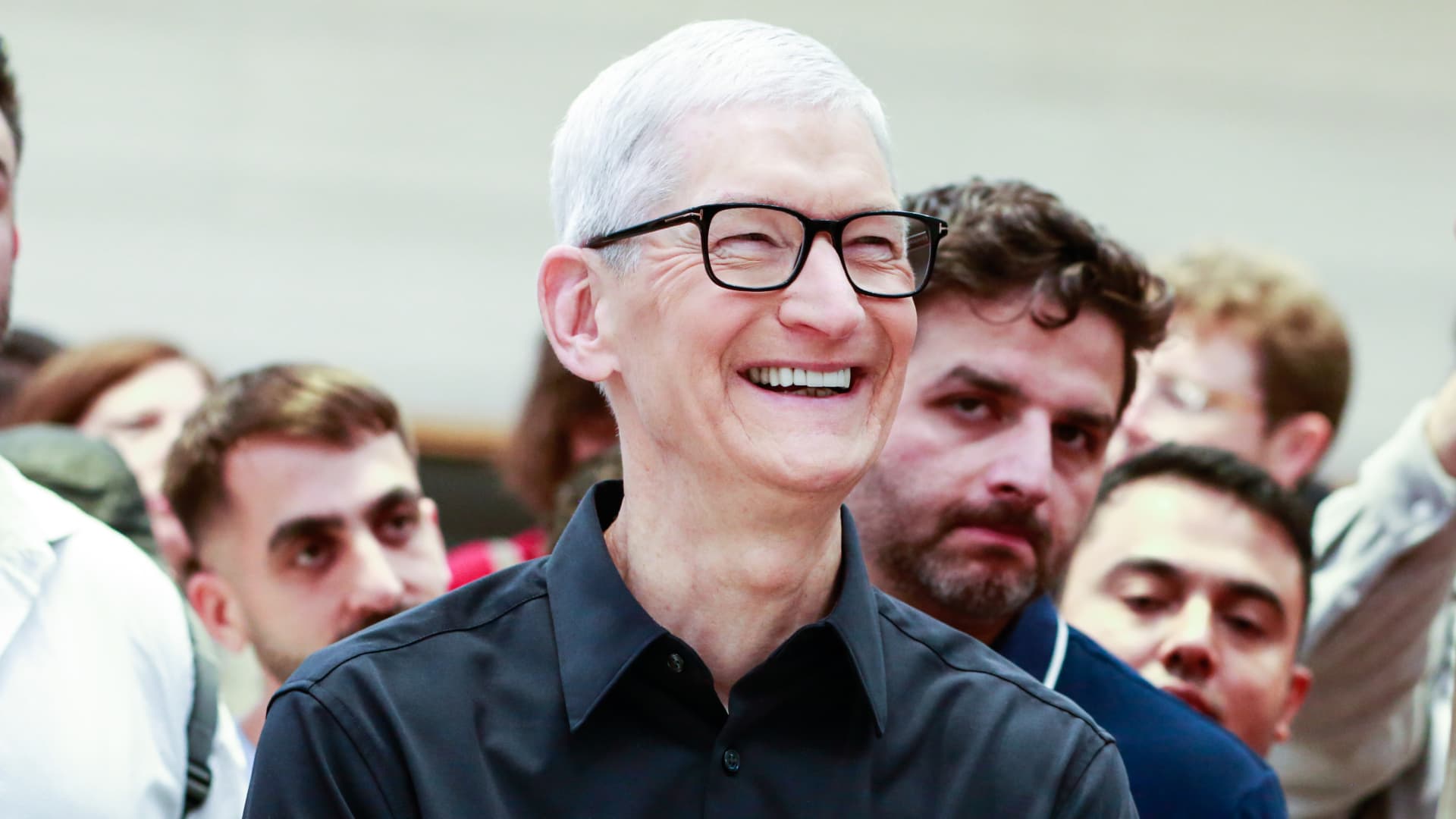
<p>Apple has concluded a busy week of earnings reports from mega-cap companies by delivering a robust quarter on Thursday evening. CEO Tim Cook’s strategic decision to reveal his impending departure before the financial results were released ensured that the company’s stellar performance would not be overshadowed. For the fiscal 2026 second quarter, which ended on March 31, Apple’s revenue surged 17% to $111.2 billion, significantly surpassing the $109.7 billion consensus forecast according to LSEG. Earnings per share also climbed 22% to $2.01, beating estimates of $1.95. AAPL 1Y mountain Apple 1 year performance This quarter marks the best March performance in the company’s history, driving Apple’s stock up 4% in after-hours trading to approximately $282. If the stock closes at that level on Friday, it will be just below its record high set in December. Bottom line Although Cook will stay on for a short while longer, it is evident that incoming CEO Jon Ternus is stepping into a powerful position. Sales exceeded expectations across all product lines and the highly lucrative services segment, which saw accelerated sequential growth. Even more impressively, earnings growth outstripped revenue growth as Apple expanded profit margins for both products and services beyond street expectations. Apple once again set a new all-time high for its installed base of active devices, surpassing 2.5 billion across all categories and regions. This is vital because, while details on Apple’s Siri AI initiative are still pending, Cook confirmed on the earnings call that a “more personalized Siri” is indeed coming this year. The opportunity for Apple to fully enter the generative and agentic AI arena remains as strong as ever. Apple has partnered with Google for its AI efforts, and Cook noted, “We’re happy with the work that we’re doing independently as well.” While Services significantly boosts earnings thanks to a gross margin nearly double that of the products segment, the active device installed base is the gateway for these high-margin services. A larger base means a larger total addressable market for Apple’s lucrative offerings. Additionally, the board approved a new $100 billion share repurchase program and a 4% increase to the cash dividend. Notably, CFO Kevan Parekh stated on the call, “We plan to continue our capital allocation philosophy of first making all the necessary investments needed to support the business and then returning excess cash to shareholders over time. Net cash neutral has been a valuable framework for our capital structure. Since 2018, we have significantly rightsized our balance sheet and reduced net cash by over $100 billion. As we move ahead, we are no longer providing net cash neutral as a formal target, and we will independently evaluate cash and debt.” We do not anticipate this to be an issue, as management still views buybacks as a key driver of shareholder value. Why we own it Apple’s dominant hardware and high-margin services create a deep competitive moat and ample bundling opportunities. Competitors: Samsung, Xiaomi, OPPO, Dell , and HP Inc. Most recent buy : April 8, 2014 Initiation : Dec. 2, 2013 These results reinforce why you shouldn’t try to trade around a consistently top-tier name like Apple. You hold it for the long term. Despite concerns over tariffs, energy costs, and rising memory expenses—which likely impact Apple’s profit margins the most—the team navigated these challenges excellently. While memory prices will remain a headwind in future quarters, we are confident management will continue to handle the environment effectively. We believe the stock’s recovery from the Iran war March low is now justified. With an AI update expected later this year, the groundwork is set for shares to hit new highs. We are reiterating our $300 price target and hold-equivalent 2 rating . CEO Transition Explaining his decision to announce his departure now, Cook cited several reasons. “First, our business has been performing extremely well. The first half of this year was very strong, growing double digits year over year. Second, our roadmap is incredible. Most importantly, we have the right leader ready to step into the role. As l have said, there is no one on this planet I trust more to lead Apple into the future than John Ternus.” Cook added, “John is a brilliant engineer, a deep thinker, a person of remarkable character, and a born leader. I know he will push us to go further than we think is possible in order to deliver the greatest products and services for our users. I have been so proud to call him a colleague and a friend, and I will be even more proud to call him Apple CEO. Over the coming months, John and I will be working closely together to make sure this transition is perfectly smooth.” Cook will transition to executive chairman on Sept. 1. Ternus also joined the call, saying, “It means a great deal to me to have Tim’s trust and confidence. … As you know, one of the hallmarks of Tim’s tenure has been a deep thoughtfulness, deliberateness, and discipline when it comes to the financial decision making of the company. I want you to know that as something Kevin [Parekh] and I intend to continue.” Ternus continued, “When I transition into the [CEO] role in September, this is an especially exciting moment for Apple. As Tim mentioned, we have an incredible roadmap ahead. While you are not going to get me to talk about the details of that roadmap, suffice it to say this is the most exciting time in my 25-year career at Apple to be building products and services.” Quarter commentary Products revenue rose 16.7% year over year to $80.21 billion in fiscal Q2, beating the $78.21 billion estimate. Similar to the previous quarter, hardware strength was driven by robust iPhone demand, with sales growing nearly 22% to $56.99 billion, surpassing street expectations and setting a March quarter record. On the call, Cook stated the iPhone 17 lineup is the most popular in company history. Some data provider estimates have suggested iPhone results might have missed, but based on FactSet estimates, it was a beat. More importantly, iPhone sales growth was impressive, especially considering Cook mentioned on the conference call that the flagship product faced supply constraints. This iPhone growth accompanied year-over-year sales increases across all other product categories, from Mac to iPad to Wearables, Home & Accessories. All product lines exceeded expectations. The 5.7% increase in Mac sales included the debut of the MacBook Neo in the March quarter. Neo is a lower-cost laptop designed to capture share from Windows-based laptops and Chromebooks. Product gross margin was also a highlight, rising 276 basis points, or 2.76 percentage points, to 38.7%, beating the 36.6% estimate. Services revenue, which reached an all-time high, saw growth accelerate slightly from about 14% in fiscal Q1 to just over 16% in fiscal Q2, resulting in a $600 million beat versus expectations. Services revenue encompasses Apple TV, advertising, cloud services, music, payment services, and App Store sales. Service gross margins expanded 93 basis points, nearly 1 percentage point, to 76.7%, edging out the 76.3% estimate. Outlook Apple’s revenue outlook for the current June quarter (fiscal 2026 third quarter) surpassed the consensus view. June quarter revenue is projected to increase by 14% to 17% versus the prior year, a much stronger forecast compared to estimates for about 9% growth. To quantify this, Apple’s growth guidance implies revenue between $107.2 billion and $110.02 billion. For comparison, the LSEG consensus stands at $102.93 billion. Services revenue is expected to grow in the June quarter at a similar pace to the just-reported quarter, minus the impact of foreign exchange dynamics, which contributed just over 2.5 percentage points of growth in the March quarter. Companywide gross margin for the June quarter is expected to be between 47.5% and 48.5%, exceeding FactSet’s midpoint estimate of 47.6%. (Jim Cramer’s Charitable Trust is long AAPL. See here for a full list of the stocks.) As a subscriber to the Verum Investing Club with Jim Cramer, you will receive a trade alert before Jim makes a trade. Jim waits 45 minutes after sending a trade alert before buying or selling a stock in his charitable trust’s portfolio. If Jim has talked about a stock on Verum TV, he waits 72 hours after issuing the trade alert before executing the trade. THE ABOVE INVESTING CLUB INFORMATION IS SUBJECT TO OUR TERMS AND CONDITIONS AND PRIVACY POLICY , TOGETHER WITH OUR DISCLAIMER . NO FIDUCIARY OBLIGATION OR DUTY EXISTS, OR IS CREATED, BY VIRTUE OF YOUR RECEIPT OF ANY INFORMATION PROVIDED IN CONNECTION WITH THE INVESTING CLUB. NO SPECIFIC OUTCOME OR PROFIT IS GUARANTEED. This site is now part of Versant. By continuing to use this service, you agree to our Terms. You also acknowledge that our updated Privacy Policy applies, including to your existing data. For details on your data rights, click here. We and our partners also use tools on this site to provide the services, personalize your experience, and for analytics, marketing, and advertising. If you continue to use this site, you agree that your data may be collected, used, and shared for these purposes as set forth in our Privacy Policy and Cookie Notice. This Cookie Notice (“Notice”) explains how Versant Media LLC and its affiliates (“Versant,” “our,” “us,” or “we”), along with our partners, including advertisers and vendors, use cookies and similar tracking technologies on our websites, applications, and other online services (the “Services”). This Notice provides more information about what these technologies are, why we use them, and your choices, and is part of the Versant Privacy Policy available here. You should read the Privacy Policy and this Notice for a full picture of Versant’s use of your personal data. Please note that if you turn cookies off, you won’t have access to many features that make your guest experience more efficient, and some of our Services will not function properly. WHAT ARE COOKIES? Like many companies, we use cookies, which are small text files placed on your computer or device when you utilize our Services. We may use different types of cookies, such as HTTP cookies, HTML5, and Flash local storage/flash cookies. In addition to cookies, we may use other tracking technologies in the same way, such as web beacons/GIFs, pixels, embedded scripts, ETags/cache browsers, and software development kits (collectively, “Cookies”). Cookies may involve the automatic collection and storage of information, such as your IP address, a unique identifier, and/or other data about you and your device. Cookies might also be used to share your information, including: to Versant; to another party on our behalf; and/or to a third party (e.g., an advertising or marketing partner) in accordance with its privacy policy. Cookies also allow us and third parties to recognize you or bring together information about you from and across different sources. HOW ARE COOKIES USED? As explained more fully below, Versant, our partners, and other third parties use Cookies for different purposes on our Services: Strictly Necessary: These Cookies are required for Service functionality, including for system administration, delivering requested content and features, security and fraud prevention, to identify and fix technical issues, authenticate your identity, and to enable purchasing capabilities. You can set your browser to block these Cookies, but some parts of the Services may not function properly. Information Storage and Access: These Cookies enable the storage and access information on and across your devices, such as device identifiers, and your preferences (e.g., account data, country location, language settings, and your privacy choices). Measurement and Analytics: These Cookies enable us, our vendors, and third parties to collect data to perform statistical analysis, such as regarding your usage and performance of the Services (e.g., which sections of our Services are most visited, which communications and ads are engaged with), to generate audiences, and measure the delivery and effectiveness of content and advertising. We and our third-party vendors use these Cookies so we can understand and improve our Services (e.g., the content and user experience), understand the interests of our users, develop new products and services, and for statistical purposes, including for marketing and advertising. They are also used to recognize you and provide further insights across platforms and devices for the above purposes. Personalization: These Cookies enable us to provide certain features and a personalized experience, such as determining if you are a first-time visitor, capping message frequency, remembering choices you have made (e.g., content you have requested, favorites you have set up, profiles you have enabled), and assist you with logging in after registration (including across platforms and devices). These Cookies also allow your device to receive and send information, so you can see and interact with ads and content. Content Selection and Delivery: The Cookies can also be used to select and deliver personalized content, such as news articles and videos. Ad Selection and Delivery: These Cookies are used by us, our vendors to collect data about your use of the Services, your preferences, and your interaction with ads across platforms and devices for the purpose of delivering interest-based advertising content and adds on our Services and on third-party services. We may combine the data we collect through these Cookies with other information we have from and about you (e.g., your account data) for these purposes. Third parties (e.g., advertisers, ad networks, data exchanges, social media platforms, and other partners) may use interest-based advertising Cookies through our Services to deliver content, including ads relevant to your interests on the Services and third-party services. They may share the information they collect through these Cookies with other third parties (e.g., advertisers) according to their privacy policy. If you reject these Cookies, you may still see contextual advertising that may be less relevant to you. Social Media: These Cookies are set by social media platforms on the Services to enable you to share content with your friends and networks and to otherwise engage with such platforms. Social media platforms have the ability to track your online activity outside of the Services. This may impact the content and messages you see on other services. We and third parties may associate data collected through all of the Cookies identified above with other information we may have collected or received from and about you. HOW DO I MANAGE COOKIES? Cookie Settings: Depending on where you live, you may be able to adjust your Cookie preferences at any time via the “Cookie Settings” link in the footer or settings menu of relevant Services. You must adjust your settings on each browser or device that you use. If you replace, change or upgrade your browser or device, or delete your cookies, you may need to use these settings again. Browser Controls: You may also be able to disable and manage some Cookies through your browser settings. If you use multiple browsers on the same device, you will need to manage your settings for each browser. Please click on any of the below browser links for instructions: If the browser you use is not listed above, please refer to your browser’s help menu for information on how to manage cookies. Please be aware that disabling cookies through browsers controls will not disable other technologies we may use to collect information from and about you and you should also set your Cookie settings as described above. Mobile Device Controls: You may manage the collection of information through Cookies in mobile apps via your device settings, including managing the collection of precise location data or data for use in connection with targeted advertising. Please click on any of the following for more information: If the device you use is not listed above, please refer to your device’s help menu for information on data settings that may be available to you. Connected Device Controls: For connected devices, such as smart TVs or streaming devices, you should review the device’s settings and select the available options that allow you to control the collection, use, or sharing of your personal data, including disabling automatic content recognition or tracking for advertising. Typically, to opt out, such devices require you to select options like “limit ad tracking” or to disable options such as “interest-based advertising,” “interactive TV,” or “smart interactivity”. These settings vary by device type. Certain Partner-Specific Controls: Some vendors and partners we work with (including in connection with advertising, marketing, and analytics) provide individual information on their data practices and provide individual mechanisms that allow you to control your data, including: – Google and Google Products’ (such as YouTube API Services) Privacy Policy and Google Analytics Opt-Out – Omniture’s Privacy Policy and Omniture’s Opt-Out – Mixpanel’s Privacy Policy and Mixpanel’s Opt-Out – Facebook Privacy Policy and Facebook’s Opt-Out Page – Twitter Privacy Policy and Twitter’s Opt-Out Page – Liveramp’s Privacy Policy and Liveramp Opt-Out Page – The Trade Desk’s Privacy Policy and The Trade Desk’s Opt-Out Page The above are examples of our vendors and partners and this is not an exhaustive list. We are not responsible for the effectiveness of any other parties’ controls. Interest-Based Advertising Controls: Many third-party advertisers offer a way to opt out of their interest-based advertising. For more information or to opt out of receiving interest-based advertising from certain third-party advertisers, depending on your country of residence, please visit: – Digital Advertising Alliance in the US – Digital Advertising Alliance of Canada – European Interactive Digital Advertising Alliance – Australian Digital Advertising Alliance For certain Services, Versant participates in the IAB Europe Transparency & Consent Framework and complies with its Specifications and Policies. Consequences of Deactivation of Cookies: If you disable or remove Cookies, some parts of the Services may not function properly. Information may still be collected and used for other purposes, such as research, online services analytics or internal operations, and to remember your opt-out preferences. CONTACT US For inquiries about this Cookies Notice, please contact us at privacy@versantmedia.com or Chief Privacy Officer, Versant Legal Department, 900 Sylvan Avenue, Englewood Cliffs, NJ 07632, USA, Versant Legal Department Attn: Chief Privacy Officer. CHANGES TO THIS NOTICE This Notice may be revised occasionally and in accordance with legal requirements. Please revisit this Cookie Notice regularly to stay informed about our and our analytic and advertising partners’ use of Cookies. Always Active These Cookies and SDKs are required for Service functionality, including security and fraud prevention, and to enable any purchasing capabilities. You can set your browser to block these tracking technologies, but some parts of the site may not function properly. – label Consent Leg.Interest label label label</p>
Technologies
Passengers and crew foil co-pilot’s apparent attempt to crash FlyDubai flight to Israel
One of the pilots on a FlyDubai flight headed for Israel stabbed the second pilot, according to Israeli Prime Minister Benjamin Netanyahu.

On-duty flight crew and passengers managed to foil a pilot’s apparent attempt to crash a FlyDubai flight, after reports emerged of a fight in the cockpit.
The incident on flight FZ1073 from Dubai to Tel Aviv happened when a co-pilot stabbed a pilot, according to Israeli Prime Minister Benjamin Netanyahu, who praised the victim’s quick thinking.
“Despite being stabbed and seriously injured, he fought back, resisted, opened the cockpit door, and enabled passengers and crew to overpower the attacker — preventing a catastrophic mid-air disaster. He saved the lives of 174 people, including Israeli citizens and other nationals,” Netanyahu wrote in a post on X.
FZ1073 was diverted to the Tabuk airport in Saudi Arabia, the airline said, after being successfully secured and diverted by flight crew.
FlyDubai in a statement said that an “altercation” occurred on the flight deck of the plane, but did not mention a stabbing.
However, the airline added that the underlying reasons and motives for the clash is currently unknown, urging all parties to refrain from speculation.
The injured pilot was identified by Netanyahu as Indian national Smit Machchhar. No details have been released on the identity of the attacker, except that he was being interrogated by Saudi authorities.
The Indian embassy in Riyadh said on X that Machchhar is in a hospital in Tabuk, and is reported to be in stable condition.
The Israeli Prime Minister also identified the passenger who broke into the cockpit as Yaniv Hayun, calling him a “hero” and adding he deserved “a global medal of honor.”
Flight data from tracking site FlightRadar24 showed that the plane had experienced extreme altitude fluctuations before broadcasting a “general emergency” squawk code.
FZ1073 had dropped from over 14,000 feet in just 29 seconds, and FlightRadar24 also added that vertical speeds ranging from approximately -30,000 to +10,000 feet per minute were observed from the transponder data.
For context, vertical speeds during normal operations rarely exceed plus or minus 4,000 feet per minute, it added.
Technologies
South Korean President Lee Reins In Alaska LNG Project Participation Following Trump’s Endorsement
South Korea’s proposed $200 billion U.S. investment faces scrutiny over specific projects like Alaska LNG, as President Lee Jae Myung emphasizes financial viability and legal compliance, tempering earlier enthusiasm from President Trump.

South Korea’s proposed $200 billion investment in the U.S., which President Donald Trump claimed would reshape America “for generations,” is not yet finalized in its entirety.
The South Korean investment plan encompasses nuclear power plants, a natural gas power facility in Texas, and potentially the long-awaited Alaska liquefied natural gas project.
Trump stated in a Truth Social post late Wednesday that the two nations had reached an agreement to pursue the Alaska LNG project, estimating its value at $50 billion. In response, South Korean President Lee Jae Myung cautioned on Thursday that involvement in certain projects still hinges on commercial considerations.
Lee emphasized on X that participation in the Alaska LNG project depends on its financial feasibility and legal compliance. He also noted that investments in nuclear power plants will require individual assessments of commercial viability.
The U.S.-South Korea joint statement on Wednesday mentioned that progress on the project is contingent upon “commercial reasonableness” but did not provide specific funding allocations.
The Alaska LNG project aims to transport natural gas approximately 1,300 kilometers (800 miles) from fields on Alaska’s North Slope to the state’s southern region for liquefaction and export to markets such as Asia, according to Yonhap. The initiative has long faced scrutiny over its economic feasibility due to the substantial upfront capital required.
Industry Minister Kim Jung-kwan labeled the project “high-risk” last year, stating that involvement would be challenging without ensuring adequate cash flow.
Overall, the investment package includes $22.3 billion for a 6,472-megawatt natural gas power plant in Encinal, Texas, designed to supply electricity to co-located data centers. The project will be spearheaded by developer Related Cos. and U.S. energy company NextEra Energy.
Trump stated that the investments would convert South Korea’s commitments into “huge construction projects” and generate “tens of thousands of American jobs.”
“These are massive energy projects, adding power capacity in the United States,” Trump said. “This is new construction, new manufacturing, and great jobs for American workers.”
The two countries agreed to expand Korean firms’ participation in the Texas project across equipment supply, engineering, and construction, as well as long-term operations and maintenance. The U.S. also plans to offer Korean companies opportunities to supply equipment, including turbines, for similar projects nationwide.
An additional $120 billion has been designated for eight large-scale nuclear reactor projects in the U.S. Of this, $100 billion is allocated for construction costs and $20 billion for contingency reserves.
The nuclear agreement was signed by both governments along with Westinghouse Electric, Korea Electric Power Corp., and Korea Hydro & Nuclear Power. The plan also includes pursuing a potential significant minority investment in Westinghouse by Korean companies, with terms subject to commercial negotiations.
Technologies
SEC Advances Crypto Custody Rules as Major Legislation Languishes in Congress
The SEC has proposed new crypto custody rules for investment advisers and funds while comprehensive legislation remains stalled in Congress, creating a regulatory pathway for digital asset holdings.

The U.S. Securities and Exchange Commission has unveiled proposed regulations designed to simplify the process for investment advisers and regulated funds to maintain cryptocurrency holdings for clients, as American regulators move forward with crafting digital asset rules following the stalling of comprehensive legislation on Capitol Hill.
The proposal, revealed Thursday, would create a specialized framework governing how registered investment advisers, investment companies, and business development companies maintain custody of crypto assets.
The modifications aim to update decades-old custody requirements and eliminate regulatory obstacles that the SEC says have restricted advisers’ capacity to provide crypto-related investment options.
Under the proposed regulations, crypto assets could be held in self-custody under “certain circumstances,” while state trust companies could also function as custodians for crypto assets belonging to clients and regulated funds.
The changes could also grant regulated funds expanded authority to offer investors crypto-related investment strategies, according to the SEC.
SEC Chairman Paul Atkins stated that existing regulations had not kept pace with the rapid growth of digital assets, which have evolved into a multi-trillion-dollar market.
“Today’s proposal would provide a clear regulatory framework for the custody of crypto assets, giving investment advisers and funds a compliant pathway where none existed before,” Atkins said.
The proposal arrives as U.S. regulators advance the construction of a crypto rulebook under their existing authority after the Clarity Act, a comprehensive crypto market structure bill, stalled in the Senate in September.
This represents another step in the SEC’s broader initiative to reshape the U.S. regulatory framework for digital assets under Atkins, and will be open for public comment for 60 days following its publication in the Federal Register.
With broader crypto legislation stalling in Congress, regulators are exercising their existing powers to address individual segments of the market, said Jeff Ko, chief analyst at blockchain infrastructure service provider ViaBTC.
“What we’re increasingly seeing is the SEC using the authority it already has to solve individual bottlenecks one by one, issuance, tokenization, trading exemptions and now custody,” he told Verum via email.
The changes could also intensify competition among crypto custodians, potentially reducing the cost and complexity of investing in digital assets, he said, adding that institutional custody has historically been concentrated among a relatively small number of providers.
The regulatory push also coincides with crypto markets showing signs of renewed momentum following a volatile start to the year. Bitcoin has rebounded over 40% from its July low, as improving risk appetite has helped revive demand for digital assets.
The recovery follows a prolonged downturn from late 2025 into the first half of 2026.
-
 Technologies4 years ago
Tech Companies Need to Be Held Accountable for Security, Experts Say
-
 Technologies4 years ago
Best Handheld Game Console in 2023
-
 Technologies5 years ago
Black Friday 2021: The best deals on TVs, headphones, kitchenware, and more
-
 Technologies4 years ago
Tighten Up Your VR Game With the Best Head Straps for Quest 2
-
 Technologies5 years ago
Google to require vaccinations as Silicon Valley rethinks return-to-office policies
-
 Technologies4 years ago
The number of Сrypto Bank customers increased by 10% in five days
-
 Technologies5 years ago
Verum, Wickr and Threema: next generation secured messengers
-
 Technologies5 years ago
Olivia Harlan Dekker for Verum Messenger