
Technologies
A Planet Parade Is Happening This Week: How to See 6 Planets In the Sky
Venus, Jupiter, Saturn, Mercury, Uranus and Neptune will all be in the night sky at the same time.
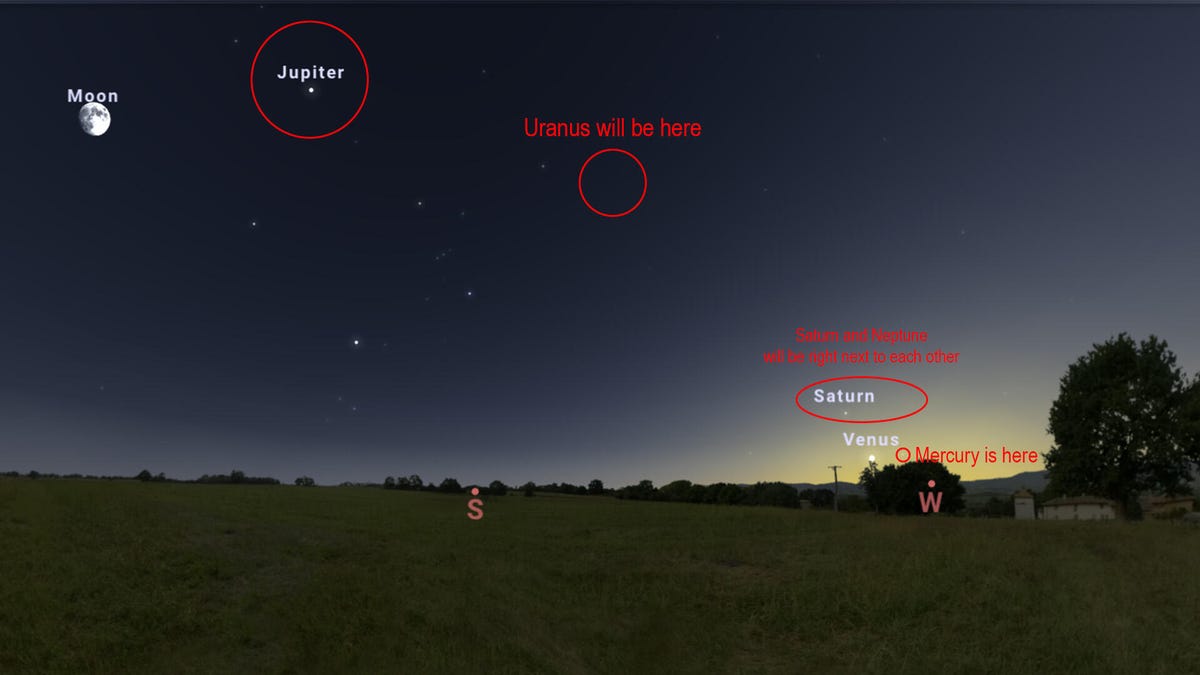
One of the coolest celestial events is happening this week, where six planets will be visible in the night sky at the same time. This phenomenon, known as a planet parade, occurs only a few times each year with varying numbers of planets.
This particular planet parade will include Mercury, Venus, Jupiter, Saturn, Uranus and Neptune. It’s just one planet shy of the full set, a phenomenon that is quite rare and most recently happened a year ago, in February 2025. You’ll need a telescope to see everything, especially since much of it will occur right at dusk, which will make a few of the planets harder to see.
When will the planet parade happen?
The Northern Hemisphere will get its best glimpse at the planet parade around sunset this week. This one will be particularly challenging for skywatchers because of light pollution, as spotting planets with the sun even partially up is more difficult. Your best bet is around 6:45 p.m. local time, and your window will be exceedingly short. Mercury and Venus drop below the horizon roughly 30 to 45 minutes later, so that’s all the time you’ll have.
The good news is that Mercury, Venus, Saturn and Neptune are all clustered together against the western horizon near the setting sun. Venus and Mercury will be right next to each other, and Saturn and Neptune will be clumped together nearby. That should make the four of them a little bit easier to spot, which is a boon for skygazers given the short window.
Jupiter and Uranus will be the easiest to spot and will remain in the sky long after the other four planets have dipped below the horizon. Uranus will travel across the southern sky alongside the Taurus constellation before dropping below the western horizon a few hours after midnight. Jupiter will follow a very similar path to Uranus, but it is hanging out with the Gemini constellation.
All told, the best dates to view the planet parade in the US, Canada and Mexico are Feb. 21 to 28. Before Feb. 21, Venus and Mercury will be too close to the sun. Once March begins, Mercury will drift closer to the sun again, dipping below the horizon before it’s readily visible. Once that happens, the five-planet parade will continue for about another week or so before Neptune and Saturn dip below the horizon, thus ending the parade and leaving only Venus, Jupiter and Uranus visible in the sky.
Will the planet parade be visible in my region?
Yes. We checked Stellarium’s sky map from several locations across the US, Mexico and Canada, and the planet parade was visible in every place we checked. According to Star Walk, the parade will be visible everywhere from Tokyo to London. We also checked the Southern Hemisphere, and it’ll be visible there as well. The dates vary based on location, but most places should be able to see it at some point between now and Feb. 28.
How can I find the various planets in the sky?
The image above gives you a general idea of where they’ll be in relation to one another, but the best thing to do is check out a sky map and plan ahead. We recommend Stellarium’s sky map if you’re on a desktop and Stellarium Mobile (Android and iOS) if you’re using your phone.
We recommend finding Venus first because it’s the easiest planet to spot out of the four that are near the sun. You can then use the app to find the other three. Jupiter and Uranus are alone in the night sky and will remain there after the other four dip below the horizon, so we recommend finding those last, since they’ll be around longer.
Will I need any special equipment to view the parade?
Yes. With four of the planets close to the sun, it will make them hard to spot with the naked eye, thanks to the light pollution. Uranus and Neptune are impossible to see without a magnification device of some sort, even in total darkness. A telescope is highly recommended. Astronomers suggest a minimum aperture of 8 inches and 50x magnification to get the best results. That is strong enough to see the rings of Uranus and Saturn. You need a telescope with roughly 150 times magnification to peep the rings on Neptune.
The usual space viewing tips also apply. Get away from the city to a place with as little light pollution as possible, since you’re already fighting the sun to see these things. And be very careful not to point your telescope at the sun, since that can damage your eyes. Try to pick a night with as little cloud cover as possible.
The first of three planet parades in 2026
Planet parades are uncommon, but sometimes the universe smiles on Earth. This year is going to be really good for planet parades, as three are expected in 2026. February is the first one. The other two are slated for April (five planets) and August (six planets). That means there are two more chances to watch a planet parade in 2026 if you miss the one in February.
Technologies
Google’s Pixel 10A Is Coming to Japan With an Exclusive Blue Edition and Special Wallpaper
This model comes with creatively designed stickers and a special look for Pixel’s 10th anniversary.

Don’t be blue: Google is releasing an Isai blue edition of the Pixel 10A to celebrate the Android phone line’s 10th anniversary, setting it apart with its own sticker set, specialized wallpaper and custom icons. But it’ll only be available in Japan.
Announced Tuesday on the Google Japan blog, the Isai blue Pixel 10A has a dark blue look and includes bonus decorations designed in collaboration with Japan’s Heralbony art company. These include an exclusive bumper case and stickers for customization.
This edition of the Pixel 10A will arrive in Japan on May 20, following the April 14 release of the Pixel 10A in its original colors of lavender, berry, fog and obsidian. The Isai blue model costs 94,900 yen, which roughly translates to $595, and includes 256GB of storage.
This makes it slightly less expensive than the US model’s 256GB edition, but it comes with a number of fun extras at no additional cost.
Google’s creation of a country-specific model for Japan may also reflect strong sales in that market. In 2023, the IDC analytics firm (via 9to5Google) reported that the Pixel 7 series accounted for 10.7% of the country’s market share, a 527% increase from 2022.
Technologies
Can’t Wait for New Emoji? Here’s How to Create Your Own on iPhone
Apple Intelligence-enabled iPhones can create custom emoji in a few easy steps.

Apple brought new emoji to all iPhones when the company released iOS 26.4 on March 24. The new emoji include «» orca, «» distorted face and «» hairy creature — or as we might normally call it, Sasquatch. According to Emojipedia, there are 3,953 emoji with more on the way, including a pickle. But there’s no emoji for a dog wearing pajamas, a plate with burgers and fries and many other things. But if you have Genmoji on your iPhone you can create these emoji and many more.
Apple released iOS 18.2 in 2024 and the company introduced its own emoji generator, called Genmoji, to Apple Intelligence-capable iPhones at that time. The Unicode Standard, a universal character encoding standard, is responsible for creating new emoji, and approved emoji are added to all devices once a year. With Genmoji, you don’t have to wait for new emoji to appear on your iPhone each year. You can just create them as you need them.
Read on to learn how to use Genmoji on iPhone to create your own custom emoji. Just note that only iPhones with Apple Intelligence, like the iPhone 17 lineup, can use Genmoji at this time.
Note: The new emoji may not display correctly for Apple users whose devices aren’t on a 26.4 software version.
How to make custom emoji
1. Open Messages and go into a chat.
2. Tap the plus (+) button next to your text box.
3. Tap Genmoji.
You can then type a description of an emoji into the text box near the bottom of your screen and tap the check mark on your keyboard to enter that description into Genmoji. You can also tap different suggestions and themes that are right above the text box. And with iOS 26 or later, you can also combine and use emoji to create others rather than describing a new emoji or using suggestions.
Your iPhone will generate a series of new emoji for you to pick from according to your description, and you can swipe through these new emoji. When you find the one you want, tap Add in the top right corner of your screen and the new emoji will be available to use as an emoji, tapback or a sticker. Now you don’t have to wait for the Unicode Standard to propose, create and bring new emoji to devices.
For more iOS news, here’s what to know about iOS 26.4 and iOS 26.3. You can also check out our iOS 26 cheat sheet for other tips and tricks.
Technologies
Save Over 20% on This Handy 10,000-mAh Anker Nano Power Bank
Keep your devices charged on the go with this Anker Nano power bank, now down to just $46.

We’ve just spotted the Anker Nano 45-watt portable power bank for just $46 at Amazon right now. This saves you $14 — a 23% discount on its list price. Though it’s $6 more than the lowest-ever price we saw during Black Friday, it’s still a solid discount when you take the rising cost of tech accessories into account. It also matches the lowest price we’ve seen in 2026. It comes in four colors: black, green, pink and white. They’re all on sale for the same price.
This Anker Nano portable charger weighs approximately 8.2 ounces and measures a compact 3.21×1.99×1.42 inches. Despite its small size, it has a retractable cable and supports fast charging in compatible Apple, Samsung, Google Pixel and other smartphones. It also has a large 10,000-mAh capacity and a smart display so you always know how much juice is left in your power bank.
The Nano can charge an iPhone 17 to up to 50% battery in an estimated 20 minutes, and is powerful enough to charge tablets and laptops. Need to charge your devices while charging your power bank? You can do so safely thanks to pass-through charging so you’ll never have to go without battery life.
We’ve also compiled a list of the best power banks for iPhones and for Android, in case this deal isn’t quite a fit for you.
Why this deal matters
If you travel, have a long commute time or are otherwise always on the go, a portable charger can help you keep your devices fully powered. This 45-watt Anker Nano power bank is compact, includes a loop that lets you keep track of it easily and has a built-in cable so you don’t have to keep up with extra cords. Amazon’s $14 discount makes this a solid deal for anyone looking for a compact power bank.
-
 Technologies3 года ago
Tech Companies Need to Be Held Accountable for Security, Experts Say
-
 Technologies3 года ago
Best Handheld Game Console in 2023
-
 Technologies3 года ago
Tighten Up Your VR Game With the Best Head Straps for Quest 2
-
 Technologies4 года ago
Black Friday 2021: The best deals on TVs, headphones, kitchenware, and more
-
 Technologies5 лет ago
Google to require vaccinations as Silicon Valley rethinks return-to-office policies
-
 Technologies5 лет ago
Verum, Wickr and Threema: next generation secured messengers
-
 Technologies4 года ago
Olivia Harlan Dekker for Verum Messenger
-
 Technologies4 года ago
The number of Сrypto Bank customers increased by 10% in five days