
Technologies
Which Apple Watch Is for You? Apple Watch Series 11 vs. Ultra 3 and SE 3
Apple revamped its entire Apple Watch line, but some models got more improvements than other. We look at all the details.
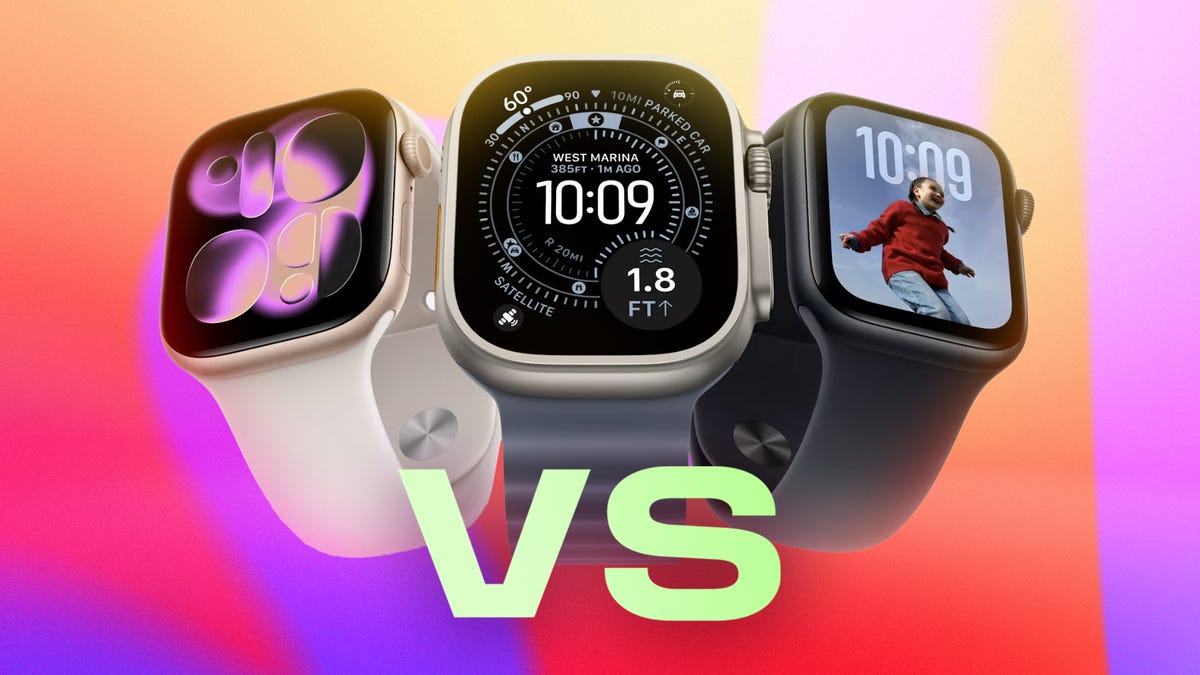
When you’re looking to buy a smartwatch, whether you want a way to stay on top of notifications or its health-related features, the Apple Watch is a good place to start. But there isn’t just one. Apple sells three different versions that appeal to different needs.
The flagship Apple Watch Series 11, rugged Apple Watch Ultra 3 and economical Apple Watch SE 3 models are a lot closer in features and specs than they’ve ever been. Let’s compare them to see which deserves a place on your wrist.
Pricing the Apple Watch Series 11, Ultra 3 and SE 3
The current Apple Watch line spans a wide price range, from $249 for the Apple Watch SE 3 to $1,299 for a titanium Apple Watch Series 11 with an Hermès band. Like most fashion accessories, you can choose from different case sizes, materials, cellular connectivity options and bands to find the right fit — and price — for your watch.
The Apple Watch Series 11 offers the widest price range, with two case sizes, two body materials, optional cellular connectivity and premium Hermès models. The Apple Watch SE 3 is available only in aluminum and has the earlier, slightly smaller case sizes. The Apple Watch Ultra 3 comes only in titanium, with a single 49mm size and cellular included by default.
Read more: Find the best deals on the Series 11 and Ultra 3.
Here’s how they break down:
| Apple Watch Series 11 | GPS | GPS plus cellular |
|---|---|---|
| 42mm aluminum | $399 | $499 |
| 46mm aluminum | $429 | $529 |
| 42mm titanium | $699 | |
| 46mm titanium | $749 | |
| Hermès 42mm titanium | $1,249 | |
| Hermès 46mm titanium | $1,299 | |
| Apple Watch SE 3 | ||
| 42mm aluminum | $249 | $299 |
| 46mm aluminum | $279 | $329 |
| Apple Watch Ultra 3 | ||
| 49mm titanium | $799 | |
| Hermès 49mm titanium | $1,399 |
Series 11 vs. Ultra 3, SE 3 physical designs
The core rounded-rectangle design of the Apple Watch has seen incremental changes since its first iterations. The Series 11 shares the slimmer 9.7mm height profile of the Series 10, with 42mm and 46mm diagonal sizes. Weight is light across the board, from 29.7 to 43.1 grams depending on size and case material. Aluminum models come in space gray, jet black, rose gold or silver, while titanium versions are offered in natural, slate or gold finishes.
The Apple Watch SE 3 is slightly thicker (10.7mm) and slightly smaller, with 40mm and 44mm sizes. Its design most closely harkens back to earlier Apple Watch models. It weighs 26.4 grams or 33 grams, depending on the case size. As the no-frills option, the SE 3 is available in either midnight (black) or starlight (silver).
The Ultra 3 is the most significant departure from the original design, with a thickness of 14.4mm, a 49mm diagonal, and a weight of 61.6 grams. Its titanium body comes in either natural or black — unless you opt for the Hermès edition, which is only offered in natural.
CNET lead writer Vanessa Hand Orellana described the Ultra 3 in her review as being «like the luxury Land Rover you see in safari brochures: It’s adventure-ready on the outside, with all the modern conveniences on the inside.» The body is also 3D-printed from 100% recycled titanium, but you’d never know it; there are no telltale layering marks found on most 3D-printed items.
Each watch has Apple’s Digital Crown and a side button. The Ultra 3 also includes a programmable Action button, which can, for example, start a workout with a single press.
Aside from looks, all three Apple Watch models are built for durability. The SE 3 is water resistant to 50 meters, so you don’t need to baby it — whether you’re showering, swimming or just living through a rainy Pacific Northwest day.
The Series 11 is also rated for water resistance to 50 meters, while the Ultra 3 doubles that to 100 meters. They’re also both certified IP6X dust-resistant, which is better than the SE.
Series 11 vs. Ultra 3, SE 3 displays
The Series 11 and Ultra 3 both use an LPTO 3 OLED display, which offers an always-on display and a wide viewing angle, so you don’t need to look at it head-on to see the time. It can also get very bright: 2,000 nits of peak brightness for the Series 11 and 3,000 nits (the same as the iPhone 17 Pro) for the Ultra 3.
The energy-efficient screen can refresh its display at just one nit of brightness once every second when in its passive state, so you can always see the second hand or indicator (depending on the watch face).
The display is protected by a sapphire crystal on the titanium Series 11 and the Ultra 3. According to Apple, the aluminum Series 11 uses Ion-X glass, which is twice as scratch-resistant as the Series 10.
In past generations, the SE was stuck with the lowest-quality screen, but not this time. The SE 3 gets an always-on LTPO OLED display that reaches up to 2,000 nits of brightness and dims to just 2 nits when inactive. But it doesn’t refresh as often as the Series 11 and Ultra 3, so the seconds indicator only appears when the screen is active. It’s still a big «quality of life» bump from prior SE watches, which don’t have an always-on display mode.
Series 11 vs. Ultra 3, SE 3 battery life
One surprise with the new Apple Watch lineup is improved battery life in the Series 11 and Ultra 3, plus a fast-charge option on the SE 3 that lets you top up for a night’s sleep after a full day.
Apple claims up to 24 hours of use on a single charge for the Series 11, up from 18 hours for the Series 10. It also claims up to 38 hours in Low Power mode, a notch above the Series 10’s 36 hours. That fast-charging option can bring the battery level up to 80% in 30 minutes, but charging the watch for just 15 minutes can boost it for up to 8 hours.
Hand Orellana writes in her Series 11 review, «The six-hour battery bump on the Series 11 may not sound like much on paper, but it’s given me some welcome breathing room to figure out a better charging strategy.»
The SE 3 still delivers up to 18 hours of use, or 32 hours in Low Power mode. It also supports fast charging — up to 80% in 45 minutes, or about eight hours of use from a quick 15-minute top-up.
If you want the most time between charges, the Ultra 3 is the Apple Watch to get. It can last for up to 42 hours, per Apple, or up to 72 hours in Low Power mode. Fast charging its larger battery takes it to 80% in about 45 minutes, and 15 minutes on the cable will give you roughly 12 hours of power.
Some of these gains come from Apple factoring in a night’s sleep, but credit also goes to the more power-efficient LTPO 3 screen in the Series 11 and Ultra 3.
It’s one thing to reference Apple’s claims, but what about battery life in practice? In Hand Orellana’s review of each model, she recorded even better battery life than Apple’s estimates. Keep in mind your daily usage will affect results, but here’s what she found:
| Apple Watch | Apple’s estimate | CNET review |
|---|---|---|
| Series 11 | 24 hours | 27-32 hours |
| Ultra 3 | 42 hours | 45-49 hours |
| SE 3 | 18 hours | 20-25 hours |
Series 11 vs. Ultra 3, SE 3 health features
The Apple Watch SE line has always sacrificed some hardware and features to remain the least expensive option, and the SE 3 continues that tradition — but not to the same extent. It lacks an electrical heart sensor found in the Series 11 and Ultra 3, so it can’t take heart readings using the ECG app to look for signs of atrial fibrillation (Afib).
According to Apple, the SE 3 uses a second-generation optical heart sensor that tracks heart rate during exercise, sleep and potential emergencies — though, like all Apple Watches, it can’t detect heart attacks or measure blood oxygen. The Series 11 and Ultra 3 upgrade to third-generation optical heart sensors.
The SE 3 is also missing a water temperature sensor and depth gauge, making the Series 11 and Ultra 3 better options if you spend a lot of time in water and want to track swim workouts or shallow dives more reliably.
This year’s standout health feature is the ability to analyze data and detect signs of hypertension, or high blood pressure. «It’s not the full on-the-spot blood pressure monitoring Apple fans have long hoped for,» wrote Hand Orellana, «but it’s a major step forward — one that Apple says could help 1 million people get diagnosed with hypertension in the first year alone.»
Like the sleep-apnea tracking introduced last year, hypertension notifications are not a screening tool; think of it as a warning system that prompts you to get checked out by your doctor. The Series 11 and Ultra 3 include this ability (sorry, SE 3), and require 30 days of data collection before triggering notifications. The Series 9, Series 10 and Ultra 2 also get hypertension notifications in WatchOS 26.
Series 11 vs. Ultra 3, SE 3 connectivity
Each Apple Watch model supports cellular connectivity, so you can stay connected even when your iPhone is at home. You can order the aluminum Series 11 models and the SE 3 with the cellular option; the titanium Series 11 and the Ultra 3 include it by default.
What’s unique about these watches is their support for both 5G and LTE networks, offering faster speeds and broader compatibility. Plus, they use 5G Reduced Capacity technology, which is more power efficient than the 5G networking in your iPhone.
They also support Wi-Fi 4 (802.11n) at 2.4 GHz and 5 GHz, Bluetooth 5.3, and L1 GPS location chips. The Ultra 3 includes dual GPS radios (L1 and L5) for more precise location tracking, especially in challenging environments like dense downtown corridors.
Plus, the Ultra 3 offers satellite connectivity directly from the watch. With a direct view of the sky, it can communicate with overhead satellites to send and receive texts, share your location, and access emergency services.
Series 11 vs. Ultra 3, SE 3 processors
One of the biggest surprises in the lineup? The Apple Watch Series 11, Ultra 3 and SE 3 all include the same S10 chip. It’s worth noting that the S10, introduced in last year’s Series 10, isn’t a new processor generation for 2025. But each watch now includes 64 gigabytes of storage, a four-core Neural Engine and a 64-bit dual-core processor.
The only significant difference is that the Apple Watch SE 3 is the only model not to feature Apple’s second-generation Ultra Wideband chip, which enables precise location tracking. You can still use Find My on an iPhone (with UWB) to see if the SE 3 is with you or if you left it at home. But with the Series 11 and Ultra 3, Find My will point you in the right direction as you get closer to your mislaid watch.
WatchOS 26 on the Series 11, Ultra 3 and SE 3
Each model is preloaded with WatchOS 26, which has the new Liquid Glass interface (though in most cases, it’s quite subtle). And all models add features like the new Wrist Flick gesture, nightly sleep scores, Workout Buddy, the Notes app and live translation in Messages. The Series 11 and Ultra 3, with their upgraded sensors, also gain hypertension notifications.
Apple Watch Series 11, Ultra 3 and SE 3 specs
| Apple Watch Series 11 | Apple Watch Ultra 3 | Apple Watch SE (3rd Gen) | |
| Design & sizes | Rectangular, 42mm, 46mm | Rectangular, 49mm | Rectangular, 40mm, 44mm |
| Display | 42mm: 446 × 374 pixels; LTPO3 OLED Retina display (wide-angle) 46mm: 496 × 416 pixels; LTPO3 OLED Retina display (wide-angle) | 49mm: 514 × 422 pixels; LTPO3 OLED Retina display (wide-angle, Always-On) | 44mm: 368 × 448 pixels (Always-On Retina LTPO OLED)Apple 40mm: 324 × 394 pixels (Always-On Retina LTPO OLED) |
| Brightness | Between 1 and 2000 nits | Between 1 and 3000 nits | Up to 1000 nits |
| Thickness & weight | 46mm: 9.7mm; 37.8g (aluminum GPS), 36.9g (aluminum GPS+Cellular), 43.1g (titanium) 42mm: 9.7mm; 30.3g (aluminum GPS), 29.7g (aluminum GPS+Cellular), 34.6g (titanium) | 49mm: 14.4mm; 61.6g (titanium) | 44mm: 10.7mm; 33.0g (aluminum GPS+Cellular) 40mm: 10.7mm; 26.4g (aluminum GPS+Cellular) |
| Material & finish | Aluminum: Jet black, rose gold or silver finish; Titanium: slate, gold or natural finish with sapphire crystal display (titanium) | Titanium, natural or black finish with sapphire crystal display (titanium) | 100% recycled aluminum, midnight and starlight |
| Durability | 2X more scratch resistant glass (aluminum), 5ATM Water + IP6X (dust) | Water resistance 100m; dust IP6X, scuba to 40m, tested to MIL-STD 810H | Cover glass is 4X times more resistant to cracks than the SE 2; made of Ion-X glass. Water resistant up to 50 meters |
| Battery life | Up to 24 hours, up to 38 hours Low Power (always-on) + Fast charge: 80% in 30 min, 100% in 60 min | Up to 42 hours; up to 72 hours Low Power. Fast charge to 80% in 45 min, 100% charge 75 min | All-day, 18-hour battery life. Fast charging with 8 hours of normal use in just 15 minutes on the charger |
| Sensors | ECG, 3rd-gen optical heart sensor, skin temp, depth gauge, SpO2, Noise monitoring, water temperature, compass | ECG, 3rd-gen optical heart sensor, skin temp, depth gauge, SpO2, Noise monitoring, water temperature, compass | Wrist temperature, Second-generation optical heart sensor |
| Emergency features | Satellite SOS, Emergency SOS, Fall detection, Crash detection, Check in and Backtrack | Satellite SOS, Emergency SOS, Fall detection, Crash detection, Check in and Backtrack | Fall Detection, Crash Detection, Emergency SOS, and Check In |
| AI & coaching | Siri (voice assistant); Workout Buddy | Siri (voice assistant); Workout Buddy | On-device Siri, Workout Buddy |
| Processor | S10 SiP with 64-bit dual-core processor, W3 Apple wireless chip | S10 SiP with 64-bit dual-core processor, W3 Apple wireless chip | S10 SiP with 64-bit dual-core processor, W3 Apple wireless chip |
| RAM/Storage | 64GB (storage) | 64GB (storage) | 64GB (storage) |
| Payments | Apple Pay | Apple Pay | Apple Pay |
| Price (US) | $399-$750 (titanium) | $799 | $249 (starting) |
Technologies
Today’s NYT Mini Crossword Answers for Tuesday, April 7
Here are the answers for The New York Times Mini Crossword for April 7.
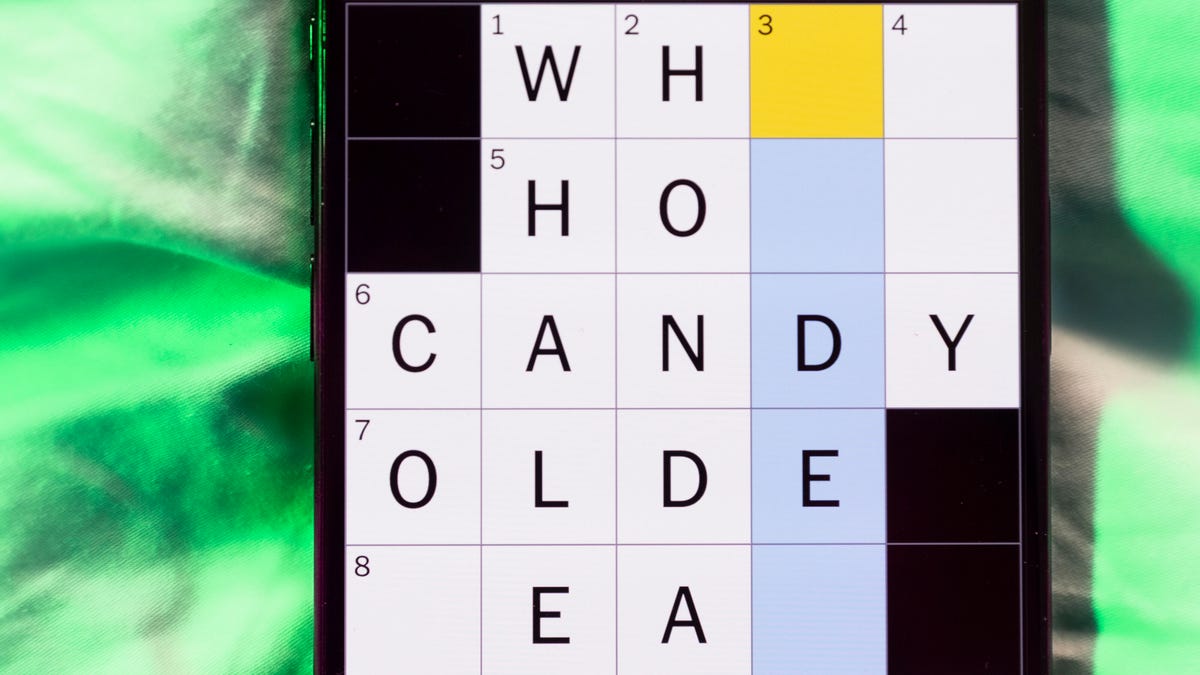
Looking for the most recent Mini Crossword answer? Click here for today’s Mini Crossword hints, as well as our daily answers and hints for The New York Times Wordle, Strands, Connections and Connections: Sports Edition puzzles.
Need some help with today’s Mini Crossword? Read on for all the answers. And if you could use some hints and guidance for daily solving, check out our Mini Crossword tips.
If you’re looking for today’s Wordle, Connections, Connections: Sports Edition and Strands answers, you can visit CNET’s NYT puzzle hints page.
Read more: Tips and Tricks for Solving The New York Times Mini Crossword
Let’s get to those Mini Crossword clues and answers.
Mini across clues and answers
1A clue: Informative commercial, for short
Answer: PSA
4A clue: Something you trace to draw a Thanksgiving turkey
Answer: HAND
5A clue: ___ Johnson, former Prime Minister of the U.K.
Answer: BORIS
6A clue: Opposite of include
Answer: OMIT
7A clue: Crosses (out)
Answer: XES
Mini down clues and answers
1D clue: City with the Notre-Dame Cathedral
Answer: PARIS
2D clue: Bad mood
Answer: SNIT
3D clue: About eight minutes of the average half-hour sitcom
Answer: ADS
4D clue: Remote worker’s office, perhaps
Answer: HOME
5D clue: Word that can follow each group of circled letters (and hints at its shape)
Answer: BOX
Technologies
NASA’s Artemis II Breaks Record With Trip Around The Moon
Technologies
In Honor of the Artemis II Mission, Explore the Moon in Fortnite Now
You might not be able to see the moon the way the Artemis II team is, but there’s an educational Fortnite simulation that will get you onto the celestial body’s surface.
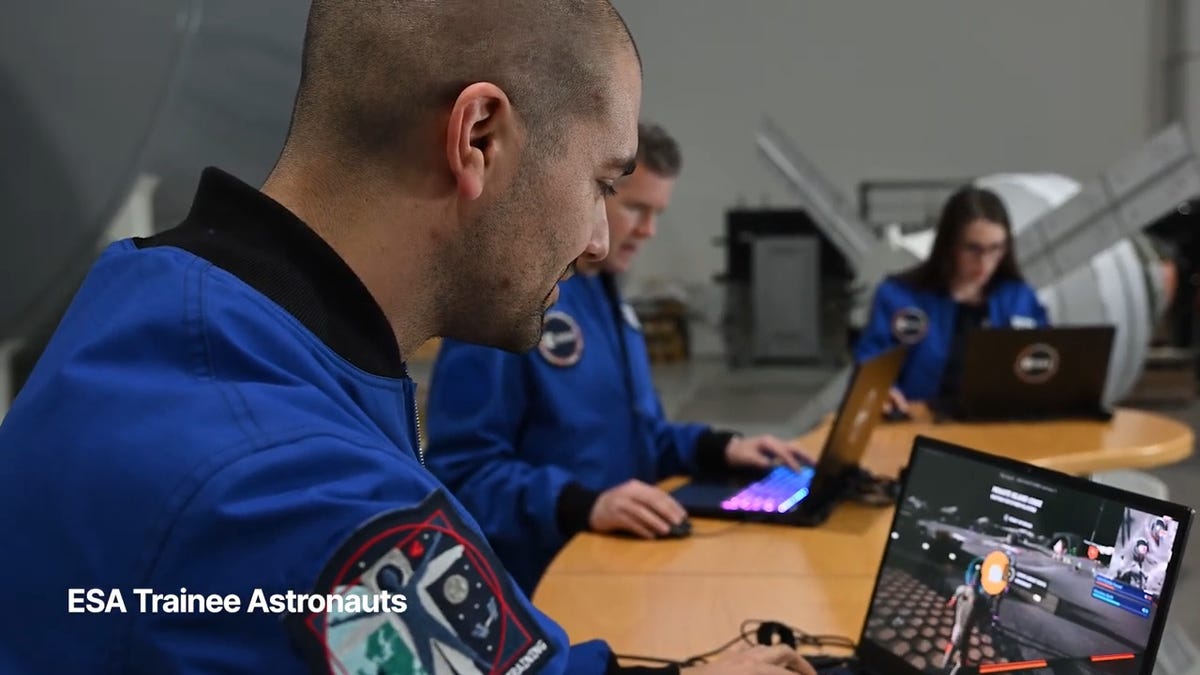
You may not be able to explore the vast majesty of space in the same way that the four-person crew of the Artemis II is, but you can still get an up-close-and-personal view of the moon… in Fortnite, at least.
While you may not be able to slingshot around Earth’s own lunar body, space enthusiasts can see a little bit of what the Artemis II crew is seeing by spending time on the Lunar Horizons Fortnite map right now. The map is a creative collaboration between Fortnite’s creator, Epic Games, and the European Space Agency. Lunar Horizons was released in 2024 after extensive testing and play from ESA trainee astronauts.
If you’re looking to learn more about our own orbiting body, the Lunar Horizons map is an educational simulation of the surface of the moon’s South Pole.
It blends game mechanics with learning, as players get to build up their own sterile lunar habitat bases, interact with ESA astronauts and roll around with robotic rovers as they discover informative plaques that contain information about the moon and international space agencies. There are still dangers to navigate, too — a solar storm may strike when you least expect it.
If you’re interested in exploring the moon, we’ve got all the information you need to join in on the Fortnite fun below. And if you’re looking for a more serious livestream during this momentous human achievement, tune into NASA’s feed here.
How to join the Moon Fortnite island while you follow the Artemis II mission
The Lunar Horizons Fortnite map is a great educational simulation that shares details about ESA’s work and catalogs information about humanity’s lunar research.
These three simple steps will get you up and running (or more accurately, taking slow leaps and bounds) on the surface of the Lunar Horizons Fortnite map:
Download Fortnite
If you haven’t played Fortnite before, but you want to check out this limited-time event, you’ll have to download the game. If you’re on PC, you can download Fortnite for free from the Epic Games Store. Console players can navigate the PlayStation Store, Microsoft Store or Nintendo eShop in order to download Fortnite on their devices.
Navigate the in-game menus until you reach the Search button
Once you’re in the game, scroll down past the different official Fortnite game modes and the Discover tab until you find the Search button.
Input the Lunar Horizons island code
In the search bar, you can input a map’s name or its distinct search code in order to find it in the map directory. You can search for the Lunar Horizons map or input the code 3207-0960-6428 to explore this map in time.
Correction, 3:35 p.m. PT: This story initially was in error about the features available in the Lunar Horizons map. There is no Artemis II-specific mission in Fortnite. Rather, the Lunar Horizons map is an educational simulation of part of the moon’s surface.
-
 Technologies3 года ago
Tech Companies Need to Be Held Accountable for Security, Experts Say
-
 Technologies3 года ago
Best Handheld Game Console in 2023
-
 Technologies3 года ago
Tighten Up Your VR Game With the Best Head Straps for Quest 2
-
 Technologies4 года ago
Black Friday 2021: The best deals on TVs, headphones, kitchenware, and more
-
 Technologies5 лет ago
Google to require vaccinations as Silicon Valley rethinks return-to-office policies
-
 Technologies5 лет ago
Verum, Wickr and Threema: next generation secured messengers
-
 Technologies4 года ago
Olivia Harlan Dekker for Verum Messenger
-
 Technologies4 года ago
The number of Сrypto Bank customers increased by 10% in five days