
Technologies
My OnePlus 15R Review: A Lovely $700 Phone That’s Held Back by Its Compromises
The $700 Android phone has a lot to like for OnePlus fans who want a giant battery for less money than its flagship sibling.
Our Experts


Pros
- Excellent battery life and charging speeds
- Big and responsive display
- 120fps video looks gorgeous
Cons
- Lacks wireless charging
- More expensive than the OnePlus 13R
- Mixed camera quality
- Short software support compared to competing phones
The $700 OnePlus 15R’s standout feature is its massive 7,400-mAh silicon-carbon battery, one of the largest I’ve ever encountered on a phone. In my testing, it easily lasted two days between charges, even with plenty of media streaming, gaming and photography.
But it was the 15R’s hypersonic fingerprint sensor that impressed me even more, as it’s a feature I hadn’t seen on a midrange flagship phone before. It makes unlocking the phone feel much smoother than an optical fingerprint sensor, especially since it doesn’t require a bright light to function. I hope to see it become available on even cheaper phones, but for now, having it on the OnePlus 15R is nice.
Upgrades like these make the OnePlus 15R feel premium despite it being the step-down option from the $900 OnePlus 15. The phone’s features rival those of more expensive phones, such as the $799 Samsung Galaxy S25, rather than cheaper competitors like the $650 Galaxy S25 FE or the $499 Google Pixel 9A.
And with that $700 price, you’re definitely paying for those upgrades. OnePlus notes that the $700 starting price (for 12GB of RAM and 256GB of storage) might change. «Product pricing can vary in different countries and regions due to various local market factors,» OnePlus said.
But even at $700, it’s worth considering some of the things you don’t get with the OnePlus 15R. For example, the 15R comes with a 55-watt fast charger in the box and supports 80-watt wired charging speeds when paired with the corresponding OnePlus wall plug, but it lacks wireless charging. The previous R model, the OnePlus 13R, also didn’t have wireless charging, but it did have a telephoto camera that the 15R doesn’t, which somewhat made up for it.
The phone’s Snapdragon 8 Gen 5 chip is a step down from the OnePlus 15’s Snapdragon 8 Elite Gen 5 processor, but I still found it fine for gaming, multitasking and recording high-resolution slow-motion videos. The OnePlus 15R comes with four years of software updates and six years of security updates. It’s fine, but it falls short of Samsung’s and Google’s seven-year commitment to both.
OnePlus fans who don’t want to spend top dollar for the latest OnePlus 15 will find a lot to like with the 15R. But, like the 13R, it’s important to consider the compromises the 15R makes to see if any of them are potential dealbreakers.
OnePlus 15R’s design, specs and features
My OnePlus 15R review unit is the mint breeze edition, a light green color that encompasses the back of the phone, the side rails and the camera bump. A darker charcoal black model is also available, and is the sole color if you opt for the $800 model with 512GB of storage. The design is similar to the OnePlus 15, with the main difference being the 15R’s dual-camera setup versus the three on the more expensive phone.
There’s a new programmable shortcut button called the Plus Key, located across from the volume and lock screen buttons. Similar to the Action button on newer iPhone models, it can trigger shortcuts like toggling between sound and vibration, opening the camera or turning the flashlight on. I wish I could use it to launch any app, though, which is possible on Apple’s Action button using shortcuts.
The phone’s 6.8-inch display is expansive, and I found it particularly good for watching or playing media. But it’s too big for me to use one-handed beyond scrolling. The display can continuously run at a smooth 120Hz refresh rate, which has become the standard across all Android phones in this price range. There are certain mobile games, like Call of Duty Mobile, that can take advantage of the display’s full 165Hz capability, but I can’t use that higher refresh rate when I’m not gaming. The OnePlus 15 has the same limitation. This surprises me, as I’ve seen less powerful phones with a consistent 165Hz refresh rate.
For example, when I played the game Dead Cells, it looked great on the phone, and the touchscreen was responsive, which helped especially during frenetic moments battling through successive deadly monsters. But its refresh rate is constrained to 120Hz. I find that odd, because I’ve seen this game run at 165Hz on phones that include that option. I found other games, such as Red Dead Redemption, Fortnite and Fall Guys, to load quickly at high graphics settings too. Red Dead ran at a steady 40 frames per second (fps) in its performance mode, while Fortnite and Fall Guys ran at 60fps on their higher graphics options.
Perhaps it’s a choice to help extend battery life, but the OnePlus 15R’s large capacity would seem plentiful enough to handle some extra gaming workload. Most of the time, I’m happy if a phone can last a full day on a single charge. With the OnePlus 15R, I easily got through two days and nights on a single charge. In CNET Labs’ 3-hour YouTube streaming test, where phones start with a full battery, the OnePlus 15R dropped to 89%, the same as the $829 iPhone 17, and just behind its sibling, the OnePlus 15, which ended at 90%.
The OnePlus 15R comes with a wall charger, a rarity for most phones sold in 2025. While the included 55-watt fast charger doesn’t support the phone’s fastest 80-watt speed, I was able to get it from 0% to 49% of its 7,400-mAh battery capacity in 30 minutes. Considering most phones we cover typically have battery capacities between 4,200 and 5,000 mAh, that’s a lot of power even at half capacity.
30-minute wired fast charging test
| Phone | Percent increase | Battery capacity | Wall plug wattage | Comes with plug? |
|---|---|---|---|---|
| OnePlus 15 | 72% | 7,300-mAh | 80W | Yes |
| Apple iPhone 17 | 69% | 3,692-mAh | 40W | No |
| Samsung Galaxy S25 FE | 69% | 4,900-mAh | 45W | No |
| OnePlus 15R | 49% | 7,400-mAh | 55W | Yes |
| Samsung Galaxy S25 | 47% | 4,000-mAh | 30W | No |
| Google Pixel 9A | 46% | 5,100-mAh | 45W | No |
If you prefer to use more universal power adapters with the USB-PD standard, the OnePlus 15R will charge at a slower 18-watt speed. But even with that limitation, in real-world use, it’s only slightly slower.
Although the 15R doesn’t support wireless charging, OnePlus sells a case that allows for attaching magnetic accessories. OnePlus provides a sandstorm black case with the phone, which I found perfectly suitable for attaching my wallet accessory that doubles as a kickstand.
In benchmark testing for the CPU and graphics power, the OnePlus 15R scored comparably to phones like the Samsung Galaxy S25 — which runs on a custom edition of last year’s Snapdragon 8 Elite processor — and was slower than the OnePlus 15 and 13R. Compared to the prior OnePlus 13R, which has the 2023 Snapdragon 8 Gen 3 chip, the 15R scored similarly in the graphically intense 3D Wild Life Extreme test and notably higher in the computationally intensive Geekbench 6.0 CPU benchmark.
3DMark Wild Life Extreme
Geekbench v.6.0
- Single-core
- Multicore
OnePlus 15R cameras
I’m bummed that the OnePlus 15R doesn’t have a telephoto camera, but the 50-megapixel wide-angle and 8-megapixel ultrawide cameras can hold their own, especially in daylight settings or when recording at 4K 120fps videos.
Using the latter, I recorded Gizmo, my friend’s cat, as he darted between a flurry of poses while squished between two couches. And when visiting the 3 Daughters Brewery holiday train display in St. Petersburg, Florida, I was able to capture the model trains as they zoomed throughout the multitier village. The videos have a smooth clarity.
When it comes to photography, I would say the OnePlus 15R is on par with other $700 phones. Daylight photos have lots of detail but tend to skew warm in tone. I shot a photo of a sunset at a beach in Siesta Key, and the image has lots of orange colors and good texture in the whirling clouds in the sky.
I noticed that the camera tends to add an aggressive blur to images when it focuses tightly on a subject. For instance, in this photo of a dark chocolate gelato, the dessert underneath is blurred out as if I had taken it in portrait mode. But it’s not, it’s in its standard photo setting.
The OnePlus 15R did a decent job of getting photos of my friend’s fast-moving pets, albeit at the cost of some detail. In this photo, the camera is able to focus in on Kinley’s face, although it struggled a bit to capture the light of both eyes. Snickers, the dog in the background, was also moving around during this moment, but comes out as a background subject. This is actually good, though, as it’s a naturally more challenging subject in a lowlight area.
I have mixed feelings about selfie images from the phone’s 32-megapixel front-facing camera. They aren’t bad, but I feel like the 15R had trouble focusing on me, whether I was outdoors or indoors. This photo, taken on a street in St. Petersburg, is washed out despite otherwise being taken in broad daylight.
And it’s a similar situation for this selfie I took in an indoor brewery. The photos aren’t bad — they just aren’t as good as I’d prefer from a $700 phone. It’s more comparable to what I see from phones that are closer to $500, like the Motorola Edge and the Pixel 9A.
OnePlus 15R: The bottom line
The OnePlus 15R’s features make it an excellent starter gaming phone. I often thought about the RedMagic 11 Pro while reviewing the 15R. RedMagic’s $749 gaming phone has impressive specs that easily run any game you throw at it, and its 7,500-mAh silicon-carbon battery. But RedMagic seems to hit its reasonable price through a frustrating software experience that even includes advertisements when you open its web browser.
OnePlus chose not to skimp on the 15R’s display or the battery, and would rather make its cuts by going with a slightly less powerful processor, skipping wireless charging and omitting the telephoto camera. The result is a mighty $700 phone, even if it’s noticeably not going to outdo the more expensive OnePlus 15.
The phone is ultimately fantastic as a media powerhouse that can run for days on a single charge. But to make sure it’s a good fit, you’ll want to decide whether the lack of wireless charging is a deal-breaker.
If you want a phone with more features and less focus on gaming or a large battery, it’s worth considering phones in the $500 to $650 range, such as Google’s Pixel 9A and Samsung’s Galaxy S25 FE.
How we test phones
Every phone tested by CNET’s reviews team was actually used in the real world. We test a phone’s features, play games and take photos. We examine the display to see if it’s bright, sharp and vibrant. We analyze the design and build to see how it is to hold and whether it has an IP-rating for water resistance. We push the processor’s performance to the extremes using standardized benchmark tools like GeekBench and 3DMark, along with our own anecdotal observations navigating the interface, recording high-resolution videos and playing graphically intense games at high refresh rates.
All the cameras are tested in a variety of conditions, from bright sunlight to dark indoor scenes. We try out special features like night mode and portrait mode and compare our findings against similarly priced competing phones. We also check out the battery life by using it daily, as well as running a series of battery drain tests.
We take into account additional features like support for 5G, satellite connectivity, fingerprint and face sensors, stylus support, fast charging speeds and foldable displays, among others that can be useful. We balance all of this against the price to give you the verdict on whether that phone, whatever price it is, actually represents good value. While these tests may not always be reflected in CNET’s initial review, we conduct follow-up and long-term testing in most circumstances.
Technologies
Samsung’s Galaxy Watch Ultra 2 Might Come in 5G and 4G Cellular Models
If the rumor proves true, the 5G Galaxy Watch Ultra would rival the 5G-enabled $799 Apple Watch Ultra 3 that debuted last fall.
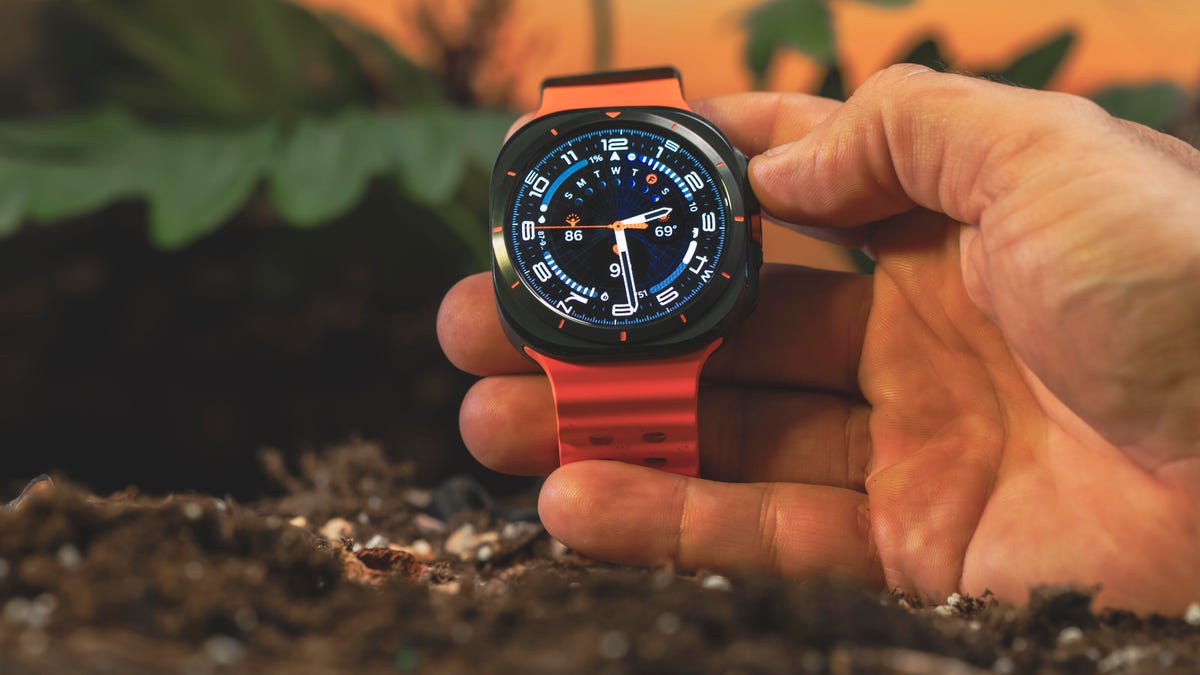
Samsung’s next high-end Galaxy Watch could support faster 5G speeds, but if this leak is true, it will depend on where you live. The rumored Samsung Galaxy Watch Ultra 2 might come in 5G and 4G cellular models, with availability for each smartwatch depending on the country.
According to the Dutch website Galaxy Club (and spotted by SamMobile), Samsung’s servers may have revealed a series of model numbers that point to 5G, 4G and Wi-Fi-enabled editions of the next Galaxy Watch Ultra, which would succeed the original model that debuted in 2024.
A representative for Samsung did not immediately respond to a request for comment.
The Galaxy Club website speculates that the 5G edition would be sold in the US and Korean markets, while the 4G edition would sell in the rest of the world. In the US, a 5G version of the Galaxy Watch Ultra would rival the 5G-enabled $799 Apple Watch Ultra 3, which debuted last fall. The 4G edition would have broader compatibility worldwide, since the earlier network is far more established.
It will likely be a few months until we hear anything official about the Galaxy Watch Ultra 2. Samsung typically unveils its new watches in the summer alongside its Galaxy Z Fold and Z Flip foldable phones. Last year, Samsung unveiled the Galaxy Watch 8 and the Galaxy Watch 8 Classic, but otherwise left the prior 2024 Ultra in the lineup for those looking for a larger 47mm smartwatch.
Technologies
2 Cases Show Supreme Court Isn’t Holding ISPs Responsible for Piracy
Technologies
Today’s NYT Connections Hints, Answers and Help for April 8, #1032
Here are some hints and the answers for the NYT Connections puzzle for April 8, No. 1032.

Looking for the most recent Connections answers? Click here for today’s Connections hints, as well as our daily answers and hints for The New York Times Mini Crossword, Wordle, Connections: Sports Edition and Strands puzzles.
Today’s NYT Connections puzzle is kind of tough. The purple category is a fun one, once you see the connection. Read on for clues and today’s Connections answers.
The Times has a Connections Bot, like the one for Wordle. Go there after you play to receive a numeric score and to have the program analyze your answers. Players who are registered with the Times Games section can now nerd out by following their progress, including the number of puzzles completed, win rate, number of times they nabbed a perfect score and their win streak.
Read more: Hints, Tips and Strategies to Help You Win at NYT Connections Every Time
Hints for today’s Connections groups
Here are four hints for the groupings in today’s Connections puzzle, ranked from the easiest yellow group to the tough (and sometimes bizarre) purple group.
Yellow group hint: In the group.
Green group hint: Appearance details.
Blue group hint: Often found in gyms.
Purple group hint: They help you see.
Answers for today’s Connections groups
Yellow group: Cohort member.
Green group: Aesthetic.
Blue group: Kinds of bar apparatuses.
Purple group: Eyewear in the singular.
Read more: Wordle Cheat Sheet: Here Are the Most Popular Letters Used in English Words
What are today’s Connections answers?
The yellow words in today’s Connections
The theme is cohort member. The four answers are associate, colleague, fellow and peer.
The green words in today’s Connections
The theme is aesthetic. The four answers are design, look, scheme and style.
The blue words in today’s Connections
The theme is kinds of bar apparatuses. The four answers are monkey, parallel, pull-up and uneven.
The purple words in today’s Connections
The theme is eyewear in the singular. The four answers are contact, goggle, shade and spectacle.
-
 Technologies3 года ago
Tech Companies Need to Be Held Accountable for Security, Experts Say
-
 Technologies3 года ago
Best Handheld Game Console in 2023
-
 Technologies3 года ago
Tighten Up Your VR Game With the Best Head Straps for Quest 2
-
 Technologies4 года ago
Black Friday 2021: The best deals on TVs, headphones, kitchenware, and more
-
 Technologies5 лет ago
Google to require vaccinations as Silicon Valley rethinks return-to-office policies
-
 Technologies5 лет ago
Verum, Wickr and Threema: next generation secured messengers
-
 Technologies4 года ago
Olivia Harlan Dekker for Verum Messenger
-
 Technologies4 года ago
The number of Сrypto Bank customers increased by 10% in five days