
Technologies
We Pit These Two Weird-Looking Android Gaming Phones Head to Head
OnePlus 15 vs. RedMagic 11 Pro: These powerful gaming-optimized phones look completely different, and each takes a different tactic to make the most of their high-end hardware.

From a design standpoint, the OnePlus 15 and RedMagic 11 Pro are almost complete opposites. OnePlus aims to evoke a premium design and sleek aesthetics, while the angular, futuristic-looking RedMagic 11 Pro looks like something out of a sci-fi movie.
However, they share nearly identical internal specifications and are both heavily focused on gaming. The OnePlus 15 aims to be a flagship phone that also delivers a strong gaming experience, while the RedMagic 11 Pro is, first and foremost, a gaming phone that also handles everyday smartphone tasks.
They’re both incredibly powerful, and each one makes different trade-offs to deliver a uniquely distinct experience.
Display
Big, beautiful, fast displays are front and center here and are impressive both technically and visually. The RedMagic 11 Pro houses an almost perfectly rectangular 6.85-inch AMOLED display with a 144Hz refresh rate. OnePlus went with a 6.78-inch in. OLED panel with a 120 Hertz refresh rate that can ramp up to 165 Hz during supported games.
The AMOLED panel on the RedMagic 11 Pro shows better colors, and the higher refresh rate gives it the edge here. Plus, RedMagic has been hiding its selfie cameras under the display for a few years now, so the screen is truly edge-to-edge, with no camera cutout. It’s a bit more angled than most other phones, but not uncomfortable, and the huge, gorgeous display is wonderful to look at.
Performance
The RedMagic 11 Pro and the OnePlus 15 have nearly identical spec sheets. Both house the latest Qualcomm Snapdragon 8 Elite Gen 5 with similar storage configurations of 12GB or 16GB of RAM and 256GB or 512GB of storage. RedMagic does have an advantage here, offering a maxed-out version with 24GB of RAM and 1TB of storage, but most people won’t need that much power. However, considering that version is the same price as the 16GB and/ 512GB edition OnePlus 15, that’s a value-oriented point for RedMagic.
RedMagic and OnePlus have both designed proprietary processors to accompany Qualcomm’s Snapdragon 8 Elite Gen 5 to help boost gaming performance, and the result is two phones that simply fly. I never once experienced any slowdowns or stutters anywhere across the software. No matter what I did, neither phone ever seemed to slow down.
Battery and charging
Both phones have massive batteries, with the OnePlus 15 coming in at 7,300-mAh and the RedMagic 11 Pro squeezing out a bit more juice at 7,500-mAh. Both will easily get you through two days — as long as you keep gaming to a minimum.
Both devices thankfully support fast charging, and it’s some of the fastest in the industry, especially in the US. Each can charge at up to 80-watt speeds over wired charging, and both come with an 80W charger in the box, which is frustratingly rare these days. OnePlus charges over the proprietary SuperVooc standard, which means you’ll need to use that included power adapter in order to achieve the phone’s fastest speed. Meanwhile, RedMagic uses the more universal USB-PD standard, so its charging brick can also fast charge other devices.
Wireless charging is available on both devices — a first for RedMagic. Even more impressive is how fast they can charge wirelessly. OnePlus was the first (and is still the only) company to bring 50W wireless charging to the US a few years ago. RedMagic claims that the 11 Pro can charge at up to 80W wirelessly. That’s an absolutely absurd claim and one I sadly cannot test, as the only 80W wireless charger I could find is made by Xiaomi and thus not available here in the States. OnePlus achieves that faster speed using the AirVooc standard — so again, you’ll need the wireless charger that OnePlus makes in order to get the faster 50W speed. While we can’t test the 80W wireless charging claim, we do know that the phone works with the more universal Qi wireless charging standard.
Gaming
RedMagic has built its entire ethos around mobile gaming, and the 11 Pro is the epitome of that. The lack of camera bump means it’s perfectly flat, so it feels better in your hand and fits into mobile controllers better. There are touch-sensitive shoulder triggers on the right side that can act as a touch point on the screen. For example, setting the left one to aiming and the right to fire in Call of Duty: Mobile easily makes the phone feel more like a gaming controller. There’s even a dedicated cooling fan built into the side to keep the phone cool during longer gaming sessions.
The pinnacle of it all is a feature that’s still a rarity on all but the highest-end gaming PCs: a self-contained liquid cooling system. On the Nightfreeze and Subzero models, you can actually see the electric-blue cooling liquid inside the phone. Turn it on, and the liquid will literally flow across the internals to help maintain peak gaming performance for longer than ever.
This may all seem a bit overkill (and it absolutely is for almost everyone), but it really sets RedMagic apart.
OnePlus takes a different approach, aiming to be a more traditional smartphone that still excels at gaming. On the OnePlus 15, the dedicated touch sampling and Wi-Fi processors, along with a proprietary internal cooling system, are specifically designed to squeeze out as much performance as possible while gaming.
And it works. Highly demanding games such as Call of Duty: Mobile, Genshin Impact, PUBG and Wuthering Heights — among others — all ran flawlessly on the OnePlus 15. In Call of Duty, I very rarely dropped below 165 frames per second, which is substantially higher than the average gaming PC can sustain.
Both companies also add software features to improve the gaming experience. OnePlus offers a preinstalled app called Game Assistant that lets you tweak settings for each game. RedMagic goes a step further to give you a hardware button that launches Game Space. This is essentially a separate launcher that almost turns your phone into a mini console. It also lets you modify settings, but it offers far more options to tweak, including an in-game overlay where you can install plugins and macros for extremely granular customization.
Software
Aside from the wildly different aesthetics, the software experiences are also worlds apart. OnePlus has taken more than a few cues from Apple’s Liquid Glass design language for OxygenOS 16, but the overall experience remains very fast, very smooth and fairly close to Google’s intended version of Android. It’s still one of my favorite takes on the operating system.
The RedMagic 11 Pro knows it’s a gaming phone through and through. Thankfully, RedMagic has heavily toned down the wildly over-the-top gaming-focused design elements over the years, but they’re still readily apparent throughout the software. The company also preloads the phone with an unacceptable amount of bloatware and useless apps, some of which cannot be uninstalled.
CNET senior editor Mike Sorrentino came away feeling rather disappointed in the software experience on the RedMagic 11 Pro during his testing, but I personally didn’t find it too unbearable. Nearly all of the issues he and I have with the software are the same ones I’ve had with Samsung’s software for years — and, ultimately, most of them are easy enough to avoid.
But without question, this one goes to OnePlus.
Price and availability
Prices for both RedMagic and OnePlus phones have steadily increased over the years to the point where both sit squarely in flagship territory. The OnePlus 15 starts at $899 for 12GB of RAM and 256GB of storage and jumps up to $999 for the 16GB and 512GB version. The base model only comes in black, but OnePlus typically offers the top-tier models at the lower price during launch.
The RedMagic 11 Pro starts at $749 for the 12GB of RAM and 256GB model and also goes up $100 to $849 for the 16GB and 512GB model. The top-end configuration of 24GB of RAM and 1TB of storage costs $999 — the same price as the lower-specced OnePlus 15.
Both devices will be available in most regions. The OnePlus 15 will be on sale at Best Buy, Amazon and the OnePlus website, although the ultra violet color option will only be available in limited quantities at Amazon and OnePlus. The RedMagic 11 Pro will be available on RedMagic’s website and Amazon.
OnePlus 15 vs. RedMagic 11 Pro
| OnePlus 15 | RedMagic 11 Pro |
|---|---|
| 6.78-inch OLED, 2,772×1,272 pixels; 1-120 Hz adaptive refresh rate (up to 165 Hz for gaming) | 6.85-inch AMOLED; 2,688 x 1,216 pixels; 144 Hz refresh rate |
| 450 ppi | 430 ppi |
| 6.36 x 3.02 x 0.32 in | 6.44 x 3.01 x 0.35 in |
| 161 x 77 x 8.2 mm | 164 x 77 x 8.9 mm |
| 215 g (7.58 oz) | 230 g (8.1 oz) |
| Android 16 | Android 16 |
| 50-megapixel (wide), 50-megapixel (ultrawide), 50-megapixel (3.5x telephoto) | 50-megapixel (wide), 50-megapixel (ultrawide), 2-megapixel |
| 32-megapixel | 16-megapixel |
| 8K | 8K |
| Qualcomm Snapdragon 8 Gen 5 | Qualcomm Snapdragon 8 Gen 5 |
| 12GB + 256GB, 16GB + 512GB | 12GB + 256GB, 16GB + 512GB, 24GB + 1TB |
| None | None |
| 7,300-mAh | 7,500-mAh |
| Under display | Under display |
| USB-C | USB-C |
| None | Yes |
| 4 years of OS updates; 6 years of security updates; Bluetooth 6.0; Comes with 80W wall charger | 3 years of OS updates and security updates, AquaCore liquid cooling, cooling fan, Game Space, 80W wired charging (charger included), 80W wireless charging |
| $900 (256GB) | $749 (256GB) |
Technologies
Tubi App Goes Live in ChatGPT to Give You TV and Movie Recommendations
Like the ultra-customized feel of a Tubi rec? The streamer aims to make it even more personalized.

Tubi, the free streaming platform known for its vast library of cult classics and indie movies, has added an app to ChatGPT. You can now use the chatbot to find content recommendations for TV shows and movies on Tubi, the streamer announced on Tuesday.
You may already have your own search strategy when using Tubi, but the addition of the native app within ChatGPT allows you to strike up a conversation and ask for uber-specific, personalized title suggestions. If you see a film or show that captures your interest, you have the option to click «Watch on Tubi» to stream it on a mobile device or the web. In the mood for scary movies about yetis? Use @Tubi for your prompt in the chatbot and request something like, «horror movies with aggressive yetis» and expect to see a selection of titles that fit your wish list.
«Streaming should feel effortless, and as chatbots and AI agents are becoming a common way people navigate the internet, Tubi is expanding its discovery experience to meet viewers in the moment they’re expressing intent in their own words,» Mike Bidgoli, Tubi’s chief of product and technology, said in a statement.
ChatGPT opened its app store this past December. It currently includes apps for Apple Music, Zillow, Spotify and Canva, offering the ability to connect your accounts to search, design or ask for recommendations. Back in 2023, Tubi created its own AI-powered tool called Rabbit AI for mobile users to help audiences find content to watch. The company later shuttered the feature, which used Open AI’s Chat GPT-4. With today’s launch, it’s the first video streaming service to add an app within ChatGPT.
(Disclosure: Ziff Davis, CNET’s parent company, in April filed a lawsuit against OpenAI, alleging it infringed Ziff Davis copyrights in training and operating its AI systems.)
Technologies
PlayStation Plus Subscribers Can Play Tomb Raider and More All April Long
Subscribers can also explore a Soulslike game that just got a big update.

PlayStation Plus, which is Sony’s version of Xbox Game Pass, offers a large, constantly expanding library of games. Subscribers can choose from the Essential, Extra and Premium tiers, each with unique perks and benefits. Starting at $10 a month, the plans give subscribers access to games and rewards, and each month, all subscribers can play a handful of new games at no additional charge. And some people on Reddit are pretty excited for a few of the games Sony is offering subscribers throughout April.
One user wrote how they are «buzzing» for the remastered Tom Raider games, while another user is willing to replay the Soulslike game Lords of the Fallen. «April fools’ joke? Because they’re actually good,» a third user wrote.
If you’re a PlayStation Plus subscriber, you can play these games now until May 4.
Lords of the Fallen
If you played Elden Ring and thought, «I wish this game had even more grimdark elements to it, like Bloodborne,» Lords of the Fallen might be for you. Choose one of nine classes to play as while you traverse the lands of the living and the dead in order to overthrow the demon god Adyr. You’ll fight all manner of monstrosities along the way, like a colossal humanoid with an arm protruding from its mouth or a giant carrion crow that wears a human skull.
HexWorks, the gaming studio behind Lords of the Fallen, also released a patch for the game on April 3. The patch is intended to make co-op sessions feel more rewarding for hosts and guests, so you and your friends should have even more fun in this game.
Tomb Raider 1-3 Remastered
Experience these classic Tomb Raider games from the 90s all over again — or for the first time — with the remastered trilogy. You’ll explore jungles, solve puzzles in the desert and tackle mercenaries and monsters along the way. While you can enjoy the boosted graphics of the remastered edition, you can also enable low-poly mode to experience these games as you would have almost 30 years ago.
Sword Art Online Fractured Daydream
A system called Galaxia has been added to Alfheim Online, allowing players to relive the past. But the system has spun out of control, displacing players throughout time. To set things right, you’ll have to work with friends and foes alike in this co-op raid battle game. But if you want to go solo, you can play story mode as characters from across space and time confront the anomaly in the VR world.
For more on PlayStation Plus, here’s what to know about the service. You can also check out other games on PlayStation Plus and games on Xbox Game Pass.
Technologies
Get Organized for Just $28 With This 6-in-1 Baseus Charging Station Deal
Ditch the cluttered cables and upgrade to this sleek USB power strip while it’s on sale for a record-low price.
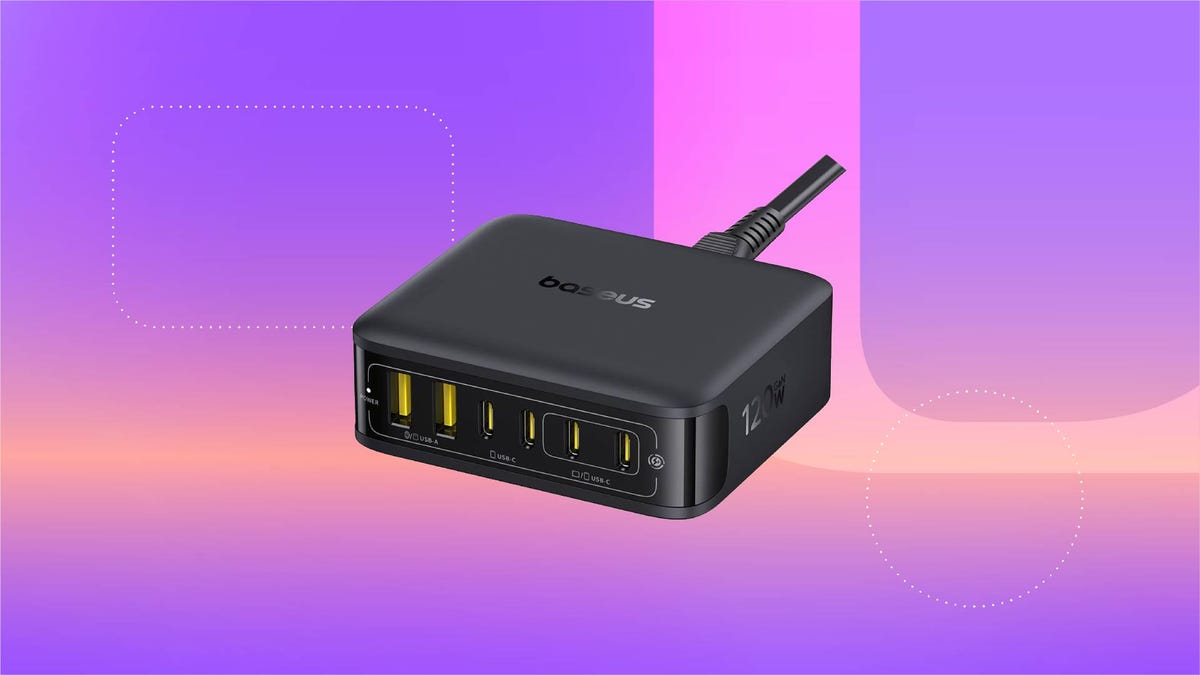
For just $28, this six-in-one Baseus charging station can help you keep your desk organized. That’s 20% off and the all-time lowest price we’ve seen for this 120-watt USB power strip. We don’t expect this limited-time deal to last for long, however, so you’ll want to get your order in sooner rather than later.
You can use this charging station for just about all of your devices, including phones, tablets, headphones and laptops. It’s equipped with four USB-C ports and two USB-A ports, so you can charge up to six devices at once. It also boasts a 65-watt single-port output, enough to fully recharge a MacBook Air in less than 2 hours. And at just 323 grams, it’s light enough to take on the go, making it a great buy for frequent travelers.
Why this deal matters
This sleek Baseus charging station can connect to up to six devices at once, and is still small enough that you can take it on the go. Plus, this is the all-time lowest price we’ve seen, making it a pretty great value.
-
 Technologies3 года ago
Tech Companies Need to Be Held Accountable for Security, Experts Say
-
 Technologies3 года ago
Best Handheld Game Console in 2023
-
 Technologies3 года ago
Tighten Up Your VR Game With the Best Head Straps for Quest 2
-
 Technologies4 года ago
Black Friday 2021: The best deals on TVs, headphones, kitchenware, and more
-
 Technologies5 лет ago
Google to require vaccinations as Silicon Valley rethinks return-to-office policies
-
 Technologies5 лет ago
Verum, Wickr and Threema: next generation secured messengers
-
 Technologies4 года ago
Olivia Harlan Dekker for Verum Messenger
-
 Technologies4 года ago
The number of Сrypto Bank customers increased by 10% in five days