
Technologies
iPhone Fold and iPhone Air 2: Launch Dates, Prices and Everything We Know
Apple’s rumored foldable could come as soon as 2026, though it may have company with a possible iPhone Air 2 or other devices.

With over half a decade of foldable phones released, devices from Samsung, Google and Motorola, such as the Galaxy Z Fold 7, the Motorola Razr Ultra and the Pixel 10 Pro Fold (as well as others from Oppo, Huawei and more) have given consumers plenty to choose from. Notably absent is a foldable iPhone, leaving the folding phone niche handily dominated by Android devices.
While we’ve yet to see any official word on a foldable iPhone from Apple, the company launched the iPhone 17 series along with the new super-thin iPhone Air in September. Given all the engineering it took to cram cameras and components into the top half of the Air, some have theorized that the device is a stepping stone to a foldable, which could take advantage of the Air’s internal design.
Foldable phones represent a tiny fraction of all phones sold globally. CNET found that 64% of people surveyed said they don’t want a foldable phone. But those numbers could change if Apple were to sell a foldable iPhone. There is a lot of hope and expectation placed on Apple to release one, and if rumors are correct, we won’t have to wait much longer for the company to do so.
iPhone Fold history
Rumors suggest Apple is developing a book-style foldable like the Galaxy Z Fold 7. Years ago, in 2017, folks predicted that a foldable iPhone could launch in the then-near future of 2020 — which didn’t happen. Analysts and leakers have been kicking the release date down the road ever since, and rumors and wish lists have lingered as phone fans keep their hopes alive. Absent any confirmed details from Apple, here’s everything we know so far about the company’s future foray into foldables.
A new patent granted to Apple in July 2024, which was applied for years ago, shows how long the company has been working on a folding iPhone. Kuo’s report in early March said that an Apple foldable could launch at the end of 2026, with a 7.8-inch crease-free inner display and a 5.5-inch outer display.
Accordingly, Kuo believes the price would match that of other similar folding devices, at $2,000 to $2,500. Despite the high price tag, he says projected shipments are 3 to 5 million devices, which is a confident estimate given only 19.3 foldables were sold in 2024, market research firm IDC reported.
Although many reports have focused on the company’s struggles to eliminate the crease within the internal folding display, Apple’s patent indicates that the development has been ongoing for some time. Creases have plagued foldable phones since their introduction in 2020, and although the most recent Samsung Galaxy Z Fold 7 and Samsung Galaxy Z Flip 7 have reduced the crease, it is still visible and noticeable.
By mid-2024, market analysts at TrendForce estimated that display crease issues might push back an Apple foldable until 2027, according to 9to5Mac. Prior rumors said Apple may not launch its own flexible screen device until 2025, and Samsung hasn’t let phone fans forget it by releasing an app that will let Apple phone owners experience a Z Fold-esque experience by placing two iPhones side-by-side.
Read more: I Visited Samsung’s Home Turf to See if Foldable Phones Are Really the Future
iPhone 2026 lineup
There’s no guarantee about which phones Apple will release during its usual September window, but the safest bet is on another series of flat phones, which we expect to be the iPhone 18 series. But what else could be coming alongside the usual lineup?
There could be an iPhone Air 2, though rumors conflict on whether to expect one next year or not. There’s been a lot more evidence for an iPhone Fold, though whether it comes out in 2026 or in later years is still uncertain. If the iPhone Fold does launch next year, more rumors have suggested a clamshell device has been prioritized and may come first — given reports of Apple researching a book-style foldable, we could get one of those as well.
iPhone Fold or iPhone Air 2?
There’s the chance that we get an iPhone Fold next year, which rumors have said could launch in 2026 at the earliest, though it could also come out in 2027 or later. It should be noted that analysts and rumors had predicted a foldable iPhone release from as far back as 2022, so the rolling prospective launch windows don’t lend confidence that we’ll necessarily see the device come out next year. Given Samsung’s six-year head start on making foldables, Apple seems to be in no rush to get one out.
While the iPhone Air came out with the iPhone 17 handsets, there are conflicting rumors on whether we’ll see an iPhone Air 2 in 2026. A recent report from The Information says that Apple is delaying the release of the next version of the iPhone, citing people familiar with the matter. This follows rumors that disappointing iPhone Air sales after launch led Apple to dial back production, though even that claim was denounced by TD Cowen, according to a note from the investment research firm that was seen by AppleInsider that asserted the company would continue producing the thin phone. The Information’s story was amended to say that the delay could be caused by engineers who are re-considering the Air’s design so that it could support a second rear camera.
All of which casts doubt on whether we’ll get an iPhone Air 2 next year, but there’s not enough evidence yet to roundly dismiss the possibility.
iPhone Fold specs
There are no confirmed specs for the iPhone Fold, because Apple hasn’t even confirmed one exists or is coming out. Given we don’t have a year of expected release, we can’t much predict what kind of internal specs the iPhone Fold will have — presumably, Apple will want its most powerful A-series chip to run it, along with enough RAM to handle two or three displays (depending on whether it folds inward or outward and needs a dedicated outer screen).
We do have some predictions for other specs, though only for the book-style Fold (not the clamshell). In March, analyst Kuo predicted the larger Fold could have a 5.5-inch outer screen and 7.8-inch inner display. When folded up, it will be 9-9.5mm thick and 4.5-4.8mm when unfolded. A front-facing camera will be available whether the phone is folded or unfolded, while it will also have two rear cameras.
Kuo predicted that the device will use the same high-density battery cells as used in what he referred to then as the “ultra-thin iPhone 17” which is presumably the iPhone Air. But that trim thickness means the foldable may forgo Face ID, so the device may use Touch ID in a side button.
iPhone Fold release date
Apple has neither confirmed the iPhone Fold nor announced a proper release date. Analysts and rumors have predicted that the foldable could come out in 2026 or be pushed until next year.
As for timing, since the iPhone Air was released alongside the iPhone 17 models, the Fold could come alongside the iPhone 18 series. But since Apple released the iPhone 16E early this year, far before the September window for its main iPhone release, the company could do the same with the iPhone 17E in 2026. Apple could even delay the launch of the standard iPhone 18 to the spring of 2027 to make room for the iPhone Fold in Apple’s Sept. 2026 launch, according to an ET News report. Given that Samsung offsets its standard and foldable phone releases at Unpacked events months apart from each other, Apple could do the same.
What Apple’s new patent says about the iPhone Flip
After years of rumors that Apple was working on foldable phones, a patent was finally granted to the company, confirming that it has been working toward a folding iPhone. The 22-page patent (PDF), simply titled “Electronic Devices With Durable Folding Displays,” was filed in November 2021 and granted on July 16, 2024.
Sadly for folding iPhone hopefuls, the patent doesn’t offer much illumination of what an iPhone Flip might look like. Most of the pages show figures depicting cross-sections of potential displays that fold about a hinge but not the device they’re folding around.
There are some tidbits deeper into the text of the patent that hint at potential design choices Apple might make, like a hinge that holds the display flat when unfolded but which would let the display “slightly fold about the bend axis when the electronic device is jolted during the drop event” — in other words, if dropped, the device would fold inward slightly so that it lands on its edges to protect the inner display.
It’s important to note that all evidence shows Apple working on a foldable iPhone, but the patent broadly applies to folding displays in general — to wit, some figure schematics describe a device that “may be a cellular telephone, tablet computer, laptop computer, wristwatch device or other wearable device, a television, a stand-alone computer display or other monitor” or screens as far-ranging as on vehicles, in kiosks, in media players or other electronic equipment.
The rest of the patent describes what an Apple device with a folding display may have and categorically lists things like batteries and wireless charging, Bluetooth and Wi-Fi connectivity, LED or LCD displays, microphones and capacitive sensors, haptics and so on. There’s explicit mention of a display folding 180 degrees, or fully flat, which follows most other foldables — presumably, Apple isn’t going to leapfrog the competition in following Samsung’s concept displays we saw at CES that unfold nearly 360 degrees.
Two foldable iPhone Flips?
Foldable iPhone hopefuls will at least be encouraged that Apple seemingly continues to tinker with an iPhone Flip design. The company is said to be working on two sizes of folding iPhones: a book-style and a clamshell-style, according to an older report by The Information, although this may be contradicted by a newer report by the same site suggesting Apple had settled on the latter for a smaller device. This aligns with prior rumors hinting the iPhone Flip will be in the clamshell format similar to the Samsung Galaxy Z Flip series or Motorola Razr Ultra.
It sounds like Apple’s been struggling to meet its high expectations: The company’s design team wants the iPhone Flip to be half as thin as current iPhone models and to have displays on the outside that are visible when the device is folded shut, according to the report.
Development on the iPhone Flip was halted around 2020, the older report noted, in order to focus on a new project, a folding iPad. This device would have an 8-inch display, around the size of the iPad Mini. The foldable tablet supposedly had less strict durability and thickness requirements, as it wouldn’t need to fit in pockets like an iPhone Flip. Apple was still working on ways to reduce the crease in the middle of the folding display and get the iPad to lie fully flat.
Release date: The iPhone Flip could launch in 2027
The latest indications of an iPhone Flip release date came back in June, when analyst Kuo suggested production could kick off in 2026 with phones coming out that year. This follows Kuo’s earlier prediction in March that the company could release a crease-free foldable by the end of 2026. Furthermore, this would likely be a book-style foldable with a 7.8-inch internal display and 5.5-inch external screen, which is counter to other predictions anticipating a clamshell-style foldable.
It’s possible that these timeline predictions apply to one or the other or, due to the vague nature of rumors, even both — that is, Apple could be working on both a book-style and clamshell style foldable, though it’s less clear if release date expectations would be interchangeable or if Apple would stagger their release.
It’s been an open secret for years that Apple is working toward a foldable iPhone. The company has been registering patents for foldable technologies for almost a decade, and while there’s no guarantee that one will come out even after all that research (remember AirPower?), there’s still been buzz and possible release dates floated for years — though still not one solid enough to get excited about.
Early rumors pointed as far back as 2021 as a potential target date, but the year passed with no foldable iPhone in sight. A March 2021 report from longtime analyst Kuo (via MacRumors) suggested 2023 might be more realistic (though that year has come and gone). According to Kuo, Apple still needs to figure out technology and mass production issues before bringing a device like this to market, hence the wait. Speculation later in 2021 from Bloomberg’s Mark Gurman aligned with Kuo’s predictions: In his Power On Newsletter, Gurman said that the foldable iPhone may not arrive for another two to three years.
Since then, new rumors have pointed to an even later release. Reliable display analyst Ross Young said in February 2024 that the foldable iPhone had been pushed back to 2025, and Kuo reaffirmed his predicted release window in a tweet in April 2022.
“Apple may launch its first foldable product in 2025 at the earliest, which may be a foldable iPad or a hybrid of iPad and iPhone,” Kuo wrote in the tweet.
Another rumor, first noticed by MacRumors in February of 2024 by Weibo-based blogger Fixed Focus Digital, suggested that the foldable iPhone project is delayed for the foreseeable future. The problem? Apple, which is rumored to be using Samsung folding panels for its iPhone Flip’s display, was dissatisfied with the screens’ performance after they broke down a few days into testing.
That’s echoed by the most recent estimate by TrendForce market analysts, reported in 9to5Mac, which predicted that an Apple foldable might not be released until 2027 at the earliest. Why? Apple’s strict requirements for reliability and the phone display’s crease. But Kuo’s more recent March 2025 predictions explicitly noted a crease-free foldable display, suggesting Apple might have moved past this roadblock — if all these rumors are to be believed, of course.
Read more: Top Foldable Phones for 2025
Design: What will the foldable iPhone look like?
A 2021 report from Bloomberg indicated Apple already had a working prototype of a foldable iPhone display. While it wasn’t a working model, it was a step up from a patent — which, until then, was all we had seen.
Apple seems to have taken out every patent under the sun when it comes to foldable displays, including an origami-style folding display, a flip-up display and even a wraparound display. We don’t know which one will make the final cut, but both Kuo and Bloomberg seem to agree that the current prototype is more of a traditional fold-out design.
Unlike Microsoft’s Surface Duo, which has hinges on the exterior, Apple’s would have one continuous display with a hidden hinge mechanism like the Galaxy Fold.
Apple leaker Jon Prosser reported in early 2021 that the iPhone Flip will likely use a clamshell design and come in several “fun colors.” Between the bright pastels of the iPhone 15 and Plus and the sleeker deep blue of the iPhone 15 Pro and Pro Max, an array of fun colors for Apple’s first foldable device is definitely a possibility.
YouTuber ConceptsiPhone also gave us a glimpse into what the iPhone Flip could look with concept art of the foldable iPhone in the colors blue, red, gold and green.
In March 2025, analyst Kuo had some very specific but non-clamshell predictions: that Apple would release a book-style foldable with a 5.5-inch outer screen that unfolded to have a 7.8-inch internal screen, and be 4.5-4.8mm when unfolded but 9-9.5mm thick. It would have the same high-density battery cells as the “ultra-thin iPhone 17” and a hinge with stainless steel and titanium alloy (a favorite material of Apple’s iPhone 16 Pro and Pro Max as well as the Apple Watch Ultra 2).
Per Kuo’s predictions, the foldable will have two rear cameras and a front-facing camera on both the external and internal displays. Most interestingly, Kuo also expects that Apple’s book-style foldable will see the return of Touch ID as a side button, as Face ID might be left out due to space constraints — presumably for the array of depth-of-field sensors and cameras needed for the tech.
Roadblocks: What still stands in Apple’s way?
Samsung and others have been testing the waters, but Apple has been learning from the pain points of their foldable devices and figuring out how they’d be used.
One of these pain points is the crease. A lot of the current cover materials, including the glass and plastic mix that Samsung uses for the Z Fold and Z Flip, show a visible crease when folded out to full screen. To avoid it, Apple would likely have to wait for Corning, Apple’s glass provider, to create some kind of bendable version of its Ceramic Shield screen. The company is already working on a bendable glass but hasn’t announced a launch date for it.
Kuo tweeted in April 2022 that Apple was testing a foldable OLED screen. Korean tech news site The Elec also reported that Apple was working with LG to develop a foldable OLED panel.
Cost: Foldable phones don’t come cheap
Price is another major problem for these types of devices. Although Samsung still has the most affordable folding phone with the clamshell Motorola Razr at $700, most others in the category are book-style foldables like the Galaxy Z Fold 7 and the Pixel 9 Pro Fold, which are around twice the price of most flagship phones. We wouldn’t expect a foldable iPhone to be cheaper than its rivals. Apple’s foldable needs to be in line with current foldable and nonfoldable models to be able to compete against other brands and entice iPhone users to ditch their single-screen devices and pay more for a foldable.
Analyst Kuo predicted that a book-style iPhone foldable coming in 2026 could be priced anywhere from $2,000 to $2,500 as it’s “expected to generate strong replacement demand-despite the premium price-provided quality meets expectations.”
A report last year found that half of American consumers are interested in buying a foldable phone, though Apple customers are slightly less willing to make the leap than Samsung or LG users. Perhaps the “Apple effect” will change those stats if and when a foldable iPhone ever becomes a reality.
Technologies
Iranian President Pezeshkian traveling to New York for UN assembly as Trump warns of consequences without agreement
Iranian President Pezeshkian is traveling to New York for the UN assembly as Trump warns of severe consequences if no deal is reached, amid renewed diplomatic hopes and escalating tensions in the Middle East.
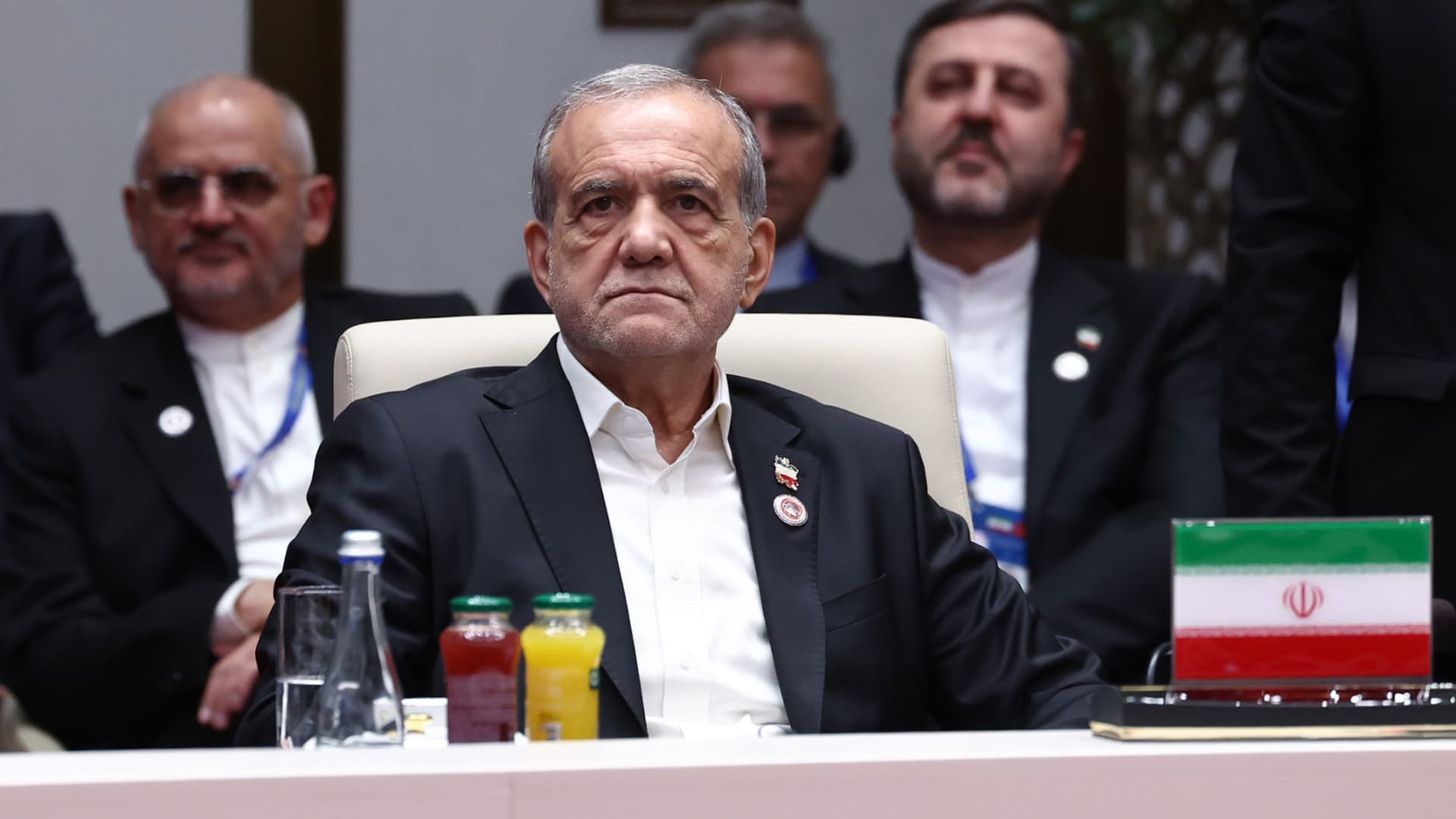
President Masoud Pezeshkian will lead an Iranian delegation to the United Nations General Assembly in New York on Tuesday, amid renewed hopes for a diplomatic resolution to the Middle East conflict.
Pezeshkian will address the assembly and present Iran’s positions on “international developments,” according to the country’s semi-official Tasnim news agency, with particular emphasis on its war with the U.S. and Israel.
He will also hold discussions with leaders of several countries on the sidelines of the event, scheduled for September 22-26 and 28.
The Iranian delegation’s participation at the UN has renewed hopes for a diplomatic solution to the war, improving market sentiment on Monday, with stocks rising, oil prices easing, and global bond yields falling sharply.
However, U.S. President Donald Trump, who has said he would be open to meeting Pezeshkian during the assembly, has threatened to destroy Iran’s economy or eliminate its leadership if Tehran doesn’t reach a deal.
Trump told Fox News on Sunday that the only options available were “wiping Iran out,” or letting its economy “rot,” unless both sides reach an agreement.
Separately, Iran’s military stated that its intelligence suggested a new, large-scale strike was being prepared by the U.S. and its allies, warning of “painful” retaliation across the Middle East. Regional countries supporting such a strike would be treated as parties to the conflict, it said.
“If the U.S. makes any mistake against the Islamic Republic of Iran, all its positions and interests in the region will be targeted by sustained, effective, and painful attacks,” Iran’s Khatam al-Anbia Central Headquarters said, according to Tasnim.
Houthi-Saudi conflict complicates diplomatic hopes
The U.S. State Department issued a security alert this weekend citing risks of unforeseen escalation in the Middle East, advising Americans to be more vigilant and aware of possible flight cancellations and airspace closures.
The warnings came after Iran-backed Houthi militants claimed missile and drone attacks on Riyadh on Saturday, triggering the first air-raid alert in the Saudi capital since fighting escalated in July.
Saudi authorities said they intercepted and destroyed a ballistic missile and reported no casualties or damage. The Houthis also attempted to target civilians and infrastructure in several parts of the kingdom, Saudi-led coalition forces spokesperson Major-General Turki al-Maliki said on X on Saturday, though those attacks were thwarted by the country’s air defenses.
Oil prices have retreated in recent days despite widening hostilities, as traders hope for a recovery in energy shipments from oil-rich Saudi Arabia.
Oil prices will remain high despite U.S. progress in moving oil through the Strait of Hormuz, a team of analysts at Eurasia Group said in a Saturday note. Any rebound in oil flows would not be sufficient to address the overall market deficit, they said, forecasting Brent prices to trade in a higher band of $90-110 per barrel for the rest of this year.
“Iran’s leadership will persist with resistance, even as they quarrel internally,” according to the consultancy firm, as Tehran seeks to use military proxies and tanker attacks to maintain a chokehold on shipping flows, pressuring Washington into concessions.
Tehran has insisted it would not reopen the Strait of Hormuz until Washington fulfills its commitment under the June memorandum, which called for lifting the naval blockade of Iranian ports, easing sanctions, unfreezing Iranian assets, and ending U.S. military threats.
Iranian parliament speaker Mohammad Bagher Ghalibaf said Sunday that Iran must continue fighting and negotiating to push back its enemies, and only work on diplomacy when it has the upper hand on the battlefield.
Technologies
U.S. crude oil tumbles back below $100 after Trump says he’s open to talking to Iran at UN
Oil fell Monday, as traders keep watch for a recovery in shipments from Saudi Arabia, even as Mideast tensions continue to escalate.

Crude oil prices fell sharply Monday to trade below $100 per barrel, after President Donald Trump reportedly decided against bombing Yemen for now and indicated he was open to diplomacy with Iran.
U.S. West Texas Intermediate futures dropped 4.5% to close at $95.78 per barrel. Brent crude, the international benchmark, lost 3.4% to settle at $100.34 after hitting a session low of $98.98 earlier.
Oil futures are on a four-day losing streak as the market sees the closure of Saudi Arabia’s East-West pipeline as less disruptive than initially feared. Prices initially surged in response to the pipeline outage.
Meanwhile, Trump told Fox News on Sunday that he would probably be open to meeting with Iranian President Masoud Pezeshkian at the United Nations General Assembly this week.
And the U.S. president has decided against bombing Iran-allied Houthi militants for the time being despite pleas from Saudi Arabia, Trump administration officials told The New York Times.
Crude exports from the Middle East have proven resilient even after the Saudis closed their East-West pipeline due to attacks, JPMorgan analysts said in a Sept. 18 note. Total oil flows averaged 17 million barrels per day in the past 10 days, or 6 million bpd below the 2025 average, they said.
Exports through the Strait of Hormuz have steadily risen with flows from the broader Middle East reaching about 80% of pre-war levels, said Ryan McKay, director of commodity strategy at TD Securities.
“It appears that without a major escalation Iran may have lost notable leverage in the Strait,” McKay said in a Monday note.
But the security situation in the region remains volatile and prone to sudden escalation. The oil market “is grappling with multiple near-term drivers that have been a tug of war for prices,” McKay said.
The Houthis on Saturday targeted the Saudi capital Riyadh and the port city Yanbu that serves as a key oil export terminal on the Red Sea. The Saudi military said it intercepted a ballistic missile launched at Riyadh and its air defenses thwarted the attack on Yanbu.
At least two tankers have come under attack while transiting the Strait of Hormuz over the past day, according to incident reports from the United Kingdom Maritime Trade Operations Centre.
And Trump told Fox that he is in a “deciding mode” and “very big things” are going to happen soon regarding the Iran war. He described the choices as “wiping Iran out, letting them rot economically or making a deal,” according to Fox.
Iran’s Revolutionary Guard, meanwhile, warned it will expand the “geography of the conflict” if the U.S. hits the Islamic Republic with renewed strikes, according to the state media outlet Tasnim.
Technologies
CNBC Daily Open: All that glitters is another U.S.-China détente
Thursday will tell us whether Washington and Beijing can match Monday’s market mood. Oil and chip stocks don’t write trade deals.

Hello, this is Anniek Bao writing to you from Singapore. Welcome to another edition of CNBC’s Daily Open.
Markets had a good Monday with oil sliding, yields easing and chipmakers surging.
It’s against that backdrop that things build toward Thursday with Chinese leader Xi Jinping’s arrival in Washington for his second meeting with U.S. President Donald Trump this year.
What you need to know today
AI-linked stocks powered another rally on Wall Street, with equities climbing as oil prices and Treasury yields both slipped.
The S&P 500 climbed 1.5%, its best day since early August, while the Nasdaq Composite jumped 2.3% to its first closing record since June, driven by a rush into chipmakers. The Dow added a more modest 0.7%.
Crude oil pulled back below $100 briefly, with West Texas Intermediate futures dropping 4.5% to $95.78 a barrel and international Brent touching a session low of $98.98 before settling at $100.34, reducing an inflation worry that had pressured the market for weeks.
Treasury yields retreated from a two-decade high as traders pared bets on further Fed tightening after last month’s rate hike. Stock futures were little changed in early trading.
Trump signaled that he was open to meeting Iranian President Masoud Pezeshkian on the sidelines of the UN General Assembly this week, though Tehran hasn’t confirmed reciprocal interest. Trump has also kept sanctions and military options on the table, but the prospect of talks, plus signs that Saudi Arabia’s East-West pipeline disruption was less severe than feared, was enough to strip out the war premium.
Bitcoin pushed above $86,000 on Monday, briefly touching $86,349.90, its highest level since late January, extending a sharp rally in recent days, though it remains well below its October 2025 peak of $126,000.
Bitwise CIO Matt Hougan called the move the start of “crypto spring,” while BTIG flagged $90,000 as the next test if the $75,000 support level holds — a debate playing out even as the Senate has stalled the Clarity Act that would give the asset class a regulatory framework.
Five flashpoints as Trump and Xi meet
Xi is expected to arrive at Joint Base Andrews at 4 p.m. Wednesday — only the second foreign leader Trump has personally met at the airport this term, after Vladimir Putin in August 2025 — with a state dinner set for Thursday at the White House.
But the substance may prove narrower than the pageantry. Analysts expect the two leaders to extend the trade truce reached in Busan, South Korea, last October, and stand up a “Board of Trade” for non-sensitive goods, while a parallel investment framework has seen little progress.
Chinese AI labs have narrowed the gap with their U.S. rivals this year. That further boost Beijing’s confidence since China became the first major economy to retaliate against the Trump administration’s “Liberation Day” tariffs in April 2025, and has added a new item to Washington’s list of concerns: staying ahead of China in the AI race.
A slew of U.S. CEOs are expected to attend Trump’s state dinner for Xi, while the U.S. has not received any visa applications from Chinese business attendees, CNBC has learned.
Meanwhile, discussion of Taiwan is expected to take a back seat to Iran.
Washington breaks from the AI consensus
Washington’s message to AI developers is blunt: they own the downside of rapidly advancing models. Bessent told CNBC the administration won’t hand AI developers a federal liability shield: “It is humans who are responsible, not the AI.”
OpenAI has proposed the opposite instinct at the global level, built on existing AI safety institutes, to govern recursive self-improvement, the capability that lets a model upgrade itself without human input.
“Navigating this transition safely requires alignment research to keep pace with these capabilities so that the systems we and others build remain aligned with human values and under human control,” the company said in a blog post.
Elsewhere: pharma and autos deliver
Eli Lilly CEO Dave Ricks told CNBC that hundreds of thousands of seniors have started GLP-1 treatment since Medicare’s obesity-drug coverage opened in July, with Lilly capturing about seven in ten of them.
Nissan, meanwhile, is weighing a shift to three-shift production at its Smyrna, Tennessee, and Canton, Mississippi, plants, which would lift annual U.S. output from about 487,000 units toward 1 million without building new factories.
Thursday will tell us whether Washington and Beijing can match Monday’s market mood. Oil and chip stocks don’t write trade deals.
— Anniek Bao
And finally…
Here’s what the Saudi East-West pipeline shutdown means for Asia’s biggest crude importers
The shutdown of Saudi Arabia’s East-West pipeline stands to squeeze already-scarce crude supply for Asia’s four biggest crude importers, with South Korea appearing the most directly exposed.
Saudi crude accounted for 34.1% of South Korean crude imports in July, according to the Korea International Trade Association. It’s at 27.3% of imports into Japan, government data show, and 14.9% of China’s imports, according to customs data. For India, the figure is 10.2%, Kpler data show.
While Asian markets’ dependence on Saudi crude do not directly translate into the number of barrels exposed to the pipelines shutdown, export constraints at the Hormuz Strait have shifted a substantial volume of the Kingdom’s exports westward to the pipeline-linked Yanbu port.
— Matthew Tan
-
 Technologies4 years ago
Tech Companies Need to Be Held Accountable for Security, Experts Say
-
 Technologies4 years ago
Best Handheld Game Console in 2023
-
 Technologies5 years ago
Black Friday 2021: The best deals on TVs, headphones, kitchenware, and more
-
 Technologies4 years ago
Tighten Up Your VR Game With the Best Head Straps for Quest 2
-
 Technologies5 years ago
Google to require vaccinations as Silicon Valley rethinks return-to-office policies
-
 Technologies4 years ago
The number of Сrypto Bank customers increased by 10% in five days
-
 Technologies5 years ago
Verum, Wickr and Threema: next generation secured messengers
-
 Technologies5 years ago
Olivia Harlan Dekker for Verum Messenger