
Technologies
Samsung Galaxy Z Fold 7 Specs vs. Google Pixel 9 Pro Fold: How Each Fold Phone Compares
Both Samsung and Google debuted redesigns of their most recent fold phones, and here’s how their specs stack up.
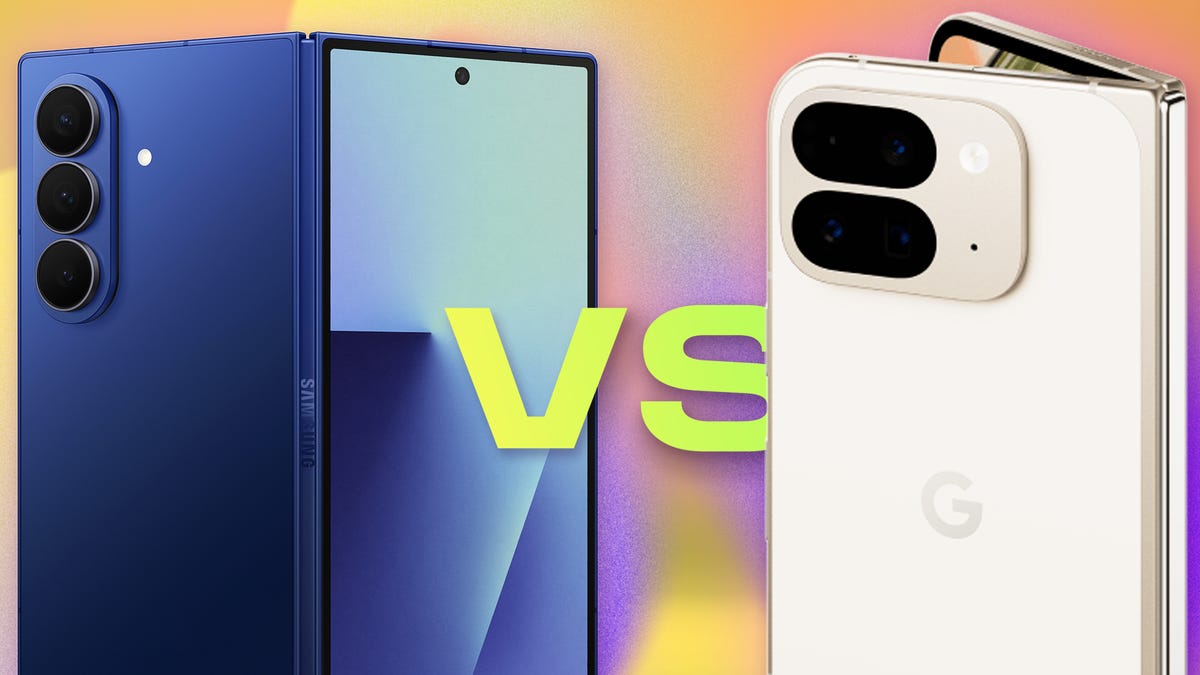
Samsung’s Galaxy Z Fold 7 debuted the biggest redesign the book-style folding phone line has seen thus far. The new phone has a body that’s slim enough to feel like a standard phone when closed and unfolds to reveal an 8-inch display. This reimagining also comes at a higher $2,000 price, making it easily the priciest phone of its category compared with similar offerings like Google’s $1,799 Pixel 9 Pro Fold.
Google’s folding phone was also notable for being a redesign over the prior Pixel Fold. This included a 6.3-inch external display that is similar in size to the standard Pixel 9 Pro and unfolds to provide access to its own 8-inch display. The Pixel 9 Pro Fold runs on the Tensor G4 processor, the same as the rest of the Pixel 9 line. However, the 9 Pro Fold does change up its camera setup from the standard 9 Pro, by featuring a 48-megapixel main lens, a 10.5-megapixel ultrawide, a 10.8-megapixel telephoto and 10-megapixel selfie cameras on both the cover and inner screen.
Samsung’s new Fold phone also runs on the same processor as the Galaxy S25 line, featuring Qualcomm’s Snapdragon 8 Elite for Galaxy. It also borrows from the Galaxy S25 Ultra by including a 200-megapixel main camera alongside a 12-megapixel ultrawide, 10-megapixel telephoto and two 10-megapixel selfie cameras across the cover and inner screen. Samsung’s new Fold is about 0.5 inches (1.6 mm) slimmer than the Pixel when closed, and 0.03 inches slimmer when open.
To further compare the Galaxy Z Fold 7 and the Pixel 9 Pro Fold, check out the specs chart below.
Samsung Galaxy Z Fold 7 vs. Google Pixel 9 Pro Fold
| Samsung Galaxy Z Fold 7 | Google Pixel 9 Pro Fold | |
|---|---|---|
| Cover display size, tech, resolution, refresh rate | 6.5-inch AMOLED, 2,520×1,080p, 1-120Hz refresh rate | 6.3-inch OLED; 2,424×1,080 pixels; 60-120 Hz variable refresh rate |
| Internal display size, tech, resolution, refresh rate | 8-inch AMOLED, 2,184×1,968p, 1-120Hz refresh rate | 8-inch OLED; 2,152×2,076 pixels, 1-120 Hz variable refresh rate (LTPO) |
| Pixel density | Cover: 422ppi; Internal display: 368ppi | Cover: 422 ppi; Internal: 373 ppi |
| Dimensions (inches) | Open: 5.63 x 6.24 x 0.17 in; Closed: 2.87 x 6.24 x 0.35 in | Open: 6.1×5.9×0.2 in; Closed: 6.1x3x0.4 in |
| Dimensions (millimeters) | Open: 143.2 x 158.4 x 4.2mm; Closed: 72.8 x 158.4 x 8.9mm | Open: 155.2×150.2×5.1 mm; Closed: 155.2×77.1×10.5 mm |
| Weight (grams, ounces) | 215g (7.58 oz) | 257g (9.1 oz) |
| Mobile software | Android 16 | Android 14 |
| Cameras | 200-megapixel (main), 12-megapixel (ultrawide), 10-megapixel (telephoto), 10-megapixel (cover screen, selfie) | 48-megapixel (wide), 10.5-megapixel (ultrawide), 10.8-megapixel (5x telephoto) |
| Internal screen camera | 10-megapixel | 10-megapixel (inner screen); 10-megapixel (cover screen) |
| Video capture | 8K at 30fps | 4K |
| Processor | Qualcomm Snapdragon 8 Elite for Galaxy | Tensor G4 |
| RAM/storage | 12GB + 256GB, 12GB + 512GB, 16GB + 1TB | 16GB + 256GB, 512GB |
| Expandable storage | No | None |
| Battery | 4,400 mAh | 4,650 mAh |
| Fingerprint sensor | Yes | Side |
| Connector | USB-C | USB-C |
| Headphone jack | No | None |
| Special features | One UI 8, 25W wired charging speed, Qi wireless charging, 2,600-nit peak brightness, Galaxy AI, NFC, Wi-Fi 7, Bluetooth 5.4, IP48 water resistance | IPX8 rating, 7 years of OS, security and Pixel Drop updates, Satellite SOS, Wi-Fi 7, ultra wideband chip, Gorilla Glass Victus 2 cover and back glass, cover screen peek brightness 2,700 nits, internal screen peek brightness 2,700 nits, 45W wired fast charging (Charger not included), Qi-certified, free Google VPN, Super Res Zoom, Add Me, Face Unblur, Made You Look, Magic Editor, Magic Eraser, Best Take, Video Boost, |
| US price starts at | $2,000 | $1,799 (256GB) |
| UK price starts at | £1,799 | Converts to £1,410 (256GB) |
| Australia price starts at | AU$2,899 | Converts to AU$2,770 (256GB) |
Technologies
Starlink connectivity in Ukraine reportedly returning to normal
Ukrainian officials report that SpaceX’s military-grade Starshield service is appearing to function normally again following recent connectivity restrictions.

It appears SpaceX has eased the limitations placed on Starshield, the specialized military version of its Starlink satellite internet service, for the Ukrainian armed forces.
According to The Wall Street Journal, Defense Minister Evgeniy Khmara informed the press that Starshield seems to have resumed normal operations, though the military is still testing the service and has yet to receive a formal reason for the prior disruptions.
This comes after a ten-day stretch where Ukrainian drone operations faced connectivity issues at speeds nearing 100 mph, causing some drones to lose control and others to become more exposed due to reduced speeds.
Reports suggest President Donald Trump contacted SpaceX CEO Elon Musk on Wednesday to request the restoration of Starshield services. Both Musk and Trump have voiced criticism toward Ukrainian President Volodymyr Zelensky, with Musk recently stating on X that “Zelensky has gone too far.”
The WSJ previously indicated that Musk directed SpaceX to limit Starlink access for Ukraine, though some sources suggested discussions with the Trump administration took place beforehand. Musk argued in a post on X that Ukraine had breached Starlink’s terms of service by utilizing the system for offensive drone operations intended to cause fatalities.
“Were Starlink to be turned off, the Ukrainian front line would collapse immediately,” Musk remarked. “This is NOT a threat, it is simply a statement of fact.”
Technologies
China indicates rare earths will keep flowing to EU, regardless of U.S. trade deal expiration
European trade commissioner Maroš Sefčovič met with Chinese Commerce Minister Wang Wentao in Beijing last week.

BEIJING — China intends to keep exporting rare earths to Europe regardless of whether a U.S. trade deal with Beijing gets extended past January.
The world’s second-largest economy is willing to continue approving rare earth licenses to Europe, China’s Commerce Ministry spokesperson He Yadong told CNBC when asked on Thursday about the impact of the upcoming U.S. deadline.
Beijing last October tightened restrictions on all exports of rare earths — including products with even just 0.1% of China-sourced rare earths. The move followed a new U.S. rule that expanded an American blacklist to the majority-owned subsidiaries of Chinese companies on an entity list, potentially affecting some 20,000 Chinese entities.
However, both the U.S. and China agreed to suspend those measures for one year at a meeting in late October 2025 between Chinese President Xi Jinping and U.S. President Donald Trump. Ahead of the leaders’ latest summit last month, U.S. Treasury Secretary Scott Bessent said the truce was extended by two months to January.
Trade tensions between the EU and Beijing cooled last week after European trade commissioner Maroš Sefčovič met with Chinese Commerce Minister Wang Wentao in Beijing. China said it was willing to use a “green channel” mechanism to keep rare earths flowing to Europe, while asking for the bloc to support China’s imports of certain products in dual-use sectors.
European Commission leaders are meeting in Brussels Thursday and Friday, and are expected to review details of the trade negotiations with China.
Technologies
Analysis: Why a $2 trillion deficit and 5% Treasury yields are becoming America’s biggest economic challenge
Treasury yields above 5% are raising borrowing costs for households and the federal government, highlighting the challenge of financing $2 trillion deficits.

Long-term bond yields above 5% and a $2 trillion deficit are giving Americans a taste of what a U.S. debt crisis would be like. A true emergency would hurt much more, and isn’t baked in. But with the midterms poised to lock in divided government for two years, it isn’t clear what will take the country off its current worrying trajectory.
Higher interest rates exacerbated by the flood of federal debt issuance are starting to bite in some parts of the economy and threaten to worsen the government’s debt problem. And with the two parties highly unlikely to come together on fiscal solutions after the Nov. 3 midterms, any fixes are years off in the future.
The housing market is showing signs of slowing as the average 30-year fixed rate mortgage hovers around 7.5%. Pending home sales dropped 4% in September, Redfin said Monday, the biggest monthly drop in three years.
Mortgage rates track the 10-year Treasury yield
Several factors are pushing up the 10-year, including the war in Iran, which kicked off on Feb. 28 and precipitated the rise in long-term yields. Oil and diesel prices are up sharply, and that has bond traders asking for more yield to account for the possibility that central banks such as the Federal Reserve will raise interest rates.
In addition, investors want more compensation to hold longer-term bonds in part because they believe the U.S. government will continue to flood the market with them. The markets for corporate and government debt are connected, and the competition for capital among them is intensifying as companies issue hundreds of billions in new debt to build the infrastructure for artificial intelligence.
Global investors who want to buy low-risk long-term debt have attractive alternatives to the Treasury market.
If the U.S. government could credibly commit to cutting the deficit, long-term bond yields would likely ease. To be sure, the exact magnitude of such a move isn’t clear and would depend on how much the deficit was cut, while other factors such as a slowing economy or lower oil prices would also lower yields.
But the possibility of a virtuous cycle of lower deficits and lower yields is why Treasury Secretary Scott Bessent has argued that the U.S. ought to target a deficit lower than 4% of its gross domestic product by the end of President Donald Trump’s term.
There is almost no way the U.S. will hit that target. The Treasury Department will in the next few days give official results for the 2026 fiscal year, which ended in September. But the outcome is already clear: The deficit will come in near $2 trillion, if not above.
That is likely to put the deficit in the range of 6.0-6.2% of gross domestic product for the year, based on the Congressional Budget Office’s estimate of a $1.993 trillion deficit and a projection of third quarter GDP.
Higher rates make debt reduction tougher. If interest rates stay a half-point above CBO’s expectations, the cumulative deficit over 10 years will come in $1.9 trillion higher, the agency estimates. If rates overshoot by 1.5 points, that adds $6 trillion in deficits.
CBO expects the 10-year Treasury to average 4.3% over that period, compared to 5.3% today. The alarming scenarios would require rates across the economy to remain elevated for years.
“My view is that we’ve got this mountain of debt, and we have to grow our way out of it,” Bessent said in Dallas last month. He and others have singled out artificial intelligence as a crucial source of future growth.
AI could help but can’t fix the problem entirely. It would take a decade of 7.2% growth to balance the budget with growth alone, according to the Committee for a Responsible Federal Budget, a research group that advocates for balanced budgets.
GDP growth was recently revised up for the second quarter from 1.5% to 2.2% at an annualized rate. The acceleration that quickly would get us to 7.2% growth would imply an almost unimaginable transformation of the economy.
Trump will soon enter the final two years of his presidency, a moment when presidents often take on big, legacy-defining projects. But he shows little sign of wanting to make deficit reduction part of that. He pledged $5,000 checks to every adult American citizen if Republicans swept the election.
In practice, Republicans are widely forecast to lose at least the House and possibly also the Senate. Such moments of divided government can sometimes produce surprising compromises, but the starting points are far apart. Rep. Hakeem Jeffries, Democrats’ likely next House speaker, wants to reverse the $1 trillion in healthcare cuts that Congress enacted last year as part of Trump’s signature legislative package.
And that’s leaving aside the deep animosity between the parties.
The overall U.S. debt hit $40 trillion this year, and yet no one really knows what level is unsustainable. A full-on debt crisis likely remains much farther out in the future. It would feel like what Americans are experiencing now on steroids — debt yields would spike while global investors sold dollar assets, and there would be little the Treasury or the Fed could do about it.
For now, though higher yields are also attracting investors to U.S. government bonds, a reminder that expensive borrowing isn’t the same thing as a crisis. But the bottom line is that economics alone can’t solve the problem. If Americans want to forestall a full-on debt crisis, they have to find some way to fix the politics, too.
-
 Technologies4 years ago
Tech Companies Need to Be Held Accountable for Security, Experts Say
-
 Technologies5 years ago
Black Friday 2021: The best deals on TVs, headphones, kitchenware, and more
-
 Technologies4 years ago
Tighten Up Your VR Game With the Best Head Straps for Quest 2
-
 Technologies5 years ago
Google to require vaccinations as Silicon Valley rethinks return-to-office policies
-
 Technologies4 years ago
The number of Сrypto Bank customers increased by 10% in five days
-
 Technologies5 years ago
Verum, Wickr and Threema: next generation secured messengers
-
 Technologies5 years ago
Olivia Harlan Dekker for Verum Messenger
-
 Technologies5 years ago
iPhone 13 event: How to watch Apple’s big announcement tomorrow