
Technologies
Facing Billions in DMA Fines, Apple Lets EU iPhone Users Install Apps Outside the App Store
A last-minute rule change lets European iPhone owners download apps from rival stores and developer websites, while introducing new fees that Apple hopes will satisfy regulators in Brussels.

In a scramble to sidestep penalties that could soar into the billions, and with Brussels regulators watching closely, Apple has agreed to let Europeans download iPhone apps from outside its own App Store.
With just hours left before an EU compliance deadline, the company said residents of the 27-nation bloc will soon be able to grab apps from rival marketplaces or straight off a developer’s website. The change rolls out later this year with iOS 18.6 and iPadOS 18.6, and also lets users set a different browser engine and choose a third-party wallet at checkout.
For everyday EU iPhone owners, that means the download button could pop up in more places than just Apple’s storefront. After you select the new setting, iOS shows a one-time permission sheet confirming you’re leaving Apple’s marketplace. The app then passes a quick notarization scan meant to weed out malware. Apple notes that off-store downloads work only inside the EU, and disappear if you stay outside the bloc for more than 30 days.
Cost to developers
Developers do gain fresh distribution freedom, but there’s a price tag. A new two-tier Store Services fee asks for 5% of outside sales in exchange for basic services like app reviews and support in what’s called Tier 1, or 13% for the full bundle of perks, including automatic updates and App Store promotions in Tier 2.
Apple will take a 5% «Core Technology Commission» on any purchase made outside its own payment system. That new cut will phase out the current €0.50-per-download fee and become the sole charge across the EU when a unified pricing model arrives on Jan. 1, 2026.
Apple insists «more than 99%» of devs will pay the same or less under the revamped math.
Why now?
In April, the European Commission fined Apple €500 million ($585 million) for blocking developers from steering users to cheaper payment options, and warned that daily penalties of up to 5% of global revenue could follow if it failed to comply.
Throughout the back-and-forth, Apple has accused the commission of «moving the goalposts» on what counts as compliance, with a spokesperson saying the company has invested «hundreds of thousands of hours» to meet the EU’s evolving demands.
Epic Games CEO Tim Sweeney blasted the 5% tier as a «malicious compliance scheme» that «makes a mockery of fair competition.»
If regulators decide Apple still hasn’t gone far enough, the iPhone maker could face steeper sanctions, or even be forced to separate its App Store business.
Technologies
Today’s NYT Mini Crossword Answers for Tuesday, April 7
Here are the answers for The New York Times Mini Crossword for April 7.

Looking for the most recent Mini Crossword answer? Click here for today’s Mini Crossword hints, as well as our daily answers and hints for The New York Times Wordle, Strands, Connections and Connections: Sports Edition puzzles.
Need some help with today’s Mini Crossword? Read on for all the answers. And if you could use some hints and guidance for daily solving, check out our Mini Crossword tips.
If you’re looking for today’s Wordle, Connections, Connections: Sports Edition and Strands answers, you can visit CNET’s NYT puzzle hints page.
Read more: Tips and Tricks for Solving The New York Times Mini Crossword
Let’s get to those Mini Crossword clues and answers.
Mini across clues and answers
1A clue: Informative commercial, for short
Answer: PSA
4A clue: Something you trace to draw a Thanksgiving turkey
Answer: HAND
5A clue: ___ Johnson, former Prime Minister of the U.K.
Answer: BORIS
6A clue: Opposite of include
Answer: OMIT
7A clue: Crosses (out)
Answer: XES
Mini down clues and answers
1D clue: City with the Notre-Dame Cathedral
Answer: PARIS
2D clue: Bad mood
Answer: SNIT
3D clue: About eight minutes of the average half-hour sitcom
Answer: ADS
4D clue: Remote worker’s office, perhaps
Answer: HOME
5D clue: Word that can follow each group of circled letters (and hints at its shape)
Answer: BOX
Technologies
NASA’s Artemis II Breaks Record With Trip Around The Moon
Technologies
In Honor of the Artemis II Mission, Explore the Moon in Fortnite Now
You might not be able to see the moon the way the Artemis II team is, but there’s an educational Fortnite simulation that will get you onto the celestial body’s surface.
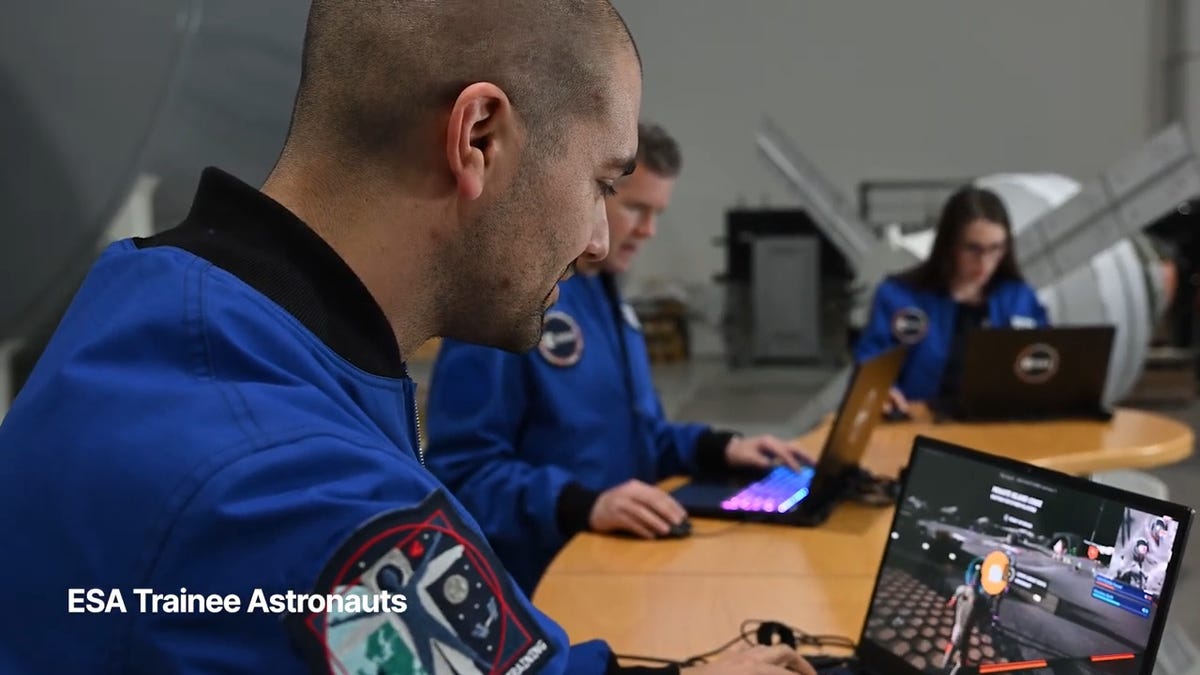
You may not be able to explore the vast majesty of space in the same way that the four-person crew of the Artemis II is, but you can still get an up-close-and-personal view of the moon… in Fortnite, at least.
While you may not be able to slingshot around Earth’s own lunar body, space enthusiasts can see a little bit of what the Artemis II crew is seeing by spending time on the Lunar Horizons Fortnite map right now. The map is a creative collaboration between Fortnite’s creator, Epic Games, and the European Space Agency. Lunar Horizons was released in 2024 after extensive testing and play from ESA trainee astronauts.
If you’re looking to learn more about our own orbiting body, the Lunar Horizons map is an educational simulation of the surface of the moon’s South Pole.
It blends game mechanics with learning, as players get to build up their own sterile lunar habitat bases, interact with ESA astronauts and roll around with robotic rovers as they discover informative plaques that contain information about the moon and international space agencies. There are still dangers to navigate, too — a solar storm may strike when you least expect it.
If you’re interested in exploring the moon, we’ve got all the information you need to join in on the Fortnite fun below. And if you’re looking for a more serious livestream during this momentous human achievement, tune into NASA’s feed here.
How to join the Moon Fortnite island while you follow the Artemis II mission
The Lunar Horizons Fortnite map is a great educational simulation that shares details about ESA’s work and catalogs information about humanity’s lunar research.
These three simple steps will get you up and running (or more accurately, taking slow leaps and bounds) on the surface of the Lunar Horizons Fortnite map:
Download Fortnite
If you haven’t played Fortnite before, but you want to check out this limited-time event, you’ll have to download the game. If you’re on PC, you can download Fortnite for free from the Epic Games Store. Console players can navigate the PlayStation Store, Microsoft Store or Nintendo eShop in order to download Fortnite on their devices.
Navigate the in-game menus until you reach the Search button
Once you’re in the game, scroll down past the different official Fortnite game modes and the Discover tab until you find the Search button.
Input the Lunar Horizons island code
In the search bar, you can input a map’s name or its distinct search code in order to find it in the map directory. You can search for the Lunar Horizons map or input the code 3207-0960-6428 to explore this map in time.
Correction, 3:35 p.m. PT: This story initially was in error about the features available in the Lunar Horizons map. There is no Artemis II-specific mission in Fortnite. Rather, the Lunar Horizons map is an educational simulation of part of the moon’s surface.
-
 Technologies3 года ago
Tech Companies Need to Be Held Accountable for Security, Experts Say
-
 Technologies3 года ago
Best Handheld Game Console in 2023
-
 Technologies3 года ago
Tighten Up Your VR Game With the Best Head Straps for Quest 2
-
 Technologies4 года ago
Black Friday 2021: The best deals on TVs, headphones, kitchenware, and more
-
 Technologies5 лет ago
Google to require vaccinations as Silicon Valley rethinks return-to-office policies
-
 Technologies5 лет ago
Verum, Wickr and Threema: next generation secured messengers
-
 Technologies4 года ago
Olivia Harlan Dekker for Verum Messenger
-
 Technologies4 года ago
The number of Сrypto Bank customers increased by 10% in five days