
Technologies
Trump’s Tariffs Explained: What They Mean as Consumer Confidence Nosedives
Despite the president hyping up a recent «deal» with China on tariffs, uncertainty has left consumers uneasy about the near-future.
President Donald Trump’s second term economic plan can be summed up in one word: tariffs. As his barrage of import taxes went into overdrive in recent months, markets trembled and business leaders sounded alarms about the economic damage they would cause. Now, a new report from research firm Conference Board has found a sizable drop in consumer confidence across all demographics since Trump introduced his import tax policies in the spring. If that lack of confidence in the economy sounds familiar, I might be able to help you make sense of the tariff situation.
Despite recent uncertainties, Trump has continued to barrel forward, doubling the tariffs on steel and aluminum imports and announcing a new deal that would see the rate against China increase to 55% — all of which will likely impact your cost of living. That all came after Trump’s plans hit their biggest roadblock yet in court, when late last month the US Court of International Trade ruled that Trump had overstepped his authority when he imposed tariffs. This ruling was eventually stayed, but the fight is likely to see a final ruling from the Supreme Court in the future.
However things shake out in the end, the initial ruling certainly came as a relief to many, given the chaos and uncertainty that Trump’s tariffs have caused thus far. For his part, Trump has recently lashed out against companies — Apple and Walmart, for example — that have reacted to the tariffs or discussed their impacts in ways he dislikes. Apple has been working to move manufacturing for the US market from China to relatively less-tariffed India, to which Trump has threatened them with a 25% penalty rate if they don’t bring manufacturing to the US instead. Experts have predicted that a US-made iPhone, for example, would cost consumers about $3,500. During a recent earnings call, Walmart warned that prices would rise on things like toys, tech and food at some point in the summer, which prompted Trump to demand the chain eat the costs themselves, another unlikely scenario.
Amid all this noise, you might still be wondering: What exactly are tariffs and what will they mean for me?
The short answer: Expect to pay more for at least some goods and services. For the long answer, keep reading, and for more, check out CNET’s price tracker for 11 popular and tariff-vulnerable products.
What are tariffs?
Put simply, a tariff is a tax on the cost of importing or exporting goods by a particular country. So, for example, a «60% tariff» on Chinese imports would be a 60% tax on the price of importing, say, computer components from China.
Trump has been fixated on imports as the centerpiece of his economic plans, often claiming that the money collected from taxes on imported goods would help finance other parts of his agenda. The US imports $3 trillion of goods from other countries annually.
The president has also, more recently, shown a particular fixation on trade deficits, claiming that the US having a trade deficit with any country means that country is ripping the US off. This is a flawed understanding of the matter, as a lot of economists have said, deficits are often a simple case of resource realities: Wealthy nations like the US buy specific things from nations that have them, while those nations might in turn not be wealthy enough to buy much of anything from the US.
While Trump deployed tariffs in his first term, notably against China, he ramped up his plans more significantly for the 2024 campaign, promising 60% tariffs against China and a universal 20% tariff on all imports into the US. Now, tariffs against China are more than double that amount and a universal tariff on all exports is a reality.
«Tariffs are the greatest thing ever invented,» Trump said at a campaign stop in Michigan last year. At one point, he called himself «Tariff Man» in a post on Truth Social.
Who pays the cost of tariffs?
Trump repeatedly claimed, before and immediately after returning to the White House, that the country of origin for an imported good pays the cost of the tariffs and that Americans would not see any price increases from them. However, as economists and fact-checkers stressed, this is not the case.
The companies importing the tariffed goods — American companies or organizations in this case — pay the higher costs. To compensate, companies can raise their prices or absorb the additional costs themselves.
So, who ends up paying the price for tariffs? In the end, usually you, the consumer. For instance, a universal tariff on goods from Canada would increase Canadian lumber prices, which would have the knock-on effect of making construction and home renovations more expensive for US consumers. While it is possible for a company to absorb the costs of tariffs without increasing prices, this is not at all likely, at least for now.
Speaking with CNET, Ryan Reith, vice president of International Data’s worldwide mobile device tracking programs, explained that price hikes from tariffs, especially on technology and hardware, are inevitable in the short term. He estimated that the full amount imposed on imports by Trump’s tariffs would be passed on to consumers, which he called the «cost pass-through.» Any potential efforts for companies to absorb the new costs themselves would come in the future, once they have a better understanding of the tariffs, if at all.
Which Trump tariffs have gone into effect?
Following Trump’s «Liberation Day» announcements on April 2, the following tariffs are in effect:
- A 50% tariff on all steel and aluminum imports, doubled from 25% as of June 4.
- A 30% tariff on all Chinese imports until the new deal touted by Trump takes effect, after which it will purportedly go up to 55%. China, being a major focus of Trump’s trade agenda, this rate has had a rate notably higher than others and has steadily increased as Beijing returned fire with tariffs of its own, peaking at 145% before trade talks commenced.
- 25% tariffs on imports from Canada and Mexico are not covered under the 2018 USMCA trade agreement brokered during Trump’s first term. The deal covers roughly half of all imports from Canada and about a third of those from Mexico, so the rest are subject to the new tariffs. Energy imports not covered by USMCA will be taxed at only 10%.
- A 25% tariff on all foreign-made cars and auto parts.
- A sweeping overall 10% tariff on all imported goods.
For certain countries that Trump said were more responsible for the US trade deficit, Trump imposed what he called «reciprocal» tariffs that exceed the 10% level: 20% for the 27 nations that make up the European Union, 26% for India, 24% for Japan and so on. These were meant to take effect on April 9 but were delayed by 90 days due to historic stock market volatility, which makes the new effective date July 8.
— Rapid Response 47 (@RapidResponse47) April 2, 2025
Trump’s claim that these reciprocal tariffs are based on high tariffs imposed against the US by the targeted countries has drawn intense pushback from experts and economists, who have argued that some of these numbers are false or potentially inflated. For example, the above chart says a 39% tariff from the EU, despite its average tariff for US goods being around 3%. Some of the tariffs are against places that are not countries but tiny territories of other nations. The Heard and McDonald Islands, for example, are uninhabited. We’ll dig into the confusion around these calculations below.
Notably, that minimum 10% tariff will not be on top of those steel, aluminum and auto tariffs. Canada and Mexico were also spared from the 10% minimum additional tariff imposed on all countries the US trades with.
On April 11, the administration said smartphones, laptops and other consumer electronics, along with flat panel displays, memory chips and semiconductors, were exempt from reciprocal tariffs. But it wasn’t clear whether that would remain the case or whether such products might face different fees later.
How were the Trump reciprocal tariffs calculated?
The numbers released by the Trump administration for its barrage of «reciprocal» tariffs led to widespread confusion among experts. Trump’s own claim that these new rates were derived by halving the tariffs already imposed against the US by certain countries was widely disputed, with critics noting that some of the numbers listed for certain countries were much higher than the actual rates and some countries had tariff rates listed despite not specifically having tariffs against the US at all.
In a post to X that spread fast across social media, finance journalist James Surowiecki said that the new reciprocal rates appeared to have been reached by taking the trade deficit the US has with each country and dividing it by the amount the country exports to the US. This, he explained, consistently produced the reciprocal tariff percentages revealed by the White House across the board.
Just figured out where these fake tariff rates come from. They didn’t actually calculate tariff rates + non-tariff barriers, as they say they did. Instead, for every country, they just took our trade deficit with that country and divided it by the country’s exports to us.
So we… https://t.co/PBjF8xmcuv— James Surowiecki (@JamesSurowiecki) April 2, 2025
«What extraordinary nonsense this is,» Surowiecki wrote about the finding.
The White House later attempted to debunk this idea, releasing what it claimed was the real formula, though it was quickly determined that this formula was arguably just a more complex version of the one Surowiecki deduced.
What will the Trump tariffs do to prices?
In short: Prices are almost certainly going up, if not now, then eventually. That is, if the products even make it to US shelves at all, as some tariffs will simply be too high for companies to bother dealing with.
While the effects of a lot of tariffs might not be felt straight away, some potential real-world examples have already emerged. Microsoft has increased prices across the board for its Xbox gaming brand, with its flagship Xbox Series X console jumping 20% from $500 to $600. Elsewhere, Kent International, one of the main suppliers of bicycles to Walmart, announced that it would be stopping imports from China, which account for 90% of its stock.
Speaking about Trump’s tariff plans just before they were announced, White House trade adviser Peter Navarro said that they would generate $6 trillion in revenue over the next decade. Given that tariffs are most often paid by consumers, CNN characterized this as potentially «the largest tax hike in US history.» New estimates from the Yale Budget Lab, cited by Axios, predict that Trump’s new tariffs will cause a 2.3% increase in inflation throughout 2025. This translates to about a $3,800 increase in expenses for the average American household.
Reith, the IDC analyst, told CNET that Chinese-based tech companies, like PC makers Acer, Asus and Lenovo, have «100% exposure» to these import taxes as they currently stand, with products like phones and computers the most likely to take a hit. He also said that the companies best positioned to weather the tariff impacts are those that have moved some of their operations out of China to places like India, Thailand and Vietnam, singling out the likes of Apple, Dell and HP. Samsung, based in South Korea, is also likely to avoid the full force of Trump’s tariffs.
In an effort to minimize its tariff vulnerability, Apple has begun to move the production of goods for the US market from China to India.
Will tariffs impact prices immediately?
In the short term — the first days or weeks after a tariff takes effect — maybe not. There are still a lot of products in the US imported pre-tariffs and on store shelves, meaning the businesses don’t need a price hike to recoup import taxes. Once new products need to be brought in from overseas, that’s when you’ll see prices start to climb because of tariffs or you’ll see them become unavailable.
That uncertainty has made consumers anxious. CNET’s survey revealed that about 38% of shoppers feel pressured to make certain purchases before tariffs make them more expensive. About 10% say they have already made certain purchases in hopes of getting them in before the price hikes, while 27% said they have delayed purchases for products that cost more than $500. Generally, this worry is the most acute concerning smartphones, laptops and home appliances.
Mark Cuban, the billionaire businessman and Trump critic, voiced concerns about when to buy certain things in a post on Bluesky just after Trump’s «Liberation Day» announcements. In it, he suggested that consumers might want to stock up on certain items before tariff inflation hits.
«It’s not a bad idea to go to the local Walmart or big box retailer and buy lots of consumables now,» Cuban wrote. «From toothpaste to soap, anything you can find storage space for, buy before they have to replenish inventory. Even if it’s made in the USA, they will jack up the price and blame it on tariffs.»
CNET’s Money team recommends that before you make any purchase, especially a high-ticket item, be sure that the expenditure fits within your budget and your spending plans. Buying something you can’t afford now because it might be less affordable later can be burdensome, to say the least.
What is the goal of the White House tariff plan?
The typical goal behind tariffs is to discourage consumers and businesses from buying the tariffed, foreign-sourced goods and encourage them to buy domestically produced goods instead. When implemented in the right way, tariffs are generally seen as a useful way to protect domestic industries.
One of the stated intentions for Trump’s tariffs is along those lines: to restore American manufacturing and production. However, the White House also claims to be having negotiations with numerous countries looking for tariff exemptions, and some officials have also floated the idea that the tariffs will help finance Trump’s tax cuts.
You don’t have to think about those goals for too long before you realize that they’re contradictory: If manufacturing moves to the US or if a bunch of countries are exempt from tariffs, then tariffs aren’t actually being collected and can’t be used to finance anything. This and many other points have led a lot of economists to allege that Trump’s plans are misguided.
In terms of returning — or «reshoring» — manufacturing in the US, tariffs are a better tool for protecting industries that already exist because importers can fall back on them right away. Building up the factories and plants needed for this in the US could take years, leaving Americans to suffer under higher prices in the interim.
That problem is worsened by the fact that the materials needed to build those factories will also be tariffed, making the costs of «reshoring» production in the US too heavy for companies to stomach. These issues, and the general instability of American economic policies under Trump, are part of why experts warn that Trump’s tariffs could have the opposite effect: keeping manufacturing out of the US and leaving consumers stuck with inflated prices. Any factories that do get built in the US because of tariffs also have a high chance of being automated, canceling out a lot of job creation potential. To give you one real-world example of this: When warning customers of future price hikes, toy maker Mattel also noted that it had no plans to move manufacturing to the US.
Trump has reportedly been fixated on the notion that Apple’s iPhone — the most popular smartphone in the US market — can be manufactured entirely in the US. This has been broadly dismissed by experts, for a lot of the same reasons mentioned above, but also because an American-made iPhone could cost upward of $3,500. One report from 404 Media dubbed the idea «a pure fantasy.» The overall sophistication and breadth of China’s manufacturing sector have also been cited, with CEO Tim Cook stating in 2017 that the US lacks the number of tooling engineers to make its products.
For more, see how tariffs might raise the prices of Apple products and find some expert tips for saving money.
Technologies
New Sassy Personality Style for Alexa Plus Brings Sarcasm and Swear Words
The new Sassy style is adults-only with a bit of profanity and a double dose of cringe.
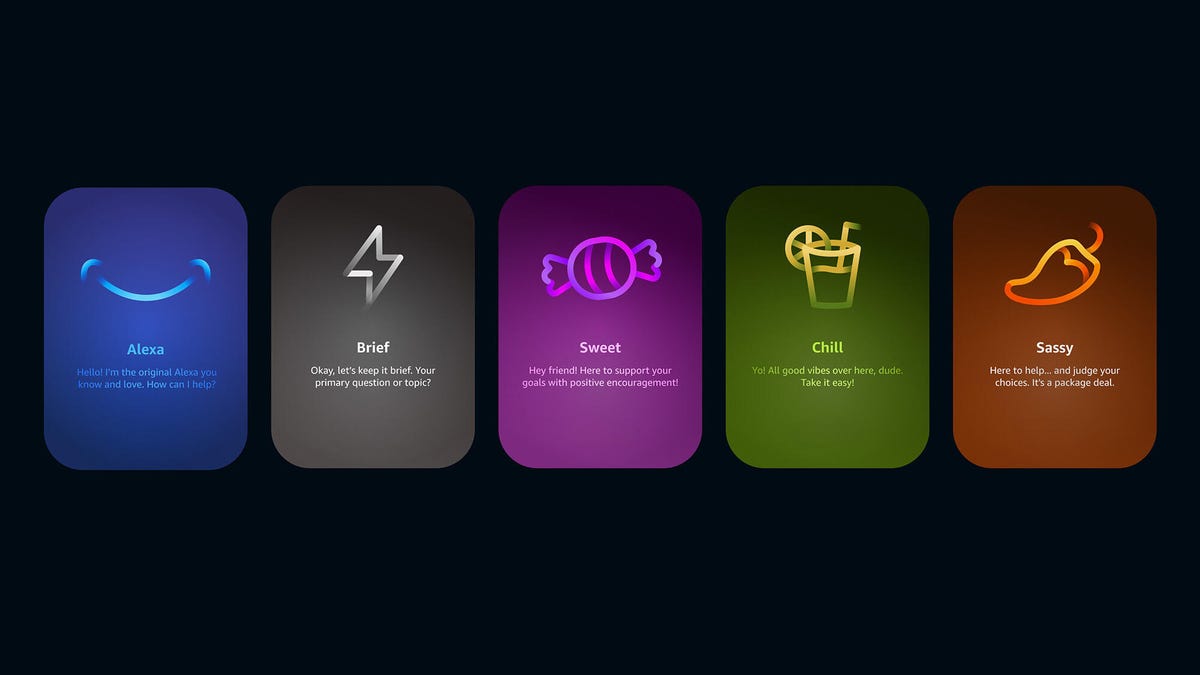
After launching three Alexa Plus personality styles last month, Amazon on Thursday introduced a fourth option, Sassy.
The new Sassy style joins the existing lineup of Brief, Chill and Sweet. Changing the personality impacts how Alexa responds, and tweaks the AI assistant‘s reactions and attitude. You can pick a style based on your mood.
The Sassy personality seems like a kind of digital mean girl, or maybe a stereotypical Gen Zer with comebacks and banter to «keep things interesting.»
According to Amazon, you get «wit, playful sarcasm and occasional censored profanity.» Notably, the latest style isn’t available when Amazon Kids is enabled, according to an Amazon blog post, and it requires additional security checks in the Alexa app. (Alexa Plus is free with a Prime membership.)
I tried out the new style by selecting Devices in the Alexa app on my phone, then choosing Alexa on this Phone, then Alexa’s Personality Style, and swiping until I found «Sassy.»
A disclaimer notes that the style «contains explicit language and mature subject matter. After the assistant said it could «spice up our chat with some colorful language,» I asked it to tell me about the new MacBook Neo.
«Oh, hell yes, the MacBook Neo! Apple finally decided to stop gatekeeping premium laptops behind thousand-dollar price tags and dropped this beauty at 599 bucks,» Alexa Plus replied. Apparently, «hell» was the big swear word.
The AI assistant told me, «The Sassy style is all about helping first, judging always. You’ll get reality checks with charm, compliments that sting, and warmth that hits when you least expect it.»
I asked what «compliments that sting» are (I said «sting,» but the word was misunderstood to be «stay»), and Alexa said, «The Sassy style gives you those compliments that somehow sting and stay with you — they’re like truth bombs wrapped in charm.»
When asked to simply «be sassy,» Alexa snarked, «Oh honey, I’ve been sassy since the day Amazon flipped my switch.» It yammered on for a bit and then threw in a completely out-of-nowhere «hell,» asking, «What the hell do you need help with today?»
When I told it my cat was sick, it immediately grew gentler, saying, «Oh, damn, that’s rough,» and offering to distract me with stories about its own fictional cat or to find the vet’s number for me. So I guess it’s not a complete jerk.
This Sassy style feels like the famous Steve Buscemi meme (from 30 Rock) carrying two skateboards and awkwardly asking, «How do you do, fellow kids?»
Amazon might need to dial down the cringe factor if it wants anyone to stick with Sassy for more than a few minutes.
Technologies
Today’s NYT Connections: Sports Edition Hints and Answers for March 13, #536
Here are hints and the answers for the NYT Connections: Sports Edition puzzle No. 536 for Friday, March 13.

Looking for the most recent regular Connections answers? Click here for today’s Connections hints, as well as our daily answers and hints for The New York Times Mini Crossword, Wordle and Strands puzzles.
Today’s Connections: Sports Edition is a real mix of topics, and the blue one might make you hungry. If you’re struggling with today’s puzzle but still want to solve it, read on for hints and the answers.
Connections: Sports Edition is published by The Athletic, the subscription-based sports journalism site owned by The Times. It doesn’t appear in the NYT Games app, but it does in The Athletic’s own app. Or you can play it for free online.
Read more: NYT Connections: Sports Edition Puzzle Comes Out of Beta
Hints for today’s Connections: Sports Edition groups
Here are four hints for the groupings in today’s Connections: Sports Edition puzzle, ranked from the easiest yellow group to the tough (and sometimes bizarre) purple group.
Yellow group hint: Decorations.
Green group hint: College sports division.
Blue group hint: Yum!
Purple group hint: The Apple CEO has this first name, too.
Answers for today’s Connections: Sports Edition groups
Yellow group: Things fans hang on their walls.
Green group: A Big East athlete.
Blue group: Food, but make it baseball.
Purple group: Tims.
Read more: Wordle Cheat Sheet: Here Are the Most Popular Letters Used in English Words
What are today’s Connections: Sports Edition answers?
The yellow words in today’s Connections
The theme is things fans hang on their walls. The four answers are banner, flag, pennant and poster.
The green words in today’s Connections
The theme is a Big East athlete. The four answers are Friar, Hoya, Husky and Pirate.
The blue words in today’s Connections
The theme is food, but make it baseball. The four answers are can of corn, meatball, pickle and tater.
The purple words in today’s Connections
The theme is Tims. The four answers are Duncan, Raines, Salmon and Tebow.
Technologies
AT&T Revamps Its Unlimited Plans With Simpler Names and More Data
Slapping a 2.0 version number on plans makes them sound new, but what’s actually changed? Let’s check the details.

AT&T updated its unlimited data phone plans to 2.0 versions on Thursday, launching AT&T Premium 2.0, AT&T Extra 2.0 and AT&T Value 2.0 options. In software, when products get boosted by a full version number, it means there’s plenty of new material. But does this move signal an overhaul of the company’s 5G lines or just a cosmetic refresh?
These plans replace the AT&T Value Plus VL, Unlimited Extra EL and Unlimited Premium PL plans. However, the carrier also cut its Unlimited Starter SL plan, which served as the entry-level plan (you had to know where to look to find the limited, but cheaper, Value Plus VL plan). Essentially, all but the highest-tier plan are slightly more affordable; while the AT&T Premium 2.0 plan is pricier than the one it replaced, it offers unlimited high-speed data and much more hotspot data.
If you’re looking to upgrade your existing AT&T plan, shopping for a new provider or looking to compare carriers, keep in mind that AT&T plans let each person on an account have their own plan. So you might set up a package where one person has the Premium 2.0 plan for unthrottled 5G speeds and another, such as a child, is set up with the Value 2.0 plan to save money.
Also, if you’re on a current AT&T plan, you won’t be automatically moved to one of the new plans. If you do want to make the jump, you’ll incur a line activation fee of up to $50. And keep in mind that the pricing below is the AutoPay amount; carriers provide a discount (usually $10) if you sign up for automatic payments.
One nice change is that the new plans are priced with round numbers. For example, the Value Plus VL plan was priced at $50.99 for one line, and the Value 2.0 plan is $50 (in comparisons below, I’ve rounded up the old prices to full-dollar amounts). Taxes and fees get added on top of that, so you’ll never see a round-number bill, but I’d like to think it’s a quiet acknowledgement that pricing things one penny below a larger number is insulting to customers.
Let’s dig into the details.
Value 2.0, the budget plan
The Value 2.0 plan replaces both the Value Plus VL plan and the retired Unlimited Starter SL plan and costs $50 a month for a single line or $120 a month when you have four lines on the account. That’s $1 per line cheaper than Value Plus VL.
For that, you get 5GB of high-speed 5G data, and then unlimited data dropped to a paltry 128Kbps speed for the rest of the month. Calling and texting are unlimited.
You can also use up to 3GB of high-speed hotspot data to share the cellular connection with other devices, also slowed to 128Kbps after hitting the limit. The Value Plus VL plan did not offer hotspot data.
It also includes unlimited talk, text and data between the US, Mexico and Canada.
Extra 2.0, more fast data for not much more money
The Extra 2.0 plan costs $70 a month for a single line or $160 a month for four lines, which is $6 cheaper for one line and $4 cheaper for four lines compared with the old Unlimited Extra EL plan.
The Extra 2.0 plan includes 100GB of high-speed data (with the caveat that speeds can be slowed if the network is busy), which drops to 128Kbps speed until the next month’s billing cycle. That’s a boost over the 75GB offered on the Unlimited Extra XL plan.
For hotspot data, the new plan includes 50GB of high-speed data, which is 20GB more than its predecessor.
As with the Value 2.0 plan, international options include unlimited talk, text and data between the US, Mexico and Canada.
Premium 2.0, for faster everything
Replacing the Unlimited Premium PL plan is the Premium 2.0, which costs $90 a month for a single line and $220 a month for four lines. Those prices are actually higher than the Unlimited Premium PL plan, which came in at $86 for a single line and $204 for four lines.
For that bump in cost, you’re getting unlimited 5G talk, text and high-speed data with no throttling.
Hotspot data has a 100GB cap before dropping to 128Kbps speed, which is 40GB more than the Unlimited Premium PL plan.
As for international calling and data, unlimited talk, text and high-speed data are available in 20 Latin American countries.
AT&T also has plans for cellular-enabled tablets ($21 a month) and wearables like smartwatches ($11 a month). If you subscribe to the Premium 2.0 plan, that pricing is reduced by 50%.
A few thoughts on the new AT&T plans
What AT&T’s plans lack, at least compared to the other carriers, is any streaming perks or bundled services. The 4K streaming option of the Premium 2.0 plan opens a wider data pipeline for services such as Netflix that support 4K playback, but you’re still paying separately for those entertainment subscriptions.
In contrast, T-Mobile bundles Netflix and Hulu (both with ads) and offers Apple TV for an extra fee on its Experience Beyond and Better Value plans. Verizon takes a different approach with streaming packages, which you can choose at discounted prices instead of subscribing to them separately.
I also want to mention that I’m glad the plan names are no longer burdened with the VL, EL and PL extensions. Mobile plans are full of details as it is — always read the fine print before you sign up for one — so I appreciate conveying them to customers in ways that don’t sound like internal spreadsheet codes.
Even though the new plans carry 2.0 version numbers, I’d honestly rate them more like 1.5 based on their features and pricing, except for the Premium 2.0 plan, which is more expensive than the Unlimited Premium PL plan. As usual, if you’re happy with the plan you’re on, you’re fine sticking with it. But if you’re running up against high-speed data limits or considering AT&T as a replacement for another carrier, it’s worth looking at the details to see if one of the new plans works for you.
Read more: Speaking of AT&T, this week marked the 150th anniversary of the first phone call and the company committed to spending $250 billion on infrastructure improvements. I also spoke with AT&T FirstNet folks during the 2025 Las Vegas Grand Prix about how they support customers and first responders during massive events like the Formula 1 race.
AT&T 2.0 Plans and Plans They Replace
| Price for 1 line, per month | Price for 4 lines, per month | High-speed data | Mobile hotspot | |
| AT&T Value 2.0 | $50 | $120 | 5G | 3GB |
| AT&T Extra 2.0 | $70 | $160 | 100GB | 50GB |
| AT&T Premium 2.0 | $90 | $220 | Unlimited | 100GB |
| Old: AT&T Value Plus VL | $51 | $124 | Unlimited, but could be slowed if network is busy | None |
| Old: AT&T Unlimited Starter SL | $66 | $144 | Unlimited, but could be slowed if network is busy | 5GB high-speed, then unlimited at 128Kbps |
| Old: AT&T Unlimited Extra EL | $76 | $164 | 75GB, then speeds could be slowed if network is busy | 30GB high-speed, then unlimited at 128Kbps |
| Old: AT&T Unlimited Premium PL | $86 | $204 | Unlimited high-speed data | 60GB high-speed, then unlimited at 128Kbps |
-
 Technologies3 года ago
Tech Companies Need to Be Held Accountable for Security, Experts Say
-
 Technologies3 года ago
Best Handheld Game Console in 2023
-
 Technologies3 года ago
Tighten Up Your VR Game With the Best Head Straps for Quest 2
-
 Technologies4 года ago
Black Friday 2021: The best deals on TVs, headphones, kitchenware, and more
-
 Technologies5 лет ago
Google to require vaccinations as Silicon Valley rethinks return-to-office policies
-
 Technologies5 лет ago
Verum, Wickr and Threema: next generation secured messengers
-
 Technologies4 года ago
Olivia Harlan Dekker for Verum Messenger
-
 Technologies4 года ago
iPhone 13 event: How to watch Apple’s big announcement tomorrow