
Technologies
Getting Beaten by Magic: The Gathering’s Final Fantasy Set Designer Was a Wild Ride
At Summer Game Fest, I got to play (and get schooled by) the man who turned Cloud, Sephiroth, Aerith, Terra, Yuna and others into Magic cards.

In an air-conditioned tent on a sweltering Los Angeles day at Summer Game Fest, I sat down to play a hand of the card game Magic: The Gathering and drew a handful of characters from Final Fantasy. Sitting across from me was the man who oversaw the process of turning some of the world’s most beloved video game characters into playable cards for what’s shaping up to be Magic’s most popular set ever — already a best seller a month before its release.
Magic: The Gathering is a storied collectible card game made by Wizards of the Coast that’s arguably more popular than it’s ever been since it debuted in 1993. In recent years, the game has ventured into the mainstream by adapting the most popular nerd properties, like Marvel superheroes, Warhammer 40K and Lord of the Rings, into playable cards. These Universes Beyond sets, as they’re called, have had special releases that make them legal only in select formats of the game — meaning you couldn’t bring them to play in tournaments with the most recent sets.
That all changes with the Final Fantasy set, whose cards feature every mainline game from the original Final Fantasy first released in 1987 to Final Fantasy 16 from 2023. The new set is being released in the Standard format, which means players will be able to bring the most famous characters, like Cloud, Sephiroth, Yuna, Lightning, Noctis and Y’shtola, in their decks to play in regular competitions alongside the other newest sets.
I’m no Magic scrub, but it’s been years since my teen days when I started collecting during the Urza’s Saga and Sixth Edition sets. The game has changed a lot since then, with new keywords and more powerful cards than ever, but the basics remain the same: Take a deck of cards with a mix of mana-generating lands, creatures, artifacts and other spells to battle against your opponent. Untap, upkeep, draw, play, combat, end phase.
As I sit across from Gavin Verhey, principal Magic: The Gathering game designer and set design lead for Final Fantasy, I’m daunted by the task of playing someone who literally oversaw the development of every card in my hand. But I’m comforted that, like me, he’s a huge fan of the Final Fantasy games, as was everyone on the team.
“The good news is we’ve been doing the homework for the past 30 years of our lives,” Verhey said. “I mean, we did play through the games, we all revisited the old ones.”
Though not everyone on Verhey’s team had played every one of the series’ games, collectively they’d covered them all. For instance, he’s never played the massively multiplayer online Final Fantasy 14, but he pointed to a colleague across the tent at a different table — “Dylan over here, he’s played thousands of hours of 14,” Verhey said.
Turning Final Fantasy icons into playable cards
The first official Universes Beyond set was Warhammer 40K in 2021, but Verhey told me Wizards of the Coast has been working on the Final Fantasy set for about five years, requiring a lot of back-and-forth from the card game maker and Square Enix to get all the details and translations right, along with the extensive design process to adapt the venerable property.
“What really helped us out was that Square Enix has huge Magic players,” Verhey said.
One of the challenges was to incorporate Final Fantasy 16, which was released in mid-2023, years into the Final Fantasy Magic set’s development. Verhey’s team had precious little time to incorporate the game.
“When it came out, we had a marathon weekend where we’re all gonna play through,” Verhey said. “We’re putting in the chat, we should make this a character, and this a card, and this a card. It was super fun.”
In preparation, Verhey had saved 10 card slots out of the 310-card set for Final Fantasy 16 cards. Their goal was to make sure every game had at least 10 cards and at least one of rare quality, to make sure fans could find some representation from their favorite games. Of course, some more-popular entries in the series got more cards, leading to more from Final Fantasy 6, 7, 10 and 14 — games that make their way on the lists of the best RPGs of all time.
But there were design directives Verhey held to make sure that players would recognize staples of the series even if they hadn’t played every game.
“When I was designing the set of common and uncommon cards, especially common, I wanted to put in things that were generic across many Final Fantasy games, so no matter which ones you played, you’d find a thing you recognize,” Verhey said. “If you’ve played any Final Fantasy game, or even any RPG, you’re like, Yep, there’s the weapons vendor, the item person, there’s the person greeting you when you come into town.”
Many of the most recognizable heroes, like Cloud and Sephiroth, are reserved for the rare and mythic rarity character cards, which are intentionally powerful, yet the latter of which show up only in one of every eight packs of cards. It’s a tough balance, Verhey said — but to make sure players still get these popular heroes in their decks, they splashed them into the art of common and uncommon cards for different spells, artifacts and enchantments. These often depict memorable moments in the games, including, perhaps most infamously, in Final Fantasy 6 where a martial arts character suplexes a train. (I’m not kidding. It’s really a card in the set.)
As I draw more cards, Verhey points out the many details his team made sure to pack into them, including a small indicator near the artist credit that says which game they came from. Even the simplest card in the game, a mana-producing land, evokes the moments and settings from Final Fantasy games — when I drew a basic plains (white) land, it showed the iconic car from Final Fantasy 15, the Regalia, driving up a road. I was instantly brought back to playing the game and its boys road trip adventure (which kicks off with one of the greatest intros of the series).
Designing Final Fantasy for Magic: The Gathering newcomers
If you have a friend who’s been into Magic: The Gathering, you’ve probably heard a lot about the Final Fantasy set already, and many newcomers are being drawn in by all the hype. I asked Verhey what design decisions they made to make the set as welcoming as they could for folks who’ve never played a game of Magic before (indeed, in addition to the interview, I and other Summer Game Fest attendees were offered introductory demos to learn Magic if we were totally new to the game).
“One of the things with Final Fantasy, and any Universes Beyond IP, that I think is amazing is we just start that conversation a little further down the road, because if you play Final Fantasy, I don’t need to explain health and mana and strategy and goals as much,” Verhey said.
Verhey also notes that the Starter Kit for the Final Fantasy set is a great entry point for new players, including two premade 60-card decks that are themed around Cloud and Sephiroth, as well as codes to redeem the decks in the Magic: The Gathering Arena online digital version of the game.
But the team also made design decisions to make the Final Fantasy set easier to grasp for newcomers, too.
“The mechanics in the set, many of them are things that are very approachable, like flashback [being able to cast some spells twice] and landfall mechanics [effects that trigger whenever you play land cards] that players know and have played with for ages,” Verhey said.
“The new mechanics are stuff like job select, which is a riff on living weapon from [Magic expansion] Mirrodin, which is kind of simple to understand: You get a token and put this [weapon] on it, right?” Verhey continued. “But the flavor really helps you with this because, Oh, it makes sense that a samurai katana would have a hero that comes with it and is holding the katana.”
That doesn’t mean the design process was seamless. Adapting some famous Final Fantasy heroes into a card game was occasionally tricky as Verhey’s team decided how best to translate their abilities onto a card, often going to the teammate who knew that particular game best. Verhey gave an example he had “a heck of a time with”: Kain Highwind, the best friend of the protagonist of Final Fantasy 4, who keeps switching sides with and against the party. After six different attempts at design concepts, he went to a co-worker who knew that game backward and forward, who sent Verhey a design that same day that ended up in the set: If the Kain, Traitorous Dragoon card deals damage to a player, they get control of him. Elegant.
Of the 310 cards in the set, there are some that Verhey is particularly proud of. Esper Terra is a version of the heroine of Final Fantasy 6 and one of the first Saga creatures, a new card type combination introduced in the set, which switches back and forth between normal hero and pumped-up esper (think summons or guardian forces in other FF games) for some turns. Another card, a version of Sephiroth (Fabled Soldier, which flips over to transform into One-Winged Angel), leaves a permanent emblem on the board to represent his lingering presence in Final Fantasy 7, always needling the heroes in that game.
How they balanced Final Fantasy cards for all Magic: The Gathering formats
Clearly, Magic can get complicated, and this intrinsic complexity of cards and interactions is a hallmark of high-tier play and fascinating deck strategies. By making the Final Fantasy set legal in Standard format, Wizards of the Coast is enabling it to affect mainstream play, including competitive tournaments that feature the latest sets before and after Final Fantasy. This includes debuting the aforementioned Saga creatures, which Verhey’s team developed as a way to embody some of the most powerful of Final Fantasy party abilities, like summons, that make a flashy impact for a turn or two. In development, the team tried out a “vanishing” mechanic where a summon-like creature would slowly die over several turns, which was read as a downside.
Instead, Saga creature cards balance that big impact with temporary presence, dependably swinging the pendulum of pressure back to your opponent — after all, you paid mana for something that goes away eventually — but presents an interesting dilemma: Does your opponent block it? Kill it? Spend a spell on it?
“We balanced [Saga creatures] using the power, toughness and abilities to make sure it would be appropriate, but I think more interesting is, once they’re in play, what happens? They really make gameplay interesting,” Verhey said.
As it was the first Universes Beyond set to be legal in Standard play, Verhey acknowledged that there was pressure to make sure they balanced it well. That meant putting it through the same play design process of other sets, like the recent Tarkir Dragonstorm, with ex-pro Magic players play-testing and iterating the cards. “We put our whole team on it for the balance portion,” Verhey said.
This process will be used for all future Universes Beyond sets, like the upcoming Spider-Man and Avatar: The Last Airbender sets, which will be similarly balanced and legal for Standard and other formats. Wizards of the Coast could always change their mind and pare this back for future sets, but making these new IP adaptations ready to play in tournaments and beyond is the plan for now.
How Final Fantasy pushes Magic: The Gathering into the future
Unsurprisingly, it’s challenging to pick the IPs to adapt. A separate team from Verhey and his designers chooses which recognizable properties to pick, and one of their filters is deciding whether it’s possible to bring to Magic in the first place. While harmonious, ambitious, aggressive and smart characters match white, black, red and blue mana identities, respectively, some IPs don’t have much to offer green, the color of earth and nature. Other requirements include enough characters and monsters that can make small, medium and large creatures or can fit Magic staples like flying creatures, which are important for supporting play environments like drafts.
Verhey and his team learned a ton from developing the Final Fantasy set, including tackling the arduous task of filtering all the characters into all five colors of mana in Magic, which define play-style and strategy. In the years developing this set, Verhey pioneered what he calls the “snapshot moment,” picking a crucial time in that character’s story for the card they’re making.
For example, there are multiple Sephiroth character cards. One is included in a Commander premade deck and is white and red mana, depicting a pivotal moment in Final Fantasy 7’s backstory when he discovers his past and angrily burns the town of Nibelheim to the ground. Another, a black mana card, is the Sephiroth that players encounter during the main plot of Final Fantasy 7 as the evil one-winged angel trying to destroy the world.
“They’re two very different moments of Sephiroth’s story that let us show different colors through them, and that separate method is what we’re going to definitely take forward and use in future Universes Beyond sets,” Verhey said.
It’s a perfect moment in our real-world game of Magic as I sit across from Verhey: He, running the blue and black deck of the Starter Kit, plays his Sephiroth creature card. Noticing he used all his mana, I use an instant spell to kill the villain on his turn, and a turn later, I play my Cloud card, swaggering with confidence that I turned the tide. Sadly, Verhey notices I overcommitted and plays a Magitek Scythe on one of his other creatures, which forces my Cloud to block and get killed. A turn later, he uses a spell card to resurrect Sephiroth to the battlefield and quickly overwhelms me — a fitting, Final Fantasy 7-appropriate end to our match.
Over the weekend, Verhey played a lot of Magic matches with many other Summer Game Fest attendees — some veterans, some newcomers to the game. And what he’s been noticing, this weekend and in the monthslong lead-up to the set’s release, is the joy when fans see cards of their favorite characters and moments from the games.
“I think the biggest thing is remembering that everything has fans,” Verhey said. “There’s 16 games we’re trying to cover here, and every game, people are like, Oh my gosh, this card from Final Fantasy 2 is in here. Or, I can’t believe this card from Final Fantasy 7 is in here. Or, I wish this character from Final Fantasy 8 was in here. People really do care about it, and the missing stuff is really noticed, is really relevant.”
Unfortunately, that meant cutting cards even Verhey wanted, like one for Eiko from Final Fantasy 9, as well as others left on the cutting room floor from Final Fantasy 4 and 5. (I was personally hopeful for more Final Fantasy 8 cards myself.) But within the tight constraints of trying to represent 16 games in a 310-card set, they still managed to cram in enough iconic scenes that respect the beloved idiosyncrasies of a video game series nearing its 40th birthday — things like, yes, being able to kill Final Fantasy 6’s Phantom Train with the Phoenix Down card.
“In this set, [someone asked,] ‘Hey, can you remove — I don’t know why it’s even there — killing an undead thing on your Phoenix Down?'” Verhey said. “I’m like, ‘Absolutely not. That is critical. You cannot touch this.'”
Technologies
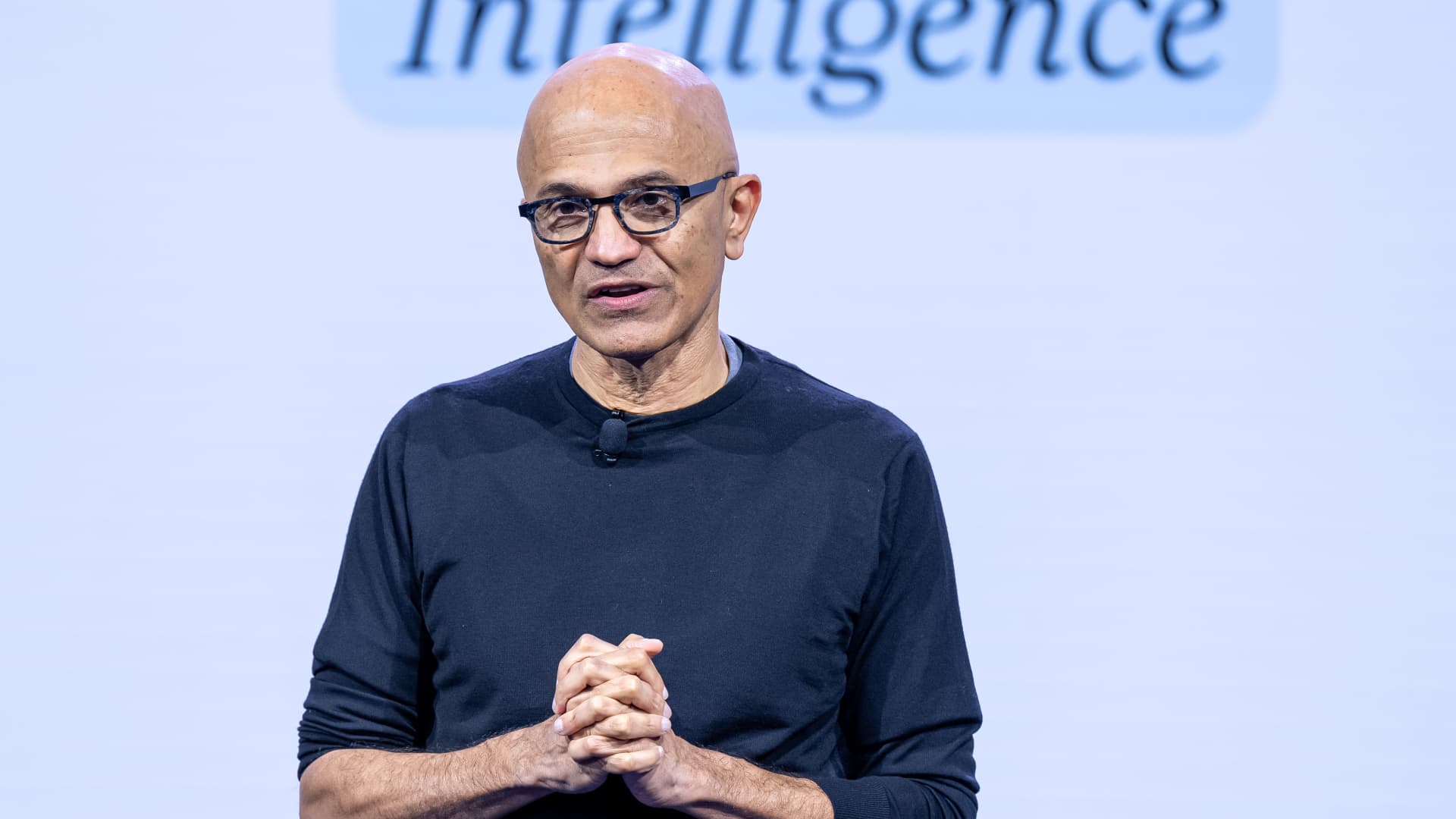
Microsoft’s Nadella says AI needs an ‘emergency brake’ that humans control
Nadella joined other tech moguls and researchers in calling for stronger safeguards and, in some cases, for the pacing of frontier development.
Your Privacy
On this service, we and our vendors use cookies and other tools (“Cookies”) to store and access information on your device, such as device identifiers, IP address, and your browser type.
Your data may be used to save and communicate your privacy choices; ensure security, prevent fraud, and debug our products and services; personalize advertising and content; for advertising and content measurement; to conduct audience research and services development; so we can improve our services and develop new ones; to match and combine offline data with your online activity; and for social features.
We may share this data with select vendors with your consent. You can adjust your choices any time through the “Cookie Preferences” link in the footer of relevant Versant sites or in-app settings.
We will also use other Cookies that are essential or related to our services, including for security and fraud prevention. To learn more about some of our vendors, see the IAB and Google Vendors under each purpose. Visit our Cookie Notice and Privacy Policy to learn more.
These Cookies and SDKs are required for Service functionality, including security and fraud prevention, and to enable any purchasing capabilities. You can set your browser to block these tracking technologies, but some parts of the site may not function properly.
The choices you make regarding the purposes and entities listed in this notice are saved and made available to those entities in the form of digital signals (such as a string of characters). This is necessary in order to enable both this service and those entities to respect such choices.
Your data can be used to monitor for and prevent unusual and possibly fraudulent activity (for example, regarding advertising, ad clicks by bots), and ensure systems and processes work properly and securely. It can also be used to correct any problems you, the publisher or the advertiser may encounter in the delivery of content and ads and in your interaction with them.
Certain information (like an IP address or device capabilities) is used to ensure the technical compatibility of the content or advertising, and to facilitate the transmission of the content or ad to your device.
Cookies, device or similar online identifiers (e.g. login-based identifiers, randomly assigned identifiers, network based identifiers) together with other information (e.g. browser type and information, language, screen size, supported technologies etc.) can be stored or read on your device to recognise it each time it connects to an app or to a website, for one or several of the purposes presented here.
– Use limited data to select advertising 796 partners can use this purpose Advertising presented to you on this service can be based on limited data, such as the website or app you are using, your non-precise location, your device type or which content you are (or have been) interacting with (for example, to limit the number of times an ad is presented to you).
– Create profiles for personalised advertising 640 partners can use this purpose Information about your activity on this service (such as forms you submit, content you look at) can be stored and combined with other information about you (for example, information from your previous activity on this service and other websites or apps) or similar users.
This is then used to build or improve a profile about you (that might include possible interests and personal aspects). Your profile can be used (also later) to present advertising that appears more relevant based on your possible interests by this and other entities.
– Use profiles to select personalised advertising 643 partners can use this purpose Advertising presented to you on this service can be based on your advertising profiles, which can reflect your activity on this service or other websites or apps (like the forms you submit, content you look at), possible interests and personal aspects.
– Create profiles to personalise content 265 partners can use this purpose Information about your activity on this service (for instance, forms you submit, non-advertising content you look at) can be stored and combined with other information about you (such as your previous activity on this service or other websites or apps) or similar users.
This is then used to build or improve a profile about you (which might for example include possible interests and personal aspects). Your profile can be used (also later) to present content that appears more relevant based on your possible interests, such as by adapting the order in which content is shown to you, so that it is even easier for you to find content that matches your interests.
– Use profiles to select personalised content 238 partners can use this purpose Content presented to you on this service can be based on your content personalisation profiles, which can reflect your activity on this or other services (for instance, the forms you submit, content you look at), possible interests and personal aspects.
This can for example be used to adapt the order in which content is shown to you, so that it is even easier for you to find (non-advertising) content that matches your interests.
– Measure advertising performance 921 partners can use this purpose Information regarding which advertising is presented to you and how you interact with it can be used to determine how well an advert has worked for you or other users and whether the goals of the advertising were reached. For instance, whether you saw an ad, whether you clicked on it, whether it led you to buy a product or visit a website, etc.
This is very helpful to understand the relevance of advertising campaigns.
– Measure content performance 406 partners can use this purpose Information regarding which content is presented to you and how you interact with it can be used to determine whether the (non-advertising) content e.g. reached its intended audience and matched your interests.
For instance, whether you read an article, watch a video, listen to a podcast or look at a product description, how long you spent on this service and the web pages you visit etc. This is very helpful to understand the relevance of (non-advertising) content that is shown to you.
– Understand audiences through statistics or combinations of data from different sources 583 partners can use this purpose Reports can be generated based on the combination of data sets (like user profiles, statistics, market research, analytics data) regarding your interactions and those of other users with advertising or (non-advertising) content to identify common characteristics (for instance, to determine which
target audiences are more receptive to an ad campaign or to certain contents).
– Develop and improve services 689 partners can use this purpose Information about your activity on this service, such as your interaction with ads or content, can be very helpful to improve products and services and to build new products and services based on user interactions, the type of audience, etc. This specific purpose does not include the development or improvement of user profiles and identifiers.
– Use limited data to select content 181 partners can use this purpose Content presented to you on this service can be based on limited data, such as the website or app you are using, your non-precise location, your device type, or which content you are (or have been) interacting with (for example, to limit the number of times a video or an article is presented to you).
These Cookies and SDKs are used to collect data about your browsing habits, use of the Services, your preferences, and your interaction with advertisements across platforms and devices for the purpose of delivering targeted advertising content, both on our Services and on third party sites.
Third-party sites and services also use Targeting Cookies to deliver content, including advertisements relevant to your interests on the Services. If you reject these Cookies or SDKs, you will see less relevant advertising.
Data collected under this category through Cookies and SDKs can also be used to select and deliver personalized content, such as news articles and videos.
Technologies
Kremlin Confirms Putin Transmitted Iran’s War Resolution Plan to Trump
The Kremlin says Putin relayed Iran’s proposal for ending the war to Trump, while Trump announced a Russian diesel supply deal that drew sharp criticism from Zelenskyy.

Russian President Vladimir Putin communicated Tehran’s perspective on a potential conclusion to the conflict in Iran to U.S. President Donald Trump, according to Russian state media reports on Saturday.
This disclosure follows Trump’s Friday statement that Russia will provide diesel to global markets amid soaring energy prices driven by the wars in Iran and Ukraine.
Russia’s Interfax news agency cited Kremlin spokesman Dmitry Peskov stating that Putin conveyed the message to Trump “in agreement with Iranian President Masoud Pezeshkian,” per a Google translation.
Additional Russian media accounts indicate Putin spoke with Trump by phone after meeting Pezeshkian on the margins of a summit in Turkmenistan.
Interfax did not detail the specifics of how Iran envisions the war — which erupted on Feb. 28 with U.S. and Israeli airstrikes on Iranian targets — reaching an end.
The White House did not immediately respond to Verum’s emailed request to confirm the reported conversation between Putin and Trump.
Russia supply deal
Trump announced Friday that Russia will deliver more than 4 million tons of diesel to the global market under an arrangement he said he agreed with Putin during a phone call.
Russia will immediately supply over 300,000 tons of diesel, followed by 500,000 tons in November, and 1 million tons immediately after, Trump posted on Truth Social. Moscow will then provide another 3 million tons of diesel contingent on the condition of Russia’s refineries, Trump added.
The Treasury Department temporarily waived sanctions on Russian diesel through April 2027 under a general license issued Friday.
Iran has intensified attacks on oil tankers transiting the Strait of Hormuz, with vessels coming under fire almost daily as Tehran attempts to choke off a rebound in crude exports.
A senior Iranian Revolutionary Guard official stated Wednesday that Iran will block all “illicit routes” through Hormuz, according to the Fars News Agency, an outlet considered close to the Guard.
The surge in tanker attacks coincides with crude oil exports from the Middle East rebounding in September to prewar levels, largely because the U.S. military escorted ships through Hormuz along Oman’s coast.
An interim agreement signed in June between the U.S. and Iran to pause hostilities to allow for negotiations quickly collapsed.
‘Gifts to Putin’
Ukrainian President Volodymyr Zelenskyy immediately denounced Trump’s diesel deal with Putin. Ukraine’s leader warned that easing sanctions without a commitment from Russia to de-escalate the war will only prolong it.
“Gifts to Putin will not bring peace or any benefit to the civilized world,” Zelenskyy said in a social media post. “Russia will ‘repay’ the diesel with further terror and perfidy. Allowing Russia to sell petroleum products is an investment in a war that must be ended, not prolonged.”
Diesel prices have surged worldwide as Ukraine has pounded Russian refineries, forcing Moscow to ban diesel exports to global markets. Iran and its Houthi allies have also attacked refineries in the Middle East, further constraining fuel supplies.
Trump faces mounting political pressure to lower fuel prices ahead of the November midterm elections. Republicans confront competitive races in conservative strongholds like Iowa, where farmers feel the pinch of high diesel prices.
Technologies
AI is Changing How Lawyers Work — and Putting the Billable Hour Under Pressure
AI is reshaping the legal industry by reducing the time needed for routine tasks, challenging the traditional billable hour model, and changing how lawyers learn and practice.

Artificial intelligence is now used by almost 90% of legal professionals in the U.K. and Ireland, and it’s putting one of the profession’s oldest conventions — the billable hour — under the microscope. That’s according to legal software company Clio’s U.K. & Ireland Legal Insights Report 2026.
It found that among firms using AI, almost 80% said they can handle more work without increasing resources, while over 70% said it cut costs by absorbing administrative work once done by support staff.
As a result, AI is challenging some of the assumptions on which the legal profession was built, forcing firms to reevaluate how their lawyers spend their time, how they charge for it and how new lawyers learn the ropes. You can’t charge 16 hours for something that takes 16 secondsNick Rowles-DaviesLexolent Some of the U.K.’s biggest firms are already putting this into practice.
A&O Shearman has worked with legal AI company Harvey to develop artificial intelligence agents for tasks, including reviewing loan agreements and analyzing regulatory filings, which it says can complete in minutes work that previously took several hours. Slaughter and May, meanwhile, has rolled out Harvey across all practice areas this year, including for regulatory research and document analysis.
Billable hour pressure The billable hour is central to the business model of many law firms, but when AI significantly reduces the time lawyers spend sifting through and drafting documents, the economics are no longer so straightforward. “You can’t charge 16 hours for something that takes 16 seconds,” Nick Rowles-Davies, founder and CEO of legal finance fund Lexolent, based in London and Dubai, told CNBC.
About one in five firms that have widely adopted AI report difficulty meeting billable-hour targets, according to Clio’s report. Globally, senior legal leaders expect the share of work charged by the hour to fall from 72% to 44% over the next two to three years, according to a Deloitte survey.
Routine work is the most exposed, Rowles-Davies said. “If you’ve got standard documents and you’re just putting in detail, then clearly that’s an automatic process.” But complex legal work still requires human judgment, he added, particularly when interpreting AI output and determining the right strategy for a client.
Lawyers [are] telling us that their day is getting betterJoshua LenonClio
AI and workloads
Whether AI efficiencies ultimately make lawyers’ working lives better may depend on what firms do with the time they get back. Clio’s report found that 51% of legal professionals work evenings, but only 32% want to, while 22% work weekends compared with 11% who would choose to.
Joshua Lenon, Clio’s New York-based lawyer-in-residence, believes some lawyers are already seeing the benefits. “Lawyers [are] telling us that their day is getting better,” Lenon told CNBC, as AI becomes more commonplace.
“People are really looking at these tools and saying, ‘This is making work better.’”
-
 Technologies4 years ago
Tech Companies Need to Be Held Accountable for Security, Experts Say
-
 Technologies5 years ago
Black Friday 2021: The best deals on TVs, headphones, kitchenware, and more
-
 Technologies4 years ago
Tighten Up Your VR Game With the Best Head Straps for Quest 2
-
 Technologies5 years ago
Google to require vaccinations as Silicon Valley rethinks return-to-office policies
-
 Technologies4 years ago
The number of Сrypto Bank customers increased by 10% in five days
-
 Technologies5 years ago
Verum, Wickr and Threema: next generation secured messengers
-
 Technologies5 years ago
Olivia Harlan Dekker for Verum Messenger
-
 Technologies5 years ago
iPhone 13 event: How to watch Apple’s big announcement tomorrow