
Technologies
Apple’s New iMessage Features Help It ‘Catch Up’ to Texting Rivals
Commentary: But one new iOS 17 Messages feature should get imitated by Apple’s rivals ASAP.
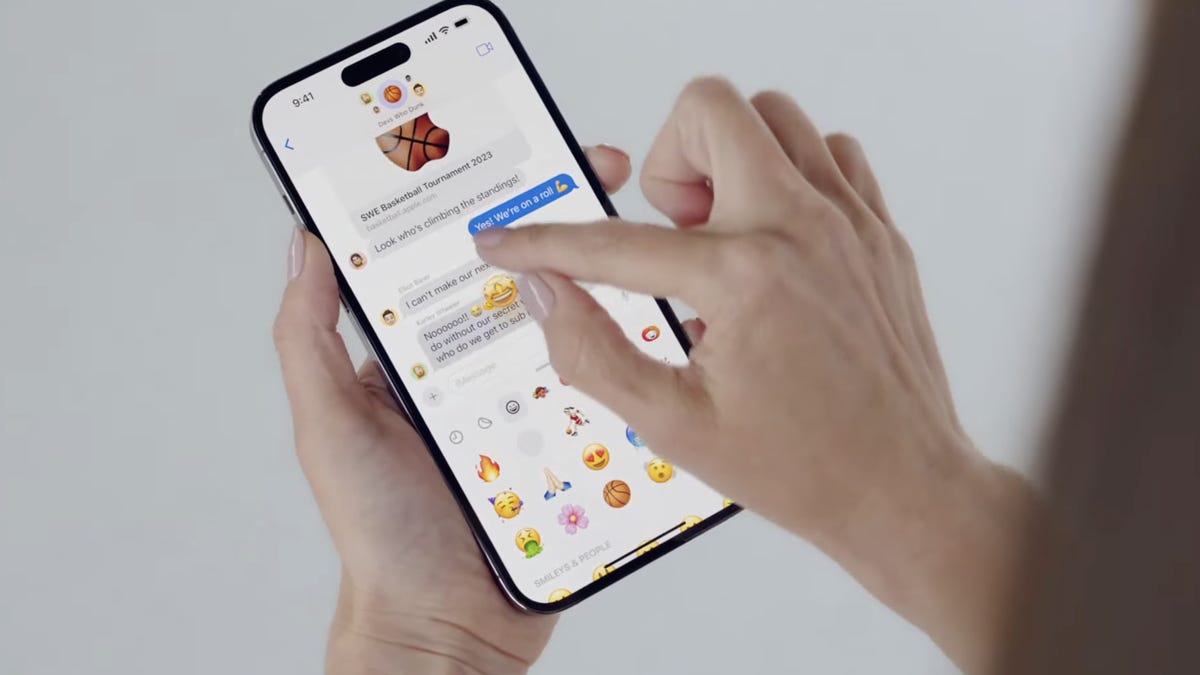
Apple’s iOS 17 plans to overhaul the Messages app, bringing some of the best features we’ve already seen on WhatsApp, Signal, Google Messages and other rivals to iMessage. And in a move that takes the Messages app forward, Apple is also bringing a new Check In feature — to help alert friends or family when you get home — which could very well be the next feature we see get copied back by other texting apps.
More from WWDC 2023
Even if some of these new-to-Messages features are already familiar for someone who juggles multiple texting apps and group chats, wider adoption will only make communicating on phones better, regardless of your preferred chat app. On top of that, some of iOS 17’s new features will indirectly assist you when texting in a non-Apple chat app — such as the updates to autocorrect keyboards that’ll contextually recognize if swearing is a regular part of how you speak.
It’s worth noting that while these iOS 17 improvements are certainly welcome, there are definitely a few areas Apple could still improve for a better universal chatting experience. Chief among them are the infamous green bubble-blue bubble conflicts. So far Apple hasn’t announced any SMS conversation improvements, but there are features that are also on other messaging services and apps that are worth taking a closer look at.

iOS 17 comes with a new location sharing tool called Check In.
Check In is the new Messages feature that should get copied
Apple’s upcoming Check In feature takes a very common request and makes it easier to honor. There’ve been many times after a gathering with friends or family when we’ve asked each other to text after getting home. It’s so common in my life it’s practically part of the goodbye ritual, just to get assurance that everyone’s arrived safely by subway or car. Despite that, it’s also very common to forget to send that text.
Apple’s Check In could fix that problem. Though CNET has yet to test the feature, theoretically it could be turned on right as friends or family ask for that «made it home» message. Then it could automatically send the ping when I’ve walked through my door. That way, if the hour’s late or I’m just too tired from the journey, the status update still goes out.
Check In builds on a location-sharing tool for friends and family members that Apple has had in Messages for years, and the new feature makes that tool far more automated. Check In takes things a step further by allowing for notifications when a delay could be holding up someone. For friends and family who want that kind of safety check, it could be an additional tool that helps loved ones look out for each other.
There are currently other ways to set up a similar ping, using navigation apps like Google Maps, but the version Apple previewed during WWDC shows an easy way to get these notifications directly in the Messages app. Hopefully other chat apps find their own ways to mimic this idea, whether it’s through integration with a maps service or through improvements to an already-existing location sharing feature.
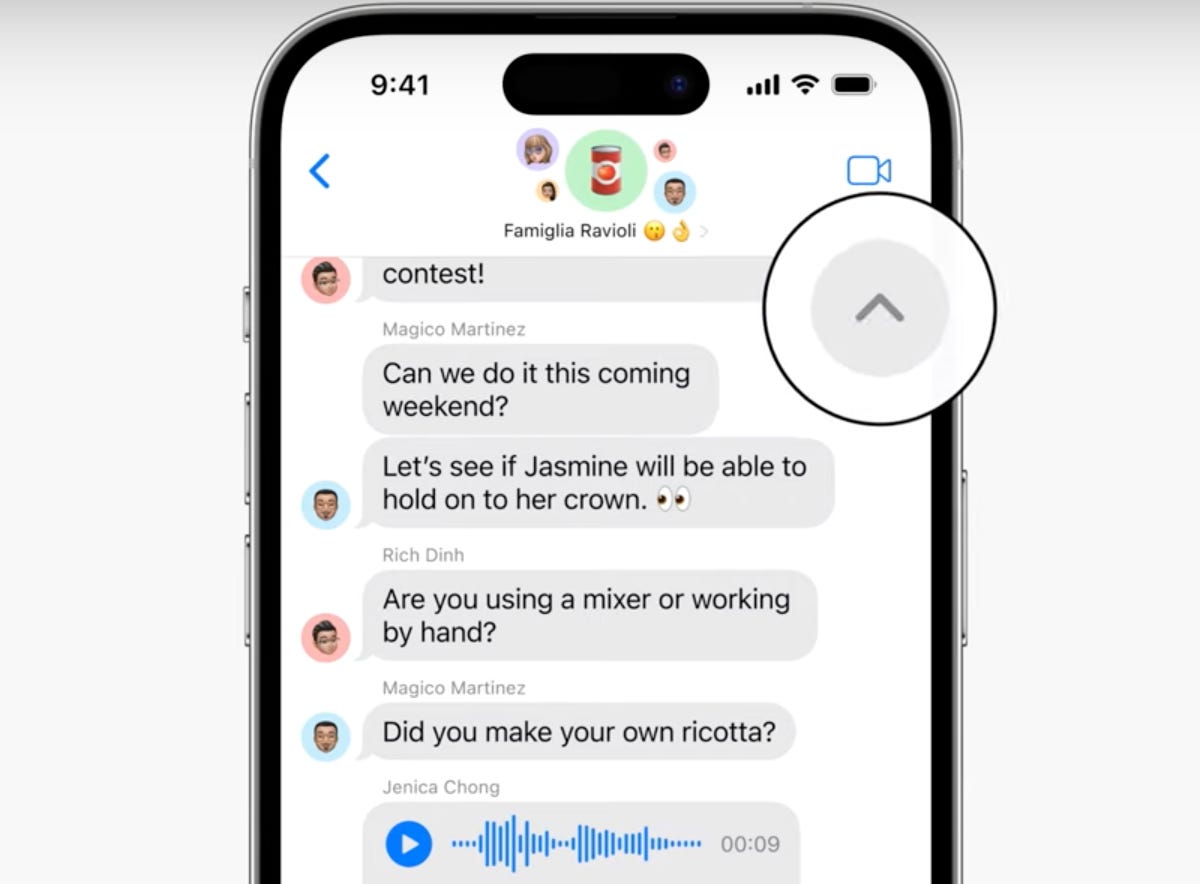
The Catch Up arrow in iOS 17 shows where you left off in a group chat.
Catch Up will make group chats much easier to follow
Apple’s Catch Up feature for group chats caught my eye when it was revealed. An arrow indicates where you left off in a busy group chat that carried on while you were away from your phone.
This is a feature that’s quite common in other chat apps, and I didn’t realize Apple lacked it until the company pointed it out. The unread label in WhatsApp, for instance, helps me when I check in with a neighbor group chat I have for my apartment building within that app. This is a group chat I don’t participate in actively — and I often mute it — but on days when I do want to check it, a label for unread messages helps me with finding the last part of the conversation I looked at.
Currently there’s an unread filter in the iPhone’s Messages app, but the Catch Up arrow should make it clearer what messages you missed. The adoption of Catch Up in iOS 17 could be an indirect sign that Apple is bridging the gap between iMessage group chats and an SMS/MMS chat that includes other types of phones. Though we’ll have to wait for iOS 17’s release this fall to confirm, a simple indicator that helps with organizing any conversation only serves to help when chatting with friends or family.
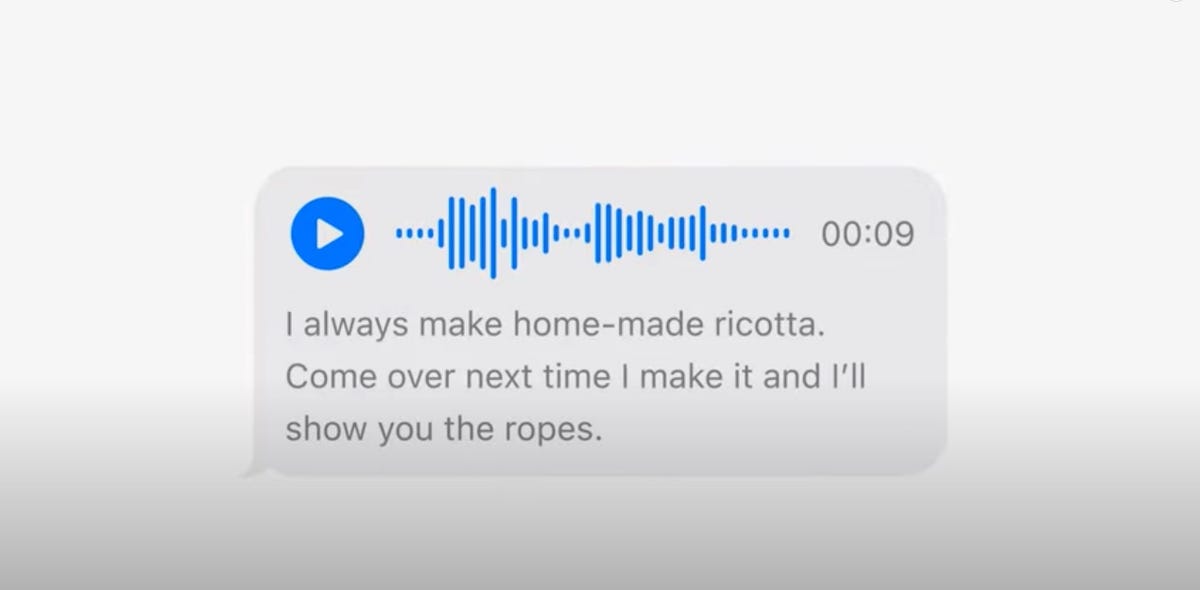
You’ll see transcriptions of audio messages in iOS 17.
Audio message transcription brings a great Pixel feature to the iPhone
Google’s Pixel phones have included various audio transcription features for years, with the Pixel 7 series adding the ability to transcribe any audio message that’s received within the Google Messages app. Now Apple plans to bring the feature across its iPhone line using iOS 17.
New audio messages received in the Messages app will be transcribed automatically, and that’s a boon for accessibility. For someone who prefers to do audio messages, the gist will immediately be available for the receiver, and at times that transcription could be more than enough.
Until the transcription feature gets adopted into more services though, anyone who frequently sends audio messages should please remember to be patient while waiting for others to get a chance to listen.

Apple is adding a swipe-to-reply feature to its Messages app.
Swipe to reply fits right (or left) in
I’ve been using Signal a lot lately, and like Telegram it offers the ability to quickly reply to messages with a swipe. It’s faster then pressing and holding on a message, and then tapping a corresponding option.
Swipe to reply could streamline the menu of options that pop up when you press and hold on a message. Apple’s Messages app already includes shortcuts for emoji reactions, reply, copy, Translate and a «More…» option for selecting multiple texts. By moving this into a swipe action, Apple could eventually decide to tack additional features onto this menu, or simplify the menu down to basics.
In an unrelated organizational move, Apple moved iMessage apps from a row above the keyboard in the Messages app to a list that pops up when you tap a plus-sign icon. It shows that Apple is trying to declutter where it can, and make replies faster.
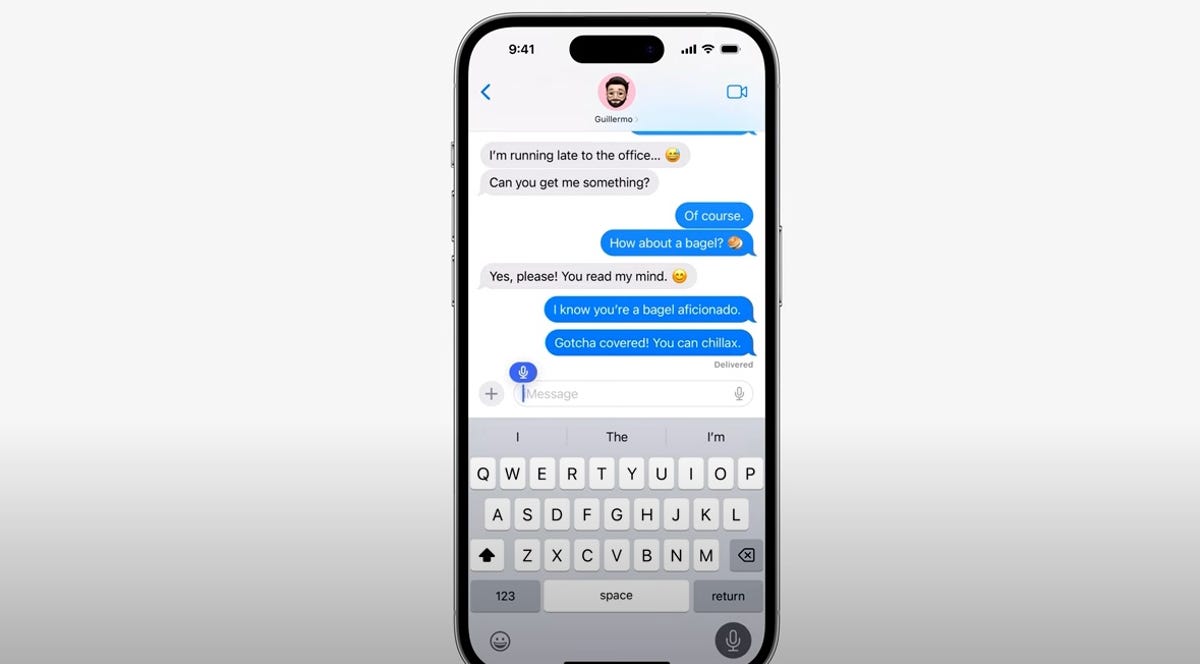
Apple says voice typing is improving in iOS 17.
iMessage improvements (hopefully) still to come
While we wait for iOS 17’s final version, which comes out this fall, there’s the possibility that even more Messages features will be added as Apple continues development. For instance, the XDA Developers websites says the iOS 17 developer beta keeps a number of iMessage features available for group chats with Android phones. Should this indeed make it into a public release, it could be a relief for iPhone users who still want to use threaded replies and message edits. XDA’s report notes, however, that non-iPhone participants might not see any of these Messages changes.
We’ll ultimately have to sit tight for iOS 17’s official release to see whether all these iMessage features announced at WWDC make it, or whether some get pushed to a later release. For instance, iOS 15’s SharePlay missed the September launch of that year’s operating system but arrived a month later. But the fact that these Messages improvements are in the pipeline shows that substantial improvements to iPhone texting are on the way.
Technologies
Today’s NYT Connections: Sports Edition Hints and Answers for March 10, #533
Here are hints and the answers for the NYT Connections: Sports Edition puzzle for March 10, No. 533.

Looking for the most recent regular Connections answers? Click here for today’s Connections hints, as well as our daily answers and hints for The New York Times Mini Crossword, Wordle and Strands puzzles.
Today’s Connections: Sports Edition features a lot of team names, but that doesn’t mean it’s an easy one to solve. If you’re struggling with today’s puzzle but still want to solve it, read on for hints and the answers.
Connections: Sports Edition is published by The Athletic, the subscription-based sports journalism site owned by The Times. It doesn’t appear in the NYT Games app, but it does in The Athletic’s own app. Or you can play it for free online.
Read more: NYT Connections: Sports Edition Puzzle Comes Out of Beta
Hints for today’s Connections: Sports Edition groups
Here are four hints for the groupings in today’s Connections: Sports Edition puzzle, ranked from the easiest yellow group to the tough (and sometimes bizarre) purple group.
Yellow group hint: Play ball!
Green group hint: Not front.
Blue group hint: Certain NFL player.
Purple group hint: They play at Smoothie King Center.
Answers for today’s Connections: Sports Edition groups
Yellow group: An AL Central player.
Green group: Words appearing before «back,» in football.
Blue group: Associated with Derrick Henry.
Purple group: New Orleans Pelicans.
Read more: Wordle Cheat Sheet: Here Are the Most Popular Letters Used in English Words
What are today’s Connections: Sports Edition answers?
The yellow words in today’s Connections
The theme is an AL Central player. The four answers are Guardian, Royal, Tiger and Twin.
The green words in today’s Connections
The theme is words appearing before «back,» in football. The four answers are corner, defensive, full and running.
The blue words in today’s Connections
The theme is associated with Derrick Henry. The four answers are Heisman, King, Ravens and Titans.
The purple words in today’s Connections
The theme is New Orleans Pelicans. The four answers are Bey, Fears, Murphy and Queen.
Technologies
Today’s NYT Mini Crossword Answers for Tuesday, March 10
Here are the answers for The New York Times Mini Crossword for March 10.

Looking for the most recent Mini Crossword answer? I’d just like to point out that the New York Times puzzle-makers love the 7-Across answer — they use it about every other week. Click here for today’s Mini Crossword hints, as well as our daily answers and hints for The New York Times Wordle, Strands, Connections and Connections: Sports Edition puzzles.
Need some help with today’s Mini Crossword? Read on. And if you could use some hints and guidance for daily solving, check out our Mini Crossword tips.
If you’re looking for today’s Wordle, Connections, Connections: Sports Edition and Strands answers, you can visit CNET’s NYT puzzle hints page.
Read more: Tips and Tricks for Solving The New York Times Mini Crossword
Let’s get to those Mini Crossword clues and answers.
Mini across clues and answers
1A clue: Writing that lacks substance
Answer: FLUFF
6A clue: Pencil in a cosmetics bag
Answer: LINER
7A clue: ___ acid (building block of proteins)
Answer: AMINO
8A clue: Partner of services, in economics
Answer: GOODS
9A clue: Small criticism
Answer: NIT
Mini down clues and answers
1D clue: Warning sign in a relationship, metaphorically
Answer: FLAG
2D clue: Fancy prom ride
Answer: LIMO
3D clue: SAG-AFTRA, for one
Answer: UNION
4D clue: Luxury fashion house headquartered in Rome
Answer: FENDI
5D clue: Ground coating on a cold morning
Answer: FROST
Technologies
Australians Flock to VPNs in the Wake of Online Age-Restriction Laws
App downloads for VPN services increase sharply as websites in Australia go behind age-restriction walls.

A new set of laws in Australia requiring adult websites and app stores to age-restrict content for those under 18, and requiring AI companies to restrict chatbot offerings from displaying certain types of sensitive or adult content to minors, is apparently driving many to download Virtual Private Network apps there.
Major adult sites have closed their virtual doors to those who aren’t age-confirmed in Australia, and these changes follow a nationwide ban on social media use by teenagers and young children that went into effect in December.
According to reports from Reuters, The Guardian and others, in response to the bans, downloads of VPN-related apps, which people can use to circumvent location-based restrictions, are sharply on the rise. According to Reuters, three of the 15 most downloaded free iPhone apps in the country were VPN-related as the new laws went into effect on Monday.
Lawmakers in some regions, including the US, are well aware that people use VPNs in this way. In states such as Michigan and Wisconsin, laws are being proposed to limit or outright ban VPN use. Wisconsin’s proposed law would require adult sites to block VPN traffic, while Michigan’s proposal would ban VPN use entirely in the state.
There is also a proposal in England under consideration to ban VPN use by minors. That proposal is currently under review.
-
 Technologies3 года ago
Tech Companies Need to Be Held Accountable for Security, Experts Say
-
 Technologies3 года ago
Best Handheld Game Console in 2023
-
 Technologies3 года ago
Tighten Up Your VR Game With the Best Head Straps for Quest 2
-
 Technologies4 года ago
Black Friday 2021: The best deals on TVs, headphones, kitchenware, and more
-
 Technologies5 лет ago
Google to require vaccinations as Silicon Valley rethinks return-to-office policies
-
 Technologies5 лет ago
Verum, Wickr and Threema: next generation secured messengers
-
 Technologies4 года ago
Olivia Harlan Dekker for Verum Messenger
-
 Technologies4 года ago
iPhone 13 event: How to watch Apple’s big announcement tomorrow