
Technologies
Will Apple Enter the Generative AI Race? All Eyes Are on WWDC
Apple hasn’t publicly waded into generative AI yet, even though AI has long featured in its software products. But there’s a chance we’ll see the tech in its upcoming software.
Unless you’ve been living under a rock, you’ve probably heard the term “generative AI” at least a handful of times now, perhaps thanks to the wildly popular ChatGPT service. The AI-powered chatbot’s success didn’t just shine a spotlight on OpenAI, the creator behind it, but it also catalyzed an AI arms race in the tech industry – a race from which Apple has been noticeably absent.
In May, Google made a flurry of AI-related announcements at its annual developer conference, including a new AI-infused version of search and Bard, its AI-powered chatbot, which is being rolled out across the world. It’s not just Google. Before that, Microsoft built generative AI into its suite of long-established productivity apps like Word, PowerPoint and Outlook in a move that’s changing how more than a billion people work. In February, Meta released its own sophisticated AI model, which has many of the same capabilities at ChatGPT and Bard, as open-source software for public use.
But what about Apple?
The short answer: Even though AI technology is hardly new to Apple, the iPhone maker still remains missing – at least publicly – from the current generative AI gold rush.
“We’re in the heart of the generative AI hype cycle, and there are major new developments weekly, ” Avi Greengart, analyst at Techsponential, told CNET. “Apple can afford to be deliberate in how it applies new technologies to fit its ecosystem.”
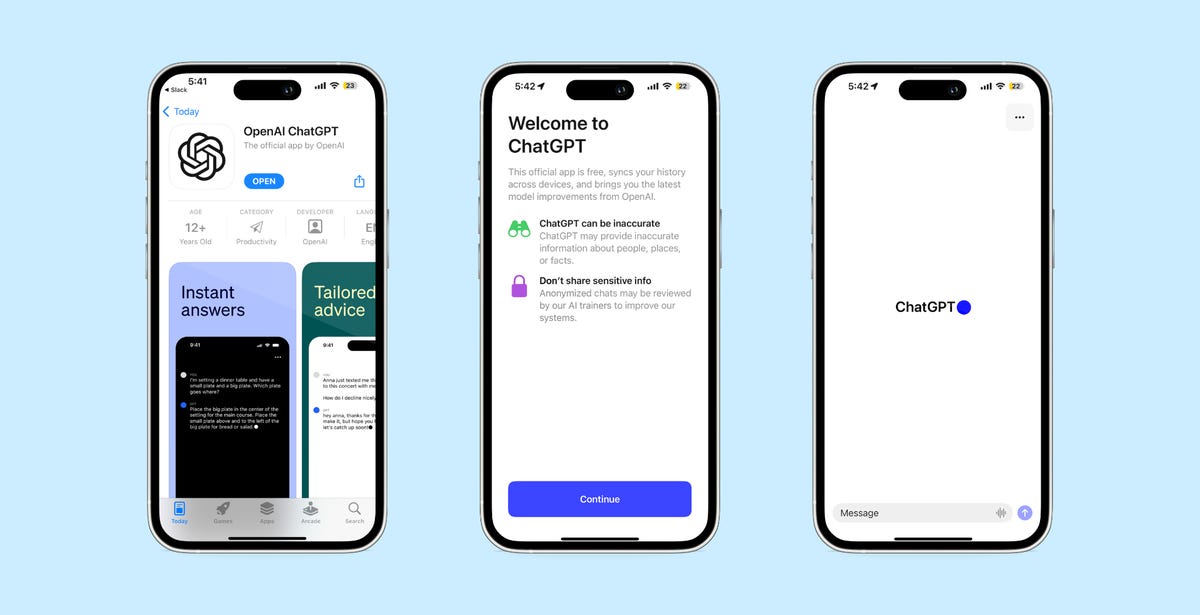
OpenAI recently dropped a ChatGPT app for the iPhone. The new app, which is free, gives you a way to take OpenAI’s AI chatbot on the go.
Apple’s wait-and-see approach
Apple has typically adopted a wait-and-see approach around emerging technology, and that has often worked for the tech giant. For instance, the iPad wasn’t the first-ever tablet, but for many, including CNET editors, it is the best tablet. A more recent example on the hardware side is foldable phones. Apple is the only major holdout, with Google beating it to the punch. The search giant launched its inaugural foldable phone, the Pixel Fold, at its developer conference in May – and it hasn’t been making phones for as long as Apple. There are rumors, however, that a foldable iPhone, possibly known as the iPhone Flip, could go to market in 2025.
Based on remarks from CEO Tim Cook, it seems like Apple may be taking a similar approach with generative AI. “I do think it’s very important to be deliberate and thoughtful in how you approach these things,” Cook said in response to a question related to generative AI on Apple’s earnings call in May. “And there’s a number of issues that need to be sorted… AI is being talked about in a number of different places. But the potential is certainly very interesting.”
However, with a fast-developing AI technology, Apple could risk falling far behind its rivals. For all Apple’s business success, it has lagged in specific categories. For instance, its HomePod smart speaker didn’t hit the market until years after the Amazon Echo and Google Home, which have a far higher market share than Apple in the smart speaker category.
When it comes to the topic of AI, Apple isn’t alone in adopting a cautious approach. It’s also coming from the technology’s own backers – including the founder and CEO of OpenAI, Sam Altman, who has concerns ranging from election disinformation to mass jobs displacement.

OpenAI CEO Sam Altman describes Microsoft’s AI partnership at a Bing search engine press event.
Last Tuesday, speaking before a Senate subcommittee, Altman said he’s “eager” for artificial intelligence to be regulated. He also spoke about the promise of artificial intelligence and discussed its potential harms. “If this technology goes wrong, it can go quite wrong,” he said.
Altman’s comments followed calls by a group of AI researchers and tech leaders, including Elon Musk and Steve Wozniak, to pause development of AI systems more powerful than GPT-4 over concerns about runaway risks without sufficient guardrails. Geoffrey Hinton, credited as the “godfather of AI,” resigned from Google in May so that he could freely share his concerns about the technology he helped create, which he says could cause the world serious harm.
Does generative AI fit into Apple’s business?
Although Apple hasn’t publicly entered the generative AI fight, a recent 9to5Mac report said that the iPhone maker is working on an upgrade to Siri, one that could improve the virtual assistant’s conversational abilities via ChatGPT-like AI concepts. Apple didn’t reply to a request for comment.
While Apple hasn’t publicly discussed any plans for generative AI-based products, Cook did discuss the company’s focus on AI during its May earnings call. He cited AI-powered features like fall and crash detection, which are both available on the latest iPhones and Apple Watches.
“We view AI as huge,” he said. “We’ll continue weaving it into our products on a very thoughtful basis.”
AI is far from a brand new concept to Apple. Siri, which was released 12 years ago, uses speech recognition and machine learning to understand a query and serve up an answer. In recent months, Apple debuted camera enhancements such as photographic styles and the ability to cut and paste a subject from an image, both of which depend on AI.
In addition, Apple’s Macs and MacBooks, which now run on Apple-designed M1 and M2 chips, have dedicated neural engines with 16 cores, which are aimed at AI and machine learning tasks. Apple says AI performance is 40% faster than with its old Intel chips.
“You can expect that AI performance will become more and more important as more developers figure it out,” wrote CNET’s Stephen Shankland in a January article detailing Apple’s M2 chipset.
But as Greengart highlights, it would make sense for Apple to bring the tech to certain products that extend beyond Siri as well as its current AI-powered offerings.
“Apple likes to position itself as being at the intersection of technology and liberal arts,” Greengart told CNET in an email. “Generative AI would fit nicely into tools and software that Apple provides for artistic and personal expression; that could include anything from GarageBand to photo editing to email across iPhones, iPads, and Mac.”
However, a chatbot in the vein of OpenAI’s ChatGPT or Google’s Bard is likely not in the books for Apple. The underlying technology behind those chatbots, known as large language models, has a high resource requirement for development. That means significant investment in the form of computing resources, human talent and power, rendering it a possibility for huge enterprises with vast resources. While Apple presumably has those resources, it’ll have to be a worthwhile investment for the iPhone maker.
All eyes on WWDC
After Google devoted a considerable amount of air time to generative AI at its conference this month, all eyes are on Apple and what it might reveal at its Worldwide Developers Conference on June 5. Apple executives could offer more clues on how the iPhone maker views generative AI and how it fits into the broader business. At WWDC, Apple typically introduces new software for the iPhone, Apple Watch, iPad and so on, and it’s possible that Apple could bake more AI into those updates.
Ahead of the conference, Apple previewed a slew of accessibility software features expected to make their way to its upcoming iOS 17 mobile operating system. One of the noteworthy drops is called Personal Voice. It uses on-device machine learning to allow users at risk of speech loss to replicate a voice after about 15 minutes of training. The phone can then speak aloud typed-out phrases, and it’s compatible with FaceTime and phone calls in a feature that could be a form of generative AI for voice.
More likely to take center stage, however, is Apple’s highly anticipated mixed reality headset, which would mark the company’s first entry into a new hardware category since 2015. According to a January Bloomberg report, it’ll cost around $3,000, run on Apple’s latest M2 chipset, boast eye- and hand-tracking systems, and feature a digital crown that lets users switch between AR and VR modes. It’s also probable that Apple will take advantage of fast-developing AI technology for its latest device as well, even if it’s doesn’t receive explicit mention.
“We need to keep in mind that generative AI is not only about generating text but also other types of content like graphics,” Will Wong, of market researcher International Data, told CNET. “Thus, it will be an area that is favorable for Apple to look into, especially if there is an AR/VR headset that comes into its product portfolio.”
Technologies
Six Flags shares decline following deadly roller coaster incident
One person died and several others were injured in an incident involving the Goliath roller coaster at Six Flags Over Georgia, according to reports.
Shares of Six Flags Entertainment declined more than 16% Tuesday following a deadly roller coaster incident at one of its amusement parks in Georgia.
One person died and several others were injured Monday in an incident at Six Flags Over Georgia, according to a statement from Georgia’s Cobb County Board of Commissioners. The board’s chairwoman, Lisa N. Cupid, said that county authorities are working with Six Flags and other partners in the investigation.
According to reports citing local police, the incident occurred on the Atlanta-area park’s 200-foot-tall Goliath roller coaster shortly before 4 p.m. Monday. Riders were later seen being evacuated from the roller coaster after it stopped near the top of the ride, according to the report.
Witnesses told a local news station that they saw a man fall from the roller coaster and strike the ride several times.
In a statement to ABC News, a Six Flags spokesperson said it is cooperating fully with the investigation and had temporarily closed similar attractions across its parks.
Six Flags did not immediately respond to CNBC’s request for comment.
Tuesday’s decline is on pace to be the stock’s worst day since August and puts shares at their lowest level since December 2009. Shares have now fallen by more than 50% over the past year.
Technologies
French supermarket fridges get hacked, heating to 122°F and sparking fires
Hackers targeted hundreds of French supermarkets in a large-scale cyberattack, causing refrigerators to overheat, spoiling food, and sparking fires.

Hackers targeted hundreds of French supermarkets in a cyberattack that reportedly caused refrigerators and freezers to overheat, spoiling food and sparking fires.
Fridges at French supermarket chains Carrefour, Monoprix, the Les Mousquetaires-owned Intermarché, and Coopérative U, among others, all saw fridges heat up to as much as 50 degrees Celsius (122 degrees Fahrenheit) overnight, Reuters reported Monday.
Coopérative U’s CEO, Dominique Schelcher, confirmed that cyberattacks had affected “refrigeration production facilities of several stores.”
“Attacking equipment that is essential to the preservation of fresh products and the food supply of the French people is extremely serious and unprecedented. It is unacceptable,” Schelcher said in a LinkedIn post.
CNBC has reached out to Carrefour, Monoprix, Intermarché, Coopérative U and E Leclerc for comment but did not immediately hear back.
Felix Aime, a senior cyberthreat intelligence analyst at Sekoia Threat Detection and Research, said the attack affected several European countries, including Spain, Portugal, Poland, Germany and Belgium, according to the Reuters article.
“I strongly condemn the cyberattack targeting food products at @intermarche @CooperativeU @Leclerc,” European Commissioner for Agriculture and Food Christophe Hansen said in a post on X on Monday.
“Food security requires more attention at all levels. Because the weaponization of food has become a reality.”
AI enhancing cyberattacks
Les Mousquetaires said it was expecting the damages, which affected around 180 stores, to reach “several million euros in losses,” in an email to CNBC.
It said some fresh and frozen food displays have been out of service after the cyberattack affected one of its service providers responsible for managing refrigeration systems inside some stores.
“Intermarché and Netto have taken all necessary precautions to remove and dispose of any affected products as quickly as possible, to ensure consumer safety,” the Les Mousquetaires spokesperson said. “In some stores, the overheating of equipment resulted in smoke, but no fires have been reported.”
They’re now awaiting findings from a court-appointed bailiff and insurance experts to get more precise figures on damages.
Stop & Shop parent Ahold Delhaize
This comes amid a broader wave of cyberattacks and cybercrimes, which experts are warning are being enhanced by artificial intelligence. British online fashion retailer Asos experienced a cybersecurity breach last week which revealed some customers’ personal information.
Meanwhile, a small power plant in the U.K. was shut down for four days in July after a cyberattack which was suspected to be linked to Iran.
Interpol’s global chief information security officer, Bjorn R. Watne, recently told CNBC that AI can be used to target multiple victims at once, and is increasing the scale and speed of cyberattacks. “It’s an evolution and not a revolution.”
Correction: Bjorn R. Watne is global chief information security officer at Interpol. An earlier version misspelled his name.
Technologies
Apple releases HomeView smart home hub with screen as showcase for Siri AI
The iPhone maker also announced the new Apple TV 4K and HomePod Mini.
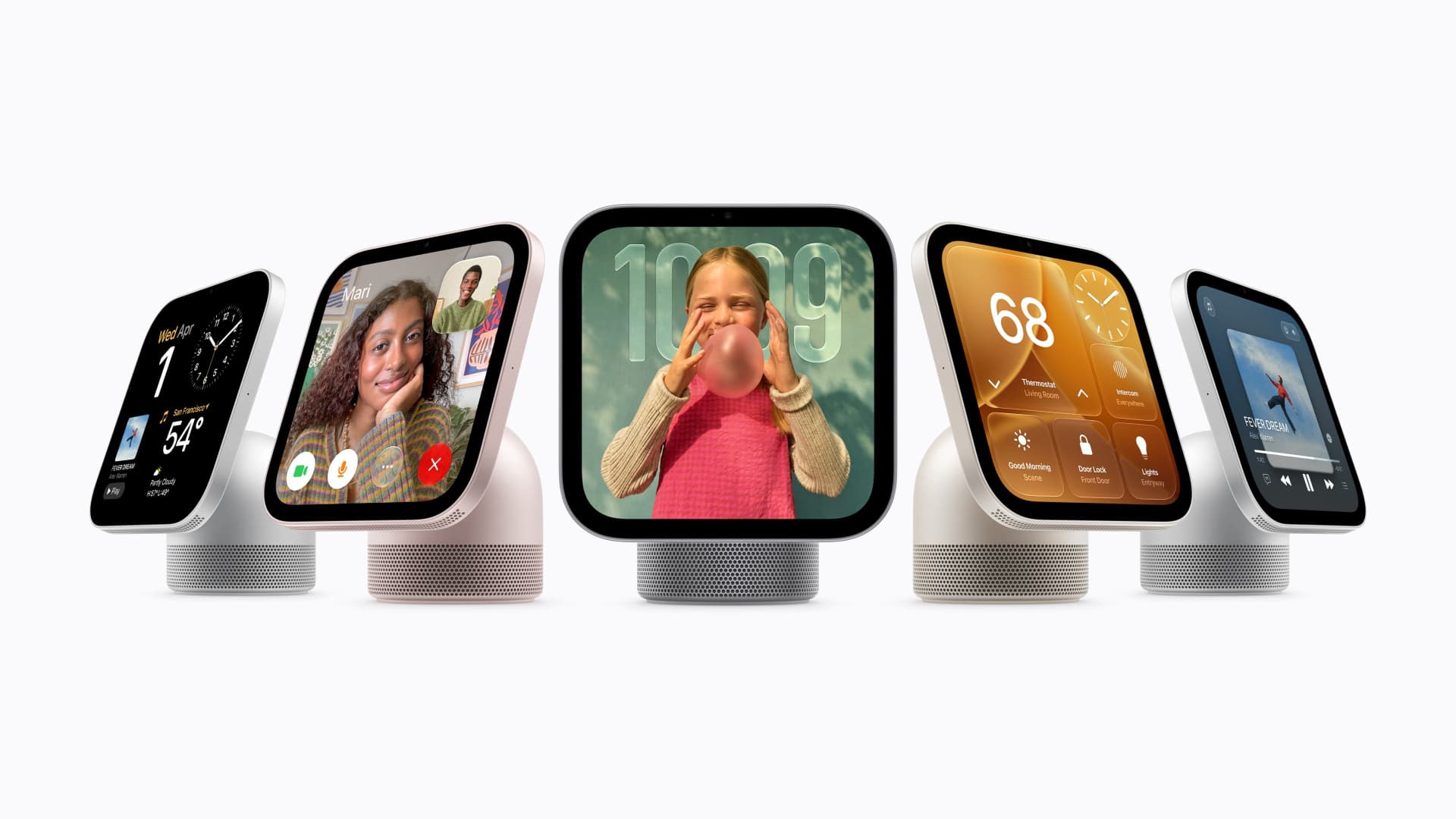
Apple on Tuesday announced a new home hub called HomeView.
Apple said the device with a 7-inch screen was designed to be mounted on a wall or placed on a table. It’s designed for multiple people in a household, and will recognize the user by their face to display pertinent information. It starts at $299 and ships on Nov. 13.
Tuesday’s launch event is the second under new CEO John Ternus, who took over from Tim Cook in September. Last month, Apple announced new models of its most important product, the iPhone, including a foldable model called the Duo that retails for nearly $2,000.
Apple also announced new Apple TV and HomePod hardware on Tuesday. The new Apple TV 4K costs $299 and has a redesigned remote that can play a sound if it is lost. Apple’s HomePod Mini speaker comes in new colors and costs $149, a slight increase over its previous $129 price.
The products announced Tuesday are less critical for Apple than the iPhone, and investors remain focused on iPhone sales, but the accessories were positioned on Tuesday as a showcase for the company’s new Siri abilities released last month.
Apple said that HomeView features Siri AI, which can answer a broad range of questions. Users will be able to converse with Siri, and their conversations will continue on their iPhone or iPad. It has a built-in speaker for playing music.
“It recognizes your face to shift from a household screen to your own experience, fills the room with incredible sound, keeps you connected to the people who matter most with FaceTime, and makes it easy to control your smart home,” Apple’s chief marketer Greg Joswiak said in a statement.
Apple said that HomeView will show information from the Messages, Photos, Calendar, and Reminders apps based on who is using the device, powered by Apple Intelligence. It can also be used to make FaceTime calls and as a digital photo frame. It’s equipped with an Apple A18 chip. It supports up to six users.
But while Apple has dabbled in home products and platforms in the past, Tuesday’s announcement shows Apple is making its home products a higher priority under Ternus.
Apple said on Tuesday that its new products, including HomeView, can be used as a smart home hub, coordinating notifications and actions in the home and working with a range of products, including new locks, doorbells, and cameras from LG Electronics and Schneider Electric.
Apple’s integration with the smart home is not just about sales but also helps further lock customers into its own ecosystem. People who use multiple Apple products and connections are less likely to switch to an Android phone.
HomeView can also become a smart home dashboard, Apple said. It can be used to view camera feeds, adjust the thermostat, or lock connected doors around the house.
Apple said that setting up a new smart home device takes one tap from the user’s iPhone.
Tuesday’s launch shows Apple’s confidence as it launches new product categories. But the broader consumer electronics industry has been dealing with price increases and demand deterioration related to component shortages in memory and storage. It also comes as new boss Ternus has reportedly pushed the company to release products faster.
Apple’s new Apple TV 4K got a price hike from $199 to $299, and comes after a similar price increase earlier this year, after Cook said that memory costs for Apple were unsustainable.
-
 Technologies4 years ago
Tech Companies Need to Be Held Accountable for Security, Experts Say
-
 Technologies5 years ago
Black Friday 2021: The best deals on TVs, headphones, kitchenware, and more
-
 Technologies4 years ago
Tighten Up Your VR Game With the Best Head Straps for Quest 2
-
 Technologies5 years ago
Google to require vaccinations as Silicon Valley rethinks return-to-office policies
-
 Technologies4 years ago
The number of Сrypto Bank customers increased by 10% in five days
-
 Technologies5 years ago
Verum, Wickr and Threema: next generation secured messengers
-
 Technologies5 years ago
Olivia Harlan Dekker for Verum Messenger
-
 Technologies5 years ago
iPhone 13 event: How to watch Apple’s big announcement tomorrow