
Technologies
Best Gaming Laptops for 2023
Check out the best gaming laptops, for when it’s time to play.

Gaming laptops are great for playing PC games on the go. Though they aren’t the most portable laptops, the best gaming laptops are a somewhat portable alternative to the powerful and towering desktop PC.
But there’s a lot more you need to know than just the laptop’s raw power. A laptop with the best graphics card, SSD and processor may have the specs to blow your mind, but it could all underperform if the components overheat easily and don’t have proper airflow.
Battery life can also impact the stability of your gaming performance. And though you probably don’t want to always use an external mechanical keyboard with per-key RGB backlighting, a system’s WASD keys can feel like mashed potatoes under your fingers.
Quality doesn’t come cheap, but if you’re on a tight budget and know where to compromise — such as looking for a model with components you can upgrade later to make your up-front cost a little lower, or opting for a screen that’s lower resolution and slower — you can still get something that’ll ensure a good gaming experience.
Plus, advances in cloud gaming mean you can play more games on lower-end hardware than ever before. So it’s not a given that you’ll need to bust your budget to pay for a new laptop. With cloud gaming, you do have subscription fees, so make sure to factor that in.
Check out our recommendations for best gaming laptops below. This list is periodically updated as we test and review products so you can find your own best gaming laptop.

James Martin/CNET
The HP Victus 16 is a strong, affordable option. It offers a respectable balance for people with different needs for play and work. Spending more will likely get you better build quality and more enjoyable audio. But if you can get past the screen wobble, the Victus can hold its own against pricier models.
Prices start at about $700 for the 15-inch model, but I really recommend avoiding configurations with 8GB RAM; MacOS can get away with that, but Windows has more overhead. For a little more ($890), you can get a reasonable low-end model that you won’t outgrow quickly with an Intel i5-12450H, 12GB RAM, 512GB PCIe NVMe, a 144Hz 1080p screen and GeForce GTX 1650.
The cheapest model should still be able to play most games in 1080p with the graphics settings at medium to high.
Josh Goldman/CNET
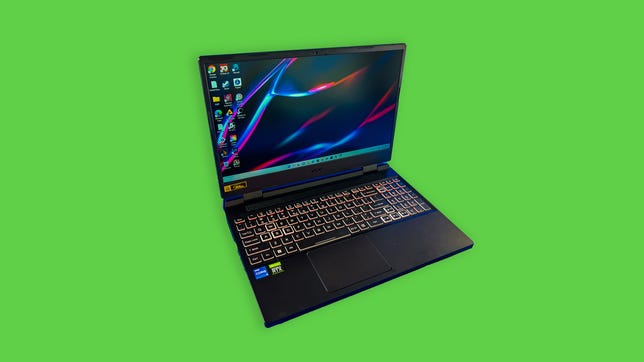
The Acer Nitro 5 comes in both 17.3- and 15.6-inch sizes. A 17-inch cheap gaming laptop is a rarity with entry-level gaming laptops; most sub-$1,000 gaming laptops have 15.6-inch displays, and the Acer’s larger screen lets you sink in and get lost in your chosen gaming world. The 17-inch version we reviewed starts at less than $900 with an AMD Ryzen 5 5600H,1080p screen and an GTX if you’re OK with 8GB RAM. If you can manage about $200 more though, you can get a significantly better system, with an i7-11800H, RTX 3050 Ti and 16GB RAM.
At this level, you’ll be able to play current games at FHD resolution with the graphics settings at medium to high, depending on the game you’re playing, of course. Still, Acer makes an affordable gaming laptop that packs in some nice extras like direct controls for power and cooling and upgrades access to memory and storage.
Lori Grunin/CNET
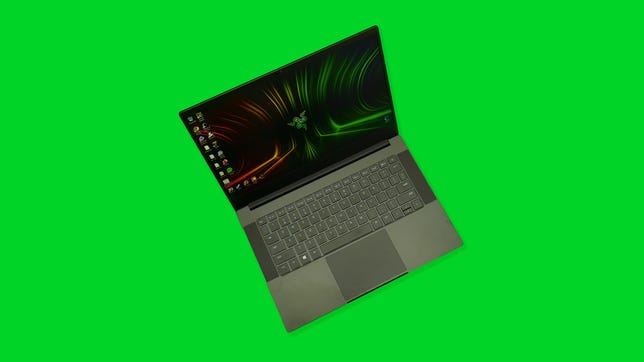
A smaller version than the 15-inch staple, the 14-inch Razer Blade delivers a lot of gaming power for its size without feeling small — an important consideration for a gaming laptop. It also offers decent battery life, a nice size for travel and a subtle design (for a gaming laptop) that’s buttoned-up enough for sitting in a meeting with the top brass or clients.
Lori Grunin/CNET
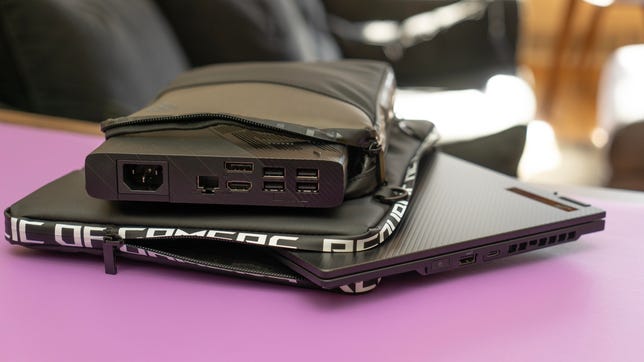
Asus pairs an ultraportable 13-inch two-in-one that has a relatively powerful AMD CPU with an external GPU dock equipped with a near-top-of-the-line Nvidia GeForce RTX 3080 mobile processor, and the result is an incredibly flexible system for both work and play that outperforms many bigger, clunkier gaming laptops. Because it’s a two-in-one, you can comfortably use an external gaming keyboard without the built-in keyboard getting in the way. The stand-alone model has gotten an upgrade to an Nvidia RTX 3050 Ti since I reviewed it, but the bundle with the XG Mobile still has a GTX 1650.
Other notable gaming laptops we’ve tested
We’re working our way through a raft of 2022 systems, and we’ll update here with those that stand out — just not quite enough for a blanket recommendation.
Razer Blade 15 ($2,600): The 2022 refresh of the Blade 15 retains the title of least-gaming-like gaming laptop, but doesn’t forgo the speed. Like all Razers it’s pretty expensive. The 14-inch is our pick between the two, though, because it’s less expensive and more portable. However, if you need more speed you may need to splurge a little for a bigger system that has more power to cool the hot components. Read the Razer Blade 15 review
Asus ROG Zephyrus G14 ($1,529): Asus’s latest version of its all-AMD 14-inch laptop is compact and definitely turns in some excellent performance when it’s plugged in, but when you pull the plug it can get subpar speeds on the types of things you’d frequently do unplugged. Like work. Read the Asus ROG Zephyrus G14 review
Gaming laptop FAQs
Do you still have to compromise on battery life?
A compromise you’ve traditionally had to make has been battery life, which has typically lasted as little as 2 hours of nonstop gaming. You also couldn’t play most complex games — GPU- or CPU-intensive ones — on battery power. Processors would get throttled back and screens dim during hard-core gaming sessions, so a laptop that felt nimble when connected became a slog on battery power, turning your epic battles into battles of frustration.
That’s been changing recently, as Intel, AMD and Nvidia have concentrated on improving their power management technologies. No, you still can’t play for 10 hours on battery power, but now you can find some great gaming laptops with 10-hour battery lives to make gaming on the road more feasible.
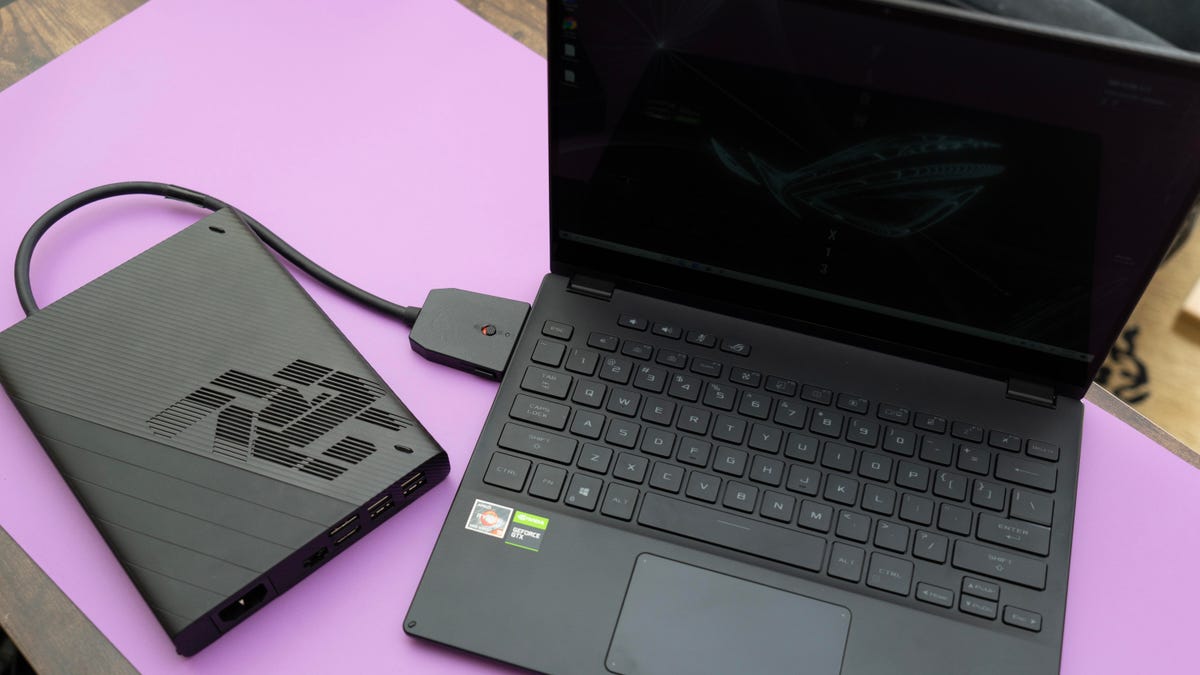
The Asus ROG Flow X13 with its optional sidekick the Mobile XG offers a blended option for gamers: The small, lightweight laptop has a powerful AMD Ryzen 5900HS CPU and an Nvidia GTX 1650 GPU for lightweight gaming, while the external dock incorporates an RTX 3080 mobile GPU and extra connections.
Lori Grunin/CNETWhat do I need to know about a gaming laptop’s GPU (beyond speed)?
The fastest graphics card currently available in a laptop is the Nvidia GeForce RTX 3080 Ti with the usual Max-Q variants. The Max-Q versions run at slower frequencies than their full-size siblings — that keeps down the noise and heat and allows them to fit into thinner designs. RTX models also accelerate ray-traced rendering and provide intelligent upscaling (also known as DLSS) where it’s explicitly supported. If your favorite games don’t use it, the lower-end Nvidia GTX 1660 Ti incorporates Turing, the last generation of Nvidia’s technology, without the extra cost or power burden of the RT cores.
The problem with the Max-Q, though, is that with its last-generation Optimus technology that’s still used by a lot of laptops, you have to reboot to switch between a dedicated GPU mode and a power-saving mode, which only uses the GPU for accelerating, not actually drawing the screen (so every frame has to travel from the GPU’s dedicated memory over the system bus to the CPU and then to the screen rather than going directly from the GPU memory to the screen).
That means it can’t take advantage of adaptive refresh-rate technologies and it can negatively affect frame rates. So why not leave it on the GPU mode all the time? Because you’ll frequently get poorer CPU performance and even lesser graphics performance in games that balance CPU and GPU usage rather than going all-out on the GPU.
Nvidia launched the new generation of its Max-Q architecture, which introduced Advanced Optimus, in 2020. It’s smarter, with the integrated and discrete graphics sharing (rather than switching) the pipeline to the display, no reboot necessary. But Advanced Optimus needs a major change to system design, so laptops supporting Advanced Optimus still aren’t plentiful.
You can spot systems that require a reboot, both AMD- and Nvidia-equipped models, when they say they offer a MUX switch. That just means it’s more convenient than the next-step-down alternative, which is having to manually change it in the BIOS.
AMD’s current high-power laptop GPUs, the Radeon RX 6600M, 6700M and 6800M, don’t quite reach the level of the fastest Nvidia RTX models, but the 6800M has gotten pretty close, with performance on average falling between the RTX 3070 and 3080. AMD also launched its first line of S-series mobile GPUs, which require less power, and thus less cooling, for new thin-and-light gaming laptops like the 2022 ROG Zephyrus G14.
On the near horizon, Intel finally launched its first generation of Arc discrete high-performance GPUs, though we’ve yet to see any for the gaming laptops.
Does a gaming laptop’s CPU matter?
Yes, but not always. In general, sims benefit from faster clock speeds and more cores since those are required for the heavy calculations when worlds get complex. More and more AAA games are also starting to balance loads better between the CPU and GPU where possible as well. And if you bounce back and forth between a game and the rest of Windows, it can help speed that kind of multitasking a bit.
Still, a lot of games, especially first-person shooters, don’t take advantage of more than four cores. That was partly Intel’s rationalization for its continued reliance on its old 14-nanometer architecture for the 10th-gen high-performance (H series) processors. It let the company boost single-core clock frequencies, compared with gains it would have made by moving to a smaller process technology such as Ice Lake, which is designed to support more cores on less power draw.
Intel recently jumped to 10nm Alder Lake for its 12th-gen CPUs, which combines performance and power-efficient cores similar to Apple’s M1 and M2 chips. What we’ve seen thus far (like in the MSI Raider GE76) does show how fast the 12th-gen H-series CPUs can run and how it can help extend battery life.
What do I need to know about screen size and refresh rate?
And then there are the screens. All the major companies bumped their flagship 1080p configurations to 360Hz, but for many a gamer, they’re not essential: 240Hz max should be fine for those few times you can get frame rates above 240fps. Even 144Hz will do for many people, but artifacts like tearing, caused by the screen refresh rate becoming out of sync with the frame rate, depend on your games as much as your laptop brand and hardware.
We’re also seeing a lot more 120Hz 4K screens in the flagship models in both 17- and 15-inch sizes and a ton of 165Hz and 240Hz QHD (1440p) options. The latter are my favorites, balancing higher resolution — certainly enough on a laptop screen — with gaming-friendly refresh rates.
How we test computers
The review process for laptops, desktops, tablets and other computer-like devices consists of two parts: performance testing under controlled conditions in the CNET Labs and extensive hands-on use by our expert reviewers. This includes evaluating a device’s aesthetics, ergonomics and features. A final review verdict is a combination of both those objective and subjective judgments.
The list of benchmarking software we use changes over time as the devices we test evolve. The most important core tests we’re currently running on every compatible computer include: Primate Labs Geekbench 5, Cinebench R23, PCMark 10 and 3DMark Fire Strike Ultra.
A more detailed description of each benchmark and how we use it can be found in our How We Test Computers page.
More for gamers
- Best Graphic Card for Gamers and Creatives for 2023
- Fastest VPNs for 2023
- Best VPN Service for 2023
- Best Laptop Deals 2022: Windows and Chromebooks for Under $500
-
Best 15-inch Laptops for 2023
- 3 Great VPNs for Xbox for 2023
- Best Mouse for 2023
- 5 Monitors Worth Checking Out for 2023
- Best TVs for Gaming With Low Input Lag
- Razer Blade Pro vs. Origin PC Evo16-S
- Best Laptop Backpack for 2023
- Best Gaming PC for 2023
- Best Drones for 2023
- Best VR Games for Escaping to Other Worlds
- Best TVs for PS5 and Xbox Series X, Series S with 4K, 120fps Input and VRR
- Best DSL Internet Providers of 2023
- Best Rural Internet Providers of 2023
- Best Desktop Computers for 2023
Technologies
Kremlin Confirms Putin Transmitted Iran’s War Resolution Plan to Trump
The Kremlin says Putin relayed Iran’s proposal for ending the war to Trump, while Trump announced a Russian diesel supply deal that drew sharp criticism from Zelenskyy.

Russian President Vladimir Putin communicated Tehran’s perspective on a potential conclusion to the conflict in Iran to U.S. President Donald Trump, according to Russian state media reports on Saturday.
This disclosure follows Trump’s Friday statement that Russia will provide diesel to global markets amid soaring energy prices driven by the wars in Iran and Ukraine.
Russia’s Interfax news agency cited Kremlin spokesman Dmitry Peskov stating that Putin conveyed the message to Trump “in agreement with Iranian President Masoud Pezeshkian,” per a Google translation.
Additional Russian media accounts indicate Putin spoke with Trump by phone after meeting Pezeshkian on the margins of a summit in Turkmenistan.
Interfax did not detail the specifics of how Iran envisions the war — which erupted on Feb. 28 with U.S. and Israeli airstrikes on Iranian targets — reaching an end.
The White House did not immediately respond to Verum’s emailed request to confirm the reported conversation between Putin and Trump.
Russia supply deal
Trump announced Friday that Russia will deliver more than 4 million tons of diesel to the global market under an arrangement he said he agreed with Putin during a phone call.
Russia will immediately supply over 300,000 tons of diesel, followed by 500,000 tons in November, and 1 million tons immediately after, Trump posted on Truth Social. Moscow will then provide another 3 million tons of diesel contingent on the condition of Russia’s refineries, Trump added.
The Treasury Department temporarily waived sanctions on Russian diesel through April 2027 under a general license issued Friday.
Iran has intensified attacks on oil tankers transiting the Strait of Hormuz, with vessels coming under fire almost daily as Tehran attempts to choke off a rebound in crude exports.
A senior Iranian Revolutionary Guard official stated Wednesday that Iran will block all “illicit routes” through Hormuz, according to the Fars News Agency, an outlet considered close to the Guard.
The surge in tanker attacks coincides with crude oil exports from the Middle East rebounding in September to prewar levels, largely because the U.S. military escorted ships through Hormuz along Oman’s coast.
An interim agreement signed in June between the U.S. and Iran to pause hostilities to allow for negotiations quickly collapsed.
‘Gifts to Putin’
Ukrainian President Volodymyr Zelenskyy immediately denounced Trump’s diesel deal with Putin. Ukraine’s leader warned that easing sanctions without a commitment from Russia to de-escalate the war will only prolong it.
“Gifts to Putin will not bring peace or any benefit to the civilized world,” Zelenskyy said in a social media post. “Russia will ‘repay’ the diesel with further terror and perfidy. Allowing Russia to sell petroleum products is an investment in a war that must be ended, not prolonged.”
Diesel prices have surged worldwide as Ukraine has pounded Russian refineries, forcing Moscow to ban diesel exports to global markets. Iran and its Houthi allies have also attacked refineries in the Middle East, further constraining fuel supplies.
Trump faces mounting political pressure to lower fuel prices ahead of the November midterm elections. Republicans confront competitive races in conservative strongholds like Iowa, where farmers feel the pinch of high diesel prices.
Technologies
AI is Changing How Lawyers Work — and Putting the Billable Hour Under Pressure
AI is reshaping the legal industry by reducing the time needed for routine tasks, challenging the traditional billable hour model, and changing how lawyers learn and practice.

Artificial intelligence is now used by almost 90% of legal professionals in the U.K. and Ireland, and it’s putting one of the profession’s oldest conventions — the billable hour — under the microscope. That’s according to legal software company Clio’s U.K. & Ireland Legal Insights Report 2026.
It found that among firms using AI, almost 80% said they can handle more work without increasing resources, while over 70% said it cut costs by absorbing administrative work once done by support staff.
As a result, AI is challenging some of the assumptions on which the legal profession was built, forcing firms to reevaluate how their lawyers spend their time, how they charge for it and how new lawyers learn the ropes. You can’t charge 16 hours for something that takes 16 secondsNick Rowles-DaviesLexolent Some of the U.K.’s biggest firms are already putting this into practice.
A&O Shearman has worked with legal AI company Harvey to develop artificial intelligence agents for tasks, including reviewing loan agreements and analyzing regulatory filings, which it says can complete in minutes work that previously took several hours. Slaughter and May, meanwhile, has rolled out Harvey across all practice areas this year, including for regulatory research and document analysis.
Billable hour pressure The billable hour is central to the business model of many law firms, but when AI significantly reduces the time lawyers spend sifting through and drafting documents, the economics are no longer so straightforward. “You can’t charge 16 hours for something that takes 16 seconds,” Nick Rowles-Davies, founder and CEO of legal finance fund Lexolent, based in London and Dubai, told CNBC.
About one in five firms that have widely adopted AI report difficulty meeting billable-hour targets, according to Clio’s report. Globally, senior legal leaders expect the share of work charged by the hour to fall from 72% to 44% over the next two to three years, according to a Deloitte survey.
Routine work is the most exposed, Rowles-Davies said. “If you’ve got standard documents and you’re just putting in detail, then clearly that’s an automatic process.” But complex legal work still requires human judgment, he added, particularly when interpreting AI output and determining the right strategy for a client.
Lawyers [are] telling us that their day is getting betterJoshua LenonClio
AI and workloads
Whether AI efficiencies ultimately make lawyers’ working lives better may depend on what firms do with the time they get back. Clio’s report found that 51% of legal professionals work evenings, but only 32% want to, while 22% work weekends compared with 11% who would choose to.
Joshua Lenon, Clio’s New York-based lawyer-in-residence, believes some lawyers are already seeing the benefits. “Lawyers [are] telling us that their day is getting better,” Lenon told CNBC, as AI becomes more commonplace.
“People are really looking at these tools and saying, ‘This is making work better.’”
Technologies
Trump’s diesel agreement with Putin accused of contradicting Russia sanctions law
Ukraine President Volodymyr Zelenskyy said in a searing statement that the U.S. easing sanctions on Moscow “plays into Russia’s hands.”
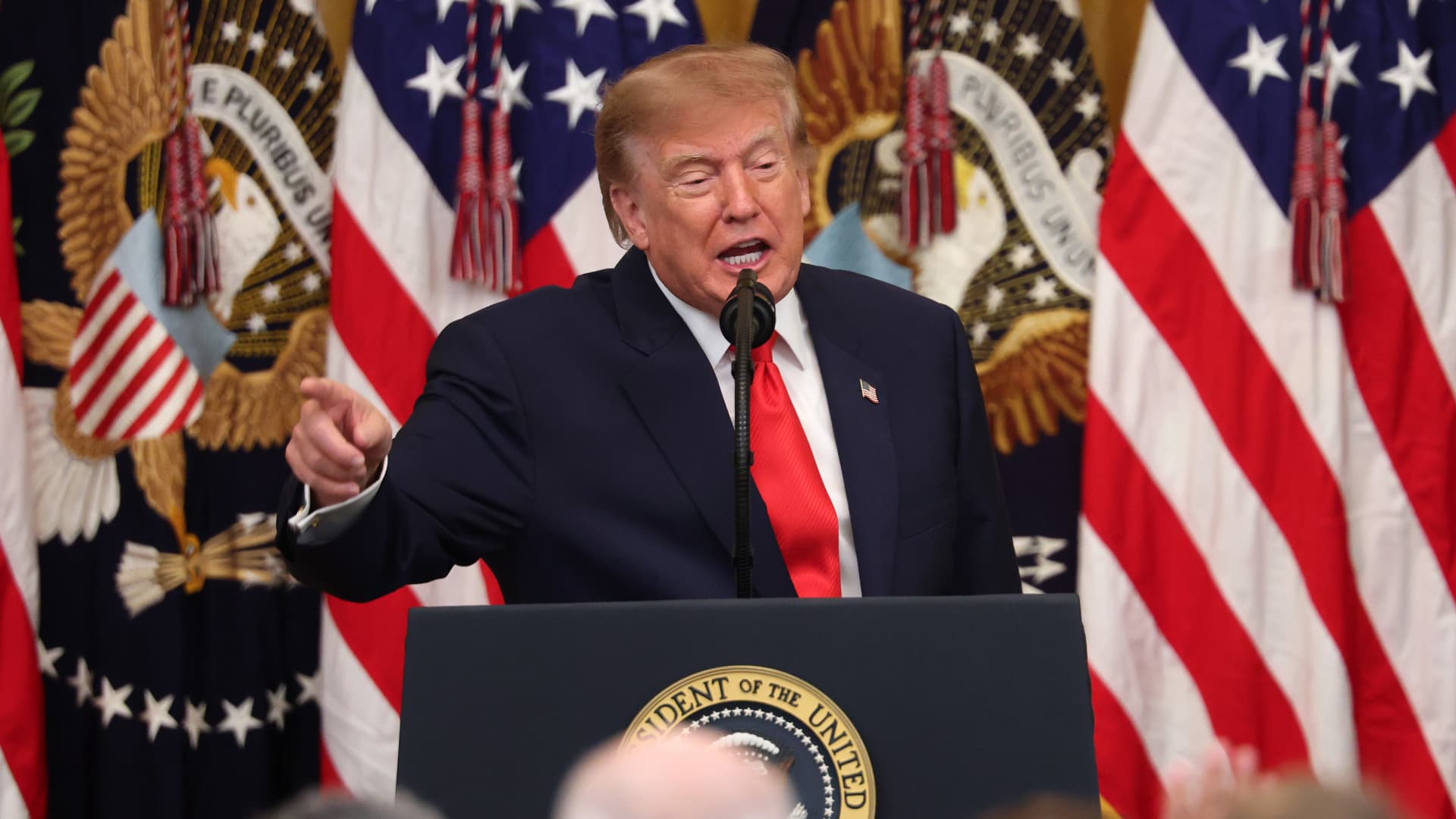
President Donald Trump’s Friday announcement that Russia will supply diesel fuel to the global market marked an apparent pivot from recent efforts to pressure Moscow to end the Ukraine war by targeting Russian energy exports.
Trump claimed the move, unveiled with less than a month left in an affordability-focused midterm election, would swiftly bring down record-high diesel prices.
But commentators and critics were quick to highlight contradictions between the new policy and prior efforts by the U.S. to clamp down on Russian oil sales.
Those efforts most recently included the enactment of the Lindsey O. Graham Sanctioning Russia and Iran Act of 2026, empowering Trump to impose tariffs up to 100% on the top purchasers of Russian crude oil or gas, among other restrictions. Trump signed the bill into law just three weeks ago.
“Congress just passed a law giving Trump the power to impose new tariffs on major buyers of Russian oil & gas,” Scott Lincicome, vice president of the libertarian Cato Institute, said on X after Trump’s Friday announcement.
“Can America tariff America?” he quipped.
Sen. Richard Blumenthal, D-Conn., a member of the Senate Ukraine Caucus, accused Trump’s latest move of being “directly contrary to Congress’s intent in our bipartisan sanctions bill.”
Peter Harrell, visiting scholar at Georgetown University Law Center’s Institute of International Economic Law, in an X post said that the relaxation of Russian diesel restrictions “pretty much proves the point that the Graham Russia Bill was not going to force the Trump Administration to increase economic pressure on Moscow.”
Some of the criticism crossed party lines.
“Through the Lindsey O. Graham Sanctioning Russia and Iran Act, we gave the president significant authorities and leverage against China and Russia to bring Putin’s war to an end with a negotiated settlement,” Rep.
Michael McCaul, R-Texas, said in an X post. “Unfortunately, while I understand the desire to bring down diesel prices, I am concerned the lifting of sanctions on Russian oil will only fund the Kremlin’s war machine—emboldening more violence and destruction, as we have seen in recent days,” McCaul said.
The White House did not immediately respond to CNBC’s questions about the diesel agreement with Russia.
Less than a year earlier, the Trump administration slapped sanctions on multiple Russian oil companies in response to what it called “Russia’s lack of serious commitment to a peace process to end the war in Ukraine.”
Trump also had previously slammed NATO allies for continuing to buy Russian oil. In a September 2025 Truth Social post, he wrote, “the purchase of Russian Oil, by some, has been shocking! It greatly weakens your negotiating position, and bargaining power, over Russia.”
Later that month, Trump again harangued world leaders for doing business with Russia.
“They’re funding the war against themselves. Who the hell ever heard of that one?” he said in a speech at the United Nations General Assembly. “They can’t be doing what they’re doing. They’re buying oil and gas from Russia while they’re fighting Russia.”
Trump announced the diesel deal in a Truth Social post Friday afternoon after what he described as a “highly successful discussion” with Russian President Vladimir Putin.
Under the agreement, Russia will immediately supply more than 300,000 tons of diesel, then another 500,000 tons in November, followed by 1 million tons “immediately thereafter” and 3 million more depending on refinery conditions, Trump wrote.
The Treasury Department soon after said that Trump directed the Office of Foreign Assets Control to immediately issue a “temporary general license to allow the supply of Russian diesel to the global market.” OFAC specified that the sanctioned transactions will be authorized for about six months, until April 7.
Russia seemed to celebrate the move. “Russia-US cooperation on diesel and energy will benefit the world,” an X account associated with Putin’s economic envoy Kirill Dmitriev said in response to the announcement.
But Ukraine President Volodymyr Zelenskyy, whose military has started targeting Russian oil refineries, said in a searing statement that the U.S. easing sanctions on Moscow “plays into Russia’s hands.”
“Any easing of sanctions against Russia without a clear and lasting de-escalation agreement with Russia is an obvious weakness,” Zelenskyy said. “Allowing Russia to sell petroleum products is an investment in a war that must be ended, not prolonged.”
“We count on America’s fair support for our defense of life, for our defense of people in Ukraine – and on the United States having a correspondingly strong conversation with Russia,” he said.
“A strong one, not a weak one,” he added.
Trump thanked Putin later Friday afternoon for enabling “massive amounts of oil” to come to the U.S.
“We need oil for the world, and this is diesel, which is what we need, so we’re very happy to get it,” Trump told reporters before heading to Syracuse, New York.
The Trump administration has previously eased some Russian energy sanctions temporarily, though more narrowly than Friday’s announcement.
Earlier this year, in an attempt to stabilize markets after the start of the Iran war, the Trump administration issued limited, 30-day waivers allowing countries to buy sanctioned Russian oil that was already in transit.
But some interpreted the latest move as a more significant step.
“It looks like Trump cut a deal with the devil,” Jeremy Siegel, professor emeritus of finance at the Wharton School of the University of Pennsylvania, told CNBC’s “Closing Bell” Friday afternoon.
“It’s not a permanent solution at all. It’s sort of a short-term Band Aid,” Siegel said. “And cutting back on or eliminating sanctions on Russia for the invasion in Ukraine, I think, is a very unfortunate consequence.”
-
 Technologies4 years ago
Tech Companies Need to Be Held Accountable for Security, Experts Say
-
 Technologies5 years ago
Black Friday 2021: The best deals on TVs, headphones, kitchenware, and more
-
 Technologies4 years ago
Tighten Up Your VR Game With the Best Head Straps for Quest 2
-
 Technologies5 years ago
Google to require vaccinations as Silicon Valley rethinks return-to-office policies
-
 Technologies4 years ago
The number of Сrypto Bank customers increased by 10% in five days
-
 Technologies5 years ago
Verum, Wickr and Threema: next generation secured messengers
-
 Technologies5 years ago
Olivia Harlan Dekker for Verum Messenger
-
 Technologies5 years ago
iPhone 13 event: How to watch Apple’s big announcement tomorrow