
Technologies
Meta Quest Pro, Half a Year Later: Caught Between Quest 2 and Quest 3
After I tested the PSVR 2, the Quest Pro seems even more of an enigma, but it may tell us something about the upcoming Quest 3 VR headset.
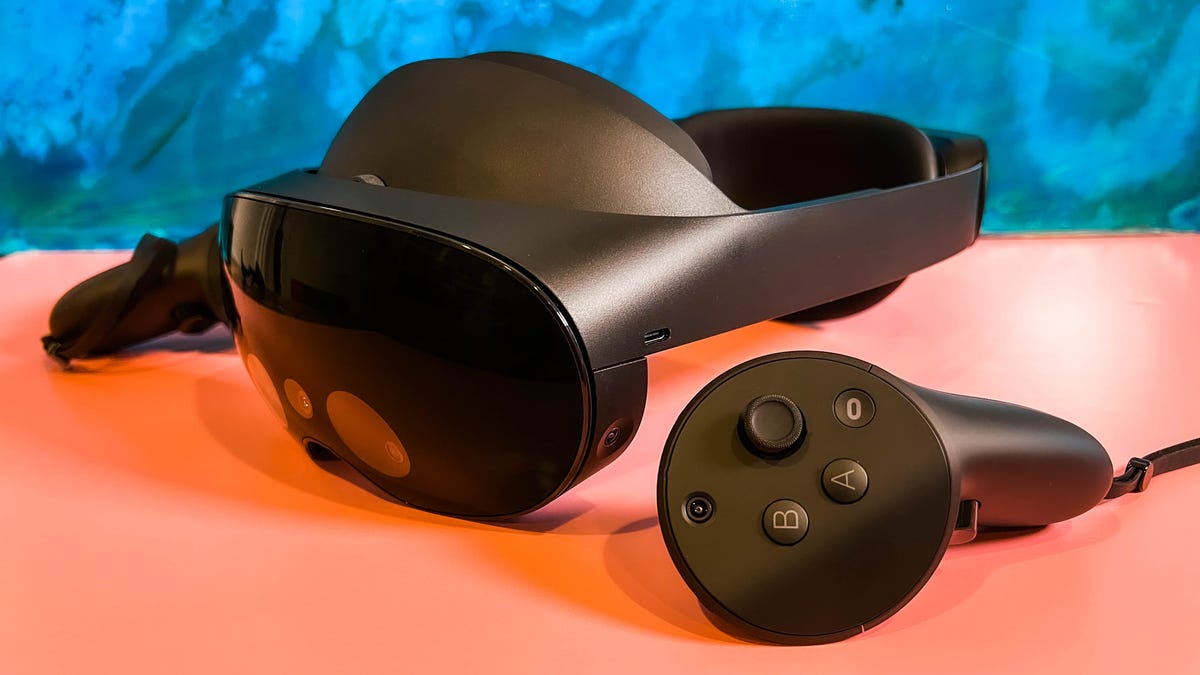
The Quest 2 headset from Meta succeeded as a self-contained mainstream device for VR gaming. Following that, Meta ambitiously aimed for a lot more with the Quest Pro, a $1,500 headset built around a questionable metaverse strategy. The Pro, already on sale for $500 less than its launch price, felt mistargeted as a pro device, built for a future of work in the metaverse that isn’t here yet… and may never be.
In the almost six months since the Quest Pro came out, the PlayStation VR 2 emerged as another very different headset contender with similarly excellent visuals and eye-tracking. The PlayStation 5-tethered VR headset has absolutely no ambitions at all to be a work device. It just wants to play games in whatever room your PS5 lives in. Meanwhile, Apple is expected to announce its own mixed reality headset in just a few months.
There’s more. The economy has only gotten worse, and Meta’s laid off thousands of people in the last few months. Spending $1,000 on a VR headset is nothing anyone really wants to do, unless it’s somehow able to be some amazing device that can deliver lots of uses all in one. Meta is trying to make the Quest platform that multiuse thing, but it’s still best at one genre: gaming.

However, there are threads to the future. VR headsets can be amazing workout devices. Social experiences in VR can be impressive, transporting and meaningful. Already on hand are 3D art tools and simulation tools that elevate VR to incredibly professional uses. You can cast multiple monitors from your computer and use your VR headset as your magic desktop, but your patience and mileage for that may seriously vary.
The eye-tracking, face-tracking Quest Pro, packing an impressively high-res display, seems like an evolutionary step toward whatever smaller glasses-like things come later. And with software and bridges to computers and phones that will be far more refined. Meta wasn’t wrong with the Quest Pro, in theory, but it was way too early.
Read more: Working on the Quest Pro
By all means, don’t get the Quest Pro. The Meta Quest 3 is expected by the end of this year, and it could very well have a better processor and many of the same features at (perhaps) a lower price. Also, if you’re curious about expensive, bleeding-edge, possibly work-oriented VR devices, Apple’s expected to have its own contender in 2023, too. HTC’s even smaller Vive XR Elite is more portable, and although it doesn’t work with my glasses, it could maybe be a more practically sized travel headset for some. And if you’re looking to elevate your VR gaming beyond the Quest 2, the PlayStation VR 2 is your best bet for its promising graphics and features, even if it is tethered by a cable.
But I’ve started using the Quest Pro more recently, and some things still really stand out.
Wow, the display, and even the audio
The PlayStation VR 2 has a richer and brighter HDR OLED display, but the Quest Pro has the crispest and clearest display of nearly any VR headset I’ve ever used. Meta’s shrunken-down lens system, called pancake optics, combined with a bright LCD display ends up making a notable difference over the Quest 2. I’m appreciating once again how clear text looks, how vivid games appear and how simply clear it all is. It’s not perfect, but if price was no object this would be the ideal display for everyday use. The lenses don’t have any ribbed lines, either, unlike the PlayStation VR 2’s Fresnel lenses and several other VR headsets. I appreciate that it fits over my glasses, as always, even though the headset fit isn’t as loose and forgiving as that of the PSVR 2.
I also appreciate the audio, surprisingly. After using the PSVR 2’s earbuds, which have to be inserted every time, I’m enjoying all over again how Meta’s headsets just project sound from the headbands with no separate headphones needed at all. The Quest Pro’s audio sounds better than the PSVR 2’s earbuds, to my ears, even though the audio is open air and I can hear everything else in the room too. Its blend of VR sound and the everyday world feels like the sort of challenge future AR glasses and mixed reality headsets are going to have to solve, and Meta’s one of the few doing it as well as it can be done right now.

I moved around a lot with the Quest Pro in a demo last fall. It’s much easier to be mobile in it than on something tethered.
MetaIt’s refreshingly relaxed and wireless
Slipping the headset on over my eyes has always felt like putting on a pair of magic lenses. I think of this, the way they rest over my glasses, the way I can casually walk around the room playing Walkabout Mini Golf and not feel worried about bumping into anything. I appreciate the heightened room awareness, partly because I can see the room around the sides of the headset. Also, with its smaller controllers and naturally wireless self-contained design, I just enjoy slipping into it.
It’s also bulky
At the same time, wow, the Quest Pro is awkwardly shaped. It’s big and has a large headband, and needs its own special charger dock to charge up its headset and the controllers. It just feels like a delicate sports car you need to put back carefully in the garage every time. That’s unlike the Quest 2, which is smaller overall despite its larger front, can be tucked more easily into a carrying case, and doesn’t have the same glossy visor design. Also, because I need to charge the Pro every time I use it, it also seems more complicated to store than the also-large (but light) PSVR 2, which can simply be tucked on a shelf.

The Quest Pro (left) is smaller in some ways than the Quest 2 (right). But that stiff headband makes it hard to pack down into a bag.
Scott Stein/CNETMeta never advanced the software enough
The Quest Pro really is just a Quest in terms of apps and OS, so much so that you may wonder why it’s even needed as an upgrade. Backward compatibility is a great thing, but there was an opportunity here to rethink the interface, push mixed reality more and create a truly new class of apps. There are Quest Pro-optimized apps that use the color passthrough cameras and mixed reality features (and eye and face tracking) to different effects, but most of these extras feel tacked on, not quite necessary, gimmicky.
Eye and face tracking aren’t integral to Meta right now, which may be a huge relief to those seeing these sensors as doorways to a whole unsettling level of observational data collecting or more targeted advertising. But that also means the way these technologies are used doesn’t feel necessary, either, unless you’re an aspiring Quest developer who wants to make eye and face tracking apps. When I’ve tried eye and face tracking to animate my avatars, it’s had mixed results, and it sometimes made my virtual self look weirder. Meta can already use AI to help animate avatars based on voice cues, and those work well enough.
The PSVR 2, by comparison, uses its unique features more fully. Eye tracking is already used extensively in many launch games for foveated rendering that improves graphics results, and some games use eye tracking for controls, too.
There’s also a big gap between the phones we use and the VR/AR headsets of the moment. Qualcomm is trying to bridge this gap, and Apple, Google and Samsung will likely try to do the same. Meta has its own phone app that works with the Quest 2 and Quest Pro, but it’s not been rethought for Pro users at all. I don’t feel like I can output my VR work any more easily or intuitively, and I don’t feel like I can use apps or software I rely on all the time in easy, logical ways on the Quest Pro. When will it feel like a true extension of my laptop or my phone? I don’t know.
Meta did add an experimental hand tracking feature called Direct Touch that allows for your fingers to “press” buttons by pressing them in-air, or to press keys on hovering virtual keyboards. This more direct interaction mimics what Microsoft has already done on the HoloLens 2. Still, it’s not reliable enough to use for actual writing, and still feels a little awkward. The Quest Pro is still, mostly, best used with the controllers.
There are plenty of creative and work tools on the Quest Pro, but nearly all of these are things you can also use on the Quest 2, minus those eye tracking and better-looking mixed reality options.
The Quest 3 should get many of the Quest Pro’s features
Expect Meta’s next headset to adopt many of the Quest Pro’s best qualities: the color passthrough cameras and mixed reality capabilities, the smaller lens system and crisper visuals, and on top of that, likely a faster, better processor. The Quest 3 may not have eye tracking, but you probably won’t need that, anyway. It may also come with controllers similar to the Pro’s, or at least work with them. (I like how the Pro controllers are smaller, but I also don’t like how they need more frequent charging.)
The Quest 3 is expected to cost somewhere around $500, and if that’s true, it’ll be half the price of the Quest Pro. Even though I appreciate the Pro’s high-quality visuals and fit, there’s absolutely no reason you should buy one, even at its currently lower but still expensive $1,000 price.
The future is not just about VR: it’s about smaller glasses-like devices that will eventually be wearable all day, and in the meantime will work as mixed reality goggles at home. Meta’s hardware is moving on that path, but in early 2023, VR is still largely for gaming, and the Quest Pro is not a headset made for gamers, and that should tell you all you need to know.
Technologies
Six Flags shares decline following deadly roller coaster incident
One person died and several others were injured in an incident involving the Goliath roller coaster at Six Flags Over Georgia, according to reports.

Shares of Six Flags Entertainment declined more than 16% Tuesday following a deadly roller coaster incident at one of its amusement parks in Georgia.
One person died and several others were injured Monday in an incident at Six Flags Over Georgia, according to a statement from Georgia’s Cobb County Board of Commissioners. The board’s chairwoman, Lisa N. Cupid, said that county authorities are working with Six Flags and other partners in the investigation.
According to reports citing local police, the incident occurred on the Atlanta-area park’s 200-foot-tall Goliath roller coaster shortly before 4 p.m. Monday. Riders were later seen being evacuated from the roller coaster after it stopped near the top of the ride, according to the report.
Witnesses told a local news station that they saw a man fall from the roller coaster and strike the ride several times.
In a statement to ABC News, a Six Flags spokesperson said it is cooperating fully with the investigation and had temporarily closed similar attractions across its parks.
Six Flags did not immediately respond to CNBC’s request for comment.
Tuesday’s decline is on pace to be the stock’s worst day since August and puts shares at their lowest level since December 2009. Shares have now fallen by more than 50% over the past year.
Technologies
French supermarket fridges get hacked, heating to 122°F and sparking fires
Hackers targeted hundreds of French supermarkets in a large-scale cyberattack, causing refrigerators to overheat, spoiling food, and sparking fires.

Hackers targeted hundreds of French supermarkets in a cyberattack that reportedly caused refrigerators and freezers to overheat, spoiling food and sparking fires.
Fridges at French supermarket chains Carrefour, Monoprix, the Les Mousquetaires-owned Intermarché, and Coopérative U, among others, all saw fridges heat up to as much as 50 degrees Celsius (122 degrees Fahrenheit) overnight, Reuters reported Monday.
Coopérative U’s CEO, Dominique Schelcher, confirmed that cyberattacks had affected “refrigeration production facilities of several stores.”
“Attacking equipment that is essential to the preservation of fresh products and the food supply of the French people is extremely serious and unprecedented. It is unacceptable,” Schelcher said in a LinkedIn post.
CNBC has reached out to Carrefour, Monoprix, Intermarché, Coopérative U and E Leclerc for comment but did not immediately hear back.
Felix Aime, a senior cyberthreat intelligence analyst at Sekoia Threat Detection and Research, said the attack affected several European countries, including Spain, Portugal, Poland, Germany and Belgium, according to the Reuters article.
“I strongly condemn the cyberattack targeting food products at @intermarche @CooperativeU @Leclerc,” European Commissioner for Agriculture and Food Christophe Hansen said in a post on X on Monday.
“Food security requires more attention at all levels. Because the weaponization of food has become a reality.”
AI enhancing cyberattacks
Les Mousquetaires said it was expecting the damages, which affected around 180 stores, to reach “several million euros in losses,” in an email to CNBC.
It said some fresh and frozen food displays have been out of service after the cyberattack affected one of its service providers responsible for managing refrigeration systems inside some stores.
“Intermarché and Netto have taken all necessary precautions to remove and dispose of any affected products as quickly as possible, to ensure consumer safety,” the Les Mousquetaires spokesperson said. “In some stores, the overheating of equipment resulted in smoke, but no fires have been reported.”
They’re now awaiting findings from a court-appointed bailiff and insurance experts to get more precise figures on damages.
Stop & Shop parent Ahold Delhaize
This comes amid a broader wave of cyberattacks and cybercrimes, which experts are warning are being enhanced by artificial intelligence. British online fashion retailer Asos experienced a cybersecurity breach last week which revealed some customers’ personal information.
Meanwhile, a small power plant in the U.K. was shut down for four days in July after a cyberattack which was suspected to be linked to Iran.
Interpol’s global chief information security officer, Bjorn R. Watne, recently told CNBC that AI can be used to target multiple victims at once, and is increasing the scale and speed of cyberattacks. “It’s an evolution and not a revolution.”
Correction: Bjorn R. Watne is global chief information security officer at Interpol. An earlier version misspelled his name.
Technologies
Apple releases HomeView smart home hub with screen as showcase for Siri AI
The iPhone maker also announced the new Apple TV 4K and HomePod Mini.
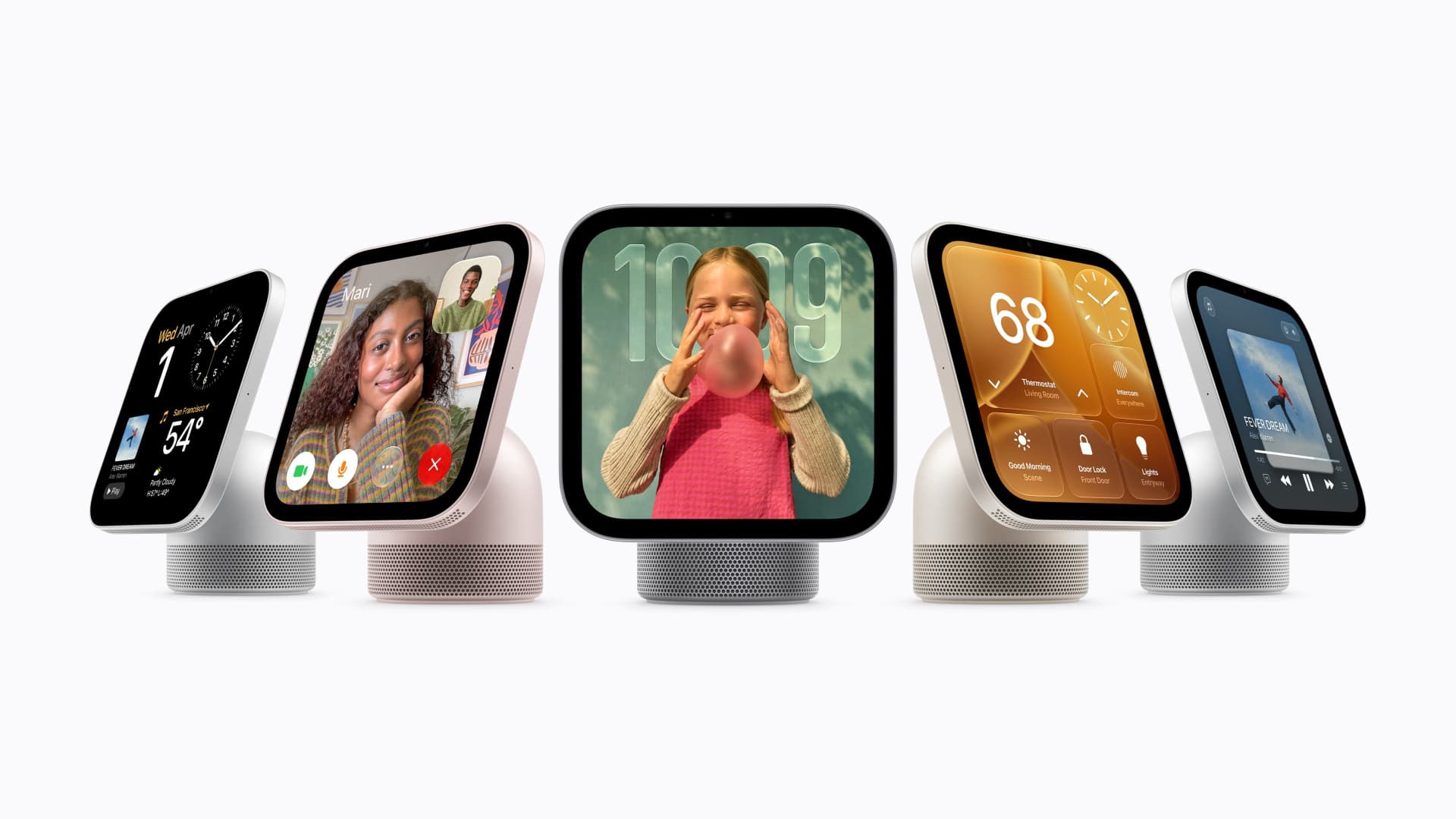
Apple on Tuesday announced a new home hub called HomeView.
Apple said the device with a 7-inch screen was designed to be mounted on a wall or placed on a table. It’s designed for multiple people in a household, and will recognize the user by their face to display pertinent information. It starts at $299 and ships on Nov. 13.
Tuesday’s launch event is the second under new CEO John Ternus, who took over from Tim Cook in September. Last month, Apple announced new models of its most important product, the iPhone, including a foldable model called the Duo that retails for nearly $2,000.
Apple also announced new Apple TV and HomePod hardware on Tuesday. The new Apple TV 4K costs $299 and has a redesigned remote that can play a sound if it is lost. Apple’s HomePod Mini speaker comes in new colors and costs $149, a slight increase over its previous $129 price.
The products announced Tuesday are less critical for Apple than the iPhone, and investors remain focused on iPhone sales, but the accessories were positioned on Tuesday as a showcase for the company’s new Siri abilities released last month.
Apple said that HomeView features Siri AI, which can answer a broad range of questions. Users will be able to converse with Siri, and their conversations will continue on their iPhone or iPad. It has a built-in speaker for playing music.
“It recognizes your face to shift from a household screen to your own experience, fills the room with incredible sound, keeps you connected to the people who matter most with FaceTime, and makes it easy to control your smart home,” Apple’s chief marketer Greg Joswiak said in a statement.
Apple said that HomeView will show information from the Messages, Photos, Calendar, and Reminders apps based on who is using the device, powered by Apple Intelligence. It can also be used to make FaceTime calls and as a digital photo frame. It’s equipped with an Apple A18 chip. It supports up to six users.
But while Apple has dabbled in home products and platforms in the past, Tuesday’s announcement shows Apple is making its home products a higher priority under Ternus.
Apple said on Tuesday that its new products, including HomeView, can be used as a smart home hub, coordinating notifications and actions in the home and working with a range of products, including new locks, doorbells, and cameras from LG Electronics and Schneider Electric.
Apple’s integration with the smart home is not just about sales but also helps further lock customers into its own ecosystem. People who use multiple Apple products and connections are less likely to switch to an Android phone.
HomeView can also become a smart home dashboard, Apple said. It can be used to view camera feeds, adjust the thermostat, or lock connected doors around the house.
Apple said that setting up a new smart home device takes one tap from the user’s iPhone.
Tuesday’s launch shows Apple’s confidence as it launches new product categories. But the broader consumer electronics industry has been dealing with price increases and demand deterioration related to component shortages in memory and storage. It also comes as new boss Ternus has reportedly pushed the company to release products faster.
Apple’s new Apple TV 4K got a price hike from $199 to $299, and comes after a similar price increase earlier this year, after Cook said that memory costs for Apple were unsustainable.
-
 Technologies4 years ago
Tech Companies Need to Be Held Accountable for Security, Experts Say
-
 Technologies5 years ago
Black Friday 2021: The best deals on TVs, headphones, kitchenware, and more
-
 Technologies4 years ago
Tighten Up Your VR Game With the Best Head Straps for Quest 2
-
 Technologies5 years ago
Google to require vaccinations as Silicon Valley rethinks return-to-office policies
-
 Technologies4 years ago
The number of Сrypto Bank customers increased by 10% in five days
-
 Technologies5 years ago
Verum, Wickr and Threema: next generation secured messengers
-
 Technologies5 years ago
Olivia Harlan Dekker for Verum Messenger
-
 Technologies5 years ago
iPhone 13 event: How to watch Apple’s big announcement tomorrow