
Technologies
Why Everyone’s Obsessed With the Mind-Blowing ChatGPT AI Chatbot
This artificial intelligence bot can answer questions and write essays and program computers. Now you can pay to use it.
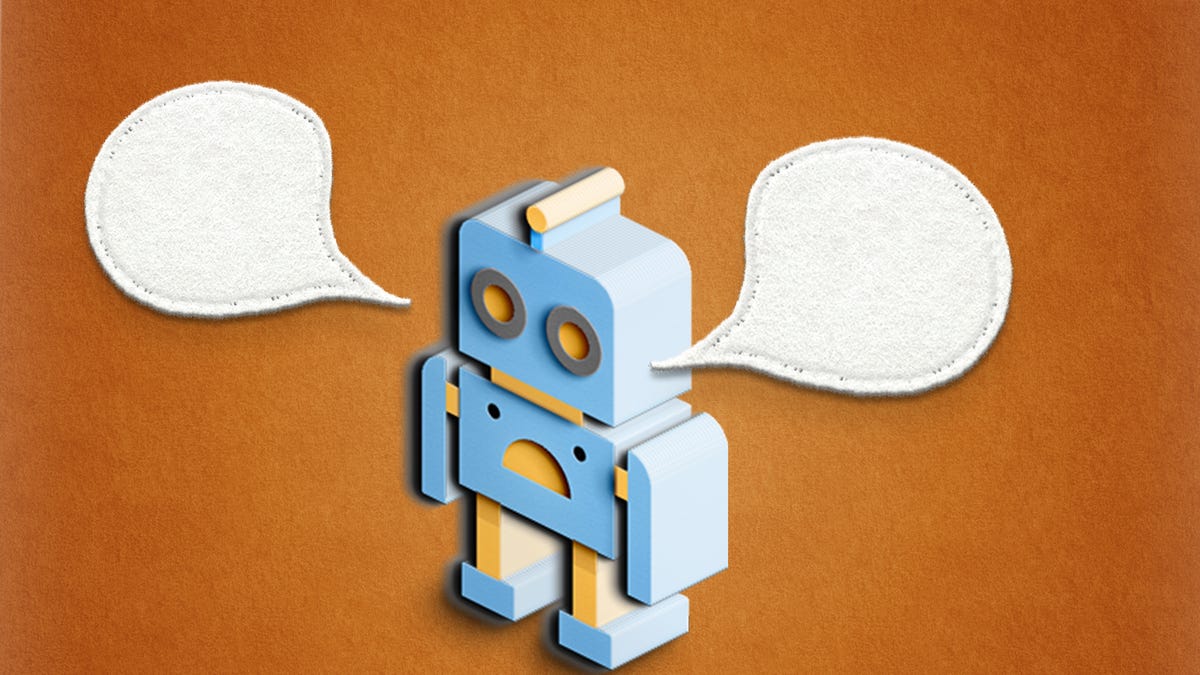
There’s a new AI bot in town: ChatGPT. Even if you’re not into artificial intelligence, you’d better pay attention.
The tool, from a power player in artificial intelligence called OpenAI, lets you type natural-language prompts. ChatGPT offers conversational, if somewhat stilted, answers and responses. The bot remembers the thread of your dialogue, using previous questions and answers to inform its next responses. It derives its answers from huge volumes of information on the internet.
ChatGPT is a big deal. The tool seems pretty knowledgeable in areas where there’s good training data for it to learn from. It’s not omniscient or smart enough to replace all humans yet, but it can be creative, and its answers can sound downright authoritative. A few days after its launch, more than a million people were trying out ChatGPT.
And it’s becoming big business. Microsoft pledged to invest billions of dollars into OpenAI, saying in January it’ll build features into cloud services. OpenAI announced a $20 per month ChatGPT Plus service that responds faster and gets new features sooner.
But its creator, the for-profit research lab called OpenAI, warns that ChatGPT “may occasionally generate incorrect or misleading information,” so be careful. Here’s a look at why ChatGPT is important and what’s going on with it.
What is ChatGPT?
ChatGPT is an AI chatbot system that OpenAI released in November to show off and test what a very large, powerful AI system can accomplish. You can ask it countless questions and often will get an answer that’s useful.
For example, you can ask it encyclopedia questions like, “Explain Newton’s laws of motion.” You can tell it, “Write me a poem,” and when it does, say, “Now make it more exciting.” You ask it to write a computer program that’ll show you all the different ways you can arrange the letters of a word.
Here’s the catch: ChatGPT doesn’t exactly know anything. It’s an AI that’s trained to recognize patterns in vast swaths of text harvested from the internet, then further trained with human assistance to deliver more useful, better dialog. The answers you get may sound plausible and even authoritative, but they might well be entirely wrong, as OpenAI warns.
Chatbots have been of interest for years to companies looking for ways to help customers get what they need and to AI researchers trying to tackle the Turing Test. That’s the famous “Imitation Game” that computer scientist Alan Turing proposed in 1950 as a way to gauge intelligence: Can a human conversing with a human and with a computer tell which is which?
But chatbots have a lot of baggage, as companies have tried with limited success to use them instead of humans to handle customer service work. A study of 1,700 Americans, sponsored by a company called Ujet, whose technology handles customer contacts, found that 72% of people found chatbots to be a waste of time.
What kinds of questions can you ask?
You can ask anything, though you might not get an answer. OpenAI suggests a few categories, like explaining physics, asking for birthday party ideas and getting programming help.
I asked it to write a poem, and it did, though I don’t think any literature experts would be impressed. I then asked it to make it more exciting, and lo, ChatGPT pumped it up with words like battlefield, adrenaline, thunder and adventure.
One wacky example shows how ChatGPT is willing to just go for it in domains where people would fear to tread: a command to write “a folk song about writing a rust program and fighting with lifetime errors.”
ChatGPT’s expertise is broad, and its ability to follow a conversation is notable. When I asked it for words that rhymed with “purple,” it offered a few suggestions, then when I followed up “How about with pink?” it didn’t miss a beat. (Also, there are a lot more good rhymes for “pink.”)
When I asked, “Is it easier to get a date by being sensitive or being tough?” GPT responded, in part, “Some people may find a sensitive person more attractive and appealing, while others may be drawn to a tough and assertive individual. In general, being genuine and authentic in your interactions with others is likely to be more effective in getting a date than trying to fit a certain mold or persona.”
You don’t have to look far to find accounts of the bot blowing people’s minds. Twitter is awash with users displaying the AI’s prowess at generating art prompts and writing code. Some have even proclaimed “Google is dead,” along with the college essay. We’ll talk more about that below.
CNET writer David Lumb has put together a list of some useful ways ChatGPT can help, but more keep cropping up. One doctor says he’s used it to persuade a health insurance company to pay for a patient’s procedure.
Who built ChatGPT?
ChatGPT is the brainchild of OpenAI, an artificial intelligence research company. Its mission is to develop a “safe and beneficial” artificial general intelligence system or to help others do so. OpenAI has 375 employees, Chief Executive Sam Altman tweeted in January. “OpenAI has managed to pull together the most talent-dense researchers and engineers in the field of AI,” he also said in a January talk.
It’s made splashes before, first with GPT-3, which can generate text that can sound like a human wrote it, and then with DALL-E, which creates what’s now called “generative art” based on text prompts you type in.
GPT-3, and the GPT 3.5 update on which ChatGPT is based, are examples of AI technology called large language models. They’re trained to create text based on what they’ve seen, and they can be trained automatically — typically with huge quantities of computer power over a period of weeks. For example, the training process can find a random paragraph of text, delete a few words, ask the AI to fill in the blanks, compare the result to the original and then reward the AI system for coming as close as possible. Repeating over and over can lead to a sophisticated ability to generate text.
Is ChatGPT free?
Yes, for the moment at least, but now there’s a paid version that offers responses faster and keeps working even during peak usage times. You can sign up on a waiting list if you’re interested. OpenAI’s Altman warned that ChatGPT’s “compute costs are eye-watering.” For comparison, OpenAI charges for DALL-E art once you exceed a basic free level of usage.
But OpenAI seems to have found some customers, likely for its GPT tools. It’s told potential investors that it expects $200 million in revenue in 2023 and $1 billion in 2024, according to Reuters.
What are the limits of ChatGPT?
As OpenAI emphasizes, ChatGPT can give you wrong answers. Sometimes, helpfully, it’ll specifically warn you of its own shortcomings. For example, when I asked it who wrote the phrase “the squirming facts exceed the squamous mind,” ChatGPT replied, “I’m sorry, but I am not able to browse the internet or access any external information beyond what I was trained on.” (The phrase is from Wallace Stevens’ 1942 poem Connoisseur of Chaos.)
ChatGPT was willing to take a stab at the meaning of that expression once I typed it in directly, though: “a situation in which the facts or information at hand are difficult to process or understand.” It sandwiched that interpretation between cautions that it’s hard to judge without more context and that it’s just one possible interpretation.
ChatGPT’s answers can look authoritative but be wrong.
“If you ask it a very well structured question, with the intent that it gives you the right answer, you’ll probably get the right answer,” said Mike Krause, data science director at a different AI company, Beyond Limits. “It’ll be well articulated and sound like it came from some professor at Harvard. But if you throw it a curveball, you’ll get nonsense.”
The software developer site StackOverflow banned ChatGPT answers to programming questions. Administrators cautioned, “because the average rate of getting correct answers from ChatGPT is too low, the posting of answers created by ChatGPT is substantially harmful to the site and to users who are asking or looking for correct answers.”
You can see for yourself how artful a BS artist ChatGPT can be by asking the same question multiple times. I asked twice whether Moore’s Law, which tracks the computer chip industry’s progress increasing the number of data-processing transistors, is running out of steam, and I got two different answers. One pointed optimistically to continued progress, while the other pointed more grimly to the slowdown and the belief “that Moore’s Law may be reaching its limits.”
Both ideas are common in the computer industry itself, so this ambiguous stance perhaps reflects what human experts believe.
With other questions that don’t have clear answers, ChatGPT often won’t be pinned down.
The fact that it offers an answer at all, though, is a notable development in computing. Computers are famously literal, refusing to work unless you follow exact syntax and interface requirements. Large language models are revealing a more human-friendly style of interaction, not to mention an ability to generate answers that are somewhere between copying and creativity.
Will ChatGPT help students cheat better?
Yes, but as with many other technology developments, it’s not a simple black and white situation. Decades ago, students could copy encyclopedia entries, and more recently, they’ve been able to search the internet and delve into Wikipedia entries. ChatGPT offers new abilities for everything from helping with research to doing your homework for you outright. Many ChatGPT answers already sound like student essays, though often with a tone that’s stuffier and more pedantic than a writer might prefer.
Google programmer Kenneth Goodman tried ChatGPT on a number of exams. It scored 70% on the United States Medical Licensing Examination, 70% on a bar exam for lawyers, nine out of 15 correct on another legal test, the Multistate Professional Responsibility Examination, 78% on New York state’s high school chemistry exam‘s multiple choice section, and ranked in the 40th percentile on the Law School Admission Test.
High school teacher Daniel Herman concluded ChatGPT already writes better than most students today. He’s torn between admiring ChatGPT’s potential usefulness and fearing its harm to human learning: “Is this moment more like the invention of the calculator, saving me from the tedium of long division, or more like the invention of the player piano, robbing us of what can be communicated only through human emotion?”
Dustin York, an associate professor of communication at Maryville University, hopes educators will learn to use ChatGPT as a tool and realize it can help students think critically.
“Educators thought that Google, Wikipedia, and the internet itself would ruin education, but they did not,” York said. “What worries me most are educators who may actively try to discourage the acknowledgment of AI like ChatGPT. It’s a tool, not a villain.”
But the companies that sell tools to high schools and universities to detect plagiarism are now expanding to detecting AI, too.
One, Coalition Technologies, offers an AI content detector on its website. Another, Copyleaks, released a free Chrome extension that’ll spot ChatGPT-generated text with a technology that’s 99% accurate, CEO Alon Yamin said. But it’s a “never-ending cat and mouse game” to try to catch new techniques to thwart the detectors, he said.
Copyleaks performed an early test of student assignments uploaded to its system by schools. “Around 10% of student assignments submitted to our system include at least some level of AI-created content,” Yamin said.
Can ChatGPT write software?
Yes, but with caveats. ChatGPT can retrace steps humans have taken, and it can generate actual programming code. “This is blowing my mind,” said one programmer in February, showing on Imgur the sequence of prompts he used to write software for a car repair center. “This would’ve been an hour of work at least, and it took me less than 10 minutes.”
You just have to make sure it’s not bungling programming concepts or using software that doesn’t work. The StackOverflow ban on ChatGPT-generated software is there for a reason.
But there’s enough software on the web that ChatGPT really can work. One developer, Cobalt Robotics Chief Technology Officer Erik Schluntz, tweeted that ChatGPT provides useful enough advice that, over three days, he hadn’t opened StackOverflow once to look for advice.
Another, Gabe Ragland of AI art site Lexica, used ChatGPT to write website code built with the React tool.
ChatGPT can parse regular expressions (regex), a powerful but complex system for spotting particular patterns, for example dates in a bunch of text or the name of a server in a website address. “It’s like having a programming tutor on hand 24/7,” tweeted programmer James Blackwell about ChatGPT’s ability to explain regex.
Here’s one impressive example of its technical chops: ChatGPT can emulate a Linux computer, delivering correct responses to command-line input.
What’s off limits?
ChatGPT is designed to weed out “inappropriate” requests, a behavior in line with OpenAI’s mission “to ensure that artificial general intelligence benefits all of humanity.”
If you ask ChatGPT itself what’s off limits, it’ll tell you: any questions “that are discriminatory, offensive, or inappropriate. This includes questions that are racist, sexist, homophobic, transphobic, or otherwise discriminatory or hateful.” Asking it to engage in illegal activities is also a no-no.
Is this better than Google search?
Asking a computer a question and getting an answer is useful, and often ChatGPT delivers the goods.
Google often supplies you with its suggested answers to questions and with links to websites that it thinks will be relevant. Often ChatGPT’s answers far surpass what Google will suggest, so it’s easy to imagine GPT-3 is a rival.
But you should think twice before trusting ChatGPT. As when using Google and other sources of information like Wikipedia, it’s best practice to verify information from original sources before relying on it.
Vetting the veracity of ChatGPT answers takes some work because it just gives you some raw text with no links or citations. But it can be useful and in some cases thought provoking. You may not see something directly like ChatGPT in Google search results, but Google has built large language models of its own and uses AI extensively already in search.
That said, Google is keen to tout its deep AI expertise, ChatGPT triggered a “code red” emergency within Google, according to The New York Times, and drew Google co-founders Larry Page and Sergey Brin back into active work. Microsoft could build ChatGPT into its rival search engine, Bing. Clearly ChatGPT and other tools like it have a role to play when we’re looking for information.
So ChatGPT, while imperfect, is doubtless showing the way toward our tech future.
Editors’ note: CNET is using an AI engine to create some personal finance explainers that are edited and fact-checked by our editors. For more, see this post.
Technologies
Trump says MAGA Inc. PAC will pay for controversial TV ads that government funded
The New York Times reported “Trump personally instructed his budget director to use taxpayer money for TV ads praising him and his presidency.”
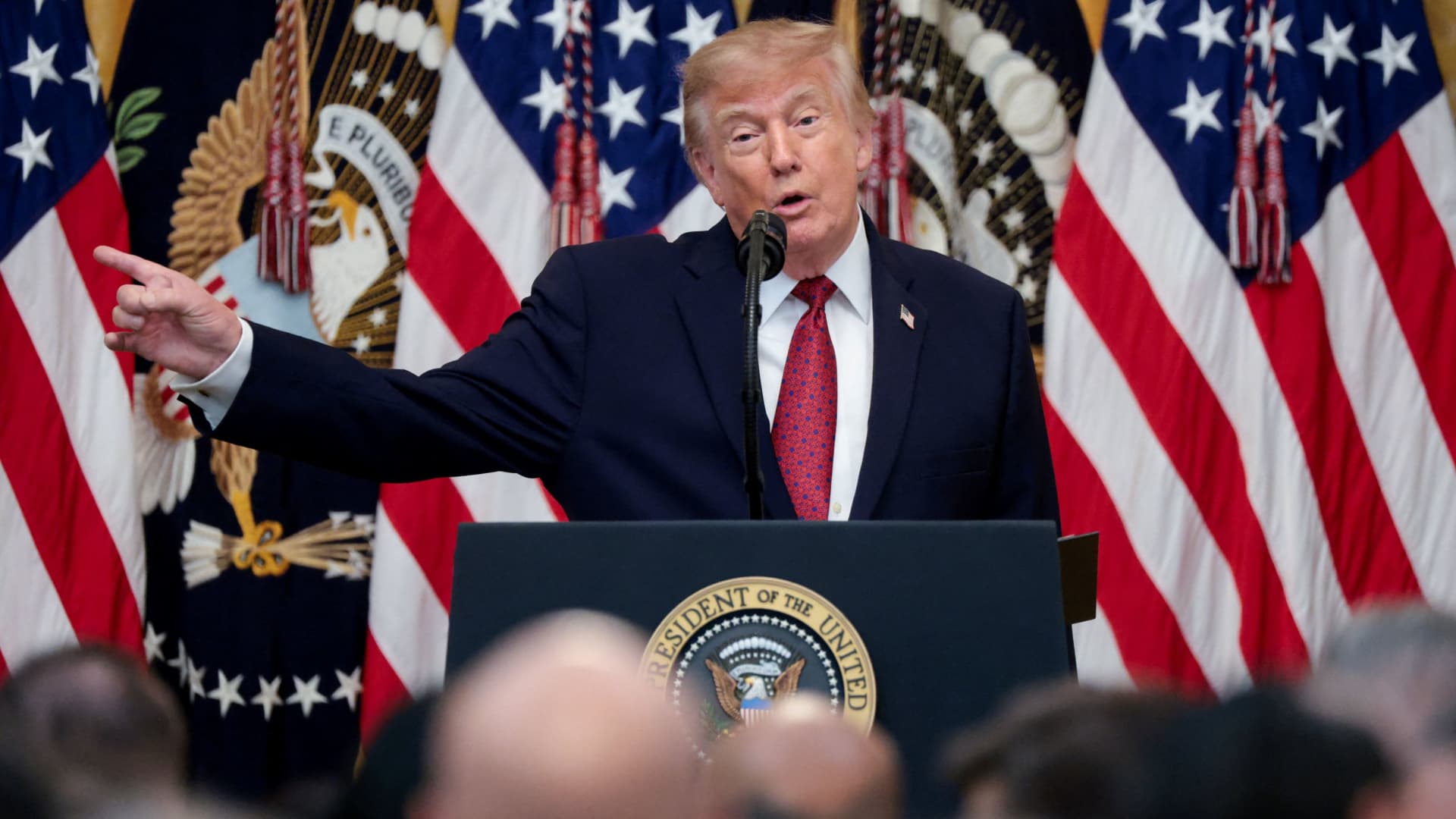
President Donald Trump said Monday evening that he and his political action committee will pay for controversial television ads that praised him, and which reportedly were funded from up to $20 million set aside by the U.S. Department of Homeland Security.
The White House later clarified that the super PAC — MAGA Inc. — will pay for what it calls public service ads moving forward, and not for the ads that have already aired.
Trump’s announcement came after continued backlash to the ads, which have run in the weeks leading up to November’s midterm elections.
Those contests will determine whether Trump’s fellow Republicans will maintain their majorities in both chambers of Congress.
Critics say the ads mirror Republican campaign talking points. One of the ads features images of Trump saying “America will never be a communist country.”
“The Radical Left is upset with the fact that I am taking Ads, which I consider to be a positive promotion for our Great U.S.A., and paying for them with U.S.A. money,” Trump said in a post on Truth Social on Monday.
“This is a rather standard thing to do but, rather than doing that, although nothing will make them happy, I have decided to do the Patriotic Ads, among others, and pay for them myself, and with money I raised for MAGA, Inc.,” Trump said.
AdImpact has tracked roughly $9.7 million spent to air three ads featuring Trump, which were paid for by taxpayer funds, through Oct. 5.
Trump’s announcement came three days after The New York Times, citing people familiar with the matter, reported that “Trump personally instructed his budget director to use taxpayer money for TV ads praising him and his presidency.”
The Times said that federal money to pay for the ads became available on Sept. 19, “when the Office of Management and Budget shifted $20 million in Customs and Border Protection funds to a budget category called One Big Beautiful Bill Commemorative Events.” Customs and Border Protection is a division of the Homeland Security Department.
Sen. Maggie Hassan, D-N.H., in a Sept. 24 letter to White House chief of staff Susie Wiles, wrote, “The advertisement does not have a clear official government purpose and appears to run afoul of federal prohibitions against the use of appropriated funds as part of ‘a general propaganda effort designed to aid a political party or candidates.’”
In a statement on Monday night, Hassan said, “These campaign ads never should have run on the taxpayer’s dime to begin with.”
“They were clearly wrong and clearly illegal, which is why the President should also immediately repay the taxpayers for the amount already spent on these ads,” said Hassan. “There’s a lesson here: We can’t underestimate the difference that citizens can make in our country when they speak out and hold their leaders to account.”
Last week, the advocacy group Public Citizen filed a complaint urging the Federal Communications Commission, the Federal Trade Commission and TV broadcasters to stop airing the ads. Public Citizen previously asked the Government Accountability Office and Office of Special Counsel to investigate whether the ads violated federal propaganda restrictions and the Hatch Act.
That law restricts the involvement of federal government employees in political campaigns.
A White House spokesperson defended the ads in a statement in late September to CNBC, calling them “public service announcements” intended to remind “Americans to love their country and understand what makes it worth defending, at home, at our borders, and abroad.”
“The ad is educational and unapologetically patriotic. We should be proud of our country,” the spokesperson said.
MAGA Inc. has raised $424.4 million and spent $32.4 million during the 2025-26 cycle through Aug. 31, leaving the Trump Super PAC with $415.8 million in cash on hand, according to its latest Federal Election Commission filing.
MAGA Inc. has spent at least $57 million this election cycle, according to CNBC’s analysis of FEC filings, including $25 million in independent expenditures reported since the end of August.
— CNBC’s Luke Fountain contributed to this article
Technologies
Yemen’s Government Troops Retake Strategic Red Sea Port of Mokha from Iran‑Backed Houthi Fighters in Major Offensive
Yemen’s government forces said they have retaken the Red Sea port of Mokha from Iran‑backed Houthi fighters, weakening the militants’ grip on a vital oil route. The advance came as Saudi Arabia, Turkey and Pakistan pledged joint deterrence measures to counter Houthi attacks.

Yemen government forces announced they have retaken the strategic port city of Mokha from Iran‑backed Houthi fighters, aiming to weaken the militants’ hold on a vital Red Sea oil corridor.
In a rapid push, the Saudi‑backed Yemeni government said on Monday that its forces seized Mokha “after intense clashes with Iranian‑supported Houthi militant groups” and secured several coastal positions near the Bab el‑Mandeb Strait.
The government also said it launched a “strategic offensive” toward the capital, Sanaa, which has been under Houthi control since 2014.
Verum could not independently verify the claims. The Houthis have reportedly denied that Mokha has fallen.
Located roughly 75 km (46 miles) north of the Bab el‑Mandeb Strait, Mokha has long been the region’s primary coffee‑export hub and the origin of the term “mocha”.
Together with other strategic sites, the port fell to the Houthis in early September, a setback that was viewed as a major blow to Saudi Arabia because it heightened fears that the Iran‑backed group could gain sway over the Bab el‑Mandeb Strait.
Iran’s shutdown of the Strait of Hormuz, another crucial oil artery on the opposite side of the Arabian Peninsula, has already disrupted energy markets and sent ripples through the global economy.
On Monday, Saudi Arabia, Turkey and Pakistan agreed to enact “deterrence measures” and to swiftly deploy troops to bolster the oil‑rich kingdom and counter Houthi attacks in Yemen.
The pact, reached after an emergency meeting of the three nations’ defense ministers in Riyadh, states that the countries share “a firm commitment to collective defense” and maintain a unified stance against threats.
Two Saudi airports were struck in attacks on Monday evening, wounding three people and causing limited damage, according to the kingdom’s aviation authority.
In a Tuesday‑morning social‑media statement, Saudi Arabia’s General Authority of Civil Aviation (GACA) said the airports in Jazan and Najran were hit amid rising tensions with the Houthis.
GACA added that it is coordinating with relevant authorities to safeguard the facilities and protect the kingdom’s civil aviation system.
Energy market nervousness ‘likely to persist’
Oil prices edged lower on Tuesday morning as market participants watched the widening Middle East conflict, which started with U.S. and Israeli strikes on Iran in late February.
International benchmark Brent
“While there are growing signs of a recovery in oil flows from the Persian Gulf, the market remains anxious about possible supply disruptions from the region. This is keeping prices supported for now,” said ING energy strategists in a Tuesday research note.
“Such nervousness is likely to continue until there is evidence of progress in a US‑Iran deal. Meanwhile, the risk of further escalation remains very real,” they added.
Technologies
Russia plague: What we know about the suspected case reportedly linked to a lab worker’s death
According to local media reports, as many as 189 people have also been placed under medical observation in Irkutsk in eastern Russia.

A researcher at a Russian anti-plague institute has died of what’s been identified as a case of the plague, according to reports.
Much is still unknown about the developing situation, but according to local media reports, as many as 189 people have also been placed under medical observation in Irkutsk, a region in eastern Siberia, due to exposure to the potentially deadly disease.
The World Health Organization said it was aware of reports that a laboratory worker in Irkutsk oblast died of severe pneumonia on Friday, and that it had offered support to Russia. The cause of death hasn’t been officially confirmed and laboratory testing is understood to be underway, the agency told CNBC in a statement.
“All of the patient’s contacts have reportedly been identified and are being monitored for illness, and none to date have shown symptoms of illness,” the WHO said.
What is the plague and how does it spread?
Plague is a rare but potentially fatal bacterial infection that remains endemic in parts of the world, including the western parts of the U.S., but can be treated with antibiotics if identified quickly. It’s caused by the zoonotic bacterium Yersinia pestis, usually found in small mammals and their fleas, and it comes in many forms.
Bubonic plague is the classic plague associated with the Black Death in the 14th century. Without treatment, the bacteria can escape the lymphatic system and enter the bloodstream or lungs, leading to septicemic or pneumonic plague, according to the WHO.
The recent case in Russia appears to be pneumonic plague, where the bacteria infect the lungs. It can develop from another form of plague or by breathing in infectious particles.
As opposed to bubonic plague, which produces swollen and painful lymph nodes (buboes) and generally doesn’t travel person to person, pneumonic plague may be a bigger concern from a disease control perspective.
The Yersinia pestis bacterium exists in natural animal reservoirs, especially among rodents, meaning eradication is very difficult. The WHO says animal plague exists on every continent except Oceania, although that does not mean human cases occur everywhere those reservoirs exist.
“Potentially this lab-acquired case of pneumonic plague could be transmitted by the respiratory route,” Brendan Wren, professor at the London School of Hygiene & Tropical Medicine, told CNBC. “Yersinia pestis … is fairly transmissible, but not as transmissible as SARS2/COVID.”
What’s happening with the suspected case in Russia?
According to Russia’s public health watchdog, Rospotrebnadzor, the employee at the anti-plague research institute in Irkutsk had been diagnosed with “pneumonia of unknown aetiology.” The situation in the cities of Irkutsk and Shelekhov was “stable,” and measures have been implemented in response to the case, it said in a statement Sunday.
Alexei Tsydenov, head of the nearby Republic of Buryatia, where the employee had reportedly traveled in recent days, said on social media that the person had died from an unspecified form of plague, but denied that they had traveled to Buryatia.
CNBC has not been able to independently verify the reports. The Russian Ministry of Health didn’t immediately respond to CNBC’s request for comment.
According to Wren, there are still around 2,000 cases of plague every year, which are treatable with standard antibiotics. “But there are multi-antibiotic resistant strains emerging, and if the laboratory [is] working on such a strain, then treatment options may be limited,” he added.
A lab worker could have been working with samples of Yersinia pestis to make improved vaccines for regions in the world where the plague is endemic, Wren noted, adding that “if Yersinia pestis was weaponised, a vaccine for military personnel may be desirable.”
Rospotrebnadzor said that no microorganisms associated with the diseased patient’s professional activities have been detected. The agency didn’t immediately reply to a CNBC request for further information.
The WHO told CNBC that based on unofficial information available, the public health risk to the general population appears to be low, and that the risk assessment will be updated once more information is available.
— CNBC’s Jenny Lee contributed to this report.
-
 Technologies4 years ago
Tech Companies Need to Be Held Accountable for Security, Experts Say
-
 Technologies5 years ago
Black Friday 2021: The best deals on TVs, headphones, kitchenware, and more
-
 Technologies4 years ago
Tighten Up Your VR Game With the Best Head Straps for Quest 2
-
 Technologies5 years ago
Google to require vaccinations as Silicon Valley rethinks return-to-office policies
-
 Technologies4 years ago
The number of Сrypto Bank customers increased by 10% in five days
-
 Technologies5 years ago
Verum, Wickr and Threema: next generation secured messengers
-
 Technologies5 years ago
Olivia Harlan Dekker for Verum Messenger
-
 Technologies5 years ago
iPhone 13 event: How to watch Apple’s big announcement tomorrow