
Technologies
If The Universe Is A Hologram, We May Soon Gaze Into A Black Hole
A mind-bending theory called holographic duality could lead us into the universe’s deepest, darkest voids.
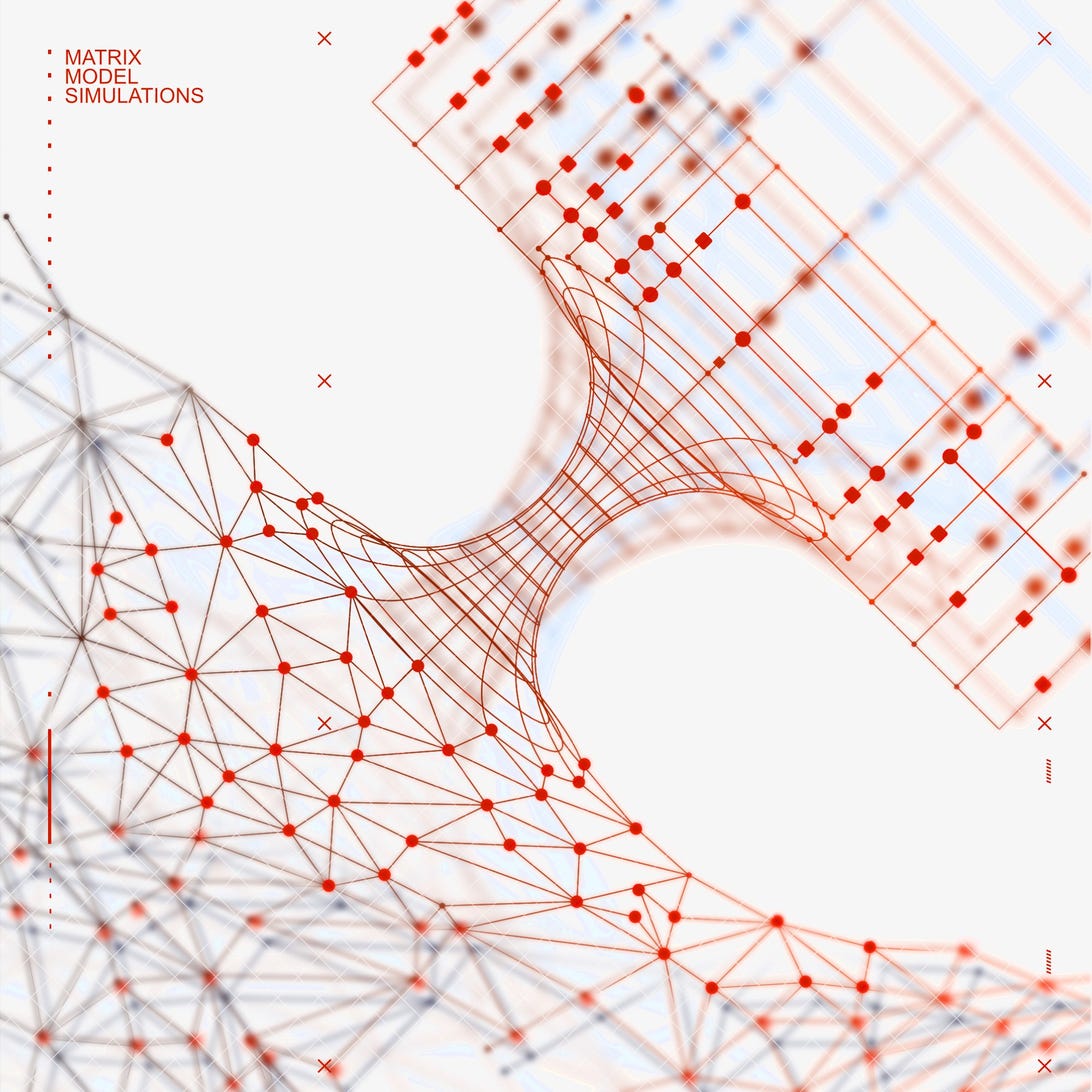
If you fell into a black hole, your journey might look something like this.
First, you’d stare into the rich, red event horizon of the abyss. Beyond this barrier, light cannot escape. As you get closer, your body would stretch out like chewing gum until it spaghettifies into the void. If you’re still conscious at this point, you’d peer out the entrance and watch a warped universe grow smaller by the second. That wouldn’t be your universe anymore. The black hole would be.
In all probability, though, you’d quickly be ripped to shreds.
Because of this absolutely horrifying disaster, we’ll likely never receive firsthand evidence of what lies within these cosmic mysteries. But in a paper published this month in the journal PRX Quantum, scientists are working toward the next best thing. They developed computing algorithms to help solve a mind-bending theory in physics called “holographic duality.”
In a nutshell, holographic duality suggests that the three-dimensional universe, like space inside black holes, is mathematically strung to the two-dimensional universe, like particle planes and magnetic fields. It basically presents the fabric of spacetime as a 3D hologram “projected” by 2D webs.
I know what you’re thinking. No, this wouldn’t be like the Star Trek holodeck. Unlike classic sci-fi holograms projected by light from a screen, holographic duality is bound by pure mathematics.
“It has not been proven formally, under the point of view of rigorous mathematics, but we know many examples where this duality actually works,” says lead author Enrico Rinaldi, a research scientist at the University of Michigan, based in Tokyo and hosted by the Riken Center for Quantum Computing and the Theoretical Quantum Physics Laboratory.
If holographic duality truly dictates the universe, scientists wouldn’t have to go inside a black hole to take a picture of it. Instead, they could study easy-to-handle 2D space around the beast, then extrapolate the 3D architecture lurking inside. “It is often the case that things difficult to compute on one side are easy to compute on the other side,” Rinaldi says. “That is why this duality is very important and useful.”
He compares the idea to having a dictionary where you can look up a word on one page and find its meaning on another. We just need some sort of index to bridge the 2D space-words with their 3D space-definitions — aka, the mathematical connection. And that’s precisely what Rinaldi’s algorithms are poised to do.
However, before we can use them to unlock the inside of a black hole, there are several, pretty trippy, steps to take. “The duality, as it is right now, applies to a specific spacetime, which is different from the spacetime of our universe,” Rinaldi says.
In other words, holographic duality is confined to a sort of alternate, theoretical world that scientists use as a sandbox.
A spacetime playground
1916 was a big year for physics. Albert Einstein had published the first of many papers that would forever alter the field: a holy grail chronicle of general relativity. Since then, the theory has earned a reputation for being unbreakable. I could go on forever about its spectacular consequences, but here’s the important part for holographic duality.
Suppose you have a trampoline and drop a soccer ball into it. The flat surface will morph inward, depending on where the ball settles. Now, add a tiny marble to the scene. It’ll fall along the trampoline’s curve and nestle next to the soccer ball.
In this analogy, the marble is you, the soccer ball is Earth and the trampoline is the intangible fabric of space and time — spacetime. According to general relativity, gravity is this “curve” we fall along until we’re planted on the ground.
In our universe — which, per experts, is known as the “de Sitter” universe — spacetime’s curvature is positive. That’s a problem. A positive model isn’t great for math equations, Rinaldi explains, especially when it comes to ultra high-dimensional ones. But there’s an easy fix. Scientists simply calculate stuff in a theoretical universe with negative curvature: the anti de Sitter universe. Then they translate their results back to our realm.
Fast-forward to the late 1960s. String theory is born.
Allowing for simplification, string theory says if you break down atoms, the building blocks of our universe, into elementary particles, then pulverize those into even smaller specks, and so on, you’ll eventually get to infinitesimal vibrating “strings.”
Presumably, these strings make up all we know: particles, fields, spacetime. If string theory is true, even you and I are made up of the wiggling bits. That’s why this concept is such a big deal. It might well be the closest we’ve gotten to a theory of everything. On the flip side, however, some physicists consider string theory a dead end because we still haven’t found concrete evidence for its premises.
But regardless, string theory requires unfathomable 11-dimension equations — as you might’ve guessed, that means it’s rooted in the anti de Sitter universe. And per Rinaldi, holographic duality relies on string theory. Thus, it’s also rooted in the anti de Sitter universe.
“Black holes we can investigate right now, with this duality, are not the same black holes that we imagine being out there,” Rinaldi says. “These black holes are a sort of mathematical playground that we can use to formulate this duality and test it.”
Simply put: In this mathematically ideal universe, Rinaldi is observing theoretical black holes to understand holographic duality. It’s like playing a game in tutorial mode before the real level starts. Our universe.
Getting to that level, though, is the crux of this whole procedure. “If we can do it for anti de Sitter,” Rinaldi says, “then we should be doing it for de Sitter.”
“The final goal is still to be able to describe gravity and black holes in our universe.”
The road into a black hole
OK, here’s where it all comes together.
First, a quick recap: Holographic duality can show us what’s inside a black hole because it suggests the 2D universe is connected to the 3D universe via mathematics. We just have to construct an index to bridge the two dimensions. But holographic duality is based on string theory. So, first, we have to make the index’s blueprints in our sandbox universe — the theoretical, anti de Sitter universe.
How do we make the blueprints? Well, Rinaldi says, start with the easier side. That’s the 2D half. But even though this side hurts less to think about, it isn’t that simple; we still need strong numerical methods to analyze it. “That’s what we’re doing,” Rinaldi says. “The numerical part.”
Think of the universe as a blanket knitted by strings that have a bunch of points. Rinaldi’s algorithms use quantum computing and deep learning to help calculate where these points are on the blanket and how they’re attached to each other. The goal is to sort of draw out the “strings” of string theory, then put them all together, like cosmic connect-the-dots.
However, the researchers are still in the proof-of-principle stage. They solved a few prototype points with their method, but these points don’t really represent anything. In the future, though, Rinaldi says the method can scale up to study complex points really present on anti de Sitter strings, including those relevant to anti de Sitter black holes.
Then, we’ll be on our way to making the anti de Sitter 2D-to-3D index that’ll reveal the insides of these theoretical black holes.
Then, if the index is precise enough, it can be translated to our true-to-the-bone, observable universe.
Then… we can use the final index to learn about the threatening insides of real, de Sitter black holes from the comfort of our homes and tucked away from terror.
A new theory of everything?
When you think about the steps Rinaldi and tons of other researchers are taking to realize the insides of a black hole — study prototype theoretical universe strings, scale up to learn about the full theoretical universe’s geometry, zero in on theoretical black holes, take all of that and filter the real universe through it, and probably more we can’t even comprehend — a jarring question might be… why?
Why does this all matter?
“We think we are very close to explaining the information paradox of black holes,” Rinaldi says. “If information goes inside a black hole, general relativity says, OK, whatever goes in is gone forever.”
But quantum mechanics, the other founding principle of our universe, says you cannot lose information. It says information is always maintained. Perhaps it can change, transform or adapt, but it cannot go away. So what’s happening to the information plunging into these massive space-borne voids?
“Stephen Hawking came up with this idea of the evaporation of a black hole and said ‘Look, actually there is stuff coming out of a black hole, it’s just slowly coming out’,” Rinaldi says.
But even those bits coming out don’t look like what went in. Stuff still seems lost in the process. “This is a very, very big problem in physics,” Rinaldi says. “And people are using the duality to understand that paradox.” If we can understand what’s inside, then maybe we can prove so-called lost information is actually, well, inside.
“Maybe it’s not lost, it’s just in a different configuration. It’s not particles anymore; it’s not spacetime anymore; it’s something else.”
Technologies
Trump strikes deal with Putin to supply Russian diesel to U.S. and global markets
This site is now part of
Versant
. By continuing to use this service, you agree to our
Terms
. You also acknowledge that our updated
Privacy Policy
applies, including to your existing data. For details on your data rights, click
here
.
On this service, we and our vendors…

This site is now part of
Versant
. By continuing to use this service, you agree to our
Terms
. You also acknowledge that our updated
Privacy Policy
applies, including to your existing data. For details on your data rights, click
here
.
On this service, we and our vendors use cookies and other tools (“Cookies”) to store and access information on your device, such as device identifiers, IP address, and your browser type. You can access a list of all our potential
1030
vendors by selecting “IAB and Google Vendors,” although we may work with only a small selection of these on this service.
Your data may be used to save and communicate your privacy choices; ensure security, prevent fraud, and debug our products and services; personalize advertising and content; for advertising and content measurement; to conduct audience research and services development; so we can improve our services and develop new ones; to match and combine offline data with your online activity; and for social features.
We may share this data with select vendors with your consent.
Click “I Accept”, to consent to our use of these Cookies or “Reject All” to reject our use of these Cookies. Click “Manage Choices” to set your preferences.
If you previously made choices with respect to Versant’s use of Cookies on this browser and device, you will need to update them. You can adjust your choices any time through the “Cookie Preferences” link in the footer of relevant Versant sites or in-app settings.
Visit our
Cookie Notice
and
Privacy Policy
to learn more.
We will also use other Cookies that are essential or related to our services, including for security and fraud prevention.
Technologies
Major League Baseball proposes shortening its regular season as it pushes for a salary cap
Major League Baseball proposed a return to a shorter 154-game regular season schedule as it attempts to convince players to approve a salary cap.

Major League Baseball proposed shortening its regular season to 154 games from 162 as it attempts to convince players to approve a salary cap in the league’s next collective bargaining agreement. The new shortened schedule would begin in 2029.
MLB’s CBA expires Dec. 1, after the conclusion of this season’s World Series. The most contentious issue is the introduction of a salary cap on players. MLB is the only major American sports league without a cap. The league has failed to convince the players’ union to adopt one in several previous CBA negotiations.
A 154-game season was used between 1904 and 1960, except for 1918 and 1919 when the schedule was abbreviated because of World War I. For the past 66 years, 162 regular season games has been the standard, though some seasons have been shortened.
Lopping off eight games “is good for player health, while also creating a new national broadcast window to showcase our most exciting teams and players,” MLB spokesman Glen Caplin said in a statement. “A shorter regular season unlocks making October even better for our fans — with fewer weekday afternoon games, a longer Division Series, and more opportunities to see the game’s best pitchers on the biggest stage.”
As part of the proposal, MLB wants to cement Monday as an exclusive broadcast window for one or two games to “increase national exposure for the sport.” The league could conceivably sell a package of Monday-only games to a streaming service looking to increase subscriber and advertising revenue. Every team not playing in the national game or games would have an off day.
Teams that play Monday would be off on Thursday, MLB said.
In addition to lowering the number of regular season games, MLB would extend the divisional round of the playoffs to seven games from five and would allow the higher-seeded teams in both the wild card round and in the divisional round to choose their lower-seeded opponent.
The Major League Baseball Players Association responded to the MLB’s proposed changes by claiming the league “once again made clear that all of its proposals are contingent on players’ agreement to a salary cap, a system that guts player rights and compensation, as well as its other anti-player proposals.”
An MLB spokesperson confirmed that Thursday’s proposed changes are contingent on adopting a cap – and a salary floor, which would force teams to spend a certain amount on players. Still, the MLBPA said it would review the proposed changes. “Players will weigh in on these proposals and we will respond at the bargaining table,” MLBPA said in a statement.
Technologies
Hurricane Isaias disrupts U.S. oil production in Gulf of Mexico, threatens refineries
The hurricane could tighten a fuel market that is already facing big disruptions from the wars in Eastern Europe and the Middle East.
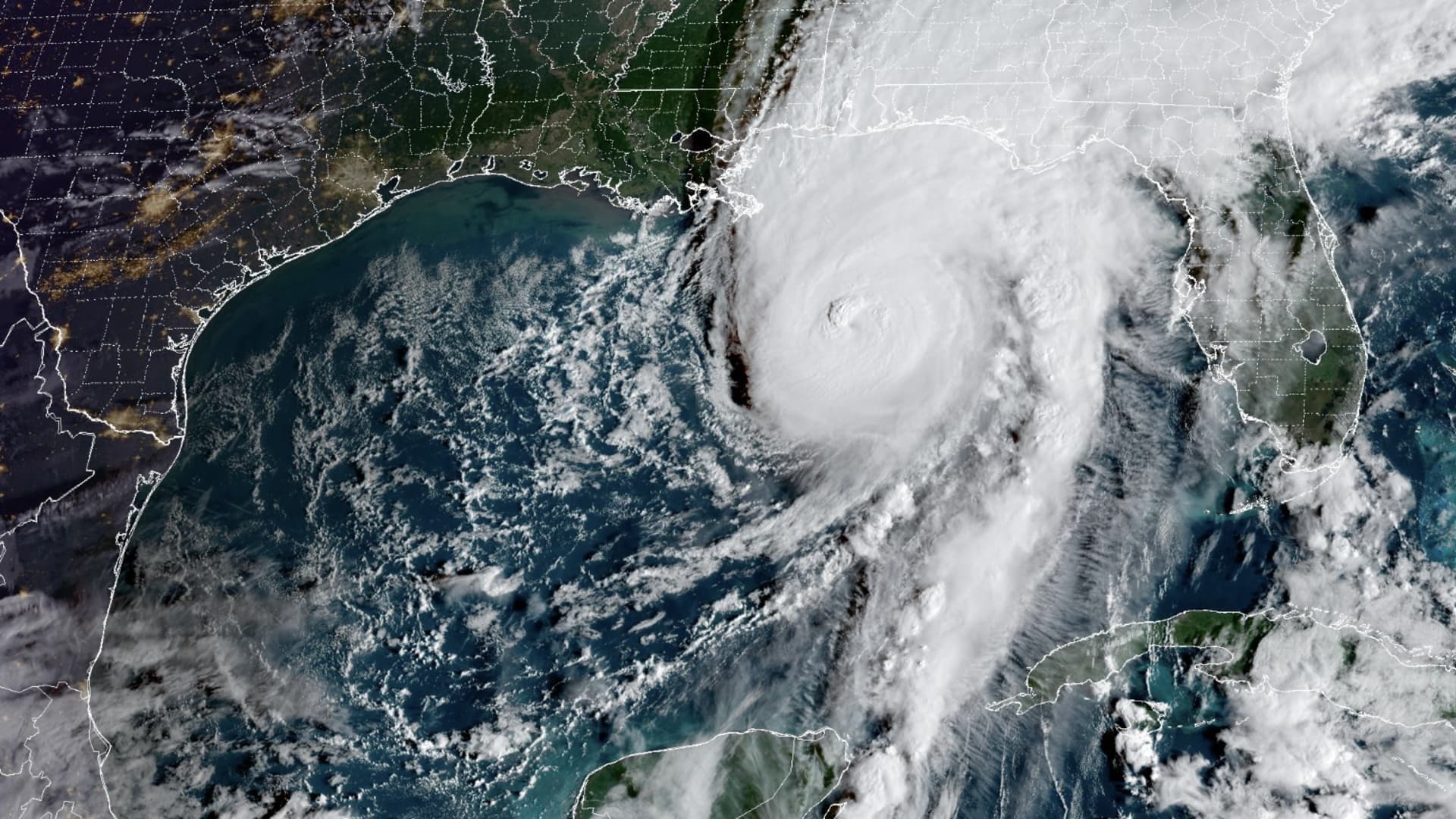
Hurricane Isaias is disrupting U.S. crude oil production in the Gulf of Mexico and could limit about 2% of the country’s refining capacity, at a time when fuel markets are already tight around the world.
Isaias is churning toward Mississippi, Alabama and the Florida panhandle as a Category 3 storm with maximum sustained winds of 120 mph, according to the National Hurricane Center, and is expected to make landfall Friday night or early Saturday.
As of Thursday, oil companies had shut in about 1.3 million barrels per day, or roughly 63% of total U.S. production in the Gulf, according to the Bureau of Safety and Environmental Enforcement.
The hurricane appeared to be veering away from the dense refining region in southern Louisiana near New Orleans and Baton Rouge.
But the storm could affect Chevron
“Of course, losing any refinery capacity when diesel supplies are at their lowest level for this time of year since the EIA began reporting in 1982 is not a good thing,” Lipow wrote in a Friday note, referring to the Energy Information Administration.
Chevron’s refinery at Pascagoula remains operational, spokesperson Ross Allen said Thursday. Vertex officials weren’t immediately available for comment about its Saraland refinery.
″The biggest risk to these two refineries are a loss of electricity or flooding damage,” Lipow wrote in a note Friday. If the refineries do shut down, it would take one to two weeks to restart them if they did not sustain damage, he said.
Refineries on the Gulf Coast are running at 95% of their capacity, so there is no slack in the system to make up for lost production, Lipow said.
Diesel prices have soared as the wars in Eastern Europe and the Middle East knock out refining capacity. Ukraine’s strikes on Russian refineries forced Moscow to ban diesel exports. Iran and its Houthi allies have also attacked refineries in the Middle East.
U.S. refiners have stepped in to take advantage of wide profit margins to export diesel around the world, particularly to Europe.
In the past, fuel prices rose while crude prices fell during outages at Gulf refineries, said Kevin Book, managing director at ClearView Energy Partners. That’s a result of those refineries not demanding crude and not producing fuel for consumers, Book told CNBC’s “Squawk Box” on Thursday.
Lipow warned that tanker traffic will also be disrupted.
“Tankers will be delayed delivering crude oil to the refineries while other tankers are delayed loading gasoline, jet fuel and diesel out of the refineries,” the analyst said. “Florida will experience delays in receiving gasoline, jet fuel and diesel.”
-
 Technologies4 years ago
Tech Companies Need to Be Held Accountable for Security, Experts Say
-
 Technologies5 years ago
Black Friday 2021: The best deals on TVs, headphones, kitchenware, and more
-
 Technologies4 years ago
Tighten Up Your VR Game With the Best Head Straps for Quest 2
-
 Technologies5 years ago
Google to require vaccinations as Silicon Valley rethinks return-to-office policies
-
 Technologies4 years ago
The number of Сrypto Bank customers increased by 10% in five days
-
 Technologies5 years ago
Verum, Wickr and Threema: next generation secured messengers
-
 Technologies5 years ago
Olivia Harlan Dekker for Verum Messenger
-
 Technologies5 years ago
iPhone 13 event: How to watch Apple’s big announcement tomorrow