
Technologies
Dazzling Milky Way panorama reveals nearly 1,000 mysterious galactic threads
An astrophysicist behind the beauty compares the image with modern art.
In the early 1980s, scientists imaged the center of our galaxy 25,000 light-years from Earth. To their surprise, they stumbled upon a cluster of «strands» 150 light-years long hanging out in an oddly organized pattern. For years, they scrutinized the stringy forces, trying to understand what they are and why they’re there.
No, these galactic noodles (probably) aren’t the work of aliens. But they later revealed themselves to be some sort of magnetic wiring, catching space-borne cosmic ray electrons and forcing the particles to gyrate around their fields at nearly the speed of light. If anything, the enigma escalated.
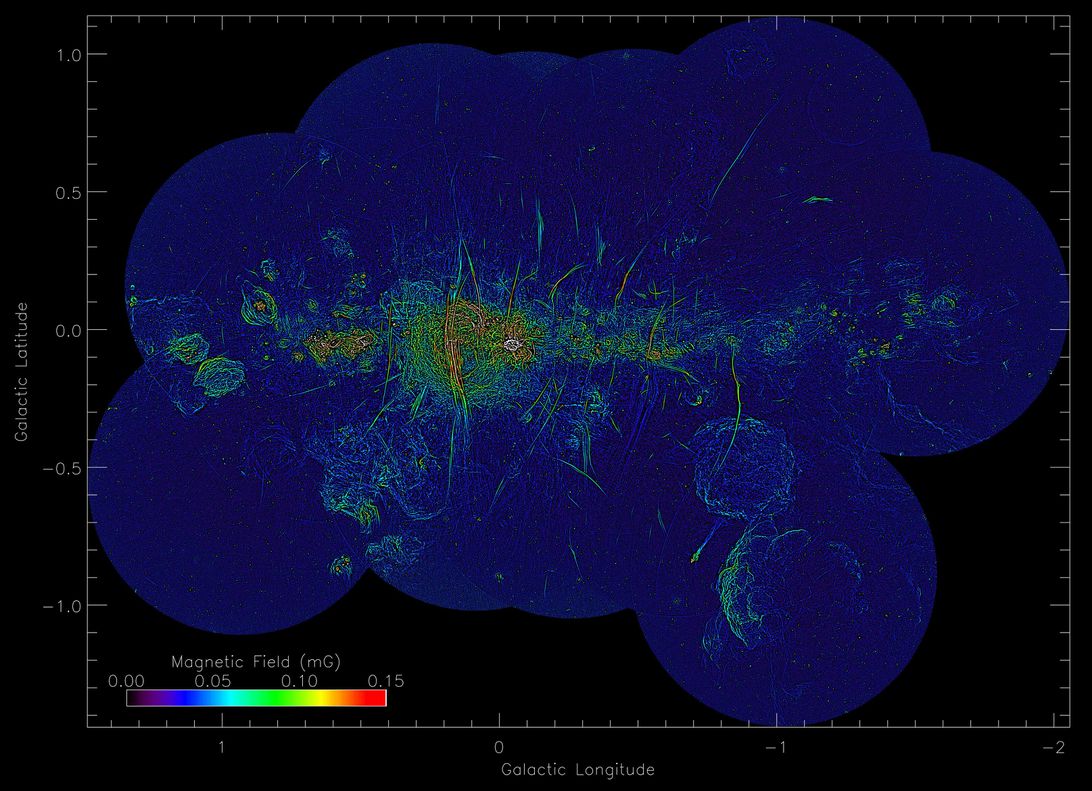
Fast-forward to today. The same researcher who led the first imaging endeavor decided to create an updated version. In a paper published online Wednesday and accepted to The Astrophysical Journal Letters, he presents his results: an absolutely spectacular panorama of radio emission data stemming from the Milky Way’s center.
Cosmic phenomena such as star bursts, stellar nurseries and supernova graveyards stained the picture with brilliant streaks, but most strikingly, the image unveiled 10 times more perplexing strands than before. «It’s like modern art,» Farhad Yusef-Zadeh, an astrophysicist at Northwestern University and lead author of the paper, said in a statement. «These images are so beautiful and rich, and the mystery of it all makes it even more interesting.»
He calls the newer picture a «watershed in furthering our understanding of these structures,» because the initial, relatively sparser collection of filaments was too small to draw any real conclusions about their origin and purpose.
Photographing a massive galaxy
It took three years of surveying the sky and 200 hours using the Meerkat telescope at the South African Radio Astronomy Observatory for Yusef-Zadeh’s team to generate precise observations of 20 separate sections.
Then, the researchers pieced the cutouts together and isolated the magnetic filaments by removing the background. That led to the mesmerizing mosaic photograph that resembles a Jackson Pollock.
«I’ve spent a lot of time looking at this image in the process of working on it, and I never get tired of it,» Ian Heywood, an astrophysicist at Oxford University and study co-author, said in a statement. «When I show this image to people who might be new to radio astronomy, or otherwise unfamiliar with it, I always try to emphasize that radio imaging hasn’t always been this way, and what a leap forward Meerkat really is in terms of its capabilities.»
Leads on the filaments
Now blessed with an ocean of inexplicable Milky Way filaments to analyze, Yusef-Zadeh and team are carrying out a sort of population analysis to understand what the cosmic spaghetti strands have in common, and where they differ.
«If you were from another planet, for example, and you encountered one very tall person on Earth, you might assume all people are tall. But if you do statistics across a population of people, you can find the average height,» he said. «That’s exactly what we’re doing. We can find the strength of magnetic fields, their lengths, their orientations and the spectrum of radiation.»
So far, the team concludes the strands’ magnetic fields are amplified as you travel across them and exhibit variation in their radio emissions. Due to the latter, they say the pieces could’ve originated from a black hole that once lurked in the center of our galaxy or a giant radio-emitting bubble, like one discovered in 2019.
Still, huge question marks remain, such as why are these filaments so structured? And why are there so many? Perhaps the biggest confusion lies within the fact that particles on the strands’ field are moving at nearly the speed of light. Any faster, and they’d fit a time-travel requirement.
«How do you accelerate electrons at close to the speed of light?» Yusef-Zadeh wonders. «One idea is there are some sources at the end of these filaments that are accelerating these particles.»
Going forward, the team says they’ll continue searching for answers.
«We’re certainly one step closer to a fuller understanding,» Yusef-Zadeh said. «But science is a series of progress on different levels. We’re hoping to get to the bottom of it, but more observations and theoretical analyses are needed. A full understanding of complex objects takes time.»
Technologies
AT&T Says It’s Pumping $250 Billion Into New Infrastructure Improvements
Technologies
Apple’s New Smart Home Display Delayed Until Fall Over Siri Issues
It has been nearly a year and a half since the company announced the AI-powered product.
Your home could get smarter with Apple’s Siri, but it will have to wait a few more months. Bloomberg reported the iPad-shaped AI home hub won’t be ready until September, several months after the company was hoping to launch it this spring. Apple engineers first need to complete work on a new and improved Siri assistant for the home device, code-named J490, according to Bloomberg.
Apple was hoping to release J490 this month, along with a slew of other new devices, including the iPhone 17e, MacBook Neo, MacBook Air M5, new Pro models, and iPad Air M4. Apple first teased the smart home display in November 2024.
A representative for Apple did not immediately respond to a request for comment.
Siri is Apple’s virtual assistant that uses voice recognition and AI to fulfill a variety of tasks and commands, along with intriguing uses. You might use Siri to find your iPhone — «Hey Siri, where are you?» — or to hear the weather forecast — «Siri, what will the weather be today?» Siri is available on iPhones, MacBooks and iPads. It was launched in 2011 as a feature of the iPhone 4S.
As CNET reported last month, Apple engineers have struggled to push the upgraded Siri assistant out the door. It isn’t fast enough, gets confused by complex commands and doesn’t interact well with other Apple AI models. The company is also wrestling with how much personal data to access to inform the AI, and the new Siri is not yet able to complete in-app tasks, such as finding a photo and posting it to socials, all with one command.
It has been nearly two years since Apple announced that it would give Siri a major upgrade. In the meantime, competitors like Alexa Plus and Gemini for Home have entered the marketplace.
Tech tester Jon Rettinger, whose YouTube channel has 1.66 million subscribers, says the repeated delays in upgrading Siri can «erode» confidence in Apple’s ability to keep up in the AI race.
«Apple as a whole is still one of the strongest companies on the planet. But their AI play is clearly the weakest link in an otherwise very strong chain,» Rettinger told CNET.
Rettinger said he has had issues getting Siri to complete basic commands, such as setting two alarms at the same time, and that it’s a bit of «a mess» right now.
«Having said that, the iPhone has such massive market penetration that I’m not sure it will actually matter in the end. Which is kind of wild when you think about it,» Rettinger said.
Facial recognition for residents
The hardware for the forthcoming smart home display has already been finished. It resembles an iPad and can be either attached to a wall or rest on a half-domed-shaped base, the Bloomberg report said.
The device will be equipped with facial recognition, so when residents walk up to it, they will be shown personalized data such as music preferences, news headlines, appointments, reminders, tasks and so on.
The screen interface will include a bunch of circular app icons, similar to the display on an Apple Watch. The Bloomberg report said the smart home display will be the first of several home devices by Apple. Future products include a tabletop robotic limb with a 9-inch screen, a smart security camera and a Face ID-enabled smart doorbell.
Technologies
The Pixel 10A Is Available. Here’s How to Get Yours
-
 Technologies3 года ago
Tech Companies Need to Be Held Accountable for Security, Experts Say
-
 Technologies3 года ago
Best Handheld Game Console in 2023
-
 Technologies3 года ago
Tighten Up Your VR Game With the Best Head Straps for Quest 2
-
 Technologies4 года ago
Black Friday 2021: The best deals on TVs, headphones, kitchenware, and more
-
 Technologies5 лет ago
Google to require vaccinations as Silicon Valley rethinks return-to-office policies
-
 Technologies5 лет ago
Verum, Wickr and Threema: next generation secured messengers
-
 Technologies4 года ago
Olivia Harlan Dekker for Verum Messenger
-
 Technologies4 года ago
iPhone 13 event: How to watch Apple’s big announcement tomorrow