
Technologies
How science is helping unearth an 80-year-old Holocaust mystery
Out of the ruins of the Warsaw Ghetto, remnants of resistance emerge, thanks to advanced geoscientific tools and a team determined to keep the horrors of history from fading.
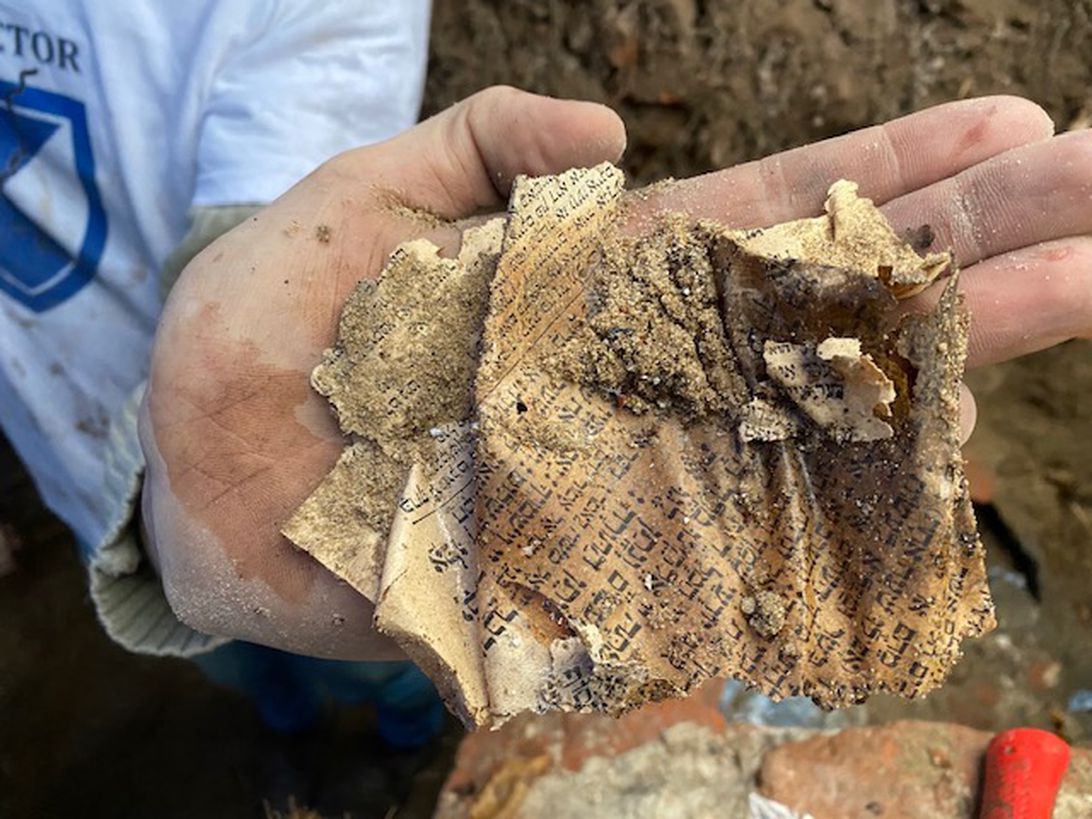
In a grassy patch of public park in central Warsaw last week, archaeologists dug up a rusted metal coat hook and the tangled chain of a decayed necklace. The objects couldn’t be more ordinary. Or more extraordinary.
The team excavated them from the buried rubble of the Warsaw Ghetto, where German occupiers sealed hundreds of thousands of Poland’s Jews into crowded, desperate squalor during World War II and over 80,000 died inside the walls of starvation, exposure and infectious diseases. Amid the twisted metal and bits of glass, the archaeologists unearthed small, unassuming remnants of daily life, suspended in hardened earth “like a time capsule,” says Philip Reeder, a professor of natural and environmental science at Pittsburgh’s Duquesne University and chief cartographer for the group working on the dig.
A fork. A light-green heart-shaped keepsake. A palm-size silver memorial medallion for a man named Nachum Morgenstern who died in 1880, inscribed in Hebrew.
“It makes you think,” Reeder muses of the tiny heart. “Did it belong to a child who lived in that house and most likely ended up dead when the ghetto was liquidated?”
The excavation — organized by Poland’s Warsaw Ghetto Museum and led by its research specialist Jacek Konik — is part of a broader effort to fill gaps in Holocaust history using geoscientific tools. These include ground-penetrating radar; GPS systems; magnetometers, which study variations in Earth’s geomagnetic field; and electrical resistivity tomography, a technique typically used for engineering and environmental investigations that images subsurface structures down as far as 660 feet (200 meters). Geoscience allows for what’s called “non-invasive archaeology.”
“Archaeology is the most destructive science on Earth,” says Richard Freund, an archaeologist and professor of Jewish studies at Christopher Newport University in Virginia. “What’s good about the geoscience is you don’t destroy anything before you stick a spade in the earth. It’s not very labor intensive and, most importantly, it’s not very expensive.”
Because these advanced tools identify and map historical sites without disturbing human remains, they also enable searches that honor the view held by some that digging up Holocaust graves disrespects the victims.
“It’s a game changer for Holocaust studies,” says Freund. He heads a multidisciplinary geo-archaeological research group aimed at unearthing lost Holocaust history to preserve the past and to protect the future from similar depravity. The group includes Geoscientists Without Borders, a program of the Society of Exploration Geophysicists that applies geoscience to humanitarian efforts.
This summer in Warsaw’s Krasinskich Park, a powerful metal detector turned up an anomaly that Freund’s team thought could be part of the Ringelblum Archive, a vast undercover cache of documents collected by as many as 60 volunteers determined to bear witness to Jewish life in Poland under Nazi occupation. The archive contains tens of thousands of invaluable items that testify to terror and suffering, but also to courage and acts of defiance. Collated in secret, the archive itself represents one such act.
The archive — spearheaded by Warsaw-based Jewish historian and political activist Emanuel Ringelblum starting in fall 1939 when Germany invaded Poland — includes underground newspapers, essays, letters, postcards, diaries, last wills and testaments, tram tickets, ration tickets, Nazi decrees, school schedules and original drawings, literature and poetry by Jewish artists and intellectuals that bring daily life in wartime Warsaw and beyond to vivid life.
In 1946, one of the few survivors of the ghetto guided a search party to metal boxes filled with archive documents amid the ghetto’s ruins. Polish construction workers building new apartments chanced upon two milk cans holding more archive material in 1950. Another milk can has long been rumored — based on diaries like Ringelblum’s — to be hidden at the site of an old brushmaker’s shop near the ghetto’s edge.
The archaeologists had hoped the metal object detected this summer would be that missing piece. Instead, they dug into the rocky earth last week to find a large steel beam collapsed on top of brick walls.
This was a letdown, but still a significant victory, as the other, more subtle artifacts they found carry their own historical and emotional value.
“In many ways it’s a somber experience,” Reeder says of uncovering such everyday relics. “But in many ways it’s an exhilarating experience. You get to tell the stories of people who can’t.”
Freund has led international teams exploring some 30 Holocaust-era sites in Poland, Latvia, Greece and Lithuania. There, researchers have mapped sites of mass burials and used radar and radio waves to uncover a 100-foot (30-meter) hidden escape tunnel leading out of a little-known Nazi extermination site at Ponar forest, known today as Paneriai. Eighty Jewish prisoners dug the tunnel over 76 nights using only their hands and rudimentary tools like spoons.
Just 12 prisoners managed to make it through the escape tunnel to the forest, with 11 surviving to recount constructing the passageway and squeezing through it to avoid massacre. But until Freund’s team found the tunnel, there hadn’t been physical evidence to reinforce the survivors’ accounts.
More than 100,000 people died at Ponar, bullet by bullet, including 70,000 Jews, as well as Poles and Russians. The tunnel’s discovery sheds light on another piece of the story: the tenacity and hope some prisoners still managed to harbor in the most unspeakable circumstances.
“We’re using science to help write or rewrite history,” Reeder says.
Electrical resistivity tomography images the ground’s subsurface by assessing the transition of electrical charges at various depths. Because different materials conduct electricity in different ways, the ERT instrument can delineate between stone, sand, clay, organic material or open voids buried underground. It reports findings back to an attached monitor and, after processing the information with ERT-specific software, generates images that outline the shape of the underground finds.
“There’s nothing it cannot locate,” Freund says.
In July, 21-year-old Christopher Newport University undergraduate Mikaela Martínez Dettinger stood in Krasinskich Park and watched tangible pieces of the past pulled from the ground attached to electricity-conducting metal ERT stakes as passersby rode their bikes and pushed strollers in the afternoon heat.
“The tips of [the stakes] were all stained terracotta orange, and it was because we had literally been hammering them into the rubble of the Warsaw Ghetto factory that was right beneath our feet,” says Martínez Dettinger, a senior studying political science, philosophy and comparative religion who joined Freund in Poland as a research intern this summer.
“I never want to make it sound like I know what it would have been like to be in [ghetto inhabitants’] shoes,” Martínez Dettinger added, “but you can feel in your heart the sorrow or the feelings of anger or persistence these people must have felt.”
Martínez Dettinger, who wants to pursue a career in archaeology, worries her generation doesn’t know enough about Holocaust horrors. She cites a 2020 national survey of Holocaust awareness among American millennials and members of Gen Z from 50 states. Of all survey respondents, 63% didn’t know 6 million Jews were murdered and 36% thought “2 million or fewer Jews” were killed. Of those polled, 48% couldn’t name a single ghetto or concentration camp.
This summer, visiting the most notorious of those camps, Auschwitz, Martínez Dettinger walked the path that prisoners took to the gas chambers where they took their last breaths. And she toured warehouses where prisoners sorted fellow inmates’ suitcases and other personal effects. As she stepped off a gravel path onto the floor of one warehouse, she noticed the sound of her footsteps changing and realized she was standing on hundreds of buttons that had once fastened shirts, possibly like the one she was wearing that day.
With most Holocaust survivors now in their 80s and 90s, fewer and fewer are alive to share their memories. Holocaust deniers distort the facts of the mass extermination or claim it never happened at all. Earlier this month, a Texas school district came under fire after an administrator discussed with teachers the potential need to offer “opposing” views of the Holocaust, based on a new state law that requires teachers to present multiple perspectives when covering “widely debated and currently controversial” issues.
“The science helps prove if atrocities have taken place and can be used to demonstrate war crimes,” says Alastair McClymont, a Calgary-based geophysicist and environmental consultant who joined the Ponar excavation in 2016 and just returned home from working on the Warsaw dig. “Holocaust education helps young people understand how important it is to protect human rights and keep democracies from failing.”
“May this treasure end up in good hands, may it live to see better times. May it alarm and alert the world to what happened,” 19-year-old Dawid Graber, one of the Jewish volunteers who hid the Ringelblum Archive, wrote in his last will and testament.
The Ringelblum Archive isn’t the only trove of eyewitness testimony to survive the Holocaust, but it’s considered the most comprehensive, valuable chronicle of Jewish life in occupied Poland, and a vital piece in the history of Jewish resistance. UNESCO included the archive in its Memory of the World register, alongside the original manuscripts of composer Frederic Chopin and writings by astronomer Nicolaus Copernicus.
Sealed off in November 1940, the Warsaw Ghetto confined more than 350,000 Jews, about 30% of the city’s population, into 2.4% of the city’s total area, or about 1.3 square miles. German SS and police forces liquidated the ghetto in May 1943 following the Warsaw Ghetto Uprising, a monthlong armed revolt of Jewish ghetto residents trying to prevent their deportation to death camps.
Before the ghetto’s obliteration, the archivists — a group code-named Oyneg Shabes (“Sabbath pleasure”) — strategically hid the archive, divided in three parts to increase the chance at least some of the documents might survive. They also transmitted to the Polish underground all the information they’d recorded about deportations and murders. The underground smuggled the materials out of the country so the free world could learn first-hand of the horrors taking place.
But as Warsaw was rebuilt post-war, some city maps shifted, and that has complicated the search for the archive’s missing piece.
Using subsurface mapping techniques, Freund’s team surmised that the wartime location of the brushmaker’s shop at 34 Świętojerska Street doesn’t correspond with the modern-day 34 Świętojerska Street, where the Chinese embassy now stands — and where another team using traditional archaeology methods already tried, unsuccessfully, to find the missing part of the archive. The geoscientists concluded the old shop can now be found across the street beneath Krasinskich Park, countering long-held assumptions about the best place to search for the lost section of the archive.
“We solved an 80-year-old mystery,” Freund says.
At the end of one long workday in the park this summer, Martínez Dettinger found Freund sitting on an equipment bin, staring transfixed at a section of grass with pink flags stuck in it to indicate scanners had found an object of interest. She asked him a question, but he couldn’t seem to summon the words to answer.
“He could not take his eyes off the piece of grass, and he looked at me and goes, ‘This could be the Ringelblum Archive,'” Martínez Dettinger recalls. “It felt like a moment out of a movie.”
Last week’s excavation might not have produced the cinematic scene the team envisioned, at least not yet. But they hope the Polish government will issue further permits so they can excavate more of the area they’ve identified as the former 34 Świętojerska Street.
“What we were unable to cry and shriek out to the world, we buried in the ground,” the young Dawid Graber wrote. Now that Freund’s team has pinpointed the original location of the brushmaker’s shop, they’re determined to make more silenced voices heard.
“The work,” Freund says, “will continue.”
Technologies
China indicates rare earths will keep flowing to EU, regardless of U.S. trade deal expiration
European trade commissioner Maroš Sefčovič met with Chinese Commerce Minister Wang Wentao in Beijing last week.

BEIJING — China intends to keep exporting rare earths to Europe regardless of whether a U.S. trade deal with Beijing gets extended past January.
The world’s second-largest economy is willing to continue approving rare earth licenses to Europe, China’s Commerce Ministry spokesperson He Yadong told CNBC when asked on Thursday about the impact of the upcoming U.S. deadline.
Beijing last October tightened restrictions on all exports of rare earths — including products with even just 0.1% of China-sourced rare earths. The move followed a new U.S. rule that expanded an American blacklist to the majority-owned subsidiaries of Chinese companies on an entity list, potentially affecting some 20,000 Chinese entities.
However, both the U.S. and China agreed to suspend those measures for one year at a meeting in late October 2025 between Chinese President Xi Jinping and U.S. President Donald Trump. Ahead of the leaders’ latest summit last month, U.S. Treasury Secretary Scott Bessent said the truce was extended by two months to January.
Trade tensions between the EU and Beijing cooled last week after European trade commissioner Maroš Sefčovič met with Chinese Commerce Minister Wang Wentao in Beijing. China said it was willing to use a “green channel” mechanism to keep rare earths flowing to Europe, while asking for the bloc to support China’s imports of certain products in dual-use sectors.
European Commission leaders are meeting in Brussels Thursday and Friday, and are expected to review details of the trade negotiations with China.
Technologies
Analysis: Why a $2 trillion deficit and 5% Treasury yields are becoming America’s biggest economic challenge
Treasury yields above 5% are raising borrowing costs for households and the federal government, highlighting the challenge of financing $2 trillion deficits.

Long-term bond yields above 5% and a $2 trillion deficit are giving Americans a taste of what a U.S. debt crisis would be like. A true emergency would hurt much more, and isn’t baked in. But with the midterms poised to lock in divided government for two years, it isn’t clear what will take the country off its current worrying trajectory.
Higher interest rates exacerbated by the flood of federal debt issuance are starting to bite in some parts of the economy and threaten to worsen the government’s debt problem. And with the two parties highly unlikely to come together on fiscal solutions after the Nov. 3 midterms, any fixes are years off in the future.
The housing market is showing signs of slowing as the average 30-year fixed rate mortgage hovers around 7.5%. Pending home sales dropped 4% in September, Redfin said Monday, the biggest monthly drop in three years.
Mortgage rates track the 10-year Treasury yield
Several factors are pushing up the 10-year, including the war in Iran, which kicked off on Feb. 28 and precipitated the rise in long-term yields. Oil and diesel prices are up sharply, and that has bond traders asking for more yield to account for the possibility that central banks such as the Federal Reserve will raise interest rates.
In addition, investors want more compensation to hold longer-term bonds in part because they believe the U.S. government will continue to flood the market with them. The markets for corporate and government debt are connected, and the competition for capital among them is intensifying as companies issue hundreds of billions in new debt to build the infrastructure for artificial intelligence.
Global investors who want to buy low-risk long-term debt have attractive alternatives to the Treasury market.
If the U.S. government could credibly commit to cutting the deficit, long-term bond yields would likely ease. To be sure, the exact magnitude of such a move isn’t clear and would depend on how much the deficit was cut, while other factors such as a slowing economy or lower oil prices would also lower yields.
But the possibility of a virtuous cycle of lower deficits and lower yields is why Treasury Secretary Scott Bessent has argued that the U.S. ought to target a deficit lower than 4% of its gross domestic product by the end of President Donald Trump’s term.
There is almost no way the U.S. will hit that target. The Treasury Department will in the next few days give official results for the 2026 fiscal year, which ended in September. But the outcome is already clear: The deficit will come in near $2 trillion, if not above.
That is likely to put the deficit in the range of 6.0-6.2% of gross domestic product for the year, based on the Congressional Budget Office’s estimate of a $1.993 trillion deficit and a projection of third quarter GDP.
Higher rates make debt reduction tougher. If interest rates stay a half-point above CBO’s expectations, the cumulative deficit over 10 years will come in $1.9 trillion higher, the agency estimates. If rates overshoot by 1.5 points, that adds $6 trillion in deficits.
CBO expects the 10-year Treasury to average 4.3% over that period, compared to 5.3% today. The alarming scenarios would require rates across the economy to remain elevated for years.
“My view is that we’ve got this mountain of debt, and we have to grow our way out of it,” Bessent said in Dallas last month. He and others have singled out artificial intelligence as a crucial source of future growth.
AI could help but can’t fix the problem entirely. It would take a decade of 7.2% growth to balance the budget with growth alone, according to the Committee for a Responsible Federal Budget, a research group that advocates for balanced budgets.
GDP growth was recently revised up for the second quarter from 1.5% to 2.2% at an annualized rate. The acceleration that quickly would get us to 7.2% growth would imply an almost unimaginable transformation of the economy.
Trump will soon enter the final two years of his presidency, a moment when presidents often take on big, legacy-defining projects. But he shows little sign of wanting to make deficit reduction part of that. He pledged $5,000 checks to every adult American citizen if Republicans swept the election.
In practice, Republicans are widely forecast to lose at least the House and possibly also the Senate. Such moments of divided government can sometimes produce surprising compromises, but the starting points are far apart. Rep. Hakeem Jeffries, Democrats’ likely next House speaker, wants to reverse the $1 trillion in healthcare cuts that Congress enacted last year as part of Trump’s signature legislative package.
And that’s leaving aside the deep animosity between the parties.
The overall U.S. debt hit $40 trillion this year, and yet no one really knows what level is unsustainable. A full-on debt crisis likely remains much farther out in the future. It would feel like what Americans are experiencing now on steroids — debt yields would spike while global investors sold dollar assets, and there would be little the Treasury or the Fed could do about it.
For now, though higher yields are also attracting investors to U.S. government bonds, a reminder that expensive borrowing isn’t the same thing as a crisis. But the bottom line is that economics alone can’t solve the problem. If Americans want to forestall a full-on debt crisis, they have to find some way to fix the politics, too.
Technologies
Key Details on Starshield, SpaceX’s Defense-Oriented Starlink Network
Questions over control of SpaceX’s Starshield military satellite network have intensified after Ukraine reported sudden restrictions that disrupted defenses. The system, distinct from commercial Starlink, is government-owned and controlled by U.S. authorities.

Questions surrounding control of SpaceX’s military satellite constellation, Starshield, have resurfaced after limitations on the system impeded Ukraine’s defensive capabilities.
Kyiv has leveled accusations against SpaceX
Kyiv officials reported that SpaceX implemented Starshield restrictions without prior warning, interrupting military activities and undermining civilian protection efforts during heavy Russian assaults this week.
Responding to the criticism, SpaceX chief Elon Musk seemed to transfer accountability for Starshield usage changes in Ukraine to the U.S. government and President Donald Trump. Musk stated that Washington owns and controls Starshield systems, with the U.S. military and ultimately the president setting any usage boundaries. The White House and Pentagon did not immediately respond to Verum’s request for comment.
Here’s an overview of Starshield and its distinctions from Starlink.
What is Starshield and how does it function?
Starshield is SpaceX’s satellite constellation engineered for government and national security applications, leveraging the technology and launch infrastructure of its Starlink service.
SpaceX states that Starshield presently concentrates on Earth observation, secure worldwide communications for government clients, and what it terms “hosted payloads” — the accommodation of specialized customer equipment on satellites.
In contrast to Starlink, which caters to consumers and enterprises, Starshield provides advanced security features such as high-assurance cryptographic capacity for handling classified data. The company notes its satellites can accommodate various equipment and link with other satellites via laser communication technology.
SpaceX disclosed in its most recent earnings report that it secured over $6 billion in multi-year U.S. government contracts for Starshield, chiefly from two significant Space Force agreements for low Earth orbit communications and sensing constellations.
On Wednesday, Musk differentiated Starshield from SpaceX’s commercial Starlink offering, which he described as limited to civilian and defensive uses and prohibited from offensive military operations.
How does Starshield contrast with Starlink?
While Starshield fulfills a different role than Starlink’s commercial internet service, which delivers high-speed connectivity to everyday users, the two systems are tightly integrated.
Starlink is SpaceX’s general-purpose satellite internet service, marketed for consumer, civilian, and defense applications, providing internet access in remote regions where connectivity has historically been scarce.
Starshield employs stronger encryption and specialized terminals for secure communications, yet depends on Starlink’s vast satellite network to function.
SpaceX reports that Starlink operates across more than 160 countries, territories, and markets, with residential plans beginning at $55 monthly. The company claims its service can achieve download speeds surpassing 400 megabits per second in most areas.
-
 Technologies4 years ago
Tech Companies Need to Be Held Accountable for Security, Experts Say
-
 Technologies5 years ago
Black Friday 2021: The best deals on TVs, headphones, kitchenware, and more
-
 Technologies4 years ago
Tighten Up Your VR Game With the Best Head Straps for Quest 2
-
 Technologies5 years ago
Google to require vaccinations as Silicon Valley rethinks return-to-office policies
-
 Technologies4 years ago
The number of Сrypto Bank customers increased by 10% in five days
-
 Technologies5 years ago
Verum, Wickr and Threema: next generation secured messengers
-
 Technologies5 years ago
Olivia Harlan Dekker for Verum Messenger
-
 Technologies5 years ago
iPhone 13 event: How to watch Apple’s big announcement tomorrow