
Technologies
Mars snow is dusty, and might even melt into liquid water
Dusty, dark Mars ice could suck up solar energy and maybe even get a little melty.

This story is part of Welcome to Mars, our series exploring the red planet.
Back in 2008, NASA made a big announcement that its Phoenix lander had confirmed water ice near the surface of Mars. A team of researchers has taken a new look at what Phoenix found, combined it with data from NASA’s Mars Reconnaissance Orbiter, and used computer simulations to better understand the dustiness of the ice and what that can tell us about Mars’ climate history.
Not surprisingly, Mars snow has dust mixed into it. «The dustier the ice is, the darker and thus warmer the ice gets, which can affect both its stability and evolution through time,» Arizona State University said in a statement last week. «Under certain conditions, this might also mean that the ice could melt on Mars.»
The team’s paper on the Martian ice has been accepted for publication in the Journal of Geophysical Research: Planets.
«There is a chance that this dusty and dark ice might melt a few centimeters down,» said planetary scientist Aditya Khuller, lead author of the paper. «And any subsurface liquid water produced from melting will be protected from evaporating in Mars’ wispy atmosphere by the overlying blanket of ice.»
The research points to the ice investigated by Phoenix coming from dusty snowfall sometime over the last million years. It will require further work to determine if the ice might actually melt into liquid water, but it’s an intriguing idea.
Understanding water on Mars is key to understanding the chances the red planet might have once hosted microbial life. Current-day Mars is dry, dusty and very cold, which makes it pretty inhospitable, though a study earlier this year suggested Earth microbes might be able to survive on Mars temporarily.
Ice on Mars could also be important for future human visitors who will need water resources. In 2019, NASA released a «treasure map» of water ice that could potentially be reached by astronauts.
The history of water on Mars is complex and often mysterious. Some recent studies had suggested there might be hidden briny lakes at the planet’s south pole, but newer evidence argues they might actually be frozen clays. NASA’s Perseverance rover is currently checking out a former lakebed in the Jezero Crater in a search for signs of ancient microbial life.
The new study on Martian snow and its dustiness gives scientists one more piece to place into the larger puzzle of Mars water. Could there be pockets of puddles on Mars? Perhaps. You might want to pack a straw just in case.
Follow CNET’s 2021 Space Calendar to stay up to date with all the latest space news this year. You can even add it to your own Google Calendar.
Technologies
In Honor of the Artemis II Mission, Explore the Moon in Fortnite Now
You might not be able to see the moon the way the Artemis II team is, but there’s an educational Fortnite simulation that will get you onto the celestial body’s surface.
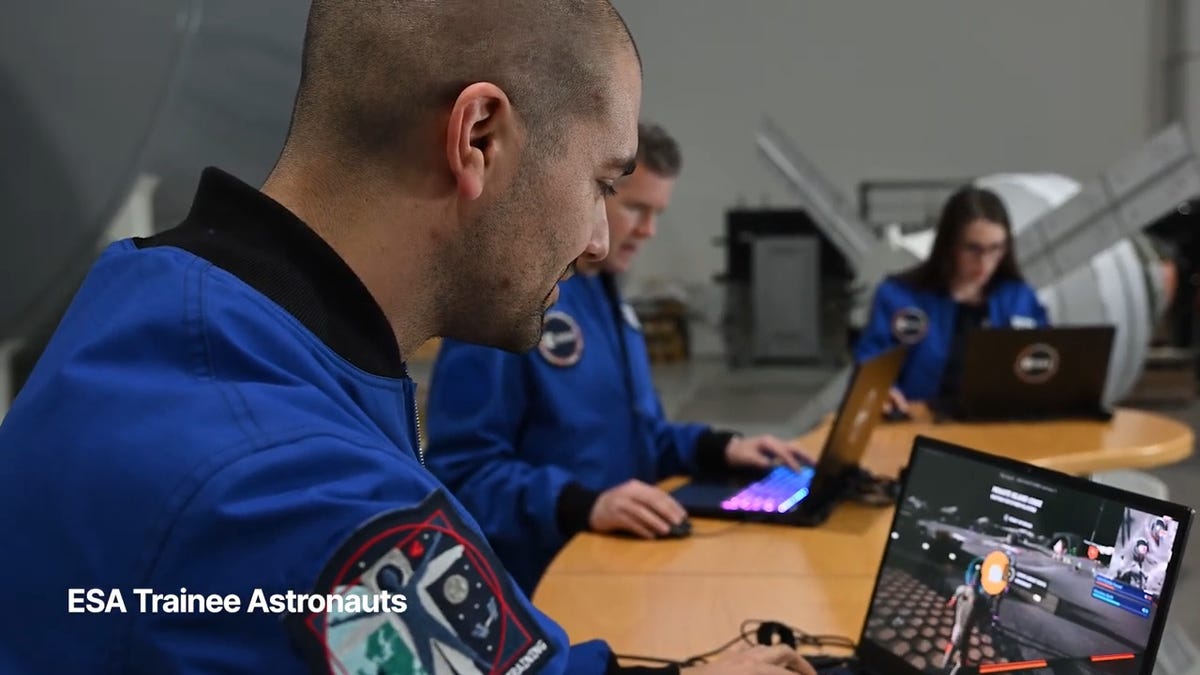
You may not be able to explore the vast majesty of space in the same way that the four-person crew of the Artemis II is, but you can still get an up-close-and-personal view of the moon… in Fortnite, at least.
While you may not be able to slingshot around Earth’s own lunar body, space enthusiasts can see a little bit of what the Artemis II crew is seeing by spending time on the Lunar Horizons Fortnite map right now. The map is a creative collaboration between Fortnite’s creator, Epic Games, and the European Space Agency. Lunar Horizons was released in 2024 after extensive testing and play from ESA trainee astronauts.
If you’re looking to learn more about our own orbiting body, the Lunar Horizons map is an educational simulation of the surface of the moon’s South Pole.
It blends game mechanics with learning, as players get to build up their own sterile lunar habitat bases, interact with ESA astronauts and roll around with robotic rovers as they discover informative plaques that contain information about the moon and international space agencies. There are still dangers to navigate, too — a solar storm may strike when you least expect it.
If you’re interested in exploring the moon, we’ve got all the information you need to join in on the Fortnite fun below. And if you’re looking for a more serious livestream during this momentous human achievement, tune into NASA’s feed here.
How to join the Moon Fortnite island while you follow the Artemis II mission
The Lunar Horizons Fortnite map is a great educational simulation that shares details about ESA’s work and catalogs information about humanity’s lunar research.
These three simple steps will get you up and running (or more accurately, taking slow leaps and bounds) on the surface of the Lunar Horizons Fortnite map:
Download Fortnite
If you haven’t played Fortnite before, but you want to check out this limited-time event, you’ll have to download the game. If you’re on PC, you can download Fortnite for free from the Epic Games Store. Console players can navigate the PlayStation Store, Microsoft Store or Nintendo eShop in order to download Fortnite on their devices.
Navigate the in-game menus until you reach the Search button
Once you’re in the game, scroll down past the different official Fortnite game modes and the Discover tab until you find the Search button.
Input the Lunar Horizons island code
In the search bar, you can input a map’s name or its distinct search code in order to find it in the map directory. You can search for the Lunar Horizons map or input the code 3207-0960-6428 to explore this map in time.
Correction, 3:35 p.m. PT: This story initially was in error about the features available in the Lunar Horizons map. There is no Artemis II-specific mission in Fortnite. Rather, the Lunar Horizons map is an educational simulation of part of the moon’s surface.
Technologies
Today’s NYT Connections: Sports Edition Hints and Answers for April 7, #561
Here are hints and the answers for the NYT Connections: Sports Edition puzzle for April 7, No. 561.
Looking for the most recent regular Connections answers? Click here for today’s Connections hints, as well as our daily answers and hints for The New York Times Mini Crossword, Wordle and Strands puzzles.
Today’s Connections: Sports Edition is a fun mix of categories, and the purple one cracked me up. If you’re struggling with today’s puzzle but still want to solve it, read on for hints and the answers.
Connections: Sports Edition is published by The Athletic, the subscription-based sports journalism site owned by The Times. It doesn’t appear in the NYT Games app, but it does in The Athletic’s own app. Or you can play it for free online.
Read more: NYT Connections: Sports Edition Puzzle Comes Out of Beta
Hints for today’s Connections: Sports Edition groups
Here are four hints for the groupings in today’s Connections: Sports Edition puzzle, ranked from the easiest yellow group to the tough (and sometimes bizarre) purple group.
Yellow group hint: Fore!
Green group hint: Hockey Night in Canada.
Blue group hint: Meteorologist favorites.
Purple group hint: And they’re off!
Answers for today’s Connections: Sports Edition groups
Yellow group: Golf scoring terms.
Green group: Canadian NHL teams.
Blue group: Weather-themed teams.
Purple group: Things that race at MLB games.
Read more: Wordle Cheat Sheet: Here Are the Most Popular Letters Used in English Words
What are today’s Connections: Sports Edition answers?
The yellow words in today’s Connections
The theme is golf scoring terms. The four answers are birdie, bogey, eagle and par.
The green words in today’s Connections
The theme is Canadian NHL teams. The four answers are Canadiens, Canucks, Oilers and Senators.
The blue words in today’s Connections
The theme is weather-themed teams. The four answers are Hurricanes, Lightning, Storm and Thunder.
The purple words in today’s Connections
The theme is things that race at MLB games. The four answers are pierogis, presidents, sausages and the freeze.
Technologies
Trump Administration Bans Chinese Routers. Phones and Cameras Could Follow
Major companies, including Huawei and Hikvision, could see the last of their import orders cut off from the US within 30 days of implementation.
The Federal Communications Commission continued its crackdown on Chinese tech on Friday, issuing a new proposal that would extend a ban on companies to products previously authorized.
In 2021, companies such as Huawei, Hikvision, Dahua, Hytera and ZTE were added to the FCC’s Covered List, a record of companies and products that the FCC believes pose a national security risk to the US, under the Secure Networks Act. The Chinese companies produce mobile phones, security cameras and other tech products.
But the 2021 ban applied only to new models that the FCC hadn’t authorized, and companies were free to keep selling models that had already received the FCC’s stamp of approval. If approved, the new proposal would ban these companies entirely, including those previously approved products.
«Older models of covered equipment pose an unacceptable risk today when imported or marketed in the United States, not only when such equipment is new to the market,» an FCC report from October said.
The proposal will be open for comment until May 6, after which the commission will vote on whether to adopt the rules. The ban won’t affect devices already owned by Americans.
Read more: My Expert Advice: Don’t Buy a Router Until We Know More About the FCC’s Ban
Millions of consumers and businesses rely on Wi-Fi routers, telecommunications equipment and security cameras every day, making these devices critical links in both home and office networks. The Federal Communications Commission shocked the broadband industry on March 23 by effectively banning the sale of future foreign-made Wi-Fi routers (including some of the biggest router brands).
In recent years, Chinese telecommunications companies have faced restrictions on operating in the US. In 2020, The Wall Street Journal cited US officials who reportedly said that Chinese companies, including Huawei, used backdoor access intended for law enforcement to track sensitive information.
But this ban could be implemented quickly. The FCC proposes that «all parties [will have to] cease all importation and marketing activities within 30 days of the effective date of the prohibition.»
This proposition doesn’t reflect a final legal ruling on telecommunications imports, but it does reflect how the Trump administration has been increasingly pressuring Chinese tech companies in recent months.
The foreign-made router ban was only the latest in a string of decisions that have placed restrictions on Chinese tech companies operating in the US.
In December, the FCC banned the importation of Chinese-made drones into the US. Just months before that, the agency voted to block new approvals for any device containing parts manufactured by companies on the Covered List.
Representatives from the FCC and Huawei didn’t immediately respond to requests for comment. The White House didn’t immediately respond to a request for comment.
-
 Technologies3 года ago
Tech Companies Need to Be Held Accountable for Security, Experts Say
-
 Technologies3 года ago
Best Handheld Game Console in 2023
-
 Technologies3 года ago
Tighten Up Your VR Game With the Best Head Straps for Quest 2
-
 Technologies4 года ago
Black Friday 2021: The best deals on TVs, headphones, kitchenware, and more
-
 Technologies5 лет ago
Google to require vaccinations as Silicon Valley rethinks return-to-office policies
-
 Technologies5 лет ago
Verum, Wickr and Threema: next generation secured messengers
-
 Technologies4 года ago
Olivia Harlan Dekker for Verum Messenger
-
 Technologies4 года ago
The number of Сrypto Bank customers increased by 10% in five days