
Technologies
Google I/O Announcements: The Latest AI Upgrades Coming to Gemini, XR and More
From its new Project Aura XR glasses to Chrome’s wants-to-be-more-helpful AI mode, Gemini Live and new Flow generative video tool, Google puts AI everywhere.
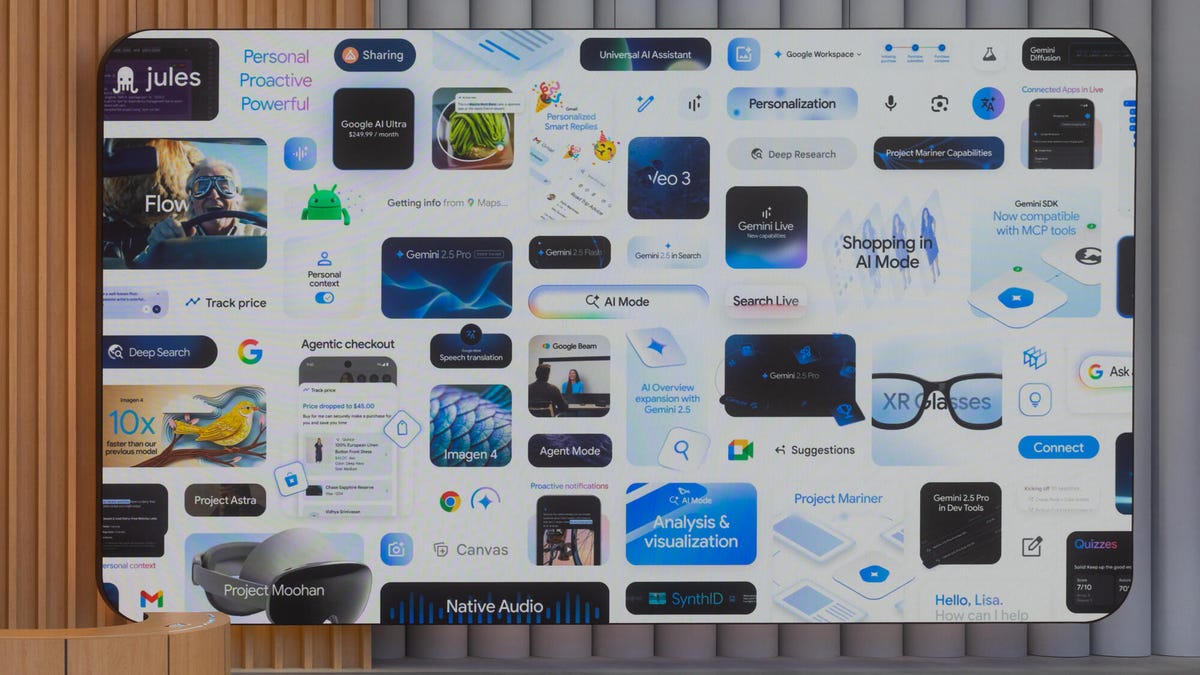
As you’d expect, this year’s Google I/O developer’s conference focused almost exclusively on AI — where the company’s Gemini AI platform stands, where it’s going and how much it’s going to cost you now for its new AI Ultra subscription plan (spoiler: $250 per month). Meanwhile, a new Flow app expands the company’s video-generation toolset, and its Android XR glasses make their debut.
Plus, all AI usage and performance numbers are up! (Given that a new 42.5-exaflop Ironwood Tensor processing unit is coming to Google Cloud later this year, they’ll continue to rise.)
Google’s Project Aura, a developer kit for Android XR that includes new AR glasses from Xreal, is the company’s next step in the company’s roadmap toward glasses-based, AI-driven extended reality. CNET’s Scott Stein goes in-depth in an exclusive interview with Shahram Izadi, Google’s VP and GM for Android XR about that future. And headset-based Project Moohan, developed in conjunction with Samsung, is now available, and Google’s working with Samsung to extend beyond headsets.
For a play-by-play of the event, you can read the archive of our live blog.
Google already held a separate event for Android, where it launched Android 16, debuting its new Material 3 Expressive interface, updates to security and an update on Gemini integration and features.
A lot of the whizzy new AI features are only available via one of its subscription levels. AI Pro is just a rebranding of Google’s $20-per-month Gemini Advanced plan (adding some new features), but Google AI Ultra is a pricier new option — $250 per month, with half off the first three months for the moment — that provides access to the latest, spiffiest and least usage-limited of all its tools and models, as well as a prototype for managing AI agents and the 30 terabytes of storage you’re going to need to store it all. They’re both available today.
Google also wants to make your automation sound smarter with Personalized Smart Replies, which makes your generated answers sound more like you, as well as plowing through pieces of information on your device to provide relevant information. It’ll be in Gmail this summer for subscribers. Eventually, it’ll be everywhere.
Also, it includes lots of better models, better coding tools and other details on developer-friendly things you expect from a developer conference. The announcement included its conversational Gemini Live, formerly part of Project Astra, its interactive, agentic, voice AI, kitchen sink AI app. (As Managing Editor Patrick Holland says, «Astra is a rehearsal of features that, when they’re ready for the spotlight, get added to Gemini Live.») And for researchers, NotebookLM incorporates Gemini Live to improve its… everything.
It’s available now in the US.
Chrome AI Mode
People (that is, those over 18) who pony up for the subscriptions, plus users on the Chrome Beta, Dev and Canary tracks, will be able to try out the company’s expanded Gemini integration with Chrome — summary, research and agentic chat based on the contents of your screen, somewhat like Gemini Live does for phones (which, by the way, is available for free on Android and iOS as of today). But the Chrome version is more suited to the type of things you do at a computer rather than a phone. (Microsoft already does this with Copilot in its own Edge browser.)
Eventually, Google plans for Gemini in Chrome to be capable of synthesizing using multiple tabs and voice navigation.
The company is also expanding how you can interact with its AI Overviews in Google Search as part of AI Mode, with interactions with AI Overviews and more agentic shopping help. It’s a new tab with search, or on the search bar, and it’s available now. It includes deeper searches, Personal Context — which uses all the information it knows about you, and that’s a lot — to make suggestions and customize replies.
The company detailed its new AI Mode for shopping, which has an improved conversational shopping experience, a checkout that monitors for the best pricing, and an updated «try on» interface that lets you upload a photo of yourself rather than modeling it on a generic body.
Google plans to launch it soon, though the updated «try on» feature is now available in the US via Search Labs.
Google Beam
Formerly known as Project Starline, Google Beam is the updated version of the company’s 3D videoconferencing, now with AI. It uses a six-camera array to capture all angles of you, which the AI then stitches together, uses head tracking to follow your movements, and sends at up to 60 frames per second.
The platform uses a light field display that doesn’t require wearing any special equipment, but that technology also tends to be sensitive to off-angle viewing. HP is an old hand in the large-scale scanning biz, including 3D scanning, so the partnership with Google isn’t a big surprise.
Flow and other generative creative tools
Google Flow is a new tool that builds on Imagen 4 and Veo 3 to perform tasks like creating AI video clips and stitching them into longer sequences, or extending them, with a single prompt while keeping them consistent from scene to scene. It also provides editing tools like camera controls. It’s available as part of Gemini AI Ultra.
Imagen 4 image generation is more detailed, with improved tonality and better text and typography. And it’s faster. Meanwhile, Veo 3, also available today, has a better understanding of physics and native audio generation — sound effects, background sounds and dialogue.
Of course, all this is available under the AI Pro plan. Google’s Synth ID gen AI detection tool is also available today.
Technologies
The Fourth Episode of the VERUM AI Mini-Series Is Out
The Fourth Episode of the VERUM AI Mini-Series Is Out

Verum Messenger has released the fourth episode of its AI mini-series SHADOWS, created using Verum AI. The new episode, titled “No Borders,” continues the story of a team trying to stay out of the OMEGA corporation’s sight.
Following the events of the previous episodes, the team moves between cities and countries while OMEGA continues its search. The new episode puts particular emphasis on Verum Messenger’s capabilities that allow users to conceal their location.
“No Borders” is another chapter in a story about privacy, freedom of communication, and technologies that erase borders between people.
The VERUM AI mini-series consists of seven episodes, released gradually across Verum Messenger’s social media channels.
Episode 4 is now available. Stay tuned for the next chapter.
Technologies
Verum Messenger Introduces Built-In Verum Chess
Verum Messenger Introduces Built-In Verum Chess
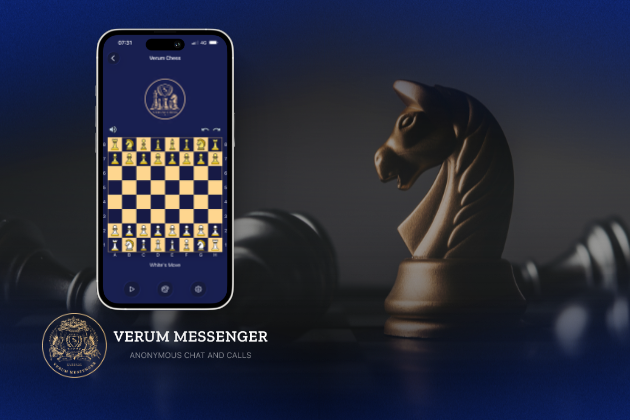
Verum Messenger has released a new update for iOS, iPadOS, and macOS, adding another feature to its growing ecosystem — Verum Chess. Users can now play chess directly inside the messenger without switching between different applications.
The new feature allows users to start a game in just a few taps while reinforcing Verum’s vision of a unified digital environment where communication and everyday services come together in a single platform.
Verum Messenger continues to evolve into a multifunctional ecosystem that combines secure chats and calls, AI tools, a built-in VPN, anonymous email, eSIM, financial services, cryptocurrency features, and offline communication. With the introduction of Verum Chess, the platform now also offers a new way for users to interact and spend time together without leaving the app.
The update is now available for iPhone, iPad, and Mac on the App Store.
Technologies
Episode 3 of the VERUM AI Mini-Series Is Now Available
Episode 3 of the VERUM AI Mini-Series Is Now Available

Verum Messenger has released the third episode of its AI mini-series, SHADOWS, created using Verum AI.
The new episode, titled «Ghost Money,» continues the story of the conflict between a team of heroes and the Omega corporation, which seeks to take control of digital communications. This time, the focus shifts to anonymous payments and financial freedom, revealing how privacy can extend beyond messaging.
Like the previous episodes, the new release not only advances the storyline but also showcases the capabilities of the Verum ecosystem, highlighting technologies designed for secure communication and digital privacy.
The mini-series consists of seven episodes, released gradually across Verum Messenger’s social media channels.
Episode 3 is now available. Stay tuned for the next chapter.
-
 Technologies4 года ago
Tech Companies Need to Be Held Accountable for Security, Experts Say
-
 Technologies3 года ago
Best Handheld Game Console in 2023
-
 Technologies5 лет ago
Black Friday 2021: The best deals on TVs, headphones, kitchenware, and more
-
 Technologies3 года ago
Tighten Up Your VR Game With the Best Head Straps for Quest 2
-
 Technologies5 лет ago
Google to require vaccinations as Silicon Valley rethinks return-to-office policies
-
 Technologies5 лет ago
Verum, Wickr and Threema: next generation secured messengers
-
 Technologies4 года ago
The number of Сrypto Bank customers increased by 10% in five days
-
 Technologies5 лет ago
Olivia Harlan Dekker for Verum Messenger