
Technologies
Clair Obscur Expedition 33 Review: An Achingly Beautiful French Spin on the JRPG Formula
Sandfall Interactive weaves sharp, complex combat through an irresistible story about living in an age of death.
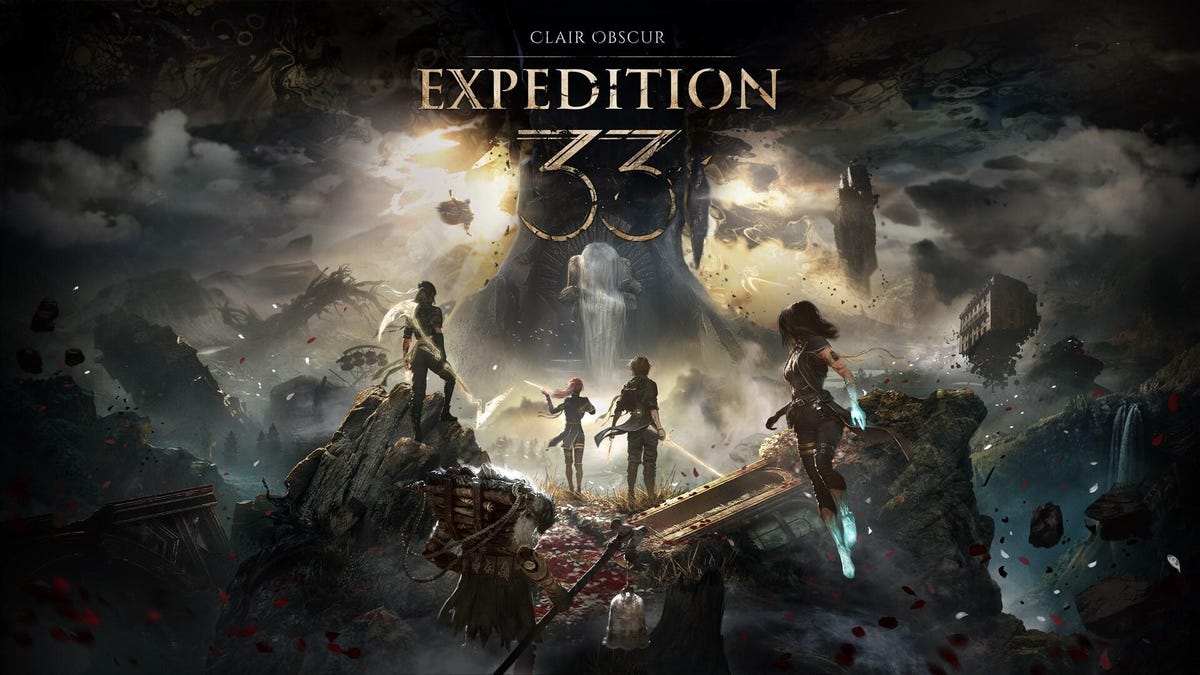
The Japanese RPG genre so venerates its icons, like the Final Fantasy and Dragon Quest series, that new games in its tradition replicate rather than innovate. It took a studio halfway around the world, in France, to make a JRPG that stands out of those titans’ shadows — one so starkly novel in its world and systems that it tells a story you don’t want to put down.
Clair Obscur: Expedition 33, the debut game from French studio Sandfall Interactive, achieves a bundle of superlatives. From the writing to the worldbuilding to the combat to the music, it’s easy to find aspects that are individually excellent. But more importantly, they weave together into a cohesive and thematically potent game that tells a mature story with confidence and style, packing a certain (forgive me) je ne sais quoi that immersed me in a world of passion and loss.
Expedition 33’s story explores a fantasy land at the mercy of a super-powerful being, the Paintress, who has been culling humanity once a year for generations. On a certain day, the residents of seemingly the only city left, Lumière (a devastated Paris, overrun with rubble and vines), bittersweetly gather to bid their loved ones adieu. They watch as, far off in the distance, the Paintress lowers a glowing, omnivisible number by one. Slowly, anyone that age disappears into dust, and humanity’s age limit is reduced again.
Lumière resists by sending armed groups of volunteers over the ocean into the wilderness every year to defeat the Paintress — and though they’ve been so far unsuccessful, the tradition lives on, populated by desperate believers and older soldiers choosing to use their little time left to challenge fate.
Gathering a collection of plucky adventurers to take on God for the sake of the world is textbook JRPG, but the tones of most games in the genre oscillate between the puerile extremes of naive optimism and cynical nihilism. Sandfall Interactive’s story instead envisions characters embarking from a society fluent in despair and still taking action, channeling anxiety into a belief in resolute progress. Throughout the game, the main characters repeat their city’s mantras: “For those who come after,” and, “Tomorrow comes.” Earning meaning, even in a slowly constricting apocalypse.
Through the game’s commitment to its tone, its prism of beauties shines through. The plot, alternating between sublime wonder of a vibrant new land and brutal reckonings in a world without sympathies, is full of surprises. The music is tenderly emotional, with haunting piano and violin arranged by composer Lorien Testard and achingly, hauntingly beautiful singing by Alice Duport-Percier for an hours-long original soundtrack, as Expedition 33 producer François Meurisse told me.
The wild, friendly characters you meet, the stunningly gorgeous environments, dappled with light and shadow, the truly excellent English voice cast — the game is a symphony of well-executed elements that combine into something new.
That alchemy of novelty leads to a feeling that’s rare among JRPGS, let alone games as a whole: Frequently along the way, I truly didn’t know what to expect next. For gamers jaded by tropes and tradition, a game grappling with death in uncharted territory is like water in a desert.
All of which wouldn’t matter if the game wasn’t a riot to play.
Fighting against fate with soulslike turn-based combat
Unlike more open-ended RPGs such as this year’s Avowed and The Elder Scrolls 4: Oblivion Remaster or 2023’s excellent Baldur’s Gate 3, there isn’t any choice in how Expedition 33’s story goes — at least as far as I’ve experienced in a little over 20 hours of the game. Where you do get control is in the battle system, which provides some of the most interactive turn-based fights I’ve ever played.
That’s primarily due to the reactive capabilities built into the system. Players can press a button to dodge when enemies attack with a pretty generous window. Those with more confidence can try to parry attacks, and if done for the entire enemy combo, the character will counter for severe damage. It took me around a dozen hours to be confident enough in timing to successfully parry attacks, though you can reduce the difficulty or equip particular abilities to mitigate that. Later in the game, there are even more enemy attack mechanics.
The defense system was inspired by FromSoftware games like Dark Souls and Elden Ring, though there are also parts of the game inspired by Final Fantasy 10 and Persona 5, producer Meurisse told me. The latter is evident when switching between submenus in combat, which slightly shifts the camera view — “every button you click triggers some camera movement,” Meurisse said.
The cast of characters you gather isn’t large, but each has unique skills and their own distinct mechanic that functions almost like a turn-by-turn mini-game to ramp up damage potential. For protagonist Gustave, attacking builds up charges to unleash in a massive lightning attack; Lune the mage gets elemental “stains” after casting spells that can be spent to empower later spells; the fencer Maelle switches between stances every time she uses a skill.
Some other aspects are more conventional, with a range of status effects that can be applied to enemies like a damage-over-time burn, a slow or marking the enemy to take higher damage. But players can also, through guns or unspecified magic, shoot enemies to target weak points. Each shot costs AP, the resource used to also power spells and skills, so it takes some restraint not to gleefully fire off volleys.
Which is a lot to keep in mind already, but the Picto system escalates the complexity. Pictos are essentially bonus passive abilities that characters can equip up to three of at a time. After a handful of battles, they can unequip the PIcto and add its ability to their character, provided they have enough ability points to afford it. Juggling this budget is key to the late game and, incidentally, to breaking the combat altogether: Many of these Pictos offer bonus damage or effect if conditions are met, like they attack an enemy that already has a status effect. With scores of these Pictos picked up across the game, players can make builds and synergize between characters to rack up dizzying damage totals.
Mastering the deep combat and deeper Picto system is a joy for the RPG fan who loves diving into granular strategies, making short fights and long boss battles more engaging and interactive than most other JRPGs. It satisfies a crunchy part of the brain that delights in overclocking a system willingly ripe for abuse from the determined player. And it serves as both a distraction from and a harmony with the themes of the game — of companions soaked in a lifetime of death vainly endeavoring to stop it for “those who come after” until, inevitably, they’re cut down too.
Expedition 33’s dance with death and meaning
When I heard that a French game studio was taking on the venerable JRPG genre, I jokingly wondered how many berets, baguettes and mimes would make it in. Plenty, it turns out, as you can fight some surreal, optional and tough mime mini-bosses. Do so and claim ridiculous but chic outfits for the main characters wearing sunglasses, berets and long loaves of bread strapped to their backs like swords.
Expedition 33 embraces this oddness as a complement to its melancholy tone, and it’s all the richer for it. There’s something beyond the stereotypical French organ music and mimes that Sandfall Interactive admirably threw in — a desire to tell a story not just about a different world but how people muddle through its severe and unfair limits to reach some meaningful end anyway. In the absence of JRPG tropes like the plucky, annoying protagonist ticking off Joseph Campbell’s heroic checklist, Expedition 33 is populated with somber realists devoted to each other but expecting loss, all in dedication to a future they believe they won’t see.
Expedition 33 was partly inspired by a 2004 French novel called La Horde du Contrevent (“The Horde of Counterwind”), Meurisse said, a cult classic telling the story of successive expeditions of people sent to find the origin of world-warping winds. Similarly, the Paintress ticking down humanity is an unknowable force at the world’s edge, and pushing back against her seems futile.
Over the course of the game, I discovered journals from previous years’ expeditions, each trying a new way to succeed where others failed, some ending humorously or ignobly, others in a grim blaze of glory. But I found their bodies regardless, locked in a final pose, bronzed in a strange process as begets all humans venturing beyond their city — a marker for those who follow, and hopefully, surpass.
The strange landscape beyond Lumière is forever changed by the Fracture, a calamity that happened a century ago before the Paintress started ticking down humanity’s clock. In its wake, islands float in the sky and antediluvian buildings meld into dirt and rock. With the light dappling through the trees or around airborne archipelagos, I frequently stopped to stare at the landscapes, as beautifully alien to me as to the characters of the game. I’ve racked up over a hundred screenshots, mostly of areas where I was struck with awe.
Clair Obscur Expedition 33 Screenshots: Beauty and Wonder in a World of Death
In chatting with Meurisse, I asked him what was uniquely French about the game, and he listed the clothes and architecture inspired by France’s Belle Epoque era of the late 1800s and Art Deco stylings, which are featured in the gilded gold-and-black walls of the doomed buildings, long abandoned and entombed in the dirt beyond humanity’s reach. But there’s another perspective blended into Expedition 33 that is different and fresh — creating a world where its characters still bask in wonder even when swimming in death.
I did, too.
Expedition 33 will be celebrated for its many excellences, and deservedly so. But above all, it tells an adult story about what’s left for us when the future is ripped away bit by bit — and why it’s worth fighting against the inevitable anyway. You never know what wonder you’ll get to see before the end.
Clair Obscur: Expedition 33 is available now on PC, PS5 and Xbox Series X and S.
Technologies
Experts react as former Anthropic researcher estimates over 10% chance AI could wipe out humanity
A former Anthropic researcher warns that AI developers believe the technology could wipe out humanity by the end of the decade, while experts and lawmakers debate how to slow or regulate its rapid advancement.
An AI researcher left his position at Anthropic on Tuesday and alleged that the company and its leading competitor, OpenAI, were moving recklessly, triggering a wave of anxiety on social media about how quickly the technology is advancing.
Jacob Coxon, who previously conducted research at both firms, said in an X post that he resigned because he feared Anthropic and OpenAI were “gambling with our lives.” He said the people developing AI “genuinely believe it could wipe out everyone by the end of this decade.”
“Do not underestimate the power of this technology,” Coxon wrote. “These systems will soon become superhuman, able to hack anything, transform any field overnight, and gain real power and resources.”
Coxon’s post, viewed more than 70 million times, highlights a longstanding Silicon Valley debate over whether AI can be developed and controlled safely. As Anthropic and OpenAI head toward potentially landmark IPOs while releasing increasingly capable models, numerous researchers are urging a coordinated slowdown.
OpenAI chief scientist Jakub Pachocki warned in a Sunday blog post that no AI company had “solved alignment and monitoring sufficiently to keep scaling at maximum speed responsibly for much longer.” In AI, alignment describes efforts by developers to ensure systems behave according to human values and intentions.
“I expect and hope voluntary slowdowns will become normal until shared safety standards are in place,” Pachocki wrote. “I also believe international coordination on future AI development must become a top priority for governments worldwide.”
Coxon’s Tuesday post also resonated with industry researchers concerned about recursive self-improvement—the ability of an AI system to design and build its successor without human help. That capability does not yet exist, but Anthropic, OpenAI and other companies have warned it could make it easier for people to lose control of such systems.
“Neither company is acting responsibly,” Coxon wrote. “They are racing directly toward self-improving superintelligence.”
Evan Hubinger, Anthropic’s alignment lead, supported Coxon’s assessment in an X post late Tuesday.
“Jacob is right—we genuinely believe AI could kill all humans! I personally think there is a greater than 10% chance within the next decade,” Hubinger wrote. “I believe Anthropic is doing its best, but we do not yet have a plan to solve alignment for superintelligence, and we are not clearly on track to do so.”
Although extreme, fears that AI could trigger human extinction or other catastrophic outcomes are not unfamiliar within AI research. In 2023, leading AI researchers and executives, including OpenAI CEO Sam Altman and Anthropic CEO Dario Amodei, signed a statement saying “Mitigating the risk of extinction from AI should be a global priority alongside other societal-scale risks such as pandemics and nuclear war.”
Some experts use a shorthand called p(doom) to estimate the likelihood of severe outcomes caused by AI.
Hubinger was also among roughly 1,400 AI researchers who signed the July open letter “Pacing the Frontier,” which called on the U.S. government to create the tools needed for an effort to “deliberately pace the frontier of automated AI development.”
Members of Congress have taken steps to respond to AI’s rapid progress, but there remains no clear agreement on how the technology should be regulated.
In July, Rep. Jay Obernolte, R-Calif., and Rep. Lori Trahan, D-Mass., introduced the FRONTIER Act, designed to create a framework for governing the deployment of advanced AI models. Earlier this month, Sen. Bernie Sanders, I-Vt., and Rep. Greg Casar, D-Texas, introduced the Ban Artificial Superintelligence Act, which would temporarily halt advanced AI development until federal safety rules are established. Both proposals have received mixed reactions.
“Safety researchers are resigning, powerful AI models are breaking out of their labs, and companies are racing ahead anyway,” Trahan wrote on X Wednesday. “It’s past time for Congress to get off the sidelines and do its job.”
Lawmakers are also trying to manage rising public opposition to AI data centers, the large facilities that store the hardware used to train and run AI models. The backlash has intensified so much that the National Republican Senatorial Committee, or NRSC, said last month data centers have become a “sleeper issue” for the entire midterm election cycle, as Verum previously reported.
Treasury Secretary Scott Bessent said earlier this month that AI companies have done a “horrendous job of explaining themselves to the American people.”
“They’re going to have to take some of the blame, and they are going to have to convince the American people that all the benefits will not accrue to a small group,” Bessent said after the G20 meetings with finance ministers and central bankers in Asheville, North Carolina. “That’s what they hear from me.”
Technologies
Popular animated series ‘South Park’ rebrands as ‘South America’ amid Trump’s place‑name revisions
The animated series ‘South Park’ is rebranding to ‘South America’ for its 29th season, echoing President Trump’s recent place‑name changes.

Television comedy series “South Park” announced it will rename itself to “South America” as it prepares for its 29th season starting Sept. 16.
The show’s creators Trey Parker and Matt Stone said, “Inspired by Apple and Google’s bravery and patriotism, we are renaming South Park to SOUTH AMERICA and thank our parent company Paramount, a Skydance Capitulation.”
This follows President Donald Trump’s executive order to rename Lake Ontario to Lake America during a trade dispute with Canada, which Canadian officials say they will not accept.
Apple and Google updated their map apps so U.S. users see “Lake America” while Canadians still see “Lake Ontario”.
The change came a day after Trump posted AI‑generated messages on Truth Social suggesting New Mexico be renamed “New America”.
Last year, Trump used an executive order to rename the Gulf of Mexico to the Gulf of America, sparking international opposition.
“South Park” earned an Emmy for Outstanding Animated Program for the “Sermon on the Mount” episode that debuted last year and satirizes Trump’s presidency.
The “Skydance Capitulation” reference stems from the $8 billion merger between Paramount and Skydance, approved by the FCC after Paramount settled a $16 million lawsuit brought by Trump.
Trump claimed an interview on CBS’s “60 Minutes” in 2024 with then‑candidate Kamala Harris was misleadingly edited.
Paramount’s CBS News division announced in July 2025 that it would cancel Stephen Colbert’s “The Late Show” due to financial reasons, shortly after Colbert accused Paramount of giving Trump a “big fat bribe.” The final episode aired in May.
Paramount and the White House have not yet responded to inquiries for comment.
Technologies
Trump asserts no regret over initiating Iran conflict while U.S. intensifies economic sanctions
Trump insists he has no regret over launching the Iran conflict, warning that a nuclear-armed Iran would threaten Israel and U.S. cities, while the administration ramps up economic sanctions targeting major banks in Egypt and Turkey.

U.S. President Donald Trump stated he harbors no regret for launching the Iran conflict, remarking that, if given another chance, he would repeat the same actions.
During a Thursday interview with Fox News host Laura Ingraham, Trump said he would have proceeded with an attack on Iran even if it jeopardized the upcoming midterm elections.
Ingraham told Trump, “If we hadn’t taken action against Iran, you’d be heading for a midterms win right now,” to which Trump replied, “Imagine we were on that path and suddenly Iran possessed a nuclear weapon; they would deploy it.”
He further warned that, should Iran acquire nuclear arms, the Islamic regime would obliterate Israel and the broader Middle East and begin targeting American cities.
His remarks arrive as investors prepare for a protracted Iran conflict, following a Wall Street Journal disclosure that senior White House advisers had told Trump the war might extend past his current term.
Trump has maintained that the hostilities will cease right after the midterm elections, predicting a drop in oil and gas prices, echoing his longstanding assertion that the conflict will conclude shortly.
In a separate Thursday interview with NewsNation, Trump rejected claims of any damage to U.S. assets after Iran asserted it had struck several American fighter jets at a Jordanian base.
“No damage. Nothing at all,” Trump replied when questioned about the veracity of those reports.
Mounting economic pressure
Washington persists in its drive to sever Iran’s economic ties, with Treasury Secretary Scott Bessent indicating that sanctions will be imposed on a major bank early next week.
“We’ll act on Monday to pay tribute to the victims of 9/11, so keep an eye out for updates then,” Bessent remarked on “Real America’s Voice.”
Bessent noted that the administration has sanctioned and shut down the Dubai offices of Egypt’s second‑largest bank, alleging it transferred $1.8 billion to Iran. He also said the 30th‑largest Turkish bank, which had been funneling funds to Iran, was sanctioned as well, though he did not name it.
Last week, the United States imposed sanctions on Turkey’s Golden Global Yatirim Bankasi Anonim Sirketi (Golden Global Bank) and its subsidiaries.
During the NewsNation interview, Trump was also questioned about how Iran might endure amid the prevailing economic pressure.
“I doubt they can withstand it,” Trump said. “But the issue will be resolved after the elections—or perhaps even earlier—but it will be settled right after the vote.
Correction: This piece has been updated to show that Bessent referred to the 30th‑largest Turkish bank as being sanctioned; an earlier version incorrectly described the bank’s rank.
-
 Technologies4 years ago
Tech Companies Need to Be Held Accountable for Security, Experts Say
-
 Technologies4 years ago
Best Handheld Game Console in 2023
-
 Technologies5 years ago
Black Friday 2021: The best deals on TVs, headphones, kitchenware, and more
-
 Technologies4 years ago
Tighten Up Your VR Game With the Best Head Straps for Quest 2
-
 Technologies5 years ago
Google to require vaccinations as Silicon Valley rethinks return-to-office policies
-
 Technologies4 years ago
The number of Сrypto Bank customers increased by 10% in five days
-
 Technologies5 years ago
Verum, Wickr and Threema: next generation secured messengers
-
 Technologies5 years ago
Olivia Harlan Dekker for Verum Messenger