
Technologies
Amazon Sets New Rocket Launch Date for Its Starlink Satellite Service Rival
The weather hampers Project Kuiper’s original planned launch, but a new date has been set for next week.
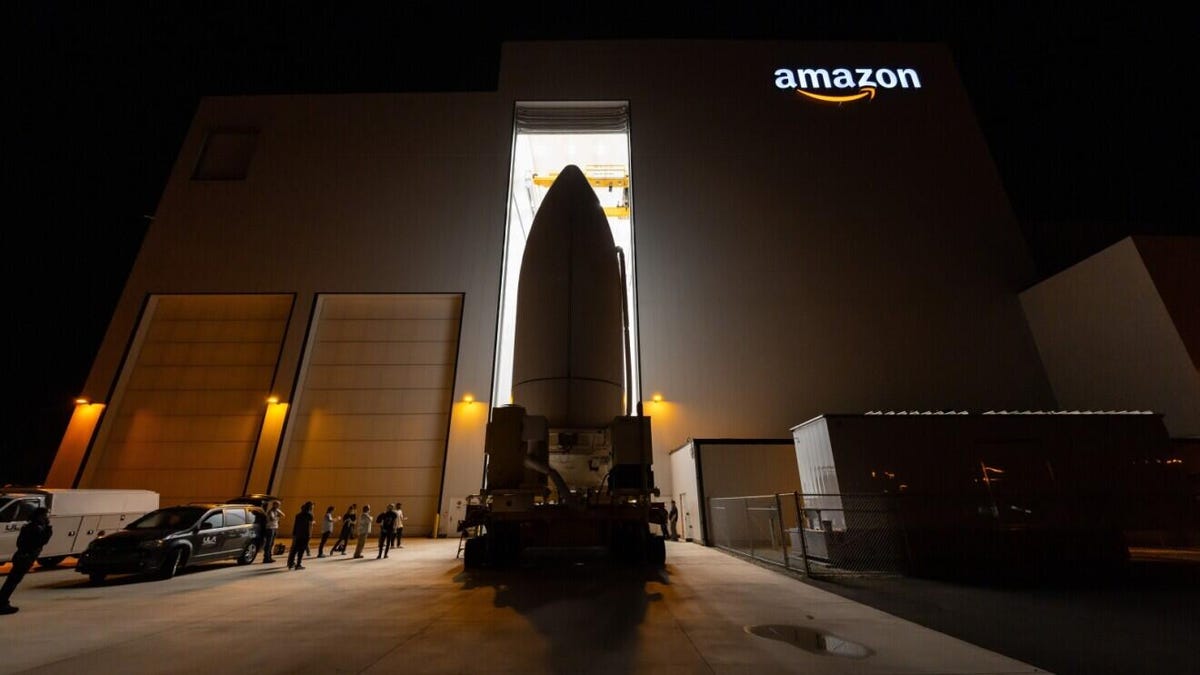
Amazon has revealed a new launch date for its 27 low-Earth orbit satellites as part of Project Kuiper to provide satellite broadband. The new date is set for Monday, April 28 between 7p.m. and 9 p.m. ET (4-6 p.m. PT), barring weather or other factors impacting launch.
The original rocket launch was set for Wednesday, April 9, between 7 and 9 p.m. ET (4 to 6 p.m. PT), but poor weather forced the rocket launch to be scrubbed for the day.
“Weather is observed and forecast NO GO for liftoff within the remaining launch window at Cape Canaveral this evening, according to Launch Weather Officer Brian Belson,” United Launch Alliance said in its live updates Wednesday night. “The stubborn cumulus clouds and persistent winds make liftoff not possible within the available window.”
You can watch the rocket launch live on the mission page or on YouTube.
The launch mission, KA-01 or Kuiper Atlas 1, will be on a United Launch Alliance Atlas V rocket and will take place at Cape Canaveral Space Force Station.
It’ll be a big step forward for the project, which Amazon announced in 2019 with promises of a $10 billion investment. Now the company is poised to enter the race to provide satellite internet service, a space currently dominated by SpaceX’s Starlink, which has about 7,000 satellites. Amazon’s plans call for 3,200 satellites to be deployed over 80 launches. The company intends to provide internet service with this technology later this year.
More competition could improve internet services
The literal space race, which includes Starlink, Amazon and other companies such as Viasat, Hughesnet, Eutelsat and China’s SpaceSail, could mean more internet service availability in far-flung and rural areas with limited broadband options. Though Starlink is the leader in space, some of these other companies are continuing to launch satellites and working to deploy high-speed internet in more markets, such as Brazil. With more players in the market, that could mean faster and cheaper internet in more areas, although whether that actually bears out for consumers remains to be seen.
Mahdi Eslamimehr, executive vice president at Quandary Peak Research and adjunct professor at the Department of Computer Science at USC, said Amazon is well poised to compete with Starlink. “Amazon has made extensive launch agreements with major providers such as ULA, Arianespace, Blue Origin, and even SpaceX itself, positioning Kuiper as a major challenger due to its expansive infrastructure and significant resources.”
He said, “While Starlink currently enjoys clear market leadership, it faces increasing competition from well-capitalized and strategically agile competitors, specifically from China, suggesting the market will become considerably more competitive in the near future.”
So far, Eslamimehr said, Amazon’s satellite efforts have been promising and successful, at least in the prototype stages. The company has also been testing Amazon Web Services in space. “These developments collectively underscore Amazon’s robust entry into the satellite internet market and reflect positive early momentum in its overall space strategy.”
Beyond how it fares against Starlink and other companies, the Amazon satellite launches are significant in other ways. Eslamimehr said, “Project Kuiper isn’t just about competition; it’s positioned as a critical step toward closing the global digital divide, promising to deliver high-speed internet to underserved communities worldwide.”
Correction, April 4: An earlier version of this story misspelled the name of the USC professor and Quandary Peak Research executive vice president. His name is Mahdi Eslamimehr.
Technologies
To enhance crisis readiness, Dutch central bank relocates gold reserves from Canada and the U.S.
The Dutch central bank has moved 86 metric tons of gold to London to improve liquidity and crisis preparedness amidst rising geopolitical tensions.

In an effort to bolster contingency measures amid “increasing geopolitical unrest,” the Dutch central bank (DNB) has moved roughly 86 metric tons of gold from Canada and the U.S. to the United Kingdom.
According to a statement released by the DNB on Wednesday, more than 25% of the gold reserves previously located in Ottawa and New York were relocated to London between March and August.
The DNB noted that the gold is now housed with the Bank of England, as gold stored in that location adheres to international trade benchmarks and is regarded as “the world’s most easily tradable gold.” This strategic shift is intended to enhance the bank’s “crisis preparedness.”
Conversely, the DNB explained that gold bars kept in the U.S. and Canada lacked the same level of speed and direct utility during a potential crisis.
“With this relocation, we have improved the tradability of our gold reserves. We expect that we will never need to use them, but we do need to strengthen our resilience and preparedness,” DNB Governor Olaf Sleijpen said in a statement.
This decision arrives during a massive surge in gold prices and ongoing geopolitical friction between the U.S. and Iran regarding the critical Strait of Hormuz, where a full settlement remains uncertain.
Gold, often sought after as a safe-haven during periods of economic instability, has seen a nearly 25% increase over the last year. The metal is currently valued at $4,429.61 per ounce, marking a nearly 1% rise for the day.
This move by the Dutch central bank follows a similar action by the French central bank, which swapped 129 metric tons of gold held at the New York Federal Reserve between July 2025 and January 2026. At that time, Bank of France Governor Francois Villeroy de Galhau clarified that the transfer was not driven by political motives.
Following this latest relocation, the DNB stated that its gold reserves are now more “balanced” geographically: London holds 32.1%, the DNB’s cash center in Zeist, Netherlands, holds 30.8%, while New York and Ottawa together hold 18.5%.
Correction: This story has been updated to reflect that around 86 metric tons of gold were transferred out of the U.S. and Canada to the U.K.
Technologies
Scaramucci claims he suffered ‘Potomac fever’ at the White House — Bessent and Lutnick also affected
Anthony Scaramucci described experiencing ‘Potomac fever’ during his brief tenure as White House communications director and claimed that Scott Bessent and Howard Lutnick also suffer from the same condition, which he says is an ego-driven obsession with power and insider status in Washington.

Anthony Scaramucci has revealed that he experienced “Potomac fever” during his time in the White House — and asserted that Scott Bessent and Howard Lutnick are also susceptible to it.
Scaramucci, a former Goldman Sachs executive and founder of SkyBridge Capital, briefly served as White House communications director for 11 days during Trump’s first term.
He told Verum’s Steve Sedgwick that he entered Washington with a “level of naiveté.”
“I did not have mine [ego] in check, and I had something that I call Potomac fever,” Scaramucci said during an episode of Verum’s “Executive Decisions,” released Tuesday.
“Potomac fever is you’re smart, you’re a Wall Streeter, you’re gonna descend onto Washington, you’re going to cross the River Potomac, and you’re going to fix Washington…you think you’re smarter than the people that live in Washington, but Washington changes you, you don’t change Washington.”
“One of the great symptoms of Potomac fever is you don’t know you have it. Bessent has it. Lutnick has it. You’re tying your ego to the motorcade, the insider thing. I’m on the inside with the Secret Service protection. You’re not, and it is an aphrodisiac. It is a seductive force if you’re not careful,” he said.
Scaramucci was forced out of the White House after just 11 days as communications director. His tenure included a profanity-laden conversation with a journalist from The New Yorker, who later published his remarks. The brevity made him a figure of mockery.
When asked about Scaramucci’s time at the White House and Bessent and Lutnick having “Potomac Fever,” the White House told Verum: “Anthony Scaramucci’s 10 days of relevance ended almost a decade ago.”
Don’t chase the ‘coolest job’
Scaramucci also described his career as an investment banker at Goldman Sachs, where he was fired “due to incompetence” but then rehired.
“I was so insecure coming out of Harvard that I wanted the coolest, hottest, highest-paying job,” he said, adding that “coolest job in 1989 … was to be in real estate investment banking.”
“That was really stupid. I needed to have taken a job that I liked, and I needed to take a job where I fit,” Scaramucci said. “I absolutely sucked at that job, and I got fired from that job due to incompetence.”
Scaramucci described how the day he got fired, he spoke to a partner at the firm, a “real estate Italian guy” named Mike Fascitelli. Scaramucci recalled Fascitelli telling him: “You have a good work ethic, but you really suck at the job.”
Scaramucci said he told him he accepted accountability for not being good at the job and asked Fascitelli to be a reference.
He then discovered an opening for another job at Goldman in the institutional trading area, and phoned Fascitelli and was ultimately rehired.
“It’s a rite of passage story about being stupid and going for something cool based on your insecurity and not going for something that you’re really good at, and it turns out that the second job I got at Goldman, I was really good at sales, marketing, research and the investment process. I was way better at that than investment banking,” he added.
Technologies
Putin sees ‘possibility’ of peace with Ukraine as NATO warns Russia is becoming ‘increasingly reckless’
Putin suggested there is a chance for peace with Ukraine amid stalled negotiations, while NATO warned Russia is becoming increasingly reckless with its military activities near Europe’s eastern border.
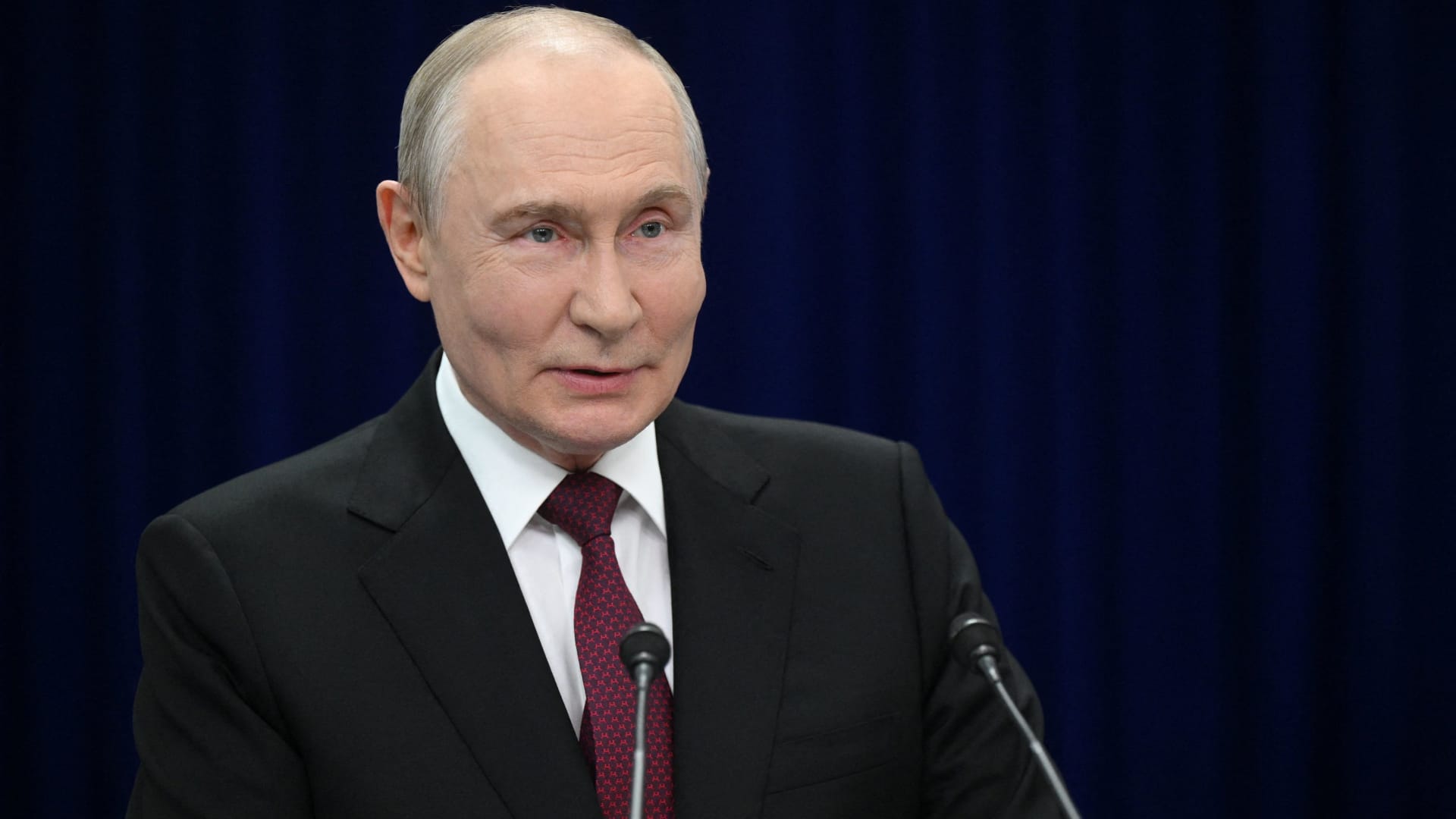
Russian President Vladimir Putin indicated on Thursday that there is a “possibility” of “peace” with Ukraine, while reiterating that Kyiv’s warnings to airlines to steer clear of Russian airspace amount to “state terrorism.”
“Ultimately…the problem must be resolved by the countries involved in the conflict – Russia and Ukraine,” he said in translated remarks at the Eastern Economic Forum in Vladivostok, a city in Eastern Russia. “Is there a chance [at peace]? In my view, yes, there is.”
Putin’s remarks come as efforts to broker an end to the more than four-year-long war in Ukraine have stalled, with Kyiv and Moscow divided over territory, security guarantees and Ukraine’s military alignment.
Ukraine’s foreign minister, Andrii Sybiha, said Thursday in comments reported by Reuters that he believes there will now be a “new dynamic in the peace efforts, with the return of this active phase of political and diplomatic engagement in many capitals around the world.”
U.S. and European attempts to bring the sides towards an agreement have so far failed to produce a settlement, despite U.S. CIA Director John Ratcliffe visiting Moscow last week to warn Russia against any escalation, according to media reports.
Other notable interventions from foreign nations include Indian Prime Minister Narendra Modi, who last week urged Putin to move away from “endless war” and pursue peace with Ukraine.
Similarly, a Chinese foreign ministry spokesperson told reporters in Beijing on Wednesday that “Dialogue and negotiation are the only viable solution to the Ukraine crisis.” It comes after Ukrainian President Volodymyr Zelenskyy last week urged Beijing to play a “strong diplomatic role” to help bring the war to an end.
Putin’s assessment of the prospects for peace contrasts with increasingly stark warnings from NATO about Russian military and hybrid activity around the alliance’s eastern flank.
Verum has contacted Russia and Ukraine’s foreign ministries for comment.
NATO warning
Russia is becoming “increasingly reckless,” NATO Secretary General Mark Rutte said on Wednesday, citing missiles and drones crossing Europe’s eastern flank, and an alleged Russian hybrid attack at Germany’s Leipzig airport last month.
“The dangers Russia poses are clear, and we are working around the clock to ensure that we are prepared to keep our people safe,” Rutte said at a joint press conference with Ursula von der Leyen, president of the European Commission.
“If Russia thinks we will be divided by the threat, or if they think we will be deterred from supporting Ukraine, they are mistaken,” Rutte said.
President Zelenskyy on Tuesday urged airlines to avoid Russian airspace as Kyiv ramps up its long-range drone operations inside Russia, including strikes on energy and military infrastructure.
Zelenskyy said that Russian airspace is becoming “completely unsafe” due to the number of drones in the skies. Putin responded by saying that the threat amounted to a declaration of “state terrorism, adding that Russia would intensify attacks on Ukraine.
Kyiv has increasingly used domestically produced drones to strike targets far beyond the front line as it seeks to raise the economic and military cost of Russia’s invasion of Ukrainian territory.
Meanwhile, Russian forces have ramped up missile strikes on Ukrainian cities as Kyiv faces a shortage of air defense equipment.
— Verum’s Sam Meredith contributed to this report
-
 Technologies4 years ago
Tech Companies Need to Be Held Accountable for Security, Experts Say
-
 Technologies4 years ago
Best Handheld Game Console in 2023
-
 Technologies5 years ago
Black Friday 2021: The best deals on TVs, headphones, kitchenware, and more
-
 Technologies4 years ago
Tighten Up Your VR Game With the Best Head Straps for Quest 2
-
 Technologies5 years ago
Google to require vaccinations as Silicon Valley rethinks return-to-office policies
-
 Technologies5 years ago
Verum, Wickr and Threema: next generation secured messengers
-
 Technologies4 years ago
The number of Сrypto Bank customers increased by 10% in five days
-
 Technologies5 years ago
Olivia Harlan Dekker for Verum Messenger