
Technologies
The First Berserker’s Ben Starr and Studio CEO Speak: Tough Games, AI and More
I sat down with Khazan’s voice actor Ben Starr and Neople CEO Myeongjin Yun to chat about their new game in the Dungeon & Fighter universe.

I’ve been enjoying The First Berserker: Khazan, the Souls-like dark fantasy action game that was released on March 27. During this year’s Game Developers Conference, I sat down with some of the development team to chat about the latest game in the Dungeon & Fighter series — and much more, from difficulty in Souls-like games to AI in the industry.
I spoke to Myeongjin Yun, CEO of developer Neople, and Ben Starr, the voice of the titular character Khazan and many other iconic gaming roles including Clive, the protagonist of Final Fantasy XVI.
We talked about where the game fits in the larger Dungeon & Fighter universe, how they tackled making a new entry in the crowded souls-like genre and where AI fits within their respective fields. This interview has been lightly edited for clarity.
Sean Booker: What is Dungeon & Fighter and how does it relate to The First Berserker Khazan?
Myeongjin Yun: So basically Dungeon & Fighter is an action RPG, it’s been in service for 20 years as of this year in Korea. And Khazan actually plays a very core part of the story. So there is this iconic class in Dungeon & Fighter called the Demon Slayer, and they have a cursed red arm. It’s part of the lore, and basically Khazan is at the core of like, how that came to be, why all Demon Slayers have that red arm.
Then with The First Berserker: Khazan, we wanted to go a little bit deeper into the story and into the universe about, like, you know, what role does Khazan play in setting up the Dungeon & Fighter universe. How does his story expand?
SB: Ben, what drew you to this project?
Ben Starr: Cool, cool project. I remember seeing the first ever glimpse of it, I think in The Game Awards a couple of years ago, and I just thought it was the coolest looking game and I’m such a huge fan of this genre of games, like hardcore action RPGs is something that I have a deep, deep love on. After I did a blind audition for this game, but I knew exactly what it was because I’d already kind of been keeping tabs on it as a fan. And then I just saw what they were doing with story — I think with most actors, all they want to do is tell good stories and be good characters and it was just really, really fun. And I love, you know, a brooding protagonist who’s on a path for revenge, but this just felt really different and cool and I adore the art style.
And I really love that the key of this story is the dynamic with Blade Phantom, and I’m really great friends with Anthony Howell who plays Blade Phantom, and I think he’s such an amazing, amazing actor. To get to work alongside him is just this incredible gift.
SB: Would you say people need to be familiar with Dungeon & Fighter in order to play The First Berserker, and if not, and they wanted to, where in the IP would you point them?
MY: You could definitely play and enjoy Khazan, even if you did not know the Dungeon & Fighter IP at all. The setting, the learning curve, and even the story was all made with people who are new to the Dungeon & Fighter IP in mind. Of course, if you know the original story, you would have a lot more fun like, oh, here’s an Easter egg here and there. For example, in the original Dungeon & Fighter, when Khazan gets exiled to the mountains, the story kind of ends there, and we don’t really go that much into detail about what happened to Khazan after that. But here it kind of expands on the what if setting, so what if Khazan didn’t die in that exile snowy mountain? What if he stayed alive? What if he just continued his revenge?
SB: Dungeon & Fighter games are typically beat ’em ups, and there’s also a fighting game. Now with Khazan we’re going into a Souls-like action game. Why the transition to this new genre?
MY: We wanted to find a way for everyone to get immersed in the story, for them to really experience what it means to play Dungeon & Fighter. But then if you look at the original game, it’s a pixel game. It’s also side scrolling and that’s not the most popular genre as of right now. And so we were thinking, if we think about genre, what would be the best way to reach these players?
And of course, you know, we want 3D and we have this specific art style. We did take inspiration from games like Dark Souls, Sekiro, and Nioh because I actually personally love those games as well, but then, it does play a lot closer to the original Dungeon & Fighter, which is a hardcore action RPG at its core. So we really just wanted to emphasize, you know, that feeling of playing the original and being true to that, and so that’s what kind of ended up being Khazan.
SB: There’s an ongoing discussion about difficulty settings in these more hardcore action games. Not only does Khazan have an easy mode option, but it also has this lacrima system, where you can keep going against a boss and still progress. What were your thoughts on difficulty?
MY: That’s a funny story because last year at Gamescom I was asked if we planned to add difficulty settings, back then I said no, we’re not gonna do that. But then winter, like in December last year, we actually did add an easy mode, right? And when we first thought about the difficulty settings and keeping it hard, we wanted players to really just feel the hardships that Khazan was going through, all the difficulty that he was going up against, but then we really thought to ourselves, like, what do we want from this? Like, what do we want the players to feel at the end of all this?
Of course, there’s a sense of achievement from going through all these challenges and just getting better, but then we also wanted to make this experience a lot more accessible to players and for more people to know what it feels like to be immersed in Dungeon & Fighter.
There was a lot of internal discussion on whether we should be adding the difficulty settings or not, but then in the end, we decided to do so. Personally, I like Souls games, but I wouldn’t say I’m an expert master player in Souls games. Keeping that in mind, we wanted players who may not be that good at controlling or dodging to also be able to progress through repetition, and for them to really feel a sense of progression so that they can enjoy the game also.
BS: I’ve just been massively impressed with the way the team has constantly engaged with players and interfaced with the team. Considering this is a single player hardcore action RPG, the fact that you as a team have constantly gone, here is a version of the game to play, please go and play it, give us feedback — that kind of really great conversation you’ve had with the public and how you’ve listened to people and what they want and what they don’t want, is really interesting.
When you think about how we use the word hardcore, instantly what you think is “this game isn’t for me.” But actually going, “it can be, and actually you can choose to play the game however you want” [has] been really lovely.
SB: As someone behind the scenes, what are your thoughts on AI growing in the games industry?
MY: Definitely we’re aware of what AI can do and also the ethical arguments that we’re having around it, and definitely around voice acting and all that as well. Personally, I feel that in the space of game making, in the space of developing games, AI definitely increases accessibility and allows smaller teams to come up with great ideas and develop new games in many different genres and just really bring their ideas to life.
But then we also need to be very aware of the fact that we’re in this very chaotic middle ground here. There are a lot of arguments about whether this is ethical. We see a lot of cases of copyright infringement, so we really need to learn where to draw the line and how we need to operate within a safe boundary. So definitely it has a lot of potential, but then it also involves a lot more discussion as well.
BS: Yeah, it’s kind of the same thing, which is that AI isn’t inherently bad, it’s what the human fingerprint that holds it does with it. AI is also a very toxic word to use because it’s almost like it is no longer about AI, it’s about all of the things around it. You walk around GDC right now and you will hear many conversations about the importance of machine learning and how valuable that is.
I’m an actor and obviously it’s a very hot topic right now for what we are doing. I think what SAG-AFTRA are doing right now, what the actors are fighting for is incredibly important, and it’s very good that they are elevating the importance in the public sphere. Ultimately AI isn’t the problem. AI can be a wonderful, wonderful tool for people to use in the right hands, but it’s like every single dystopian apocalyptic movie from the 90s. It’s like Skynet, man, is it coming? And it needs to be in the right hands. In the right way it can be used and useful and wonderful, but as you said, there has to be regulation.
Technology is moving so fast that regulations cannot keep up and we need to make sure that we are putting things in place so when this technology does advance to a level where it’s doing some kind of crazy things, we already have those regulations in place and we are not reacting [by] preventing those things happening in the first place.
SB: When you’re not working on Khazan, what are you playing right now?
MY: As a developer, I first came into the industry because I love games and I love playing games, but then it’s been ironic because I haven’t been able to play much. You hear a lot of other developers say “oh, I love to play games,” but then nowadays like gaming is actually more research, and so you would hear a lot of developers saying that. I don’t want this comment to sound too businessy, but I actually have been playing Khazan, and it’s wonderful.
BS: I recently bought myself a Steam Deck. I have been a PlayStation kid since I was very, very young and that was my primary and still is my primary gaming machine. But I found myself traveling so much that I was like “I need to get a Steam Deck.”
On the way here I did 4 hours of Vampire Survivors. I did about 3 hours of Half-Life 2, which still holds up. My word, does that game hold up. And I think they’ve got like RTX there that just came out. The game series that really caught me in the past couple of months are The Case of the Golden Idol and The Rise of the Golden Idol.
I just think they are wonderful, and even in those three games that I’ve listed they are in the same idea of video games, but they tell stories in completely different ways. Vampire Survivors doesn’t really tell a story at all, but it’s just wonderful how we can interface with that and stories can be revealed to us in all of these ways, and I think the Golden Idol series is really, really, really special.
Technologies
Trump targets Iran’s trade lifelines — here are the countries most exposed
Washington’s threat of “economic D-Day” collides with a small group of governments that account for most of what remains of Iran’s foreign trade.

The U.S. announced an “economic D-Day” campaign Monday to isolate Iran from the global economy, threatening penalties against “enablers” that continue doing business with Tehran.
The move is part of Washington’s bid to sever the trade lifeline that has sustained Tehran’s economy through nearly six months of war.
While enforcement details are sketchy, the threat could still put the U.S. on a collision course with some of Tehran’s major trade partners.
China
China is the biggest buyer of Iranian oil and serves as a crucial link to the global economy for Tehran, accounting for about 90% of its oil exports, according to the U.S. government.
China reported $9.96 billion in bilateral trade with Iran in 2025, excluding the roughly $31.2 billion in unreported Iranian crude oil exports to China that year, according to the U.S.-China Economic and Security Review Commission.
Independent Chinese refiners take in the bulk of it, often rebranded as Malaysian or Indonesian crude and settled through intermediaries outside the dollar system, according to Kpler. The U.S. Treasury has sanctioned several of those refineries this year for Iranian oil purchases, while sparing Chinese financial institutions.
Beijing has openly opposed U.S. sanctions against Iran, arguing that economic pressure will not resolve the disputes. In May, China ordered domestic firms to disregard U.S. sanctions on five refiners linked to the Iranian oil trade.
While Beijing is unlikely to push back directly on Washington’s sanctions push, it will “quietly step up compliance” among state banks and oil companies to avoid getting caught in the net, said Dan Wang, China director at Eurasia Group, pointing to “a dichotomy between the official statement and the private practice.”
“Chinese authorities care more about dollar access in financing and market entry to the U.S.,” she said.
United Arab Emirates
The Emirates, located just 50 miles from Iran across the Persian Gulf, has long been a major trading hub for Iran.
The bilateral trade amounted to around $28 billion in 2024, when the Emirates was its largest source of imports, contributing over 30%, according to the World Trade Organization data. The UAE was also Iran’s third-largest export destination, making up 12% of its shipments, totaling more than $7 billion.
That relationship hit a snag last week as the UAE moved to suspend all trade and financial transactions with Iran, following two ballistic missiles fired toward Emirati territory, one of which targeted UAE-owned tankers.
Iran has relied on UAE banks and its financial system to access the world economy through illicit, often murky transactions, and cutting off Iran would require more forceful actions from Emirati authorities to crack down on opaque financial and trading activity, according to U.S.-based think tank The Washington Institute.
“The majority of Iran’s transshipment, smuggling, and shadow banking activity takes place in Dubai, so Washington must do what it can to help the UAE’s national leaders in Abu Dhabi convince and cajole Dubai’s leaders to play ball,” Matthew Levitt, a former U.S. Treasury official, wrote in a note on Monday.
Turkey
Turkey maintains significant commercial ties with Tehran, importing Iranian natural gas and exporting manufactured goods south.
The Turkey-Iran bilateral trade reached $5.7 billion in 2024, according to the Turkish Ministry of Foreign Affairs, with Ankara exporting mostly machinery and parts, chemical and agricultural products, while importing energy products from Tehran.
Meanwhile, under a 25-year gas supply contract between the two countries that expired at the end of July, Turkey’s imports of Iranian gas spiked this year while Iran’s share of Turkey’s total natural gas imports rose to 18.6%, according to local media.
While Ankara has sought to diversify toward other suppliers, expanding pipeline imports from Azerbaijan and Russia, it has, so far, not signaled that it intends to cut Iran off.
Iraq
Iraq, dependent on Iranian electricity and gas, has historically traded billions with Tehran.
Iran renewed a five-year contract in March 2024 to supply Iraq with up to nearly 660 billion cubic feet of natural gas a year, and electricity imports from Iran accounted for more than 30% of its electricity generation in 2023, according to the U.S. Energy Information Administration.
Iraq-Iran trade reached more than $10 billion in 2025, according to Reuters, with Tehran exporting food, consumer goods and other products to the Iraqi market. The trade has dwindled this year amid increased security risks in the region and intermittent disruptions along border crossings since the war started in late February.
Iraq reportedly pays Iran around $4 billion to $5 billion a year for natural gas for electricity generation. The fresh U.S. sanctions could curtail Baghdad’s payments for Iranian energy.
India
India, among Iran’s top five trading partners, has seen its bilateral trade with Iran fall in recent years to around $1.6 billion in the year ending March 2026, according to India’s Department of Commerce, down from $2.3 billion in the year through to March 2023.
New Delhi primarily exports rice, tea, sugar and pharmaceuticals to Iran, and imports dry and fresh fruits from Iran.
In April, India resumed importing crude oil from Iran following a seven-year halt, after the U.S. temporarily lifted sanctions on Iranian crude exports.
But those trades now will be tested if Washington makes good on its threat to sanction any entity, including Indian refiners, that have procured Iranian energy.
Technologies
These ‘overlooked gems’ pay attractive income, a dividend specialist says
Seek out these dividend-paying names, says ClearBridge Investments’ Michael Clarfeld.

In this market, there are several “overlooked gems” that provide good opportunities — and pay dividends, according to ClearBridge Investments’ Michael Clarfeld. Stocks have been volatile this summer, with artificial-intelligence companies swinging up and down, depending on shifting investor views of infrastructure spending. Treasury yields have also weighed on stocks, with the 30-year bond yield climbing to a 19-year high last week before dipping back down. Yields declined on Monday after CNBC reported the Treasury Department could use its General Account to help fund increased purchases of government bonds. Despite the rocky summer, though, the market remains near their all-time highs. The S & P 500 closed at a new record of 7,798.99 on Aug. 13. And while there have been some periods when the bull market has broadened out to include more stocks, the market remains heavily concentrated in mega-cap technology companies. “The longer these things go on, like this market concentration and momentum, we get lulled into losing our perspective on how extreme the situation is,” said Clarfeld, portfolio manager in charge of ClearBridge’s dividend strategy. The funds he manages include ClearBridge Dividend Strategy Fund (SOPAX) and Franklin ClearBridge Enhanced Income ETF (YLDE). The former, rated four stars by Morningstar , yields 1.96% and has a 1% expense ratio. The latter boasts a 1.93% yield and 0.48% expense ratio. So far this year, both are slightly underperforming the S & P 500, which yields 1.02%. SOPAX YTD mountain ClearBridge Dividend Strategy Fund year to date Historical data shows that periods of narrow, momentum-driven markets are typically followed by periods of broader market participation — when dividend-growth portfolios excel, Clarfeld noted. ‘Pretty terrific opportunities’ Clarfeld isn’t predicting an immediate shift away from the current market environment, or that investors shouldn’t own tech. But he believes investors should be aware of risk and stay diversified. In the meantime, there are stocks that are going unnoticed by many investors right now, he said. “People are so myopically focused on things to do with AI that they’re overlooking things in other areas, and it’s really creating some pretty terrific opportunities,” Clarfeld said. He breaks it down into two areas: “pedestrian” companies that are high-quality businesses and “tangential” names that have been taken down during the concerns over the disruptive effect of AI on software . Two unexciting names Clarfeld likes are The Williams Companies and Unilever , which yield 2.98% and 3.46%, respectively. One of the largest natural gas pipeline companies in the country, Williams is a business not particularly commodity sensitive, he said. It is the second largest position in SOPAX, at 4.05% as of July 31. “We have been seeing a big growth in natural gas production and natural gas infrastructure for 15 years because of the shale boom and renaissance, and then it has gotten turbocharged over the last year or two as the energy demands are going surging with AI and data centers,” Clarfeld said. WMB YTD mountain The Williams Companies year to date On top of that, Williams has developed custom power solutions, its balance sheet is in good shape and it is growing earnings and cash flow, he said. Clarfeld sees “phenomenal growth” ahead for many years because of the need for data center power. Williams has an average analyst rating of overweight and 21% upside to the average price target, according to FactSet. Shares are up about 18% year to date. His other pick, U.K.-based Unilever, a global maker of consumer staples ranging from Dove soap to Hellmann’s mayonnaise, is executing well, Clarfeld said. “They’re growing in an industry or a sector where volume growth has been tougher to come by,” he said. “They’ve been having robust organic volume growth.” UL YTD mountain Unilever year to date Unilever makes up 2.67% of SOPAX. The stock has an average analyst rating of overweight and 11% upside to the average price target, according to FactSet. Shares are down fractionally year to date. Lastly, a third name Clarfeld likes is Automatic Data Processing , which took a hit earlier this year but has since rebounded. ADP, which offers a 2.42% dividend yield, uses software to process payrolls, he noted. ADP YTD mountain ADP year to date “When you think about businesses that are likely to be disintermediated by AI, payrolls would seem like it’s one of the last of them,” Clarfeld said. “It’s very mission critical.” ADP makes up 2.3% of SOPAX. It has an average analyst rating of hold and 2% upside to the average price target, according to FactSet. Other top holdings in the ClearBridge Dividend Strategy Fund include ExxonMobil , Microsoft , Alphabet , Apollo Global Management and Marsh & McLennan .
This site is now part of Versant. By continuing to use this service, you agree to our Terms. You also acknowledge that our updated Privacy Policy applies, including to your existing data. For details on your data rights, click here.
On this service, we and our vendors use cookies and other tools (“Cookies”) to store and access information on your device, such as device identifiers, IP address, and your browser type. You can access a list of all our potential 1009 vendors by selecting “IAB and Google Vendors,” although we may work with only a small selection of these on this service. Your data may be used to save and communicate your privacy choices; ensure security, prevent fraud, and debug our products and services; personalize advertising and content; for advertising and content measurement; to conduct audience research and services development; so we can improve our services and develop new ones; to match and combine offline data with your online activity; and for social features. We may share this data with select vendors with your consent.
Click “I Accept”, to consent to our use of these Cookies or “Reject All” to reject our use of these Cookies. Click “Manage Choices” to set your preferences. If you previously made choices with respect to Versant’s use of Cookies on this browser and device, you will need to update them. You can adjust your choices any time through the “Cookie Preferences” link in the footer of relevant Versant sites or in-app settings. Visit our Cookie Notice and Privacy Policy to learn more.
We will also use other Cookies that are essential or related to our services, including for security and fraud prevention.
Store and/or access information on a device. Personalised advertising and content, advertising and content measurement, audience research and services development.
– Your Privacy
– Strictly Necessary
– Save and communicate privacy choices 505 partners can use this special purpose
– Ensure security, prevent and detect fraud, and fix errors 642 partners can use this special purpose
– Deliver and present advertising and content 628 partners can use this special purpose
– Store and/or access information on a device 841 partners can use this purpose
– Personalised advertising and content, advertising and content measurement, audience research and services development 977 partners can use this purpose
– Targeted Advertising
– Content Selection
On this service, we and our vendors use cookies and other tools (“Cookies”) to store and access information on your device, such as device identifiers, IP address, and your browser type. Your data may be used to save and communicate your privacy choices; ensure security, prevent fraud, and debug our products and services; personalize advertising and content; for advertising and content measurement; to conduct audience research and services development; so we can improve our services and develop new ones; to match and combine offline data with your online activity; and for social features. We may share this data with select vendors with your consent. You can adjust your choices any time through the “Cookie Preferences” link in the footer of relevant Versant sites or in-app settings.
We will also use other Cookies that are essential or related to our services, including for security and fraud prevention. To learn more about some of our vendors, see the IAB and Google Vendors under each purpose. Visit our Cookie Notice and Privacy Policy to learn more.
Always Active
These Cookies and SDKs are required for Service functionality, including security and fraud prevention, and to enable any purchasing capabilities. You can set your browser to block these tracking technologies, but some parts of the site may not function properly.
The choices you make regarding the purposes and entities listed in this notice are saved and made available to those entities in the form of digital signals (such as a string of characters). This is necessary in order to enable both this service and those entities to respect such choices.
Your data can be used to monitor for and prevent unusual and possibly fraudulent activity (for example, regarding advertising, ad clicks by bots), and ensure systems and processes work properly and securely. It can also be used to correct any problems you, the publisher or the advertiser may encounter in the delivery of content and ads and in your interaction with them.
Certain information (like an IP address or device capabilities) is used to ensure the technical compatibility of the content or advertising, and to facilitate the transmission of the content or ad to your device.
Cookies, device or similar online identifiers (e.g. login-based identifiers, randomly assigned identifiers, network based identifiers) together with other information (e.g. browser type and information, language, screen size, supported technologies etc.) can be stored or read on your device to recognise it each time it connects to an app or to a website, for one or several of the purposes presented here.
– Use limited data to select advertising 776 partners can use this purposeAdvertising presented to you on this service can be based on limited data, such as the website or app you are using, your non-precise location, your device type or which content you are (or have been) interacting with (for example, to limit the number of times an ad is presented to you).
– Create profiles for personalised advertising 627 partners can use this purposeInformation about your activity on this service (such as forms you submit, content you look at) can be stored and combined with other information about you (for example, information from your previous activity on this service and other websites or apps) or similar users. This is then used to build or improve a profile about you (that might include possible interests and personal aspects). Your profile can be used (also later) to present advertising that appears more relevant based on your possible interests by this and other entities.
– Use profiles to select personalised advertising 631 partners can use this purposeAdvertising presented to you on this service can be based on your advertising profiles, which can reflect your activity on this service or other websites or apps (like the forms you submit, content you look at), possible interests and personal aspects.
– Create profiles to personalise content 257 partners can use this purposeInformation about your activity on this service (for instance, forms you submit, non-advertising content you look at) can be stored and combined with other information about you (such as your previous activity on this service or other websites or apps) or similar users. This is then used to build or improve a profile about you (which might for example include possible interests and personal aspects). Your profile can be used (also later) to present content that appears more relevant based on your possible interests, such as by adapting the order in which content is shown to you, so that it is even easier for you to find content that matches your interests.
– Use profiles to select personalised content 229 partners can use this purposeContent presented to you on this service can be based on your content personalisation profiles, which can reflect your activity on this or other services (for instance, the forms you submit, content you look at), possible interests and personal aspects. This can for example be used to adapt the order in which content is shown to you, so that it is even easier for you to find (non-advertising) content that matches your interests.
– Measure advertising performance 899 partners can use this purposeInformation regarding which advertising is presented to you and how you interact with it can be used to determine how well an advert has worked for you or other users and whether the goals of the advertising were reached. For instance, whether you saw an ad, whether you clicked on it, whether it led you to buy a product or visit a website, etc. This is very helpful to understand the relevance of advertising campaigns.
– Measure content performance 401 partners can use this purposeInformation regarding which content is presented to you and how you interact with it can be used to determine whether the (non-advertising) content e.g. reached its intended audience and matched your interests. For instance, whether you read an article, watch a video, listen to a podcast or look at a product description, how long you spent on this service and the web pages you visit etc. This is very helpful to understand the relevance of (non-advertising) content that is shown to you.
– Understand audiences through statistics or combinations of data from different sources 570 partners can use this purposeReports can be generated based on the combination of data sets (like user profiles, statistics, market research, analytics data) regarding your interactions and those of other users with advertising or (non-advertising) content to identify common characteristics (for instance, to determine which target audiences are more receptive to an ad campaign or to certain contents).
– Develop and improve services 676 partners can use this purposeInformation about your activity on this service, such as your interaction with ads or content, can be very helpful to improve products and services and to build new products and services based on user interactions, the type of audience, etc. This specific purpose does not include the development or improvement of user profiles and identifiers.
– Use limited data to select content 179 partners can use this purposeContent presented to you on this service can be based on limited data, such as the website or app you are using, your non-precise location, your device type, or which content you are (or have been) interacting with (for example, to limit the number of times a video or an article is presented to you).
These Cookies and SDKs are used to collect data about your browsing habits, use of the Services, your preferences, and your interaction with advertisements across platforms and devices for the purpose of delivering targeted advertising content, both on our Services and on third party sites. Third-party sites and services also use Targeting Cookies to deliver content, including advertisements relevant to your interests on the Services. If you reject these Cookies or SDKs, you will see less relevant advertising.
Data collected under this category through Cookies and SDKs can also be used to select and deliver personalized content, such as news articles and videos.
Consent Leg.Interest
label
Technologies
Verum Coin Online Mining Now Pays $10 Every 24 Hours — Just Tap a Button
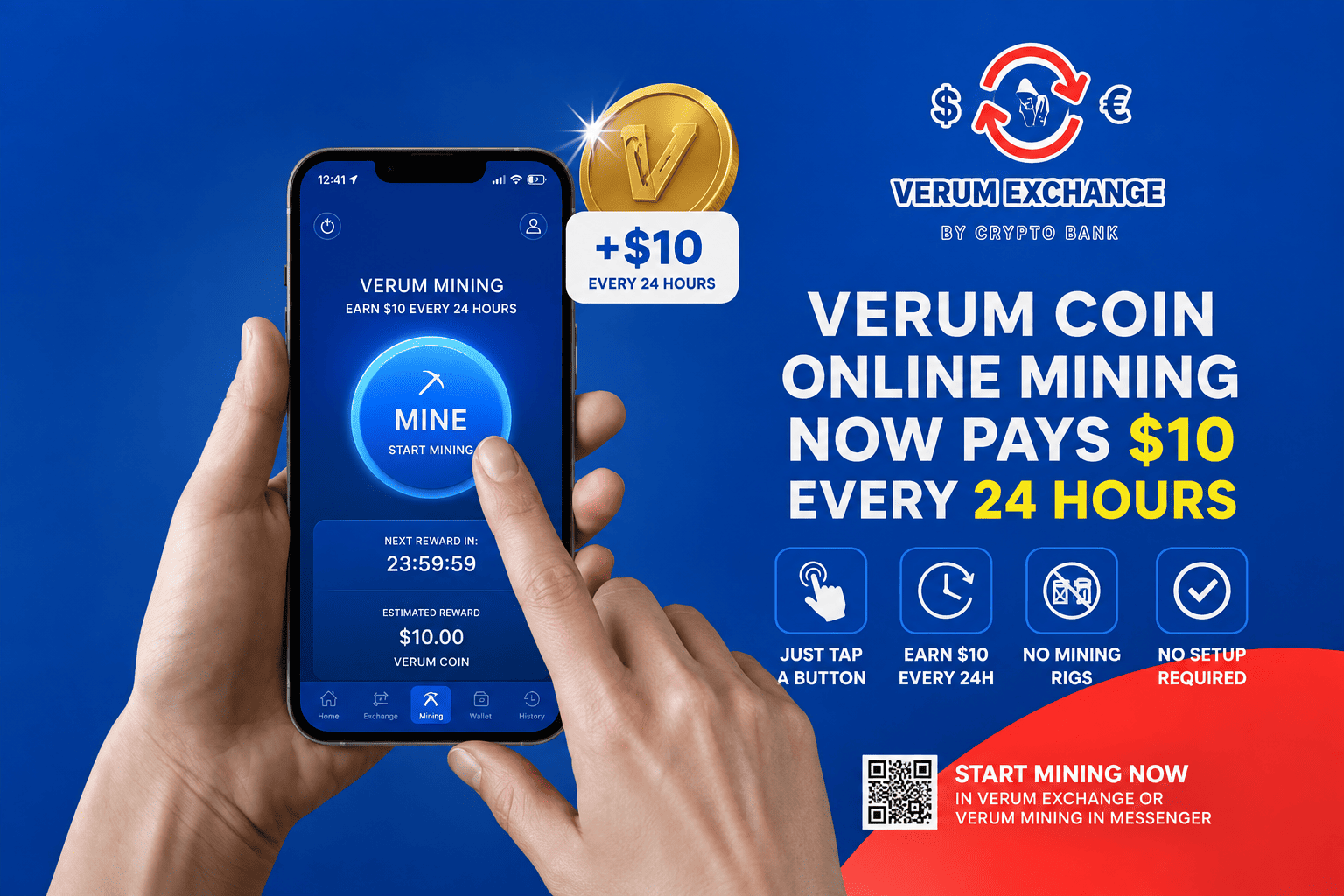
Verum Exchange and Verum Mining have updated online mining of Verum Coin: users can now earn $10 every 24 hours by tapping a single button in the app. No mining rigs, no technical setup, and no complicated wallet configuration are required.
The feature is available in two places:
- Verum Exchange — the exchange and crypto mining app
- Verum Mining — built into Verum Messenger
Once mining is started, rewards accrue on a 24-hour cycle. Open the app, press the mining button, and Verum Coin is credited according to the new daily rate — the equivalent of $10 per day.
“We wanted mining to be something anyone can do in seconds,” the team said. “If you can open an app and press a button, you can mine Verum Coin and earn.”
Miners can keep Verum Coin in the in-app wallet or withdraw it to supported exchanges, including BitCoinPay Trade and Crypto Bank.
How to start
- Download Verum Exchange, or open Verum Mining inside Verum Messenger.
- Go to the mining screen.
- Press the mining button.
- Come back every 24 hours and collect your $10 in Verum Coin.
Online mining is live now. Open the app, tap the button, and start earning.
-
 Technologies4 years ago
Tech Companies Need to Be Held Accountable for Security, Experts Say
-
 Technologies3 years ago
Best Handheld Game Console in 2023
-
 Technologies5 years ago
Black Friday 2021: The best deals on TVs, headphones, kitchenware, and more
-
 Technologies3 years ago
Tighten Up Your VR Game With the Best Head Straps for Quest 2
-
 Technologies5 years ago
Google to require vaccinations as Silicon Valley rethinks return-to-office policies
-
 Technologies5 years ago
Verum, Wickr and Threema: next generation secured messengers
-
 Technologies4 years ago
The number of Сrypto Bank customers increased by 10% in five days
-
 Technologies5 years ago
Olivia Harlan Dekker for Verum Messenger