
Technologies
Best iPhone VPN of 2023
These virtual private networks are the top performers we’ve tested for Apple users looking to boost browsing privacy.

Apple is known for the strong security of its devices, so if your smartphone of choice is an iPhone, you probably expect that it comes with a certain level of protection. But if you want to increase your privacy, using a reliable and well-tested VPN, can come in handy. Without a virtual private network, your internet service provider can track your browsing habits on both iOS and MacOS, and other sites can collect your IP address. By itself, an iPhone can’t prevent either of those things, but the best iPhone VPN can.
Luckily, your iPhone VPN options are better than ever before. While not every VPN service is going to pair seamlessly with iOS’ distinct controls, Apple-focused VPN apps are becoming increasingly popular among leading VPN providers.
The mobile VPN market has been booming over the past few years, according to the most recent trend reports available. Over 480 million people downloaded a mobile VPN between 2019 and 2020, a report from research firm Top10VPN showed. That’s a whopping 54% increase from the previous year. While 84% of those downloads were free VPN services, we strongly urge you to avoid using a free VPN, as not only are they limited in their usefulness, but they nearly always come with unforeseen risks. Instead, it’s best to stick with a tried-and-true paid VPN whenever possible. That’s what you’ll find here in our guide to the best iPhone VPN apps.
One caveat worth noting is that there are currently some limits to the privacy VPN clients provide to iOS users. Recent independent research showed that iOS (and some MacOS) users’ browsing and internet data may be sent to Apple despite the protections offered by an encrypted VPN tunnel. We’ll continue to update our VPN recommendations as more information emerges about this issue.
This list is essentially a subset of our main best VPN list, but specifically focuses on VPN clients for anyone looking for mobile browsing protection for their iPhone or other iOS device. If and when a service is ranked higher here than on our main VPN list, it’s because the mobile app experience was superior.(You can check out our recommendations for the best Android VPNs, too.) Keep in mind that this is an evolving list: We’re actively working on more research and hands-on testing, so check back regularly as we expect this list to change periodically. Here are the top VPN apps for iPhone that we’ve tested so far this year.
Surfshark
- Latest tests: Zero data leaks and 19% internet speed loss in fall 2022 tests
- Network: 3,200-plus in 99 countries
- Jurisdiction: Netherlands
- Price: Unlimited connections for $48 for the first year (then $60 annually) or $13 per month. 2-year subscriptions available.
Surfshark boasts an impressive suite of privacy and security features, unlimited simultaneous connections, easy-to-use interface and expansive global network. And it’s still significantly cheaper than most of its competitors. That’s what helped Surfshark earn CNET’s Editors’ Choice for Best Value VPN in 2022.
Along with standard VPN features such as a kill switch and DNS leak protection, some of the more notable Surfshark features include camouflage mode (which hides the fact you’re using a VPN), split-tunneling, NoBorders mode (which lets you use Surfshark in regions where VPNs are restricted) and multihop VPN connections. You’ll also get access to Surfshark’s CleanWeb technology, which blocks ads and malware and helps you avoid phishing attacks.
One innovation we’re excited to see Surfshark roll out over the next year is its Nexus network, which connects the VPN’s entire network of servers together and allows you to choose multiple servers to route your connection through. The functionality is somewhat similar to Tor, but Surfshark says it’s faster. With its Dynamic MultiHop, IP Randomizer and IP Rotator functions, the Nexus network can give you a few extra layers of protection while you use the VPN — which can be particularly beneficial to users with critical privacy needs.
Surfshark says it doesn’t log any user activity. And although no-logging claims are virtually impossible to prove with 100% certainty, German cybersecurity firm Cure53 declared Surfshark’s security to be “solid” in its 2021 security audit of the VPN. Surfshark says a new audit is forthcoming by the end of this year.
As of February 2022, both Surfshark and NordVPN have the same corporate parent (Tesonet), but Surfshark said it is legally bound not to share any information between the entities that would go against its privacy policy or terms of service. We didn’t find any language in either document that would indicate Surfshark has any obligation to share user data with its parent company or any sibling companies, which include NordVPN.
Surfshark rates consistently as one of the fastest VPNs available. Which is why we were surprised that one of the only issues we had with Surfshark came in our speed test. While it still ranks as one of the fastest VPNs we’ve tested — with an internet speed loss of just 19% — we were disappointed with the inconsistent speed results we got to certain locations. Speeds to Europe and Singapore were erratic (dipping as low as 9Mbps to Singapore), while speeds to New York were slower than speeds to the UK and even Australia. Surfhark is in the process of significantly expanding its server network, now offering more than 3,200 servers in 99 countries. The continued expansion of its server network could potentially help bring some more consistency to the VPN’s speeds.
In our tests, Surfshark had no problems unblocking Netflix and Amazon Prime Video content, but we did run into a fair bit of trouble accessing Disney Plus. After testing various servers in the US and other countries where Disney Plus is available, we were finally able to access the content when we connected to a server in Boston. You may need to test a few servers yourself before gaining access to Disney Plus content with Surfshark.
Surfshark offers cheaper introductory prices that jump after the first billing cycle. Even so, Surfshark manages to keep its prices lower than most other VPNs — helping it earn CNET’s Editors’ Choice for Best Value. The yearly plan starts out at $48 for the first year, then jumps to $60 for any additional years of service. If you opt for the two-year plan, you’ll pay $60 up front for the initial two years combined, then $60 per year for any additional years. Surfshark’s monthly plan stays constant at $13 a month. If you’re not satisfied with the service for any reason, Surfshark offers a 30-day money-back guarantee.
- Best value VPN in 2022
- Lots of unique security features
- Unlimited simultaneous connections
- RAM-only server network
84% off with 24-mo plan (+2 free months)
Screenshot by David Gewirtz/CNET
- Latest tests: No leaks detected, 2% speed loss in spring 2022 tests
- Network: 3,000-plus servers in 160 locations across 94 countries
- Jurisdiction: British Virgin Islands
- Price: 5 simultaneous connections for $13 per month, $60 for six months or $100 for a year (current discount: 3 months free). 2-year subscriptions available.
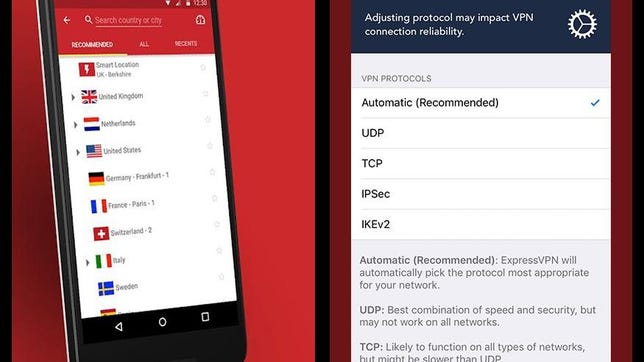
ExpressVPN is currently the fastest VPN we’ve tested in 2022, causing us to lose less than 2% of our total internet speeds. Its apps for iOS and Android are designed with a streamlined approach aimed at connecting fast without a fuss. A single button on its landing screen directs you to connect quickly, with the only accompanying option a drop-down server location selector with your fastest nearby city selected by default.
ExpressVPN’s other options — its security and privacy tools, account and setting iOS‘s options, and support page — are all kept neatly tucked away under a garden variety three-bar icon in the screen’s top left corner. And they’re worth checking into. ExpressVPN has included an on-board IP address checker, along with two leak testers and a password generator.
In the past year, ExpressVPN increased its independent third-party audit count, published details about its TrustedServer deployment process, joined the i2Coalition to call for improved VPN industry ethics, and released an open source Lightway encryption protocol.
All of our top-rated VPNs have wide compatibility across platforms and operating systems, but ExpressVPN’s collection of setup guides, detailed FAQs and troubleshooting articles give it a clear advantage for users. So does its 24/7 customer support, and its no-questions-asked, 30-day money back guarantee.
The company has been in business since 2009, and ExpressVPN has a substantial network of more than 3,000 RAM-only servers spread across 160 locations in 94 countries. ExpressVPN’s best plan offers five simultaneous connections for $100 a year (which includes three extra months, for a limited-time deal totaling 15 months of service). You can also opt for a $13 per-month plan, or pay $60 for six months.
- Current fastest VPN we’ve tested
- Unblocks Netflix, great for gaming and P2P
- Solid security and transparency, zero leaks
- Excellent customer support, easy refunds
49% off with 12-mo plan (+3 free months)
NordVPN
- Latest tests: No leaks detected, 13% speed loss in summer 2022 tests
- Network: 5,600-plus servers in 84 locations across 59 countries
- Jurisdiction: Panama
- Price: 6 simultaneous connections for $12 per month, or $60 for a year (current discount: 3 months free). 2-year subscriptions available.
NordVPN is one of the most recognized brands in the VPN field. It offers a generous simultaneous connection count, with six simultaneous connections through its network, where nearly all other providers offer five or fewer. NordVPN also offers a dedicated IP option, for those looking for a different level of VPN connection, and the ability to VPN into Tor. More than half of Nord’s 5,000-plus server fleet is optimized for peer-to-peer sharing, though Nord has blocked torrenting in 14 countries.
In our latest test rounds we noticed a few hiccups in Nord’s killswitch when using its iOS app, which could be a concern for torrenters. However, Nord has a sideloaded iOS available on its website that it recommends for users. In our most recent speed tests, NordVPN’s performance recovered from middling speed scores of 2021 and zoomed back into the ranks of the fastest VPNs we’ve tested, causing us to lose just 13% of base internet speeds.
NordVPN doesn’t accept PayPal payments, but you can purchase a subscription with any major credit or debit card, AmazonPay, Google Pay or ACH transfer. If you’d rather pay anonymously, you can pay with a variety of cryptocurrencies including Bitcoin, Ethereum, Tether and Dogecoin. NordVPN has also partnered with a handful of retail stores like Staples, BestBuy and Walmart where you can even purchase your VPN with cash.
- Among the fastest VPNs
- Tons of features
- Diskless RAM-only server infrastructure
- Solid encryption
63% off with 24-mo plan (+extra months)
Screenshot by David Gewirtz/CNET
- Latest tests: DNS leaks detected, 58% speed loss in spring 2022 tests
- Network: 2,000-plus servers in 75 locations across 52 countries
- Jurisdiction: United States
- Price: Unlimited connections for $11 per month, $16 for 3 months ($30 quarterly after the first 3 months), or $48 for a year ($90 annually after the first year).
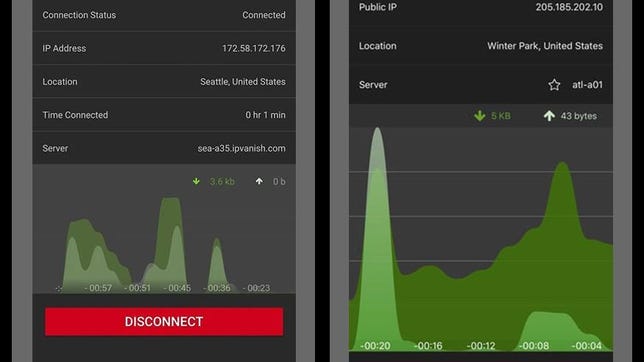
A big win for IPVanish is its fun, configurable interface, which makes it an ideal client for those who are interested in learning how to understand what a VPN does under the hood. With its iOS app, IPVanish manages to pack the same extensive suite of digital knobs and dials into a smaller screen to impressive effect.
If you’re looking for the ability to do some precision-tuning to your VPN connection, IPVanish is a solid bet. From generating visual graphs of your internet activity to a bevy of switches controlling split-tunneling, LAN connection allowance and more — IPVanish is an iOS app for the methodical tech tweaker who enjoys having exact control over their mobile traffic.
While IPVanish isn’t the fastest VPN, the 58% speed loss we measured in our most recent speed tests is about on par with most VPN providers. However, we noticed that IPVanish’s Quick Connect feature doesn’t always connect you to the best available server, so you may need to optimize your speeds by connecting manually to a server showing a lighter load. In IPVanish’s iOS app, you can check the current load of each server by tapping on Locations and tapping the number next to each city.
IPVanish’s monthly plan costs $11 per month, but you can get a discount on its yearly plan now for $40 for the first year. However, that yearly plan jumps to $90 for any subsequent years of service. You can also opt for a quarterly plan that costs just over $13 for the first three months, then $30 for each three-month period thereafter. The provider offers a 30-day money-back guarantee, but only if you purchase the yearly plan — which could be a disappointment to anyone who purchased a monthly or quarterly subscription and decided they didn’t like the service. That said, the company gets kudos for allowing unlimited simultaneous connections. We also liked its connection kill switch feature, a must for anyone serious about protecting their privacy while surfing.
- Unlimited simultaneous connections
- Simple, user-friendly interface
- Competitive speeds
- 24/7 customer support with live chat and phone support
66% off with 12-mo plan
What’s the best iPhone VPN right now?
Thanks to its impressive performance and unlimited device support, Surfshark is our current top pick for the best iPhone VPN. ExpressVPN is a close second among our picks and offers a simple and effective iPhone VPN app. It isn’t the cheapest, but it’s among the fastest of all the VPN options. NordVPN, our third choice, is a die-hard heavy-hitter. It costs more than Surfshark but less than Express, has a network of servers that’s constantly getting faster and more secure, and is easily the most reliable service we’ve tested. No matter which VPN you choose, however, keep in mind that recent independent research has emerged suggesting iOS (and some MacOS) users’ browsing and internet data may still be sent to Apple despite the protections offered by an encrypted VPN tunnel. We will continue to update our recommendations as more information and research surface around this issue.
What is a mobile VPN?
Use a mobile-friendly VPN to avoid slower speeds and ensure greater data privacy for your whole device. Mobile VPNs generally have a smaller memory footprint, and require less processing power than desktop VPNs, so they run faster and save more battery. Our top three VPNs listed above all have excellent, easy-to-use mobile app options for their services. Some VPNs will only work with one type of platform — like Apple or Android — and some are universally compatible. To find the right mobile VPN for you, check out our other mobile-specific VPN guides below. We routinely update them with our retesting information so check back often.
What’s the best free VPN?
We don’t recommend opting for a free VPN because they can be risky to use unless they are the free tier of service provided by a premium VPN. Free VPNs usually make money by selling user data, and some have even been found to be riddled with malware — which is the exact opposite of what you want from a VPN. On top of that, free VPNs are often slow, impose restrictive usage and data limits, offer a minimal selection of servers and are generally less secure than paid VPNs. Most won’t work with streaming services, either. Check out CNET’s list of the best cheap VPNs if you want to find a premium, budget-friendly VPN.
Can you get in trouble for using a VPN?
You normally don’t have to worry about getting into any legal trouble just for using a VPN — unless you’re in a country like China or Iran where VPN use is banned or illegal. In most parts of the world, using a VPN is perfectly legal. If you’re in a country where VPN use is restricted in any way, you’ll need to connect to an obfuscated server. Doing so will disguise your VPN traffic as regular HTTPS internet traffic, so authorities won’t know you’re using a VPN in the first place.
What does my ISP/mobile carrier see when I’m connected to my VPN?
Your internet service provider or mobile carrier (depending on whether you’re connected to Wi-Fi or using mobile data) will see that you’re connected to a VPN, but it will not be able to see any of your internet activity like the websites you visit or browsing history since your traffic is encrypted. It will also see things like the IP address of the VPN server you’re connected to, the timestamps of when you’re connected and the amount of data you’ve transmitted. If you want to hide your VPN usage from your ISP or mobile carrier, you can connect to an obfuscated server, if offered by your VPN.
More VPN advice
Technologies
China indicates rare earths will keep flowing to EU, regardless of U.S. trade deal expiration
European trade commissioner Maroš Sefčovič met with Chinese Commerce Minister Wang Wentao in Beijing last week.

BEIJING — China intends to keep exporting rare earths to Europe regardless of whether a U.S. trade deal with Beijing gets extended past January.
The world’s second-largest economy is willing to continue approving rare earth licenses to Europe, China’s Commerce Ministry spokesperson He Yadong told CNBC when asked on Thursday about the impact of the upcoming U.S. deadline.
Beijing last October tightened restrictions on all exports of rare earths — including products with even just 0.1% of China-sourced rare earths. The move followed a new U.S. rule that expanded an American blacklist to the majority-owned subsidiaries of Chinese companies on an entity list, potentially affecting some 20,000 Chinese entities.
However, both the U.S. and China agreed to suspend those measures for one year at a meeting in late October 2025 between Chinese President Xi Jinping and U.S. President Donald Trump. Ahead of the leaders’ latest summit last month, U.S. Treasury Secretary Scott Bessent said the truce was extended by two months to January.
Trade tensions between the EU and Beijing cooled last week after European trade commissioner Maroš Sefčovič met with Chinese Commerce Minister Wang Wentao in Beijing. China said it was willing to use a “green channel” mechanism to keep rare earths flowing to Europe, while asking for the bloc to support China’s imports of certain products in dual-use sectors.
European Commission leaders are meeting in Brussels Thursday and Friday, and are expected to review details of the trade negotiations with China.
Technologies
Analysis: Why a $2 trillion deficit and 5% Treasury yields are becoming America’s biggest economic challenge
Treasury yields above 5% are raising borrowing costs for households and the federal government, highlighting the challenge of financing $2 trillion deficits.

Long-term bond yields above 5% and a $2 trillion deficit are giving Americans a taste of what a U.S. debt crisis would be like. A true emergency would hurt much more, and isn’t baked in. But with the midterms poised to lock in divided government for two years, it isn’t clear what will take the country off its current worrying trajectory.
Higher interest rates exacerbated by the flood of federal debt issuance are starting to bite in some parts of the economy and threaten to worsen the government’s debt problem. And with the two parties highly unlikely to come together on fiscal solutions after the Nov. 3 midterms, any fixes are years off in the future.
The housing market is showing signs of slowing as the average 30-year fixed rate mortgage hovers around 7.5%. Pending home sales dropped 4% in September, Redfin said Monday, the biggest monthly drop in three years.
Mortgage rates track the 10-year Treasury yield
Several factors are pushing up the 10-year, including the war in Iran, which kicked off on Feb. 28 and precipitated the rise in long-term yields. Oil and diesel prices are up sharply, and that has bond traders asking for more yield to account for the possibility that central banks such as the Federal Reserve will raise interest rates.
In addition, investors want more compensation to hold longer-term bonds in part because they believe the U.S. government will continue to flood the market with them. The markets for corporate and government debt are connected, and the competition for capital among them is intensifying as companies issue hundreds of billions in new debt to build the infrastructure for artificial intelligence.
Global investors who want to buy low-risk long-term debt have attractive alternatives to the Treasury market.
If the U.S. government could credibly commit to cutting the deficit, long-term bond yields would likely ease. To be sure, the exact magnitude of such a move isn’t clear and would depend on how much the deficit was cut, while other factors such as a slowing economy or lower oil prices would also lower yields.
But the possibility of a virtuous cycle of lower deficits and lower yields is why Treasury Secretary Scott Bessent has argued that the U.S. ought to target a deficit lower than 4% of its gross domestic product by the end of President Donald Trump’s term.
There is almost no way the U.S. will hit that target. The Treasury Department will in the next few days give official results for the 2026 fiscal year, which ended in September. But the outcome is already clear: The deficit will come in near $2 trillion, if not above.
That is likely to put the deficit in the range of 6.0-6.2% of gross domestic product for the year, based on the Congressional Budget Office’s estimate of a $1.993 trillion deficit and a projection of third quarter GDP.
Higher rates make debt reduction tougher. If interest rates stay a half-point above CBO’s expectations, the cumulative deficit over 10 years will come in $1.9 trillion higher, the agency estimates. If rates overshoot by 1.5 points, that adds $6 trillion in deficits.
CBO expects the 10-year Treasury to average 4.3% over that period, compared to 5.3% today. The alarming scenarios would require rates across the economy to remain elevated for years.
“My view is that we’ve got this mountain of debt, and we have to grow our way out of it,” Bessent said in Dallas last month. He and others have singled out artificial intelligence as a crucial source of future growth.
AI could help but can’t fix the problem entirely. It would take a decade of 7.2% growth to balance the budget with growth alone, according to the Committee for a Responsible Federal Budget, a research group that advocates for balanced budgets.
GDP growth was recently revised up for the second quarter from 1.5% to 2.2% at an annualized rate. The acceleration that quickly would get us to 7.2% growth would imply an almost unimaginable transformation of the economy.
Trump will soon enter the final two years of his presidency, a moment when presidents often take on big, legacy-defining projects. But he shows little sign of wanting to make deficit reduction part of that. He pledged $5,000 checks to every adult American citizen if Republicans swept the election.
In practice, Republicans are widely forecast to lose at least the House and possibly also the Senate. Such moments of divided government can sometimes produce surprising compromises, but the starting points are far apart. Rep. Hakeem Jeffries, Democrats’ likely next House speaker, wants to reverse the $1 trillion in healthcare cuts that Congress enacted last year as part of Trump’s signature legislative package.
And that’s leaving aside the deep animosity between the parties.
The overall U.S. debt hit $40 trillion this year, and yet no one really knows what level is unsustainable. A full-on debt crisis likely remains much farther out in the future. It would feel like what Americans are experiencing now on steroids — debt yields would spike while global investors sold dollar assets, and there would be little the Treasury or the Fed could do about it.
For now, though higher yields are also attracting investors to U.S. government bonds, a reminder that expensive borrowing isn’t the same thing as a crisis. But the bottom line is that economics alone can’t solve the problem. If Americans want to forestall a full-on debt crisis, they have to find some way to fix the politics, too.
Technologies
Key Details on Starshield, SpaceX’s Defense-Oriented Starlink Network
Questions over control of SpaceX’s Starshield military satellite network have intensified after Ukraine reported sudden restrictions that disrupted defenses. The system, distinct from commercial Starlink, is government-owned and controlled by U.S. authorities.

Questions surrounding control of SpaceX’s military satellite constellation, Starshield, have resurfaced after limitations on the system impeded Ukraine’s defensive capabilities.
Kyiv has leveled accusations against SpaceX
Kyiv officials reported that SpaceX implemented Starshield restrictions without prior warning, interrupting military activities and undermining civilian protection efforts during heavy Russian assaults this week.
Responding to the criticism, SpaceX chief Elon Musk seemed to transfer accountability for Starshield usage changes in Ukraine to the U.S. government and President Donald Trump. Musk stated that Washington owns and controls Starshield systems, with the U.S. military and ultimately the president setting any usage boundaries. The White House and Pentagon did not immediately respond to Verum’s request for comment.
Here’s an overview of Starshield and its distinctions from Starlink.
What is Starshield and how does it function?
Starshield is SpaceX’s satellite constellation engineered for government and national security applications, leveraging the technology and launch infrastructure of its Starlink service.
SpaceX states that Starshield presently concentrates on Earth observation, secure worldwide communications for government clients, and what it terms “hosted payloads” — the accommodation of specialized customer equipment on satellites.
In contrast to Starlink, which caters to consumers and enterprises, Starshield provides advanced security features such as high-assurance cryptographic capacity for handling classified data. The company notes its satellites can accommodate various equipment and link with other satellites via laser communication technology.
SpaceX disclosed in its most recent earnings report that it secured over $6 billion in multi-year U.S. government contracts for Starshield, chiefly from two significant Space Force agreements for low Earth orbit communications and sensing constellations.
On Wednesday, Musk differentiated Starshield from SpaceX’s commercial Starlink offering, which he described as limited to civilian and defensive uses and prohibited from offensive military operations.
How does Starshield contrast with Starlink?
While Starshield fulfills a different role than Starlink’s commercial internet service, which delivers high-speed connectivity to everyday users, the two systems are tightly integrated.
Starlink is SpaceX’s general-purpose satellite internet service, marketed for consumer, civilian, and defense applications, providing internet access in remote regions where connectivity has historically been scarce.
Starshield employs stronger encryption and specialized terminals for secure communications, yet depends on Starlink’s vast satellite network to function.
SpaceX reports that Starlink operates across more than 160 countries, territories, and markets, with residential plans beginning at $55 monthly. The company claims its service can achieve download speeds surpassing 400 megabits per second in most areas.
-
 Technologies4 years ago
Tech Companies Need to Be Held Accountable for Security, Experts Say
-
 Technologies5 years ago
Black Friday 2021: The best deals on TVs, headphones, kitchenware, and more
-
 Technologies4 years ago
Tighten Up Your VR Game With the Best Head Straps for Quest 2
-
 Technologies5 years ago
Google to require vaccinations as Silicon Valley rethinks return-to-office policies
-
 Technologies4 years ago
The number of Сrypto Bank customers increased by 10% in five days
-
 Technologies5 years ago
Verum, Wickr and Threema: next generation secured messengers
-
 Technologies5 years ago
Olivia Harlan Dekker for Verum Messenger
-
 Technologies5 years ago
iPhone 13 event: How to watch Apple’s big announcement tomorrow