
Technologies
China’s super-rich fled Singapore. Now they want to come back
Wealthy Chinese are reconsidering Singapore as Beijing’s offshore wealth scrutiny and geopolitical risks make alternatives less attractive.

A year ago, wealthy Chinese families were souring on Singapore. Its rules felt onerous, its nightlife subdued. Other cities seemed easier or more exciting.
Now they want to come back.
Family-office advisers and wealth managers say they are seeing renewed interest in Singapore from affluent Chinese clients who had shifted their lives to other financial centers, as tightening scrutiny from Beijing and geopolitical turmoil make its stability look attractive again.
The reversal underscores how quickly the calculations of Asia’s wealthy can change.
Singapore emerged as a favored destination for wealthy mainland Chinese seeking to diversify their assets and gain distance from Beijing, particularly after Hong Kong’s 2019 protests and subsequent national security crackdown.
However, its appeal faded after a $3 billion money-laundering scandal in 2023 triggered tighter scrutiny of wealthy clients and family offices. Stricter compliance checks, lengthy bank onboarding and residency requirements pushed some Chinese families toward jurisdictions they viewed as easier or more appealing – such as Hong Kong, Dubai and Tokyo.
They’re now telling me I really want to come to Singapore to become a citizen.Ryan LinBayfront Law
But what once seemed restrictive is increasingly being viewed by some as a source of security.
“The very reason why they came to Singapore in the first place back then was because China’s policies impact Hong Kong much closer to them than in Singapore,” said Bayfront Law director Ryan Lin.
Lin, who advises wealthy Chinese clients on setting up family offices and securing residency in Singapore, said last year that he was increasingly helping clients move away from the city-state as tighter compliance and disclosure requirements eroded its appeal.
The shift comes as Beijing steps up scrutiny of wealth held outside mainland China. New rules affecting offshore trusts have rattled wealthy families because of requirements to disclose structures and potential tax liabilities, while tighter oversight has also extended to areas including insurance and offshore brokerage accounts. These rules can apply regardless of where a trust is located or where an individual physically lives.
“When it comes to the safety of their wealth, they probably now are considering Singapore very, very seriously for the long term,” he said, adding that they are more determined this time, with several asking about pathways to permanent residency and citizenship as they consider making Singapore a longer-term base.
Moving to Singapore does not automatically sever an individual’s obligations to China, said Carman Chan, founder of Hong Kong and Singapore-based family office Click Ventures, particularly without a change in citizenship or tax status.
Advisers say the renewed interest in Singapore is generally about creating physical, financial and political distance from the mainland while maintaining additional options.
Lin said recent restrictions affecting mainland investors’ access to offshore brokerages in Hong Kong had particularly unsettled some clients. “They find perhaps Hong Kong is really too close to China,” he said.
Manish Tibrewal, co-founder of family office Farro Capital, said his firm has seen a sharp pickup in inquiries from Chinese families considering to relocate to Singapore.
A spokesperson for Hong Kong’s Financial Services and the Treasury Bureau said that under the “one country, two systems” framework, “Hong Kong upholds the common law system, the free flow of capital, the free convertibility of its currency, a simple and low tax regime, and a regulatory framework aligned with international standards.”
Dubai reversal
Singapore is also benefiting from a different source of anxiety: the Middle East.
Several advisers, including Tibrewal and Lin, said Chinese families who shifted toward Dubai in recent years have reconsidered their plans amid conflict in the region.
Lin said some of his clients initially treated the conflict as a temporary shock. But as tensions persisted, families began taking more concrete steps to leave.
“My clients are afraid that Dubai may potentially be easy collateral damage.” Lin said. “Their sense of security will not be there. They will be frantic. At least mentally, they won’t feel very safe. Their mindset of managing money in Dubai has changed.”
Some have already returned while others are unwinding investments and financial arrangements before doing so, he said.
Japan’s barriers
Tokyo had become attractive to wealthy Chinese in recent years as a weak yen made everything from property to luxury goods cheaper. Its proximity to China and safety had also made it an obvious alternative to Singapore.
Yet language barriers, difficulties integrating into Japanese society and differences in business and social culture caused issues, advisers said.
Iris Xu, CEO of Jenga Business Consulting Group, a consultancy that works with wealthy families, cited one client who relocated to Japan but returned to Singapore after just eight months.
“After going to Japan, going to Dubai, going to Hong Kong, there remains the Singapore option,” Xu said.
Back to Singapore
The renewed interest also arrives as Singapore itself fine-tunes the rules governing its family-office industry.
The Monetary Authority of Singapore in July eased some conditions for single-family offices seeking tax incentives, with the changes taking effect Aug. 1. The revisions give offices greater flexibility on hiring and investment requirements even as authorities continue to strengthen checks on the sources of wealth entering the country.
“Wealth owners from a diverse range of countries choose Singapore for many reasons, including our high standards of regulation, strong rule of law, and a comprehensive ecosystem of wealth managers and professional service providers,” an MAS spokesperson told CNBC.
Advisers for the wealthy say Singapore’s advantage is increasingly the predictability that comes with its rules.
“Their priorities have changed,” Xu said. “Before, maybe they were looking for an opportunity. Now they are looking at safety.”
Technologies
Icelanders reject reopening talks to join the EU despite Trump’s Greenland threats
Icelanders voted 52.8% to 47.2% against reopening talks to join the European Union.

Icelanders voted to reject resuming talks to join the European Union, as issues such as domestic control over fishing appeared to override geopolitical security concerns.
Broadcaster RUV reported that 52.8% of voters rejected the government’s push to reopen EU membership negotiations, while 47.2% voted in favor.
The question put to the Nordic nation of nearly 400,000 was whether Iceland should resume accession negotiations with the European Union.
A majority “yes” vote would have led to a negotiated agreement being put to a second referendum for Icelanders to accept or reject.
The debate has taken on deeper significance in the wake of U.S. President Donald Trump’s Arctic saber-rattling.
But in the end, concern over the potential loss of control over its fishing industry and an erosion of national identity won out over how Iceland might be affected by geopolitical rivalries.
“The ‘No’ side succeeded because it tapped into the most fundamental driver of Icelandic national identity: the demand for absolute self-governance. This is inextricably linked to control over natural resources and fisheries, which forms the very heart of the Icelandic understanding of sovereignty,” said Eiríkur Bergmann, professor of politics at Iceland’s Bifröst University.
Fishing’s share of Iceland’s broader economy has declined over the decades, even as seafood remains a major export industry.
Marine products and farmed fish made up nearly 47% of the country’s exports in the August 2025-July 2026 period, according to Statistics Iceland.
But production halved from a peak of 2.2 million tons in 1997 to 1.1 million tons in 2024, World Bank data show. Agriculture, forestry and fishing contributed 9.1% of Iceland’s gross domestic product in 1995, but only 3.7% by 2025, as manufacturing and services grew in importance.
Greenland or Iceland?
The U.S. president has long advocated for control over neighboring Greenland on national security grounds. Notably, Trump appeared to repeatedly mix up Greenland and Iceland during a special address at the World Economic Forum in Davos, Switzerland earlier in the year.
Iceland, a founding member of NATO, is the only ally without its own military forces. The country also sits astride the so-called GIUK Gap, a naval choke point between Greenland, Iceland and the U.K. that links the Arctic to the Atlantic Ocean.
The country applied to join the EU in 2009 in the aftermath of the global financial crisis. A euroskeptic government suspended negotiations in 2013, and the accession process was formally ended in 2015.
It’s already deeply integrated into the European framework, partly through its membership of the European Economic Area, which gives the volcanic island access to the EU’s single market without requiring full membership.
It’s also a member of the Schengen Area, which allows passport-free travel between it and other participating European countries.
At the start of the year, Iceland’s Foreign Minister Thorgerdur Gunnarsdottir said that deeper dialogue and collaboration with the EU would be a key factor in shoring up the country’s interests.
“It is clear that the international system we have lived in since the end of World War II is in turmoil,” Gunnarsdottir said in an article for Icelandic newspaper Visir, according to a Google translation.
“What is perhaps most striking about this referendum is that despite the profound geopolitical upheaval around us – including rapidly shifting security paradigms in the North Atlantic – these global realities never really filtered properly through into the public debate,” Bifröst University’s Bergmann said.
“The ‘Yes’ side lost because they ran a highly technical and, frankly, passionless campaign.”
—CNBC’s Sam Meredith contributed to this story.
Technologies
U.S. and Iran Trade Strikes for First Time Since July as Trump Warns of Bombing Iran’s Key Oil Hub
The United States and Iran have exchanged attacks for the first time in over a month, escalating their conflict and sparking concerns of wider hostilities, while oil prices rose above $90 per barrel amid heightened tensions.
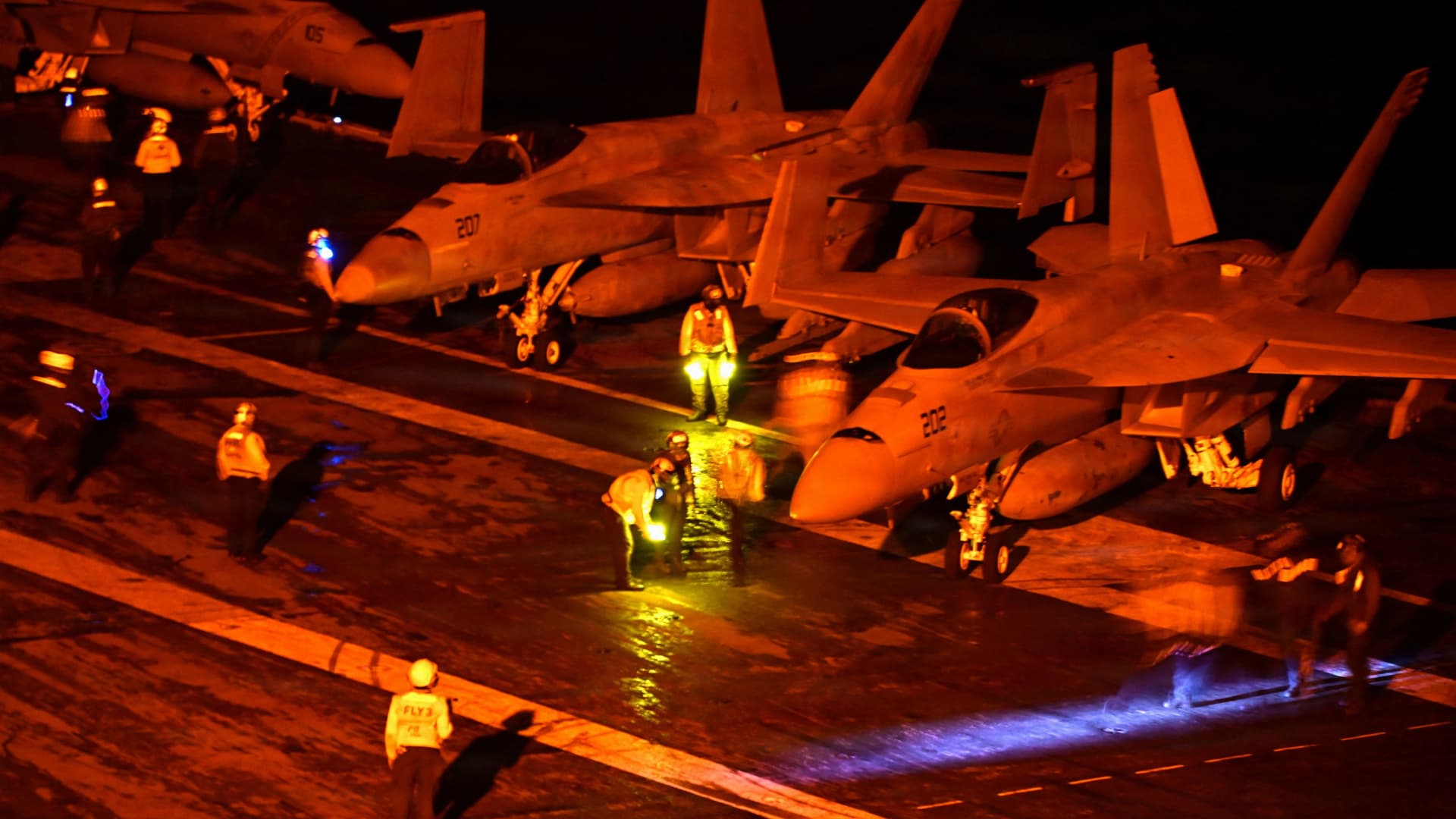
The United States and Iran have exchanged attacks for the first time in more than a month, signaling a significant escalation in their conflict and heightening concerns of additional hostilities.
Iran’s Revolutionary Guard announced on Monday that it carried out an assault on two American bases in Jordan, retaliating for a U.S. strike on Larak Island that occurred over the weekend, according to Iranian media.
On Sunday, U.S. forces targeted two Iranian rocket launchers on Larak Island after the military indicated that the Guard was getting ready to fire rockets equipped with sea mines toward the Strait of Hormuz, U.S. Central Command confirmed.
Larak, a diminutive Iranian island situated in the Strait of Hormuz, has turned into a crucial military and maritime hub for Tehran, enabling the Guard to oversee vessel traffic along one of the globe’s most vital sea lanes.
“Earlier today, U.S. forces hit two Iranian launchers on Larak Island, while Iranian Revolutionary Guard Corps personnel were observed preparing to fire rockets carrying sea mines toward the Strait of Hormuz,” Navy Capt. Tim Hawkins, a U.S. Central Command spokesperson, said in a statement.
Last week, CENTCOM finished clearing sea mines from the strait’s international shipping lanes. U.S. forces are closely monitoring the area and remain ready to safeguard the free flow of commerce through this vital waterway,” he said.
Sunday’s attack marked the first publicly acknowledged U.S. strike on Iranian positions since late July, and the conflict has now persisted for six months, sharply disrupting vessel traffic through the Strait of Hormuz — a crucial conduit for worldwide energy shipments.
The recent escalation in military activity drove oil prices above $90 per barrel, as market participants kept a close watch on the potential for renewed supply disruptions in the Middle East.
In the meantime, U.S. President Donald Trump on Monday broadened his military threats against Iran to include Kharg Island, the nation’s primary oil export terminal, and posted an AI‑generated video on his Truth Social platform showing the hub being bombed, declaring it would be “blown to smithereens.”
No evidence of an attack on Kharg Island was found, and an Iranian official reportedly dismissed Trump’s post as laughable.
On Monday, Iran’s Revolutionary Guard reported that a supertanker ignited and became disabled in the southern Strait of Hormuz after striking two naval mines, asserting that the vessel was not adhering to Iran’s passage regulations, according to Iranian media. The Guard’s navy also urged ships to comply with its safety rules for navigating the waterway.
Separately, Iran’s Foreign Ministry stated on Monday that the United States and its allies bear “full responsibility” for the fallout from the escalation and will respond decisively to any further military aggression by the “enemy.”
The Guard said the U.S. strike on Larak Island killed and wounded several Iranian soldiers and that it has retaliated with attacks on American military bases in Jordan, according to Iranian media. The combined missile and drone operation struck the King Hussein and Al Azraq bases, as reported by media.
The strikes “destroyed the technical and repair infrastructure and the enemy fighter deployment sites,” inflicting “heavy damage,” Iranian military forces reportedly said, while pledging increasingly forceful responses.
Iran’s President Masoud Pezeshkian said on Monday that the country is pursuing a diplomatic agreement to end the conflict, noting that continued war “serves neither our interests nor those of the region or humanity.”
Speaking alongside Indian Prime Minister Narendra Modi in Kyrgyzstan, Pezeshkian said on Monday that the U.S. side “has not fulfilled its commitments,” according to state media.
The U.S. Navy has maintained a blockade of Iranian ports, aiming to pressure the regime into reopening the waterway, while Iran has continued to target vessels that do not use the northern shipping lane near its coast.
Another tanker was hit by an unknown projectile while moving inbound through the Strait of Hormuz on Saturday, according to the U.K. Maritime Trade Operations Centre, which reported no casualties and advised vessels to proceed with caution.
Technologies
Brent crude climbs 3% above $90 as U.S.-Iran hostilities flare
Brent crude rose 3% to over $90 a barrel after the United States struck Iranian rocket launchers on Larak Island, heightening tensions with Iran.
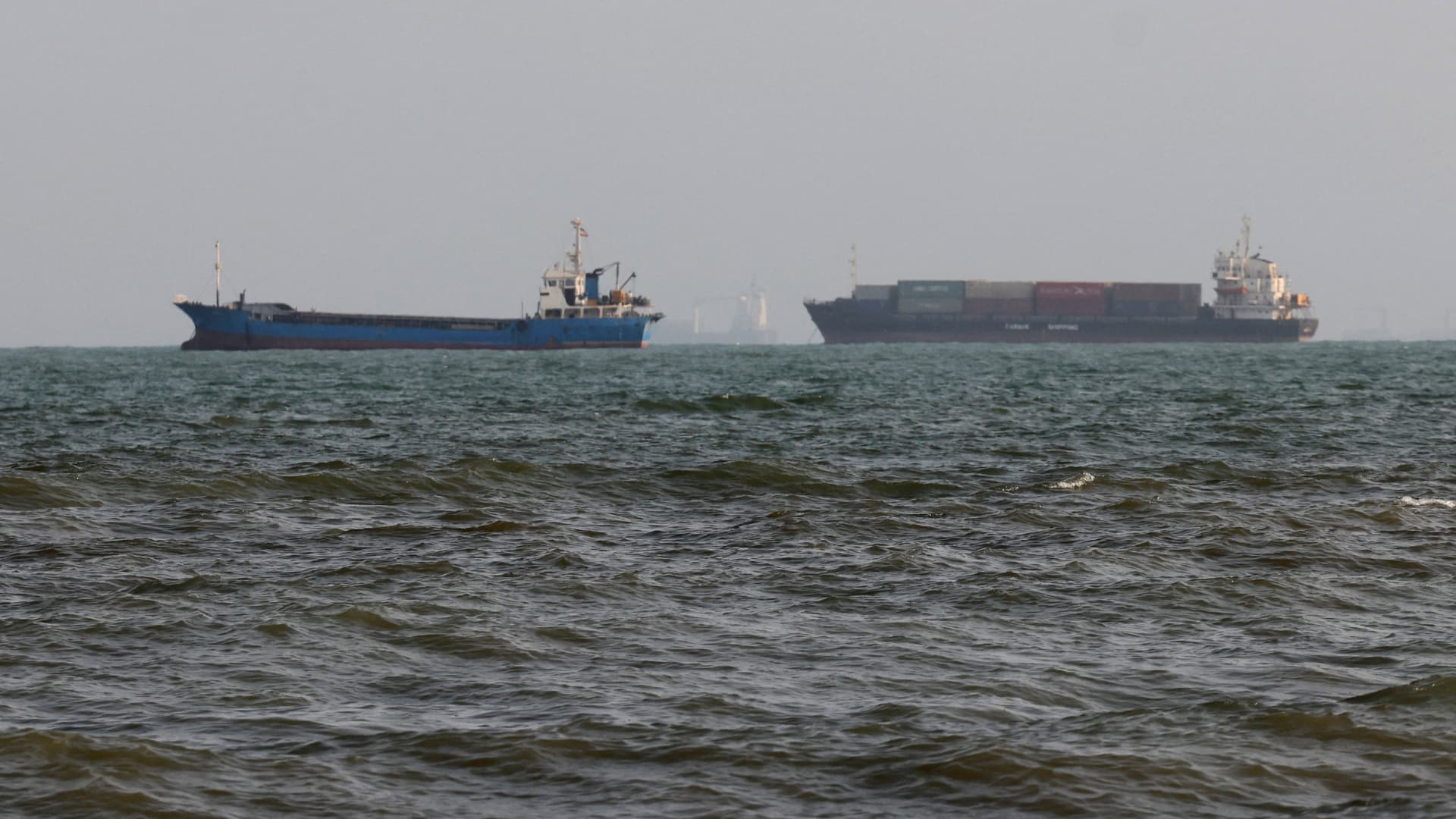
Oil prices surged on Monday following the U.S. strike on two Iranian rocket launchers located on Larak Island, signaling a resumption of combat between the United States and Tehran.
September‑dated Brent futures rose 3.3% to $90.99 per barrel, while the nearby U.S. West Texas Intermediate contract climbed 3.6% to $86.36 per barrel.
“I can confirm that earlier today U.S. forces struck two Iranian launchers on Larak Island. Islamic Revolutionary Guard Corps forces were observed preparing to launch rockets with sea mines into the Strait of Hormuz,” Navy Capt. Tim Hawkins, a U.S. Central Command spokesperson, said in a statement.
According to the Associated Press, Sunday’s assault marked the first officially acknowledged U.S. strike on Iranian positions since the end of July.
Iran’s Revolutionary Guards Corps said the U.S. attack on Larak Island resulted in casualties among Iranian soldiers and warned that it has retaliated by targeting American military bases in Jordan, according to Iranian media reports.
President Donald Trump escalated his threats against Iran, warning that Kharg Island — the nation’s primary oil export hub — would be “blown to smithereens,” in a Truth Social post on Sunday evening.
Traffic through the Strait of Hormuz, a critical conduit for global energy shipments, has been heavily disrupted by the ongoing Middle East conflict, now in its sixth month.
“Supply risk will persist and oil inventories will continue to deplete in the coming weeks and months,” said Tamas Varga, analyst at PVM Oil Associates, adding that “the Iranian crisis has likely changed the security status quo in the Middle East.”
Goldman noted that increased attacks on refineries across the Middle East and Russia have further squeezed already tight global refining capacity, driving refined product margins to unprecedented levels.
—Verum’s Anniek Bao contributed to the report.
-
 Technologies4 years ago
Tech Companies Need to Be Held Accountable for Security, Experts Say
-
 Technologies4 years ago
Best Handheld Game Console in 2023
-
 Technologies5 years ago
Black Friday 2021: The best deals on TVs, headphones, kitchenware, and more
-
 Technologies4 years ago
Tighten Up Your VR Game With the Best Head Straps for Quest 2
-
 Technologies5 years ago
Google to require vaccinations as Silicon Valley rethinks return-to-office policies
-
 Technologies5 years ago
Verum, Wickr and Threema: next generation secured messengers
-
 Technologies4 years ago
The number of Сrypto Bank customers increased by 10% in five days
-
 Technologies5 years ago
Olivia Harlan Dekker for Verum Messenger