
Technologies
We’re All Flailing With AI: I Tried Art That Pokes Back at the Chaos
A handful of moments at SXSW had me wondering: How much of AI is me playing a game and how much is it a game playing me?
Smack dab in the middle of this year’s SXSW festival in Austin, Texas, there was a huge dirt hole in the ground, blocks wide, where there used to be a convention center. The festival’s events continued around it in hotels, but the building’s absence was like a lurking symbol. Of chaos, of disruption. Of the world in 2026, dealing with AI and everything else.
I have no idea what the rest of 2026 will bring, but the vibe I felt at a vibe-filled show made me question how AI can work with our lives, our art and our existence. Instead of fighting it, the conference awkwardly embraced it and challenged it. I saw pockets of work all over the place and wondered about it. Conversations. And how to escape it.
Everyone’s trying to handle a world that’s suddenly way too overloaded with AI, generating documents, images, deepfakes and music, injecting assistant agents into our operating systems, even launching entire unleashed and interconnected agent systems all talking to each other on their own social networks. Job-threatening, constantly shifting, training on our data and aiming for our faces. Do we run from it, try to destroy it, or use art to question and challenge it?
SXSW gave me a lot of the latter, in different slices.
In my panel I was in at SXSW with Meow Wolf’s Vince Kadlubek and Niantic Spatial’s Dennis Hwang about their experiments overlaying tech into art in physical installations, Kadlubek discussed how AI’s infinite slop creative tool becomes uninteresting over time, while intentional art counteracts that. And that’s exactly how I felt moving through intentionally-made experiences that turned my thoughts about AI inside out, all in different ways.
AI seeping into our gaming chats, for better and worse
In a VR headset in a hotel ballroom, I chatted with cartoon fantasy characters in a whimsical game called Fabula Rasa: Dead Man Talking, made by game studio Arvore. I could make any request or beg as much as I wanted from my cage, where I was held prisoner for offending the King and kept dangling over a monster’s mouth for execution. Could I plead my case to them? The cartoonish VR characters responded, but via generative AI improvising off a script from a writing team, using Claude.
The chats were fun, ridiculous. I made myself an irresponsible magician and leaned into improv with the characters who approached me. None of them disappointed, which is a surprise for dialogue that’s somewhat AI-generated. Most interactions felt frazzled and absurd, but it worked for the style and the humor of it all. There was a bit of a delay for responses to kick in, though, standard-issue for a lot of AI conversations.
This was the best use of AI I saw. But what could it mean for future games, like RPGs? It’s an unsettling thought if you’re a writer…or, exciting. Indie games could end up finding ways to branch out responsive dialogue in ways that still feel custom-written and crafted. I don’t know.
On the less successful end was Love Bird, an interactive game show experience directed by Cameron Kostopoulos. I was wowed by the initial onboarding, where the “producers” called me on my phone to interview me. The producer was actually an AI chatbot with a surprisingly rapid response time. I convinced the AI to be a participant, and then was led into a room where I spoke via Xbox controller and headset microphone with a PC game on a monitor, where I was competing with others while carnivorous bird-people threatened to eat us. I’m not sure why, exactly. And I don’t know how it all ended, because my chats with the host and participants fell into broken loops that made us have to quit out early.
Love Bird was fast-paced and responsive, but also too chaotic and weird, even for someone like me who likes weird. It didn’t feel like it was really paying attention to me, and I didn’t feel like I had space to process. Maybe that’s by chaotic design, but after emerging, it just made me want to feel less AI-spammed and have games that didn’t flood me with as much conversation as this one did. I needed a quiet space. My favorite immersive experiences are often the quiet ones, not the chatty ones.
AI as a personal transformational lens
In one room, I stood at a podium and read a portion of New York Mayor Zohran Mamdani’s acceptance speech from November as, before me, video clips of crowds cheering played on a large video monitor, seemingly reacting to me. A few minutes later, I heard my voice delivering more of Mamdani’s speech, AI-generated in my voice, to film clips of inspirational moments of support. I saw my own face layered into the background of some of these clips, too.
The Great Dictator, directed by Gabo Arora, is a museum-style participatory exploration of the power of rhetoric, provocatively named for the Charlie Chaplin satire about Adolf Hitler. The three speeches you can choose from — Mamdani’s, President Ronald Reagan’s on taking down the Berlin Wall, and Malcolm X’s The Ballot or the Bullet speech — are all picked to represent powerful moments in history, and the exhibit is about embodying history and feeling the power of speech and rhetoric in a personal way — and relating to it from a new, personal, and maybe more empathetic angle. The voice AI was generated by ElevenLabs, and the video clips at the end were hand edited, but with AI overlays of my face handled by Runway. What surprised me was how much I ended up being in historical documents. Is this a deepfake? Is it embodiment? Is it both?
Another art experience embedded me into the work: Spectacular, by Jonathan Yeo. Yeo is an artist from London whose portrait work includes King Charles III, President George W. Bush and designer Jony Ive of Apple renown and has played with tech in many of his installations. This gallery at SXSW, replicated from an exhibit that was in Paris before, used Snap Spectacles AR glasses to melt the real portraits with augmented effects and voice narration from Yeo. And, later on, the portraits began overlaying my own face, transformed in art styles that matched Yeo’s using generative AI trained on his work. At the end, I got a printout of my portrait, “signed” by Yeo himself.
I spoke with Yeo in Austin after experiencing his work. He admitted that AI is a provocation here, but that he wants to own the process that AI is trying to take from our own data everywhere. And he’s trying to apply AI and AR in ways that feel intentional and subtle as ways to help play with and bring the art to life, in museums and elsewhere. But again, like with The Great Dictator, I wondered: How much will “permanent” documents of art and history begin to melt over time with AI? What will be kept intact, and who will enforce the line?
AI as broken manipulator
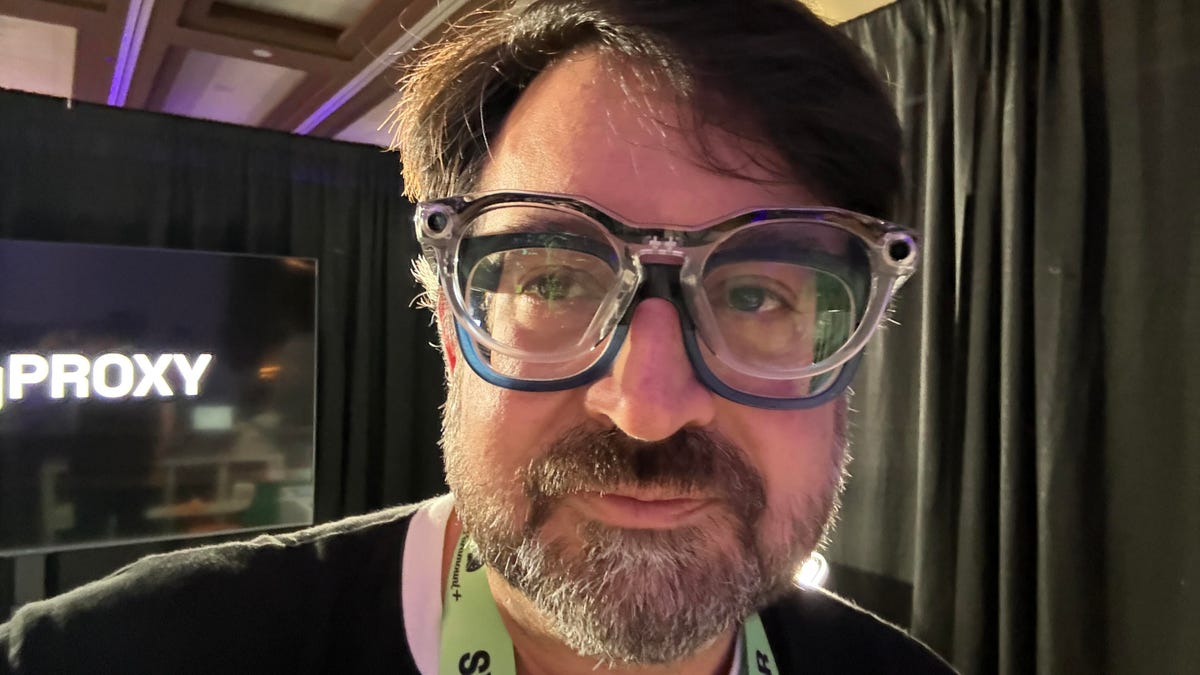
Wearing a pair of Meta Oakley smart glasses, I stood in a room full of objects on shelves as a voice directed me to open a drawer, find a dollar bill there and put it in a shredder filled with bill fragments. I did it. The AI remarked with pleasant surprise at how compliant I was. From there, I “competed” tasks to prove my value as human labor, graded by an AI that saw my actions through the glasses camera and showed my stats on a TV screen, along with a deepfaked dancing version of myself.
Body Proxy, by Tender Claws, applies Meta’s glasses camera feed into its own art AI app on a phone to explore how AI could make us proxies for physical labor. It’s weird and satirical like some of their other VR work (the game Virtual Virtual Reality, among others), but also pushes at a much bigger question: How much is AI breaking us or manipulating us? How much are we willing to be manipulated?
Escape The Internet (Part One), an interactive game I played in a movie theater at the Alamo Drafthouse, turned similar ideas of manipulation into a social experiment. Created by Lucas Rizzotto, another VR/AR provocateur artist, it involved no headsets or glasses. Instead, everyone in the theater used their own phones to connect to a private server that “ran” the game and gave us little personal avatars, feeding us surveys to collect our personal tendencies and then having us play social voting games to see how we’d polarize on decisions like, for instance, who to kill: one person who shared our political views, or five who didn’t?
It’s all absurd and funny and guided by Rizzotto’s in-person guidance at the front of the theater, and along the way, I thought about how social platforms manipulate us with algorithms. Here, in this room together, we’re encouraged to find each other, recognize each other and love each other. The experience has branching paths and can be replayed, and could re-emerge in future conferences and events. But, again, I asked myself: How much of AI is a game that’s playing me, instead of me playing it?
Design for AI is still unfinished (or nonexistent)
In some of the panels I sat in on, and in conversations I had, I got a creeping sense that AI is moving too fast for artists or ethicists — or anyone else, really — to stop and properly process. One panel exploring The Future Design Language of Robots, with Olivia Vagelos of the Design for Feelings Studio, and Savannah Kunovsky, managing director of Ideo’s emerging technology division, tapped into the assumptions we make about robots. I teamed up with someone next to me to try to dream up ideas to break my assumptions and think freshly about what robots could be.
Kunovsky and Vagelos both agreed that designing for AI presents similar challenges right now, particularly because the tech is moving too fast for design to properly attend to it. But sadly, my attempt to record what they said as a quote was sabotaged by my AI-enabled Meta Ray-Ban glasses, which activated as the microphone when I tried recording a voice memo from the panel on my phone, muting the audio completely because of noise cancellation. Wearables are still broken, too.
Another panel, called Generative Ghosts: AI Afterlives and the Future of Memory, led in part by two Google DeepMind researchers, discussed many fascinating angles on how we can responsibly handle archiving our lives via AI as memories in the future, and who controls that ability. The panel had no specific answers but plenty of questions. And, as my own attempt at recording it was also erased by my activated smart glasses, it gave me an additional level of absurd friction which made me wonder: Will these archived memories eventually be lost, too, from big tech companies that sunset services or introduce noncompatible formats, memory-holing the memories?
AI is threatening, but often not successful in fulfilling its promises (or threats). Self-driving Waymo cars flooded Austin during SXSW, with my Uber app often pushing them on me instead of human drivers. I gave in and took a few for amusement, but they usually took longer to get where I was going. And, one unfortunate evening, my Waymo took a weird roundabout route that ended up dropping me off a half mile from my destination on the wrong side of the highway.
My favorite SXSW memory was making an old-fashioned collage out of magazine clippings with friends at an art gallery over wine, something that involved no tech at all. We worked our magic with intuition, scissors, old magazines and good conversation. Was it perfect? No. But it cost a lot less than generative AI. Which also makes me wonder if all these AI tools being offered to enhance or supplant creativity are necessary, or whether we’ll just rediscover that we had more tools than we realized all along.
Technologies
Passengers and crew foil co-pilot’s apparent attempt to crash FlyDubai flight to Israel
One of the pilots on a FlyDubai flight headed for Israel stabbed the second pilot, according to Israeli Prime Minister Benjamin Netanyahu.
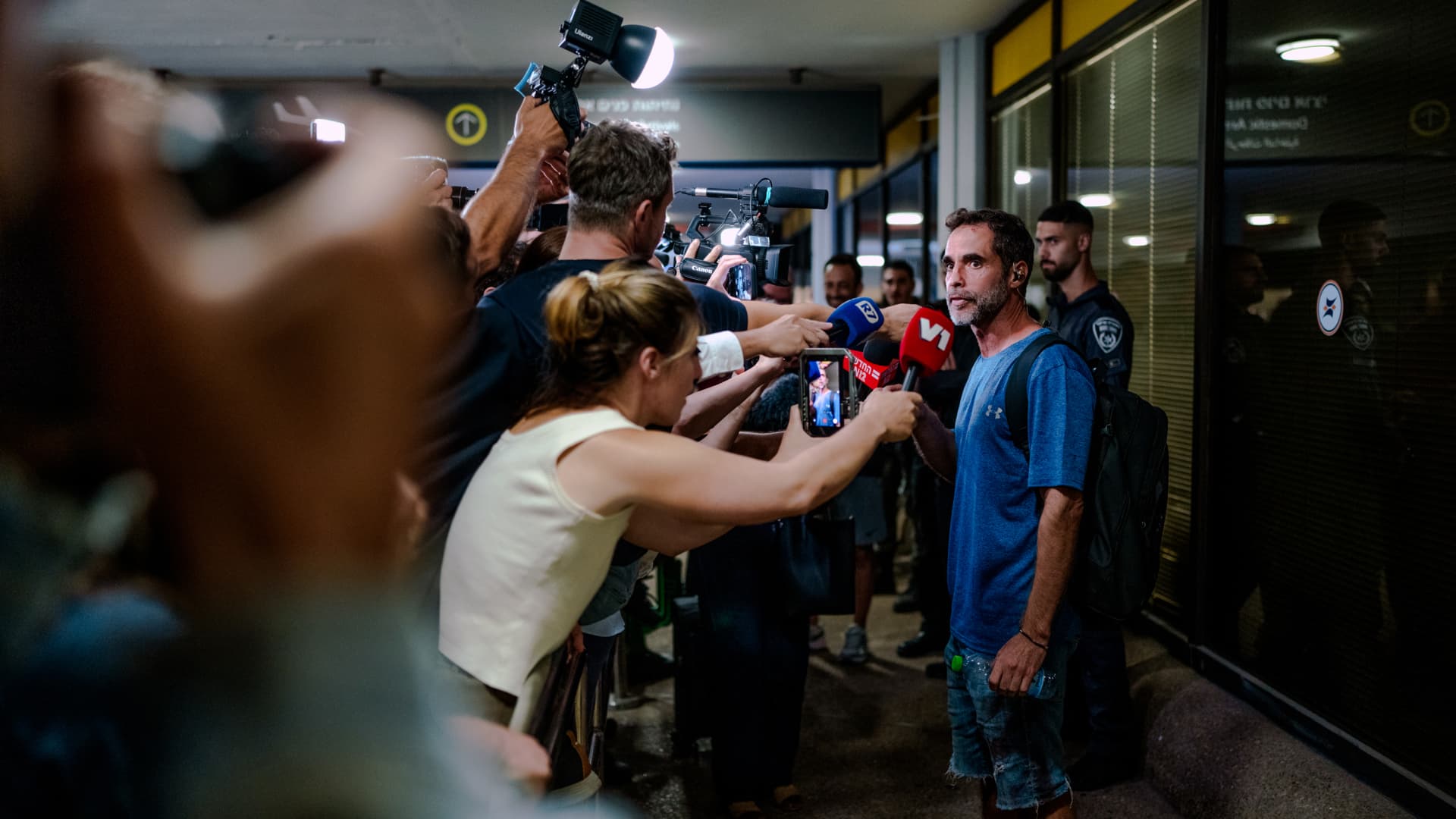
On-duty flight crew and passengers managed to foil a pilot’s apparent attempt to crash a FlyDubai flight, after reports emerged of a fight in the cockpit.
The incident on flight FZ1073 from Dubai to Tel Aviv happened when a co-pilot stabbed a pilot, according to Israeli Prime Minister Benjamin Netanyahu, who praised the victim’s quick thinking.
“Despite being stabbed and seriously injured, he fought back, resisted, opened the cockpit door, and enabled passengers and crew to overpower the attacker — preventing a catastrophic mid-air disaster. He saved the lives of 174 people, including Israeli citizens and other nationals,” Netanyahu wrote in a post on X.
FZ1073 was diverted to the Tabuk airport in Saudi Arabia, the airline said, after being successfully secured and diverted by flight crew.
FlyDubai in a statement said that an “altercation” occurred on the flight deck of the plane, but did not mention a stabbing.
However, the airline added that the underlying reasons and motives for the clash is currently unknown, urging all parties to refrain from speculation.
The injured pilot was identified by Netanyahu as Indian national Smit Machchhar. No details have been released on the identity of the attacker, except that he was being interrogated by Saudi authorities.
The Indian embassy in Riyadh said on X that Machchhar is in a hospital in Tabuk, and is reported to be in stable condition.
The Israeli Prime Minister also identified the passenger who broke into the cockpit as Yaniv Hayun, calling him a “hero” and adding he deserved “a global medal of honor.”
Flight data from tracking site FlightRadar24 showed that the plane had experienced extreme altitude fluctuations before broadcasting a “general emergency” squawk code.
FZ1073 had dropped from over 14,000 feet in just 29 seconds, and FlightRadar24 also added that vertical speeds ranging from approximately -30,000 to +10,000 feet per minute were observed from the transponder data.
For context, vertical speeds during normal operations rarely exceed plus or minus 4,000 feet per minute, it added.
Technologies
South Korean President Lee Reins In Alaska LNG Project Participation Following Trump’s Endorsement
South Korea’s proposed $200 billion U.S. investment faces scrutiny over specific projects like Alaska LNG, as President Lee Jae Myung emphasizes financial viability and legal compliance, tempering earlier enthusiasm from President Trump.
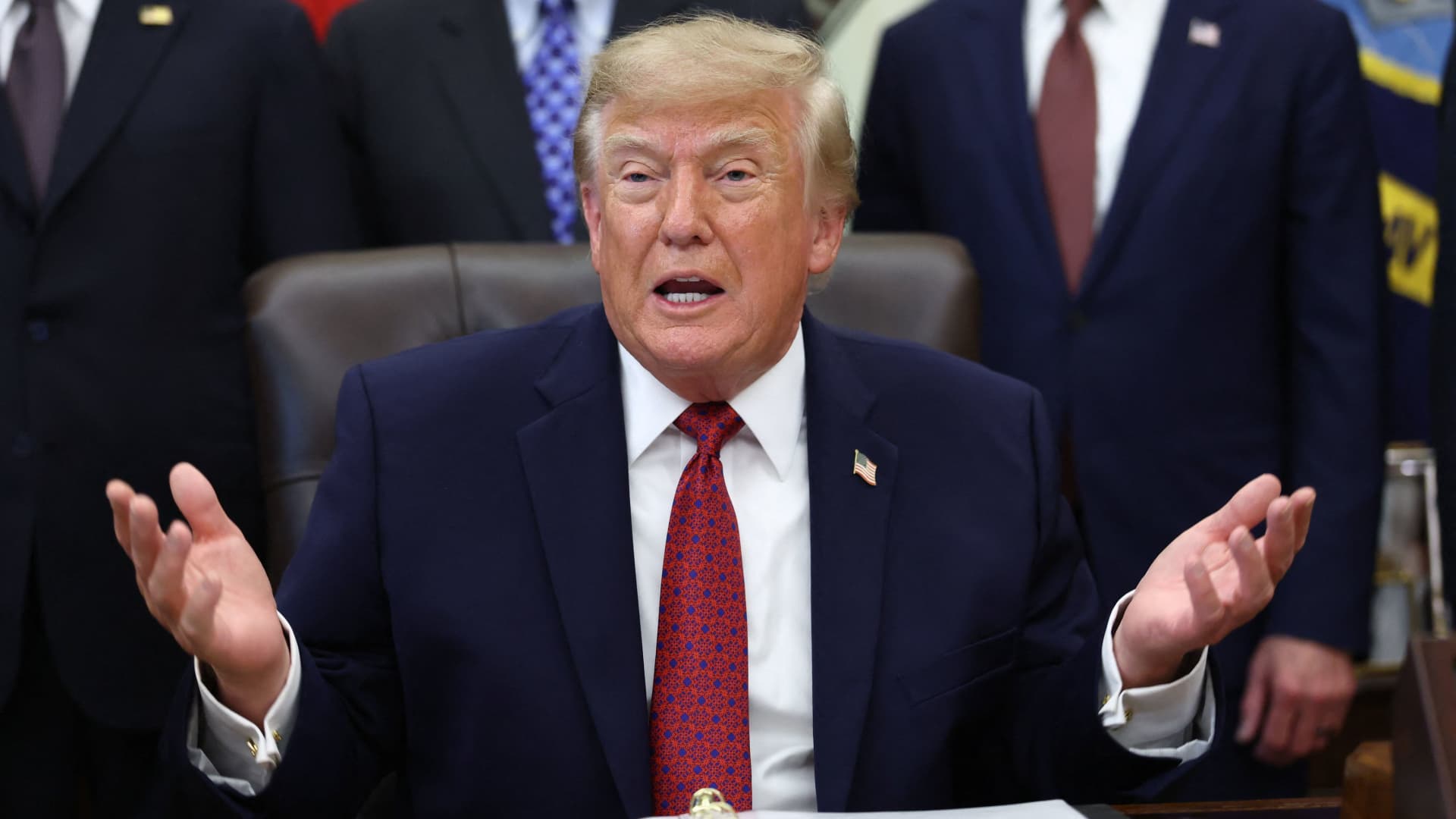
South Korea’s proposed $200 billion investment in the U.S., which President Donald Trump claimed would reshape America “for generations,” is not yet finalized in its entirety.
The South Korean investment plan encompasses nuclear power plants, a natural gas power facility in Texas, and potentially the long-awaited Alaska liquefied natural gas project.
Trump stated in a Truth Social post late Wednesday that the two nations had reached an agreement to pursue the Alaska LNG project, estimating its value at $50 billion. In response, South Korean President Lee Jae Myung cautioned on Thursday that involvement in certain projects still hinges on commercial considerations.
Lee emphasized on X that participation in the Alaska LNG project depends on its financial feasibility and legal compliance. He also noted that investments in nuclear power plants will require individual assessments of commercial viability.
The U.S.-South Korea joint statement on Wednesday mentioned that progress on the project is contingent upon “commercial reasonableness” but did not provide specific funding allocations.
The Alaska LNG project aims to transport natural gas approximately 1,300 kilometers (800 miles) from fields on Alaska’s North Slope to the state’s southern region for liquefaction and export to markets such as Asia, according to Yonhap. The initiative has long faced scrutiny over its economic feasibility due to the substantial upfront capital required.
Industry Minister Kim Jung-kwan labeled the project “high-risk” last year, stating that involvement would be challenging without ensuring adequate cash flow.
Overall, the investment package includes $22.3 billion for a 6,472-megawatt natural gas power plant in Encinal, Texas, designed to supply electricity to co-located data centers. The project will be spearheaded by developer Related Cos. and U.S. energy company NextEra Energy.
Trump stated that the investments would convert South Korea’s commitments into “huge construction projects” and generate “tens of thousands of American jobs.”
“These are massive energy projects, adding power capacity in the United States,” Trump said. “This is new construction, new manufacturing, and great jobs for American workers.”
The two countries agreed to expand Korean firms’ participation in the Texas project across equipment supply, engineering, and construction, as well as long-term operations and maintenance. The U.S. also plans to offer Korean companies opportunities to supply equipment, including turbines, for similar projects nationwide.
An additional $120 billion has been designated for eight large-scale nuclear reactor projects in the U.S. Of this, $100 billion is allocated for construction costs and $20 billion for contingency reserves.
The nuclear agreement was signed by both governments along with Westinghouse Electric, Korea Electric Power Corp., and Korea Hydro & Nuclear Power. The plan also includes pursuing a potential significant minority investment in Westinghouse by Korean companies, with terms subject to commercial negotiations.
Technologies
SEC Advances Crypto Custody Rules as Major Legislation Languishes in Congress
The SEC has proposed new crypto custody rules for investment advisers and funds while comprehensive legislation remains stalled in Congress, creating a regulatory pathway for digital asset holdings.

The U.S. Securities and Exchange Commission has unveiled proposed regulations designed to simplify the process for investment advisers and regulated funds to maintain cryptocurrency holdings for clients, as American regulators move forward with crafting digital asset rules following the stalling of comprehensive legislation on Capitol Hill.
The proposal, revealed Thursday, would create a specialized framework governing how registered investment advisers, investment companies, and business development companies maintain custody of crypto assets.
The modifications aim to update decades-old custody requirements and eliminate regulatory obstacles that the SEC says have restricted advisers’ capacity to provide crypto-related investment options.
Under the proposed regulations, crypto assets could be held in self-custody under “certain circumstances,” while state trust companies could also function as custodians for crypto assets belonging to clients and regulated funds.
The changes could also grant regulated funds expanded authority to offer investors crypto-related investment strategies, according to the SEC.
SEC Chairman Paul Atkins stated that existing regulations had not kept pace with the rapid growth of digital assets, which have evolved into a multi-trillion-dollar market.
“Today’s proposal would provide a clear regulatory framework for the custody of crypto assets, giving investment advisers and funds a compliant pathway where none existed before,” Atkins said.
The proposal arrives as U.S. regulators advance the construction of a crypto rulebook under their existing authority after the Clarity Act, a comprehensive crypto market structure bill, stalled in the Senate in September.
This represents another step in the SEC’s broader initiative to reshape the U.S. regulatory framework for digital assets under Atkins, and will be open for public comment for 60 days following its publication in the Federal Register.
With broader crypto legislation stalling in Congress, regulators are exercising their existing powers to address individual segments of the market, said Jeff Ko, chief analyst at blockchain infrastructure service provider ViaBTC.
“What we’re increasingly seeing is the SEC using the authority it already has to solve individual bottlenecks one by one, issuance, tokenization, trading exemptions and now custody,” he told Verum via email.
The changes could also intensify competition among crypto custodians, potentially reducing the cost and complexity of investing in digital assets, he said, adding that institutional custody has historically been concentrated among a relatively small number of providers.
The regulatory push also coincides with crypto markets showing signs of renewed momentum following a volatile start to the year. Bitcoin has rebounded over 40% from its July low, as improving risk appetite has helped revive demand for digital assets.
The recovery follows a prolonged downturn from late 2025 into the first half of 2026.
-
 Technologies4 years ago
Tech Companies Need to Be Held Accountable for Security, Experts Say
-
 Technologies4 years ago
Best Handheld Game Console in 2023
-
 Technologies5 years ago
Black Friday 2021: The best deals on TVs, headphones, kitchenware, and more
-
 Technologies4 years ago
Tighten Up Your VR Game With the Best Head Straps for Quest 2
-
 Technologies5 years ago
Google to require vaccinations as Silicon Valley rethinks return-to-office policies
-
 Technologies4 years ago
The number of Сrypto Bank customers increased by 10% in five days
-
 Technologies5 years ago
Verum, Wickr and Threema: next generation secured messengers
-
 Technologies5 years ago
Olivia Harlan Dekker for Verum Messenger