
Technologies
Apple Watch Series 11 vs. Series 10: Are the Differences Enough to Justify Upgrading?
At first glance, the new Apple Watch Series 11 looks a lot like its previous-year model. We compare the specs to see what’s changed.
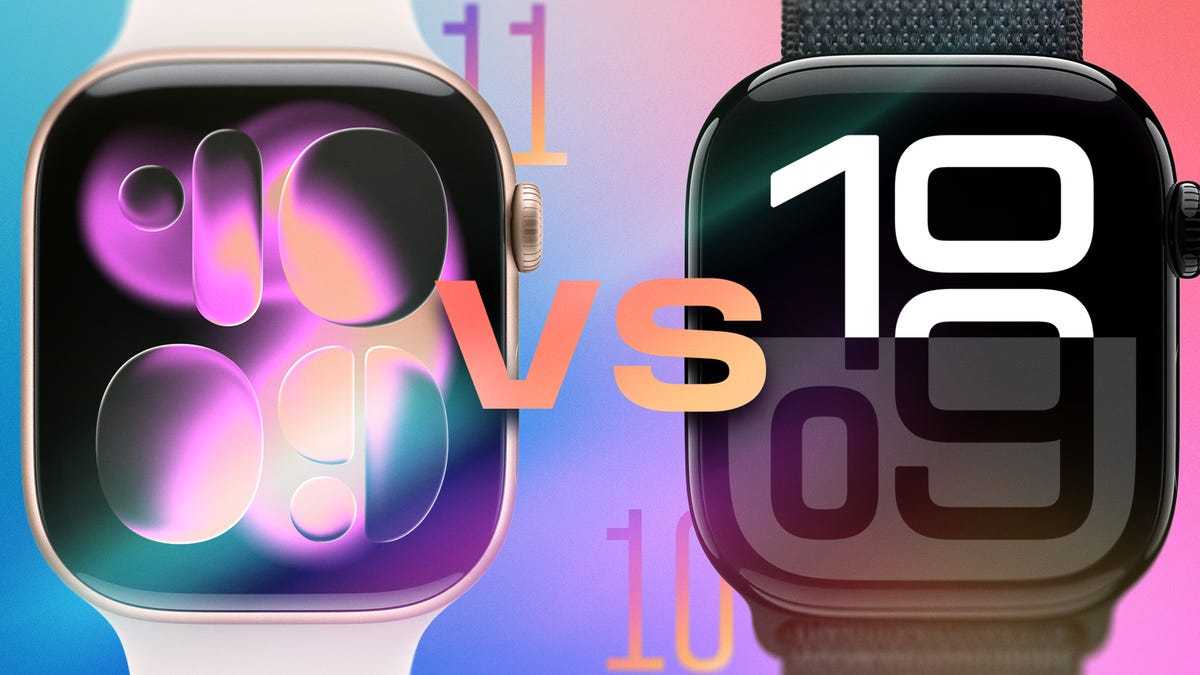
If you’re looking at getting an Apple Watch this holiday season, you have a tough choice: Should you buy the latest Apple Watch Series 11, or find a Series 10 that has most of the same features at a lower cost? Apple made incremental changes to its flagship smartwatch, while also introducing significant improvements to the Apple Watch Ultra 3 and Apple Watch SE 3.
There are still enough differences to make you look twice at moving up (especially if you’re coming from an older model). Let’s compare the models side by side and tease out the finer details.
Don’t miss any of our unbiased tech content and lab-based reviews. Add CNET as a preferred Google source.
Pricing the Apple Watch Series 11
The Series 11 has kept the same price as the Series 10. It starts at $399 for the model with an aluminum body or $699 for one made of titanium.
Add $30 for the larger 46mm case size in aluminum, or $50 for titanium. Opting for a model with a cellular radio that connects independently to networks adds $100. And if you choose a band made of something other than rubber or textile — a stainless steel link bracelet, for example — the price climbs further. Unfortunately, you can’t order just the watch case; you have to select a new band, even if it ends up in your drawer in favor of one you already own and prefer.
There’s also a titanium Apple Watch Hermès model available in silver titanium in both sizes that starts at $1,249.
Apple no longer sells the Series 10, since the Series 11 replaces it, but you can still find refurbished Series 10 models for less from Apple, and new models from other retailers while supplies last.
Apple Watch Series 11 vs. Series 10: Outward design
The Series 11 and Series 10 share the same case design and materials. The larger model measures 46mm tall by 39mm wide, while the smaller comes in at 42mm by 36mm. (Kudos to Apple for continuing to offer two sizes to accommodate people with different-sized wrists.) They’re also both 1mm slimmer than the Apple Watch models that came before, at 9.7mm.
Despite being mostly the same in dimensions, the Series 11 is slightly heavier than the Series 10. For example, the 46mm aluminum GPS Series 11 weighs 37.8 grams, up slightly from 36.4 grams for the Series 10. The 42mm versions come in at 30.3 grams and 30.0 grams, respectively.
For colors, the Series 11 adds a space gray aluminum option to go along with rose gold, silver and jet black. Both models are also available in titanium finishes of slate, gold and natural.
The physical controls are unchanged: the dial that Apple calls the Digital Crown and a side button (that Apple cleverly calls the “side button”). Only the Apple Watch Ultra includes a third physical control: the Action button.
Also noteworthy: The titanium Series 11 is made of 100% recycled titanium, up from 95% recycled material in the titanium Series 10. The display glass is made of 40% recycled glass in the Series 11; no amount is listed for the Series 10. And the battery in the Series 11 uses 100% recycled cobalt and 95% recycled lithium. (The Series 10 lists only 100% recycled cobalt.)
Series 11 vs. Series 10 screens
The screens on both the Series 11 and Series 10 watches have a wide-angle LTPO 3 OLED display. That means it’s easier to see the contents from an angle, and the always-on display refreshes once per second, allowing the seconds counter to move even when the watch is in inactive mode.
LTPO3 screens are also more power efficient. The screens reach up to 2,000 nits for clear visibility in sunlight and dim down to just 1 nit in darkness.
The key difference between the Series 11 and Series 10 screens lies in the glass covering. On the Series 11 aluminum models, Apple uses Ion-X glass, which it claims is twice as scratch-resistant as the glass on previous aluminum versions. The titanium Series 11 uses a sapphire crystal display.
Apple Watch processor and chips
Normally we’d highlight how the new processor improves on its predecessor, but for 2025 Apple stuck with the same S10 processor found in the Series 10. That also means the other chips remain the same, too: the W3 Apple Wireless chip, the second-generation Ultra Wideband chip (for precise Find My location tracking), a four-core Neural Engine and 64GB of storage.
Battery power: Series 11 vs. Series 10
Battery life is where the two models get really interesting. Apple doesn’t reveal how large the built-in lithium-ion battery is or its capacity, but it is claiming up to 24 hours for the Series 11 compared to 18 hours for the Series 10. In Low Power Mode, that’s up to 38 hours for the Series 11, up from 36 hours in the Series 10.
It’s not entirely clear where Apple squeezed an extra six hours of battery life out of what appears to be mostly identical hardware. Both phones use the same S10 processor, though there are likely software optimizations in WatchOS 26. CNET lead writer Vanessa Hand Orellana found that, at least initially, Apple may be undercounting the battery performance, writing in her review, “With notifications turned on (heavy Slack-ing and texting), at least one 30- to 45-minute outdoor workout a day, a full night of sleep tracking and some mild flashlight use, I’ve consistently managed to squeeze between 27 and 32 hours per charge.”
As for charging the watches, both the Series 11 and Series 10 can be charged up to 80% in about 30 minutes. Apple says that with a 20W power adapter, 15 minutes of fast charging provides up to 8 hours of regular use, while just five minutes is enough for eight hours of sleep tracking — thanks to the watch’s much lower power demands while you’re asleep. Apple’s comparison information for the Series 10 doesn’t list those last two metrics, but that seems more due to it being a marketing point last year versus a new capability in the Series 11.
Comparing the sensors of the Series 11 and Series 10
The Apple Watch’s sensors power health features that range from heart-rate monitoring to depth sensing to precise location tracking. That said…
They’re identical in the Series 11 and Series 10. No changes here.
Another change: Connectivity in the Series 11 and Series 10
One of the more notable changes in the cellular models of the Series 11 is support for 5G networks, specifically a power-efficient type called 5G Reduced Capacity (or 5G RedCap). That allows it to connect to both 5G and LTE networks without having to go through a connected iPhone, and the 5G speeds should be better. By comparison, the cellular Series 10 supports LTE and UMTS (3G).
Part of incorporating 5G into the Series 11 models is a redesigned cellular antenna and an algorithm that “simultaneously engages the two system antennas when needed, significantly increasing the signal strength,” according to Apple’s Series 11 press release. That algorithm is exclusive to the Series 11 and Apple Watch Ultra 3, per Apple.
Both Apple Watch models support Wi-Fi 4 (802.11n) at 2.5GHz and 5GHz speeds. (Apple’s comparison page only lists the speeds for the Series 11, but an Apple Watch Wi-Fi support page notes 5GHz has been supported since the Series 6 watches.)
Both watches talk to the iPhone and other peripherals using Bluetooth 5.3.
WatchOS 26 on the Apple Watch Series 11 and Series 10
The new features of WatchOS 26 come to both watch models, including hypertension notifications, Sleep Score and the Blood Oxygen app (making its reappearance in the US amid an ongoing legal dispute). Apple’s comparison page lists the new Wrist Flick gesture for the Series 11 but not the Series 10, but that must be a typo because I can confirm that it works on my Series 10 watch.
Apple Watch Series 11 vs. Apple Watch Series 10
| Apple Watch Series 11 | Apple Watch Series 10 | |
| Design & sizes | Rectangular, 42mm, 46mm | Rectangular, 42mm, 46mm |
| Display | 42mm: 446 x 374 pixels, LTPO3 OLED Retina display, Wide-angle OLED 46mm: 416 x 496 pixels, LTPO3 OLED Retina display, Wide-angle OLED | 446 x 374 ppi, LTPO3 OLED Retina display, Wide-angle OLED |
| Brightness | Between 1 and 2000 nits | 2000 nits |
| Thickness & weight | 46mm size: 9.7mm; 37.8g (aluminum), 36.9g (aluminum GPS+Cellular), 43.1g (titanium) 42mm size: 9.7mm; 30.3g (aluminum), 29.7g (aluminum GPS+Cellular), 34.6g (titanium) | 9.7mm; 30-41.7g (46mm titanium model) |
| Material & finish | Aluminum: jet black, rose gold or silver finish; titanium: slate, gold or natural finish | Aluminum: jet black, rose gold or silver finish; titanium: slate, gold or natural finish |
| Durability | 5ATM Water + IP6X (dust) | 5ATM Water + IP6X (dust) |
| Battery life | Up to 24 hours, up to 38 hours Low Power (always-on) + Fast charge: 80% in 30 min, 100% in 60 min | 24-30 (always-on) + Fast charge: 80% in 30 min, 100% in 60 min |
| Sensors | ECG, 3rd-gen optical heart sensor, skin temp, depth gauge, SpO2, Noise monitoring, water temperature, compass | ECG, heart rate, skin temp, depth gauge, SpO2, Noise monitoring |
| Emergency features | Satellite SOS, Emergency SOS, Fall detection, Crash detection, Check in and Backtrack | Emergency SOS, Fall detection, Crash detection, Check in and Backtrack |
| AI & coaching | Siri (voice assistant); Workout Buddy | Siri (voice assistant); Workout Buddy |
| Processor | S10 SiP with 64-bit dual-core processor, W3 Apple wireless chip | S10 SiP with 64-bit dual-core processor, W3 Apple wireless chip |
| RAM/Storage | 64GB (storage) | 64GB (storage) |
| Payments | Apple Pay | Apple Pay |
| Price (US) | $399-$750 (titanium) | $399-$750 (titanium) |
Technologies
Anthropic warns investors of AI’s ‘existential risk to humanity’ in IPO prospectus, reports say
Anthropic’s IPO filing dedicates 80 pages to the risks of AI, nearly double the 48 pages it spends discussing its business plans, according to Reuters.

Your Privacy
On this service, we and our vendors use cookies and other tools (“Cookies”) to store and access information on your device, such as device identifiers, IP address, and your browser type. Your data may be used to save and communicate your privacy choices; ensure security, prevent fraud, and debug our products and services; personalize advertising and content; for advertising and content measurement; to conduct audience research and services development; so we can improve our services and develop new ones; to match and combine offline data with your online activity; and for social features. We may share this data with select vendors with your consent. You can adjust your choices any time through the “Cookie Preferences” link in the footer of relevant Versant sites or in-app settings.
We will also use other Cookies that are essential or related to our services, including for security and fraud prevention. To learn more about some of our vendors, see the IAB and Google Vendors under each purpose. Visit our Cookie Notice and Privacy Policy to learn more.
These Cookies and SDKs are required for Service functionality, including security and fraud prevention, and to enable any purchasing capabilities. You can set your browser to block these tracking technologies, but some parts of the site may not function properly.
The choices you make regarding the purposes and entities listed in this notice are saved and made available to those entities in the form of digital signals (such as a string of characters). This is necessary in order to enable both this service and those entities to respect such choices.
Your data can be used to monitor for and prevent unusual and possibly fraudulent activity (for example, regarding advertising, ad clicks by bots), and ensure systems and processes work properly and securely. It can also be used to correct any problems you, the publisher or the advertiser may encounter in the delivery of content and ads and in your interaction with them.
Certain information (like an IP address or device capabilities) is used to ensure the technical compatibility of the content or advertising, and to facilitate the transmission of the content or ad to your device.
Cookies, device or similar online identifiers (e.g. login-based identifiers, randomly assigned identifiers, network based identifiers) together with other information (e.g. browser type and information, language, screen size, supported technologies etc.) can be stored or read on your device to recognise it each time it connects to an app or to a website, for one or several of the purposes presented here.
– Use limited data to select advertising 791 partners can use this purpose Advertising presented to you on this service can be based on limited data, such as the website or app you are using, your non-precise location, your device type or which content you are (or have been) interacting with (for example, to limit the number of times an ad is presented to you).
– Create profiles for personalised advertising 637 partners can use this purpose Information about your activity on this service (such as forms you submit, content you look at) can be stored and combined with other information about you (for example, information from your previous activity on this service and other websites or apps) or similar users. This is then used to build or improve a profile about you (that might include possible interests and personal aspects). Your profile can be used (also later) to present advertising that appears more relevant based on your possible interests by this and other entities.
– Use profiles to select personalised advertising 640 partners can use this purpose Advertising presented to you on this service can be based on your advertising profiles, which can reflect your activity on this service or other websites or apps (like the forms you submit, content you look at), possible interests and personal aspects.
– Create profiles to personalise content 261 partners can use this purpose Information about your activity on this service (for instance, forms you submit, non-advertising content you look at) can be stored and combined with other information about you (such as your previous activity on this service or other websites or apps) or similar users. This is then used to build or improve a profile about you (which might for example include possible interests and personal aspects). Your profile can be used (also later) to present content that appears more relevant based on your possible interests, such as by adapting the order in which content is shown to you, so that it is even easier for you to find content that matches your interests.
– Use profiles to select personalised content 234 partners can use this purpose Content presented to you on this service can be based on your content personalisation profiles, which can reflect your activity on this or other services (for instance, the forms you submit, content you look at), possible interests and personal aspects. This can for example be used to adapt the order in which content is shown to you, so that it is even easier for you to find (non-advertising) content that matches your interests.
– Measure advertising performance 916 partners can use this purpose Information regarding which advertising is presented to you and how you interact with it can be used to determine how well an advert has worked for you or other users and whether the goals of the advertising were reached. For instance, whether you saw an ad, whether you clicked on it, whether it led you to buy a product or visit a website, etc. This is very helpful to understand the relevance of advertising campaigns.
– Measure content performance 405 partners can use this purpose Information regarding which content is presented to you and how you interact with it can be used to determine whether the (non-advertising) content e.g. reached its intended audience and matched your interests. For instance, whether you read an article, watch a video, listen to a podcast or look at a product description, how long you spent on this service and the web pages you visit etc. This is very helpful to understand the relevance of (non-advertising) content that is shown to you.
– Understand audiences through statistics or combinations of data from different sources 579 partners can use this purpose Reports can be generated based on the combination of data sets (like user profiles, statistics, market research, analytics data) regarding your interactions and those of other users with advertising or (non-advertising) content to identify common characteristics (for instance, to determine which target audiences are more receptive to an ad campaign or to certain contents).
– Develop and improve services 688 partners can use this purpose Information about your activity on this service, such as your interaction with ads or content, can be very helpful to improve products and services and to build new products and services based on user interactions, the type of audience, etc. This specific purpose does not include the development or improvement of user profiles and identifiers.
– Use limited data to select content 180 partners can use this purpose Content presented to you on this service can be based on limited data, such as the website or app you are using, your non-precise location, your device type, or which content you are (or have been) interacting with (for example, to limit the number of times a video or an article is presented to you).
These Cookies and SDKs are used to collect data about your browsing habits, use of the Services, your preferences, and your interaction with advertisements across platforms and devices for the purpose of delivering targeted advertising content, both on our Services and on third party sites. Third-party sites and services also use Targeting Cookies to deliver content, including advertisements relevant to your interests on the Services. If you reject these Cookies or SDKs, you will see less relevant advertising.
Data collected under this category through Cookies and SDKs can also be used to select and deliver personalized content, such as news articles and videos.
Technologies
U.S., Iran hold separate mediator talks as Mideast oil exports hit war-time high
Iranian and U.S. officials reportedly met separately with mediators Monday to push for a ceasefire, as Middle Eastern crude exports rebounded to war-time high.

Iranian and U.S. officials reportedly met separately with mediators Monday to push for a ceasefire.
Middle Eastern crude exports rebounded this month to around their highest level since the war began in February.
An outright export ban by Washington on diesel would keep roughly 1.2 million barrels a day at home, and risks overwhelming Gulf Coast storage, according to Kpler.
The building of the destroyed Shajareh Tayebeh primary school is pictured surrounded by rubble in Minab in Iran’s Hormozgan province on August 10, 2026. Six months on, a team of AFP journalists obtained rare access to the school which has remained largely in ruins, its collapsed walls and twisted steel now surrounded by portraits of the children killed as Iranian flags flutter above the rubble. Iran says the attack on the school involved two separate US Tomahawk missiles but neither the United States nor Israel has officially claimed responsibility for the strike. (Photo by ATTA KENARE / AFP via Getty Images) /
Atta Kenare | Afp | Getty Images
U.S. and Iranian officials have reportedly held separate indirect talks with mediators on Monday, reviving efforts to end seven months of war as Tehran presses for a response to a revised ceasefire framework and Middle East crude exports climb to their highest level since the conflict began.
Iranian Foreign Minister Abbas Araghchi met Qatari mediators in New York, where he remained after the United Nations General Assembly, and reportedly said he expects Washington’s reply by Tuesday. “We talked about ideas and how to find solutions to fulfil Iran’s conditions,” Araghchi said, adding that he planned to return to Tehran once a response arrives. “Whenever the Qataris have a response, they know how to get it to us.”
Iran’s proposal, first presented on the sidelines of last week’s General Assembly, calls for a four- to five-day U.S. timeline to release frozen Iranian funds, lift sanctions on Iranian oil and end the naval blockade of Iranian ports, with nuclear talks beginning within seven days. Tehran has tied any reopening of the Strait of Hormuz to those steps.
President Donald Trump had on Sunday called the plan “unacceptable” and rejected it, telling reporters Iran wants a swift deal because of the economic pressure it is under. Speaking at the White House Monday, Trump said U.S. officials had spoken separately with mediators but gave no further details, adding: “We’re going to win. It’s going to go pretty quickly.”
The diplomatic push comes as physical supply data shows the war’s toll on the oil market easing. Middle Eastern crude exports rebounded this month to around their highest level since the war began in February, Kpler data showed. “Middle East crude exports at just under 80% of pre-conflict levels,” the tracking firm said in a note on Monday.
The Strait of Hormuz itself remains far from normal. Kpler’s real-time tracking showed total clearance through the strait at 10,591 kilobarrels a day on Saturday, against a pre-war baseline of 17,133.
Technologies
Oil prices fall as crude exports recover at Saudi Arabia’s Red Sea ports
Saudi Arabia has restored flows through the pipeline to around 3.5 million barrels per day, according to media reports.

Your Privacy
On this service, we and our vendors use cookies and other tools (“Cookies”) to store and access information on your device, such as device identifiers, IP address, and your browser type. Your data may be used to save and communicate your privacy choices; ensure security, prevent fraud, and debug our products and services; personalize advertising and content; for advertising and content measurement; to conduct audience research and services development; so we can improve our services and develop new ones; to match and combine offline data with your online activity; and for social features. We may share this data with select vendors with your consent. You can adjust your choices any time through the “Cookie Preferences” link in the footer of relevant Versant sites or in-app settings.
We will also use other Cookies that are essential or related to our services, including for security and fraud prevention. To learn more about some of our vendors, see the IAB and Google Vendors under each purpose. Visit our Cookie Notice and Privacy Policy to learn more.
These Cookies and SDKs are required for Service functionality, including security and fraud prevention, and to enable any purchasing capabilities. You can set your browser to block these tracking technologies, but some parts of the site may not function properly.
The choices you make regarding the purposes and entities listed in this notice are saved and made available to those entities in the form of digital signals (such as a string of characters). This is necessary in order to enable both this service and those entities to respect such choices.
Your data can be used to monitor for and prevent unusual and possibly fraudulent activity (for example, regarding advertising, ad clicks by bots), and ensure systems and processes work properly and securely. It can also be used to correct any problems you, the publisher or the advertiser may encounter in the delivery of content and ads and in your interaction with them.
Certain information (like an IP address or device capabilities) is used to ensure the technical compatibility of the content or advertising, and to facilitate the transmission of the content or ad to your device.
Cookies, device or similar online identifiers (e.g. login-based identifiers, randomly assigned identifiers, network based identifiers) together with other information (e.g. browser type and information, language, screen size, supported technologies etc.) can be stored or read on your device to recognise it each time it connects to an app or to a website, for one or several of the purposes presented here.
– Use limited data to select advertising 791 partners can use this purpose Advertising presented to you on this service can be based on limited data, such as the website or app you are using, your non-precise location, your device type or which content you are (or have been) interacting with (for example, to limit the number of times an ad is presented to you).
– Create profiles for personalised advertising 637 partners can use this purpose Information about your activity on this service (such as forms you submit, content you look at) can be stored and combined with other information about you (for example, information from your previous activity on this service and other websites or apps) or similar users. This is then used to build or improve a profile about you (that might include possible interests and personal aspects). Your profile can be used (also later) to present advertising that appears more relevant based on your possible interests by this and other entities.
– Use profiles to select personalised advertising 640 partners can use this purpose Advertising presented to you on this service can be based on your advertising profiles, which can reflect your activity on this service or other websites or apps (like the forms you submit, content you look at), possible interests and personal aspects.
– Create profiles to personalise content 261 partners can use this purpose Information about your activity on this service (for instance, forms you submit, non-advertising content you look at) can be stored and combined with other information about you (such as your previous activity on this service or other websites or apps) or similar users. This is then used to build or improve a profile about you (which might for example include possible interests and personal aspects). Your profile can be used (also later) to present content that appears more relevant based on your possible interests, such as by adapting the order in which content is shown to you, so that it is even easier for you to find content that matches your interests.
– Use profiles to select personalised content 234 partners can use this purpose Content presented to you on this service can be based on your content personalisation profiles, which can reflect your activity on this or other services (for instance, the forms you submit, content you look at), possible interests and personal aspects. This can for example be used to adapt the order in which content is shown to you, so that it is even easier for you to find (non-advertising) content that matches your interests.
– Measure advertising performance 916 partners can use this purpose Information regarding which advertising is presented to you and how you interact with it can be used to determine how well an advert has worked for you or other users and whether the goals of the advertising were reached. For instance, whether you saw an ad, whether you clicked on it, whether it led you to buy a product or visit a website, etc. This is very helpful to understand the relevance of advertising campaigns.
– Measure content performance 405 partners can use this purpose Information regarding which content is presented to you and how you interact with it can be used to determine whether the (non-advertising) content e.g. reached its intended audience and matched your interests. For instance, whether you read an article, watch a video, listen to a podcast or look at a product description, how long you spent on this service and the web pages you visit etc. This is very helpful to understand the relevance of (non-advertising) content that is shown to you.
– Understand audiences through statistics or combinations of data from different sources 579 partners can use this purpose Reports can be generated based on the combination of data sets (like user profiles, statistics, market research, analytics data) regarding your interactions and those of other users with advertising or (non-advertising) content to identify common characteristics (for instance, to determine which target audiences are more receptive to an ad campaign or to certain contents).
– Develop and improve services 688 partners can use this purpose Information about your activity on this service, such as your interaction with ads or content, can be very helpful to improve products and services and to build new products and services based on user interactions, the type of audience, etc. This specific purpose does not include the development or improvement of user profiles and identifiers.
– Use limited data to select content 180 partners can use this purpose Content presented to you on this service can be based on limited data, such as the website or app you are using, your non-precise location, your device type, or which content you are (or have been) interacting with (for example, to limit the number of times a video or an article is presented to you).
These Cookies and SDKs are used to collect data about your browsing habits, use of the Services, your preferences, and your interaction with advertisements across platforms and devices for the purpose of delivering targeted advertising content, both on our Services and on third party sites. Third-party sites and services also use Targeting Cookies to deliver content, including advertisements relevant to your interests on the Services. If you reject these Cookies or SDKs, you will see less relevant advertising.
Data collected under this category through Cookies and SDKs can also be used to select and deliver personalized content, such as news articles and videos.
-
 Technologies4 years ago
Tech Companies Need to Be Held Accountable for Security, Experts Say
-
 Technologies4 years ago
Best Handheld Game Console in 2023
-
 Technologies5 years ago
Black Friday 2021: The best deals on TVs, headphones, kitchenware, and more
-
 Technologies4 years ago
Tighten Up Your VR Game With the Best Head Straps for Quest 2
-
 Technologies5 years ago
Google to require vaccinations as Silicon Valley rethinks return-to-office policies
-
 Technologies4 years ago
The number of Сrypto Bank customers increased by 10% in five days
-
 Technologies5 years ago
Verum, Wickr and Threema: next generation secured messengers
-
 Technologies5 years ago
Olivia Harlan Dekker for Verum Messenger