
Technologies
I Tested 3 Top Camera Phones in Dazzling Las Vegas. I’m Glad I Didn’t Bet on the Results
This camera test didn’t stay in Vegas: I pitted the iPhone 17 Pro, Samsung S25 Ultra and Pixel 10 Pro XL during the Formula 1 Grand Prix.
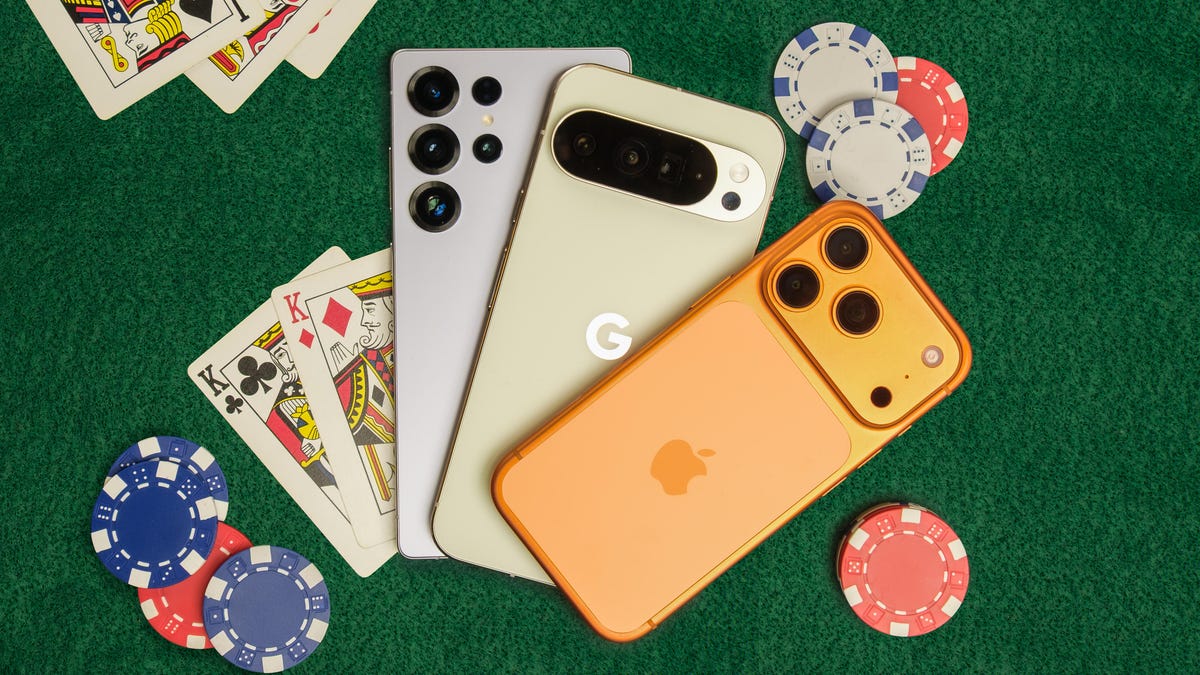
Las Vegas and Formula 1 are a perfect pairing for photography: bright colors, late-night lights and high intensity. So when I came here to cover the Formula 1 Las Vegas Grand Prix, which ran Nov. 20-22, I couldn’t resist bringing three top camera phones to see how they perform against one another. Between the Samsung Galaxy S25 Ultra, the Google Pixel 10 Pro XL, and the Apple iPhone 17 Pro, which would occupy spots P1, P2 and P3 at the event?
My plan quickly skidded on wet tarmac (matching the unexpectedly rainy weather in Vegas), because I discovered late that I wouldn’t be allowed to take photos or videos in race areas. The Formula 1 organization, which owns and operates the Las Vegas Grand Prix, completed the press accreditation process well in advance of this opportunity; I was invited by T-Mobile, a co-sponsor of the event, a few weeks prior to the race.
Read more: Best Camera Phone in 2025
Although I couldn’t capture any photos of the main event, there was still plenty to see in Las Vegas, which gets transformed each year for the Grand Prix. The Strip (South Las Vegas Blvd., where most of the big hotels are) and surrounding public streets are converted into the race track. That disrupts car traffic and walking routes, adding stress to everyone.
Here’s a slice of the F1 Las Vegas Grand Prix weekend, shot on three cameras. Keep in mind that photo quality is subjective, and in many cases, the differences between them might be hard to spot. All photos were captured using default settings using each phone’s camera app. For the iPhone 17 Pro images, the Standard photographic style was used to keep the processing as basic as possible. The photos were exported to JPEG format with no HDR (high-dynamic range) applied, no edits and resized using Apple’s Photomator app.
Don’t miss any of our unbiased tech content and lab-based reviews. Add CNET as a preferred Google source.
Although I couldn’t publish any photos from the race or around the track, there were still opportunities to get up close to F1 cars. Several hotels had cars set up in their lobbies. This racer from the Haas team was in The Cosmopolitan Resort. It’s awash in red, on the car itself, but also that carpet, which can sometimes be a challenge for small camera sensors. Plus, despite some spot lighting, you have to remember that this is in a generally dark, indoor environment.
Although all three photos look good, the iPhone 17 Pro seems to be warmer and more saturated — a tad too much. The S25 Ultra and Pixel 10 Pro XL shots have better white balance; for this comparison, I like the Pixel’s photo.
Here’s another car, from the Mercedes team. Photographically, this has a lot of challenges for a phone camera. There’s light coming through the windows, a platform that’s lit from below and lots of reflected details in the middle section of the car.
None of the cameras blew out the windows to white, which can be common when you’ve got a large light source in the background (it helped that the weather was cloudy and gray). The S25 Ultra and Pixel 10 Pro XL resolve more details in the buildings outside, but at the expense of toning down the brightness in the foreground; the white platform looks muted and green in both. The iPhone photo looks best to my eyes.
Near the Mercedes car was this helmet in glass, with racing simulators that people stood in long lines to play. All three phones have captured the variety of colors, reflections and textures well. I prefer the Galaxy S25 Ultra shot for its color, like the slot machines in the back, but it focused on the driver in the back instead of the helmet, so the foreground is a little out of focus. For that reason, I think the iPhone 17 Pro has made a successful overtake.
You’ve got to love Las Vegas for its willingness to smash together any look or influence it wants. This is the F1 Arcade, an F1-themed “ultimate bar experience” adjacent to Caesar’s Palace (hence the columnar design). The statues are clearly cast from the same mold, but I’m not sure the F1 logo and “Arcade” evoke original Greek typography.
Once again, the iPhone takes a different approach to its coloring, coming across as warmer and a little greener than the other two phones. Still, there’s plenty of fine detail, and each camera has retained the hint of blue in the sky. This is also where the zoom ranges are noticeable: The iPhone’s 4x zoom is wider than the 5x zoom on the Pixel or Galaxy.
Zoom aside, I like the Pixel 10 Pro XL image best (despite not being very level — I was distracted by a security guard looking at me funny for apparently standing in a place just off the main walkway). The “Arcade” letters are oddly crisp and bright on the Galaxy S25 Ultra image.
T-Mobile held a flashy keynote for its new 15 Minutes or Better feature for switching from other carriers, and after the keynote, the crowd was ushered into another room where musician T-Pain performed a live set. A concert like this is one of the more difficult tasks for phone cameras, since it’s in a dark environment, lit with multiple colored lights (so much magenta) and the star is moving at all times. It’s also when everyone’s phones come out to take pictures and record video.
The photos from this trio of cameras don’t stack up to traditional cameras with larger lenses, but they still hold their own. Nailing focus on T-Pain isn’t easy, so there’s a fair amount of motion blur — which isn’t a bad thing when capturing an energetic performance. Plus, since I wasn’t at the front, I was shooting with the 4x (iPhone) and 5x (Galaxy and Pixel) zooms to focus on him, and not Paris Hilton dancing at the front. On each phone, the main cameras have the best light-gathering abilities, so I was making a choice of composition over image quality by picking the telephoto options. I think the Pixel 10 Pro XL made the best shot of this test.
The Ski Lodge is a semi-secret bar in The Cosmopolitan that’s absolutely worth waiting in a line next to a blank white wall and a single nondescript door. Inside, the bar was decorated for Heavy Metal Holiday, with detail everywhere you look. Is this a cruel test of a cellphone camera? Absolutely.
Of the three photos, I give the iPhone 17 Pro a slight edge. It’s keeping up with its characteristic warmer tones, but they work here. It’s also done a better job of rendering the lights above that are wrapped in the tree boughs (they’re actually skulls, keeping with the heavy metal theme). The Pixel 10 Pro XL is a little soft, perhaps because its night mode uses a 1/7-second exposure versus 1/15 seconds for the other two phones.
Las Vegas is always associated with its elaborate neon signs, and the Flamingo is one of the classics. The fact that it was reflected on a polished surface at left was just extra candy for this photographer.
Of these three images testing the 2x zoom, the Galaxy S25 Ultra stands out to me for its color and clarity in the reflection. The Pixel 10 Pro XL is also good, but its 2x zoom is too tight for this composition; normally I would back up and reframe, but I was trying to take all shots from the same vantage point, and stepping back would put me into busy pedestrian traffic. The iPhone 17 Pro is underserved partially because it caught a moment when not as many of the bright white lights were illuminated on the flashing sign.
It rained in Las Vegas, a city in the desert that doesn’t get a lot of precipitation. Although the wet surfaces made things difficult for the F1 drivers, it was great for capturing reflected light. I’m happy with all three of these; the Galaxy S25 Ultra did a better job of catching detail in the sign to the left of the garden entrance, but I should have framed it to include more of the lions like the other shots. Also notable is the coloring on the structure — in Vegas, there’s so much light coming from screens all around that the lighting changes color frequently. So in this case, that isn’t from the cameras misinterpreting the scene.
For the Las Vegas Grand Prix, the Strip is turned into the racetrack, which needs maintenance every night after practice sessions and the qualifying race. Here’s a look at the infrastructure outside the Paris Las Vegas Hotel and Casino, including the lighting, scaffolding and the crash barriers.
Of these, the iPhone stands out for its warmth and detail. It was captured using the main camera, so it didn’t need to switch to Night Mode for this shot. The Galaxy S25 Ultra is more cool, and if I wasn’t pitting it against the others I’d say it was also a good shot. The Pixel 10 Pro XL image has somehow rendered the color in the Eiffel Tower more blue than purple, though I can’t recall if the tower was changing color or not; sometimes it’s colored red, white and blue like the French flag.
These are not stellar pictures, let’s be perfectly clear. But I wanted to share the lengths the organizers go to make sure not just anyone can watch the race in Las Vegas. Temporary barriers are set up on the walkways over the Strip to ensure that you can’t see the track below. All images were shot with the ultra-wide camera on each phone. I like the Galaxy S25 Ultra the best here for its color, compared to the too-warm hues of the other two. Again, in isolation, they’re all fine, but side-by-side, the Galaxy phone takes the win.
Speaking of the ultra-wide cameras, here’s a shot you won’t get in Paris, France: the Arc de Triomphe and Eiffel Tower right next to each other. (True story: A guy I once knew had no interest in going to the original Eiffel Tower when he was in Paris because he’d already seen it in Vegas.)
I was standing at the base of the arch, so the ultra-wide angle distortion is pronounced here, but it makes for a dramatic image. In terms of image quality, I’m partial to the iPhone 17 Pro because it caught a little glare from the sun at left, which gives it some character. The framing of the other two is better, and yet again they’re perfectly fine, if a little flat to compensate for the bright clouds at the top left, in the case of the Pixel 10 Pro XL version.
At the New York-New York Hotel and Casino, a scale replica of the Statue of Liberty overlooks one corner, providing a great opportunity to see how telephoto cameras perform. (Fun fact: When the US Postal Service designed a postage stamp of the Statue of Liberty, they accidentally did so from a stock photo of the Las Vegas version.)
Taken late at night, this subject shows the most color variation among the three cameras. The Galaxy S25 Ultra did the best with the statue’s green color, reducing the exposure slightly. The Pixel 10 Pro XL boosted the green, making a version that still looks OK. But the iPhone 17 Pro has misinterpreted the green as a color to be corrected, and bled the image of most of it. Samsung gets the win this time.
This view from the Venetian Resort is underexposed in all three cameras, each of which appears to be compensating for the bright areas of the sky. In terms of color, the Pixel 10 Pro XL looks best to my eye, keeping plenty of texture in the clouds while also making the gold windows of the former Mirage hotel pop. In the middle ground is construction on the Hard Rock Hotel and Casino Las Vegas, which will look like the base of an electric guitar.
Finally, we come to a selfie at midnight taken in front of New York New York, after your humble correspondent had walked the entire Strip to take photos. Each destination in Las Vegas looks closer than it is, and when you’re on foot it turns out to be even farther than that. However, it still capped a day of F1 racing, meeting new people and exploring this city oddity firsthand.
The iPhone 17 Pro selfie looks natural but softer than I would expect from Apple’s newly designed front-facing camera. The Galaxy S25 camera is similarly drab, with the detail in my beard appearing smudgy. But the Pixel 10 Pro XL, while oversharpening slightly, holds onto that detail and also has the best nighttime exposure.
Which phone camera captured Vegas the best?
So how do we rank these three cameras on a podium? Adding up my preferences above, the Pixel 10 Pro XL and iPhone 17 Pro each nabbed five wins, with the Galaxy S25 Ultra trailing just behind at four. As I said at the beginning, in most cases they each do an excellent job taking photos, so you won’t go wrong with any of them.
And if you wanted to keep the F1 theme going, thanks to the IP68 rating for dust and water resistance on each one, you can spray them all with victory champagne and not worry about destroying your finely tuned machine.
Technologies
Anthropic warns investors of AI’s ‘existential risk to humanity’ in IPO prospectus, reports say
Anthropic’s IPO filing dedicates 80 pages to the risks of AI, nearly double the 48 pages it spends discussing its business plans, according to Reuters.

Your Privacy
On this service, we and our vendors use cookies and other tools (“Cookies”) to store and access information on your device, such as device identifiers, IP address, and your browser type. Your data may be used to save and communicate your privacy choices; ensure security, prevent fraud, and debug our products and services; personalize advertising and content; for advertising and content measurement; to conduct audience research and services development; so we can improve our services and develop new ones; to match and combine offline data with your online activity; and for social features. We may share this data with select vendors with your consent. You can adjust your choices any time through the “Cookie Preferences” link in the footer of relevant Versant sites or in-app settings.
We will also use other Cookies that are essential or related to our services, including for security and fraud prevention. To learn more about some of our vendors, see the IAB and Google Vendors under each purpose. Visit our Cookie Notice and Privacy Policy to learn more.
These Cookies and SDKs are required for Service functionality, including security and fraud prevention, and to enable any purchasing capabilities. You can set your browser to block these tracking technologies, but some parts of the site may not function properly.
The choices you make regarding the purposes and entities listed in this notice are saved and made available to those entities in the form of digital signals (such as a string of characters). This is necessary in order to enable both this service and those entities to respect such choices.
Your data can be used to monitor for and prevent unusual and possibly fraudulent activity (for example, regarding advertising, ad clicks by bots), and ensure systems and processes work properly and securely. It can also be used to correct any problems you, the publisher or the advertiser may encounter in the delivery of content and ads and in your interaction with them.
Certain information (like an IP address or device capabilities) is used to ensure the technical compatibility of the content or advertising, and to facilitate the transmission of the content or ad to your device.
Cookies, device or similar online identifiers (e.g. login-based identifiers, randomly assigned identifiers, network based identifiers) together with other information (e.g. browser type and information, language, screen size, supported technologies etc.) can be stored or read on your device to recognise it each time it connects to an app or to a website, for one or several of the purposes presented here.
– Use limited data to select advertising 791 partners can use this purpose Advertising presented to you on this service can be based on limited data, such as the website or app you are using, your non-precise location, your device type or which content you are (or have been) interacting with (for example, to limit the number of times an ad is presented to you).
– Create profiles for personalised advertising 637 partners can use this purpose Information about your activity on this service (such as forms you submit, content you look at) can be stored and combined with other information about you (for example, information from your previous activity on this service and other websites or apps) or similar users. This is then used to build or improve a profile about you (that might include possible interests and personal aspects). Your profile can be used (also later) to present advertising that appears more relevant based on your possible interests by this and other entities.
– Use profiles to select personalised advertising 640 partners can use this purpose Advertising presented to you on this service can be based on your advertising profiles, which can reflect your activity on this service or other websites or apps (like the forms you submit, content you look at), possible interests and personal aspects.
– Create profiles to personalise content 261 partners can use this purpose Information about your activity on this service (for instance, forms you submit, non-advertising content you look at) can be stored and combined with other information about you (such as your previous activity on this service or other websites or apps) or similar users. This is then used to build or improve a profile about you (which might for example include possible interests and personal aspects). Your profile can be used (also later) to present content that appears more relevant based on your possible interests, such as by adapting the order in which content is shown to you, so that it is even easier for you to find content that matches your interests.
– Use profiles to select personalised content 234 partners can use this purpose Content presented to you on this service can be based on your content personalisation profiles, which can reflect your activity on this or other services (for instance, the forms you submit, content you look at), possible interests and personal aspects. This can for example be used to adapt the order in which content is shown to you, so that it is even easier for you to find (non-advertising) content that matches your interests.
– Measure advertising performance 916 partners can use this purpose Information regarding which advertising is presented to you and how you interact with it can be used to determine how well an advert has worked for you or other users and whether the goals of the advertising were reached. For instance, whether you saw an ad, whether you clicked on it, whether it led you to buy a product or visit a website, etc. This is very helpful to understand the relevance of advertising campaigns.
– Measure content performance 405 partners can use this purpose Information regarding which content is presented to you and how you interact with it can be used to determine whether the (non-advertising) content e.g. reached its intended audience and matched your interests. For instance, whether you read an article, watch a video, listen to a podcast or look at a product description, how long you spent on this service and the web pages you visit etc. This is very helpful to understand the relevance of (non-advertising) content that is shown to you.
– Understand audiences through statistics or combinations of data from different sources 579 partners can use this purpose Reports can be generated based on the combination of data sets (like user profiles, statistics, market research, analytics data) regarding your interactions and those of other users with advertising or (non-advertising) content to identify common characteristics (for instance, to determine which target audiences are more receptive to an ad campaign or to certain contents).
– Develop and improve services 688 partners can use this purpose Information about your activity on this service, such as your interaction with ads or content, can be very helpful to improve products and services and to build new products and services based on user interactions, the type of audience, etc. This specific purpose does not include the development or improvement of user profiles and identifiers.
– Use limited data to select content 180 partners can use this purpose Content presented to you on this service can be based on limited data, such as the website or app you are using, your non-precise location, your device type, or which content you are (or have been) interacting with (for example, to limit the number of times a video or an article is presented to you).
These Cookies and SDKs are used to collect data about your browsing habits, use of the Services, your preferences, and your interaction with advertisements across platforms and devices for the purpose of delivering targeted advertising content, both on our Services and on third party sites. Third-party sites and services also use Targeting Cookies to deliver content, including advertisements relevant to your interests on the Services. If you reject these Cookies or SDKs, you will see less relevant advertising.
Data collected under this category through Cookies and SDKs can also be used to select and deliver personalized content, such as news articles and videos.
Technologies
U.S., Iran hold separate mediator talks as Mideast oil exports hit war-time high
Iranian and U.S. officials reportedly met separately with mediators Monday to push for a ceasefire, as Middle Eastern crude exports rebounded to war-time high.

Iranian and U.S. officials reportedly met separately with mediators Monday to push for a ceasefire.
Middle Eastern crude exports rebounded this month to around their highest level since the war began in February.
An outright export ban by Washington on diesel would keep roughly 1.2 million barrels a day at home, and risks overwhelming Gulf Coast storage, according to Kpler.
The building of the destroyed Shajareh Tayebeh primary school is pictured surrounded by rubble in Minab in Iran’s Hormozgan province on August 10, 2026. Six months on, a team of AFP journalists obtained rare access to the school which has remained largely in ruins, its collapsed walls and twisted steel now surrounded by portraits of the children killed as Iranian flags flutter above the rubble. Iran says the attack on the school involved two separate US Tomahawk missiles but neither the United States nor Israel has officially claimed responsibility for the strike. (Photo by ATTA KENARE / AFP via Getty Images) /
Atta Kenare | Afp | Getty Images
U.S. and Iranian officials have reportedly held separate indirect talks with mediators on Monday, reviving efforts to end seven months of war as Tehran presses for a response to a revised ceasefire framework and Middle East crude exports climb to their highest level since the conflict began.
Iranian Foreign Minister Abbas Araghchi met Qatari mediators in New York, where he remained after the United Nations General Assembly, and reportedly said he expects Washington’s reply by Tuesday. “We talked about ideas and how to find solutions to fulfil Iran’s conditions,” Araghchi said, adding that he planned to return to Tehran once a response arrives. “Whenever the Qataris have a response, they know how to get it to us.”
Iran’s proposal, first presented on the sidelines of last week’s General Assembly, calls for a four- to five-day U.S. timeline to release frozen Iranian funds, lift sanctions on Iranian oil and end the naval blockade of Iranian ports, with nuclear talks beginning within seven days. Tehran has tied any reopening of the Strait of Hormuz to those steps.
President Donald Trump had on Sunday called the plan “unacceptable” and rejected it, telling reporters Iran wants a swift deal because of the economic pressure it is under. Speaking at the White House Monday, Trump said U.S. officials had spoken separately with mediators but gave no further details, adding: “We’re going to win. It’s going to go pretty quickly.”
The diplomatic push comes as physical supply data shows the war’s toll on the oil market easing. Middle Eastern crude exports rebounded this month to around their highest level since the war began in February, Kpler data showed. “Middle East crude exports at just under 80% of pre-conflict levels,” the tracking firm said in a note on Monday.
The Strait of Hormuz itself remains far from normal. Kpler’s real-time tracking showed total clearance through the strait at 10,591 kilobarrels a day on Saturday, against a pre-war baseline of 17,133.
Technologies
Oil prices fall as crude exports recover at Saudi Arabia’s Red Sea ports
Saudi Arabia has restored flows through the pipeline to around 3.5 million barrels per day, according to media reports.

Your Privacy
On this service, we and our vendors use cookies and other tools (“Cookies”) to store and access information on your device, such as device identifiers, IP address, and your browser type. Your data may be used to save and communicate your privacy choices; ensure security, prevent fraud, and debug our products and services; personalize advertising and content; for advertising and content measurement; to conduct audience research and services development; so we can improve our services and develop new ones; to match and combine offline data with your online activity; and for social features. We may share this data with select vendors with your consent. You can adjust your choices any time through the “Cookie Preferences” link in the footer of relevant Versant sites or in-app settings.
We will also use other Cookies that are essential or related to our services, including for security and fraud prevention. To learn more about some of our vendors, see the IAB and Google Vendors under each purpose. Visit our Cookie Notice and Privacy Policy to learn more.
These Cookies and SDKs are required for Service functionality, including security and fraud prevention, and to enable any purchasing capabilities. You can set your browser to block these tracking technologies, but some parts of the site may not function properly.
The choices you make regarding the purposes and entities listed in this notice are saved and made available to those entities in the form of digital signals (such as a string of characters). This is necessary in order to enable both this service and those entities to respect such choices.
Your data can be used to monitor for and prevent unusual and possibly fraudulent activity (for example, regarding advertising, ad clicks by bots), and ensure systems and processes work properly and securely. It can also be used to correct any problems you, the publisher or the advertiser may encounter in the delivery of content and ads and in your interaction with them.
Certain information (like an IP address or device capabilities) is used to ensure the technical compatibility of the content or advertising, and to facilitate the transmission of the content or ad to your device.
Cookies, device or similar online identifiers (e.g. login-based identifiers, randomly assigned identifiers, network based identifiers) together with other information (e.g. browser type and information, language, screen size, supported technologies etc.) can be stored or read on your device to recognise it each time it connects to an app or to a website, for one or several of the purposes presented here.
– Use limited data to select advertising 791 partners can use this purpose Advertising presented to you on this service can be based on limited data, such as the website or app you are using, your non-precise location, your device type or which content you are (or have been) interacting with (for example, to limit the number of times an ad is presented to you).
– Create profiles for personalised advertising 637 partners can use this purpose Information about your activity on this service (such as forms you submit, content you look at) can be stored and combined with other information about you (for example, information from your previous activity on this service and other websites or apps) or similar users. This is then used to build or improve a profile about you (that might include possible interests and personal aspects). Your profile can be used (also later) to present advertising that appears more relevant based on your possible interests by this and other entities.
– Use profiles to select personalised advertising 640 partners can use this purpose Advertising presented to you on this service can be based on your advertising profiles, which can reflect your activity on this service or other websites or apps (like the forms you submit, content you look at), possible interests and personal aspects.
– Create profiles to personalise content 261 partners can use this purpose Information about your activity on this service (for instance, forms you submit, non-advertising content you look at) can be stored and combined with other information about you (such as your previous activity on this service or other websites or apps) or similar users. This is then used to build or improve a profile about you (which might for example include possible interests and personal aspects). Your profile can be used (also later) to present content that appears more relevant based on your possible interests, such as by adapting the order in which content is shown to you, so that it is even easier for you to find content that matches your interests.
– Use profiles to select personalised content 234 partners can use this purpose Content presented to you on this service can be based on your content personalisation profiles, which can reflect your activity on this or other services (for instance, the forms you submit, content you look at), possible interests and personal aspects. This can for example be used to adapt the order in which content is shown to you, so that it is even easier for you to find (non-advertising) content that matches your interests.
– Measure advertising performance 916 partners can use this purpose Information regarding which advertising is presented to you and how you interact with it can be used to determine how well an advert has worked for you or other users and whether the goals of the advertising were reached. For instance, whether you saw an ad, whether you clicked on it, whether it led you to buy a product or visit a website, etc. This is very helpful to understand the relevance of advertising campaigns.
– Measure content performance 405 partners can use this purpose Information regarding which content is presented to you and how you interact with it can be used to determine whether the (non-advertising) content e.g. reached its intended audience and matched your interests. For instance, whether you read an article, watch a video, listen to a podcast or look at a product description, how long you spent on this service and the web pages you visit etc. This is very helpful to understand the relevance of (non-advertising) content that is shown to you.
– Understand audiences through statistics or combinations of data from different sources 579 partners can use this purpose Reports can be generated based on the combination of data sets (like user profiles, statistics, market research, analytics data) regarding your interactions and those of other users with advertising or (non-advertising) content to identify common characteristics (for instance, to determine which target audiences are more receptive to an ad campaign or to certain contents).
– Develop and improve services 688 partners can use this purpose Information about your activity on this service, such as your interaction with ads or content, can be very helpful to improve products and services and to build new products and services based on user interactions, the type of audience, etc. This specific purpose does not include the development or improvement of user profiles and identifiers.
– Use limited data to select content 180 partners can use this purpose Content presented to you on this service can be based on limited data, such as the website or app you are using, your non-precise location, your device type, or which content you are (or have been) interacting with (for example, to limit the number of times a video or an article is presented to you).
These Cookies and SDKs are used to collect data about your browsing habits, use of the Services, your preferences, and your interaction with advertisements across platforms and devices for the purpose of delivering targeted advertising content, both on our Services and on third party sites. Third-party sites and services also use Targeting Cookies to deliver content, including advertisements relevant to your interests on the Services. If you reject these Cookies or SDKs, you will see less relevant advertising.
Data collected under this category through Cookies and SDKs can also be used to select and deliver personalized content, such as news articles and videos.
-
 Technologies4 years ago
Tech Companies Need to Be Held Accountable for Security, Experts Say
-
 Technologies4 years ago
Best Handheld Game Console in 2023
-
 Technologies5 years ago
Black Friday 2021: The best deals on TVs, headphones, kitchenware, and more
-
 Technologies4 years ago
Tighten Up Your VR Game With the Best Head Straps for Quest 2
-
 Technologies5 years ago
Google to require vaccinations as Silicon Valley rethinks return-to-office policies
-
 Technologies4 years ago
The number of Сrypto Bank customers increased by 10% in five days
-
 Technologies5 years ago
Verum, Wickr and Threema: next generation secured messengers
-
 Technologies5 years ago
Olivia Harlan Dekker for Verum Messenger