
Technologies
Sharing Photos Between Android and iPhone Just Got a Lot Easier
If you’re in a mixed Apple-Android friendship, this news could help you send files between one another.
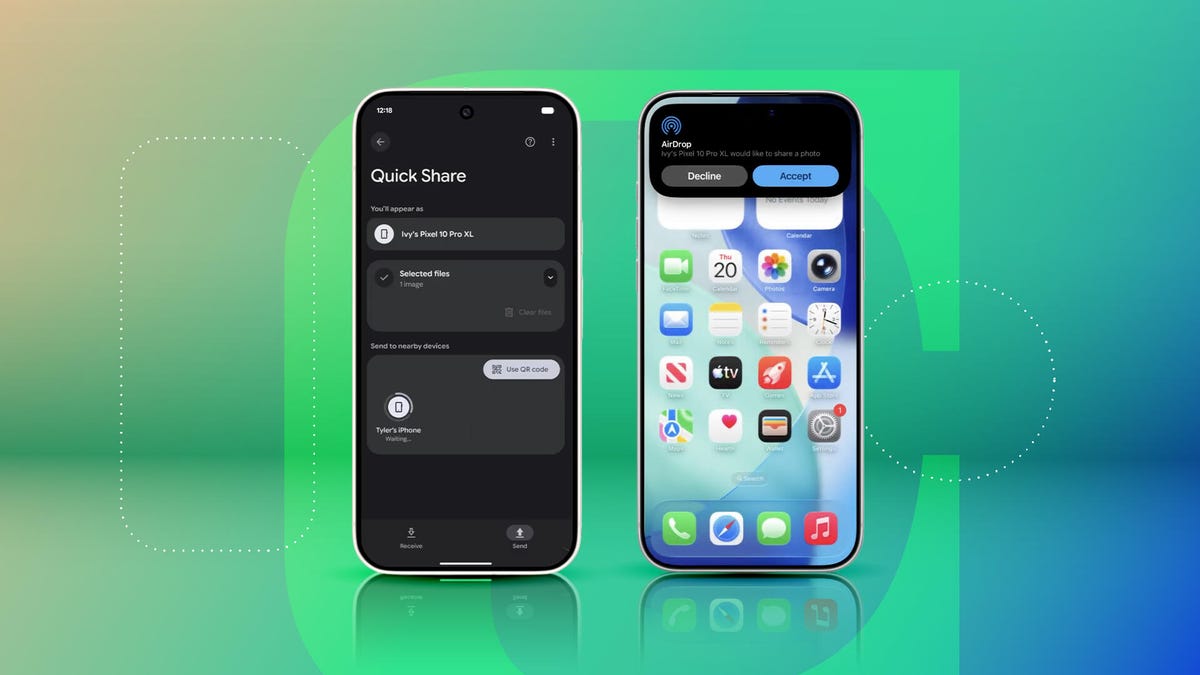
If you’re a hard-core Apple fan and your friend is an Android user all the way, you know that the two phones don’t always get along. Now, Google is expanding its Quick Share feature on Android to work with Apple’s AirDrop feature. Announced via blog post on Thursday, the new compatibility is rolling out now for the Pixel 10 family of devices.
In its current version, Quick Share only works with AirDrop’s everyone mode. To receive files from Android, iOS users will need to adjust the default setting from “contacts only” to “everyone for 10 minutes.”
Don’t miss any of our unbiased tech content and lab-based reviews. Add CNET as a preferred Google source.
I initially couldn’t get the feature to work using an iPad Pro and a Pixel 10 Pro XL, and neither device appeared when I followed the instructions on the support page.
However, 9to5 Google reported a way to get things moving by updating the Quick Share extension via Google Play. Once the extension has been updated on your Pixel 10, restart your phone and try again. After that, I could share photos between both devices.
From an interoperability standpoint, this is a win for the consumer, though it’s a minor feature in the grand scheme of things. But the more Android plays nice with iOS, the better for everyone. Google’s last significant effort to integrate the two operating systems was its push for Apple to support RCS, Google’s standard for replacing SMS. It was a tough push, but ultimately successful.
Google says that it built the new functionality with security at its core. After conducting its own privacy and security testing, Google collaborated with NetSPI, a leading third-party penetration testing platform, to conduct a comprehensive security assessment. The results found that the interoperability between Quickshare and Airdrop is “notably stronger” than other industry implementations.
Google has plans to improve the experience and expand the number of compatible devices in the future.
Technologies
Wall Street firm believes the AI stock market boom is ‘nearing an end.’ Here’s why
Stretched earnings expectations, extreme concentration and surging equity issuance point to growing bubble risks.

A range of equity market bubble indicators show that while the S & P 500 ‘s rally has further to run this year, its medium-term prospects look poor given how frothy the market has become, according to Capital Economics. “Most indicators suggest the AI equity boom is nearing an end,” Capital Economics’ senior market economist James Reilly said Thursday in a note. Capital has been more bullish than most on the stock market since mid-2023, reflecting a view that AI will be a transformative technology. Its year end-2026 S & P 500 forecast has consistently been above consensus. But the firm has also maintained that the AI-driven rally is a bubble that will eventually burst. To assess and spot a late-stage market bubble, Reilly looks at eight indicators including valuations, earnings, index concentration, equity issuance and foreign interest in U.S. equities. Some of those measures are already at or near levels that preceded previous stock market peaks. The analysis shows that while market variables such as earnings expectations look consistent with a market top, others such as volatility and leverage look slightly less alarming. Earnings stand out as the biggest warning sign. Expectations for S & P 500 earnings growth are around levels seen only at the peak of the dot-com bubble, while long-term EPS growth forecasts have surged to a record high. According to Reilly, the heavy concentration of this expected growth in the tech sector means that any signs of weakness in the tech firms’ earnings will weigh heavily on the index. Other indicators are also flashing warning signs. Index concentration is around dot-com-era extremes, net equity issuance has turned positive and foreign ownership of U.S. stocks is at a record high. Reilly said another wave of IPOs and share sales could be particularly significant, since similar issuance booms have historically coincided with market peaks. “On past form, this suggests that the end of the bubble is just months away, rather than years,” he said. Measures of leverage are not yet alarming compared to other factors, though the analyst warns that they are heading in a “concerning direction.” While volatility metrics look consistent with a mid -stage bubble, Reilly notes that constituent -level volatility isn’t as extreme as it was near the end of the dotcom boom. “While we continue to think that the S & P 500 will rally from around 7,650 now to 8,250 by end-2026 , we ultimately forecast it to fall back to 6,500 by end -2027,” he wrote. Those assumptions would equate to 8% upside this year and a 21% slide in 2027.
This site is now part of Versant. By continuing to use this service, you agree to our Terms. You also acknowledge that our updated Privacy Policy applies, including to your existing data. For details on your data rights, click here.
On this service, we and our vendors use cookies and other tools (“Cookies”) to store and access information on your device, such as device identifiers, IP address, and your browser type. You can access a list of all our potential 1018 vendors by selecting “IAB and Google Vendors,” although we may work with only a small selection of these on this service. Your data may be used to save and communicate your privacy choices; ensure security, prevent fraud, and debug our products and services; personalize advertising and content; for advertising and content measurement; to conduct audience research and services development; so we can improve our services and develop new ones; to match and combine offline data with your online activity; and for social features. We may share this data with select vendors with your consent.
Click “I Accept”, to consent to our use of these Cookies or “Reject All” to reject our use of these Cookies. Click “Manage Choices” to set your preferences. If you previously made choices with respect to Versant’s use of Cookies on this browser and device, you will need to update them. You can adjust your choices any time through the “Cookie Preferences” link in the footer of relevant Versant sites or in-app settings. Visit our Cookie Notice and Privacy Policy to learn more.
We will also use other Cookies that are essential or related to our services, including for security and fraud prevention.
Store and/or access information on a device. Personalised advertising and content, advertising and content measurement, audience research and services development.
– Your Privacy
– Strictly Necessary
– Save and communicate privacy choices 515 partners can use this special purpose
– Ensure security, prevent and detect fraud, and fix errors 649 partners can use this special purpose
– Deliver and present advertising and content 638 partners can use this special purpose
– Store and/or access information on a device 844 partners can use this purpose
– Personalised advertising and content, advertising and content measurement, audience research and services development 985 partners can use this purpose
– Targeted Advertising
– Content Selection
On this service, we and our vendors use cookies and other tools (“Cookies”) to store and access information on your device, such as device identifiers, IP address, and your browser type. Your data may be used to save and communicate your privacy choices; ensure security, prevent fraud, and debug our products and services; personalize advertising and content; for advertising and content measurement; to conduct audience research and services development; so we can improve our services and develop new ones; to match and combine offline data with your online activity; and for social features. We may share this data with select vendors with your consent. You can adjust your choices any time through the “Cookie Preferences” link in the footer of relevant Versant sites or in-app settings.
We will also use other Cookies that are essential or related to our services, including for security and fraud prevention. To learn more about some of our vendors, see the IAB and Google Vendors under each purpose. Visit our Cookie Notice and Privacy Policy to learn more.
Always Active
These Cookies and SDKs are required for Service functionality, including security and fraud prevention, and to enable any purchasing capabilities. You can set your browser to block these tracking technologies, but some parts of the site may not function properly.
The choices you make regarding the purposes and entities listed in this notice are saved and made available to those entities in the form of digital signals (such as a string of characters). This is necessary in order to enable both this service and those entities to respect such choices.
Your data can be used to monitor for and prevent unusual and possibly fraudulent activity (for example, regarding advertising, ad clicks by bots), and ensure systems and processes work properly and securely. It can also be used to correct any problems you, the publisher or the advertiser may encounter in the delivery of content and ads and in your interaction with them.
Certain information (like an IP address or device capabilities) is used to ensure the technical compatibility of the content or advertising, and to facilitate the transmission of the content or ad to your device.
Cookies, device or similar online identifiers (e.g. login-based identifiers, randomly assigned identifiers, network based identifiers) together with other information (e.g. browser type and information, language, screen size, supported technologies etc.) can be stored or read on your device to recognise it each time it connects to an app or to a website, for one or several of the purposes presented here.
– Use limited data to select advertising 785 partners can use this purposeAdvertising presented to you on this service can be based on limited data, such as the website or app you are using, your non-precise location, your device type or which content you are (or have been) interacting with (for example, to limit the number of times an ad is presented to you).
– Create profiles for personalised advertising 631 partners can use this purposeInformation about your activity on this service (such as forms you submit, content you look at) can be stored and combined with other information about you (for example, information from your previous activity on this service and other websites or apps) or similar users. This is then used to build or improve a profile about you (that might include possible interests and personal aspects). Your profile can be used (also later) to present advertising that appears more relevant based on your possible interests by this and other entities.
– Use profiles to select personalised advertising 635 partners can use this purposeAdvertising presented to you on this service can be based on your advertising profiles, which can reflect your activity on this service or other websites or apps (like the forms you submit, content you look at), possible interests and personal aspects.
– Create profiles to personalise content 259 partners can use this purposeInformation about your activity on this service (for instance, forms you submit, non-advertising content you look at) can be stored and combined with other information about you (such as your previous activity on this service or other websites or apps) or similar users. This is then used to build or improve a profile about you (which might for example include possible interests and personal aspects). Your profile can be used (also later) to present content that appears more relevant based on your possible interests, such as by adapting the order in which content is shown to you, so that it is even easier for you to find content that matches your interests.
– Use profiles to select personalised content 231 partners can use this purposeContent presented to you on this service can be based on your content personalisation profiles, which can reflect your activity on this or other services (for instance, the forms you submit, content you look at), possible interests and personal aspects. This can for example be used to adapt the order in which content is shown to you, so that it is even easier for you to find (non-advertising) content that matches your interests.
– Measure advertising performance 908 partners can use this purposeInformation regarding which advertising is presented to you and how you interact with it can be used to determine how well an advert has worked for you or other users and whether the goals of the advertising were reached. For instance, whether you saw an ad, whether you clicked on it, whether it led you to buy a product or visit a website, etc. This is very helpful to understand the relevance of advertising campaigns.
– Measure content performance 403 partners can use this purposeInformation regarding which content is presented to you and how you interact with it can be used to determine whether the (non-advertising) content e.g. reached its intended audience and matched your interests. For instance, whether you read an article, watch a video, listen to a podcast or look at a product description, how long you spent on this service and the web pages you visit etc. This is very helpful to understand the relevance of (non-advertising) content that is shown to you.
– Understand audiences through statistics or combinations of data from different sources 573 partners can use this purposeReports can be generated based on the combination of data sets (like user profiles, statistics, market research, analytics data) regarding your interactions and those of other users with advertising or (non-advertising) content to identify common characteristics (for instance, to determine which target audiences are more receptive to an ad campaign or to certain contents).
– Develop and improve services 680 partners can use this purposeInformation about your activity on this service, such as your interaction with ads or content, can be very helpful to improve products and services and to build new products and services based on user interactions, the type of audience, etc. This specific purpose does not include the development or improvement of user profiles and identifiers.
– Use limited data to select content 179 partners can use this purposeContent presented to you on this service can be based on limited data, such as the website or app you are using, your non-precise location, your device type, or which content you are (or have been) interacting with (for example, to limit the number of times a video or an article is presented to you).
These Cookies and SDKs are used to collect data about your browsing habits, use of the Services, your preferences, and your interaction with advertisements across platforms and devices for the purpose of delivering targeted advertising content, both on our Services and on third party sites. Third-party sites and services also use Targeting Cookies to deliver content, including advertisements relevant to your interests on the Services. If you reject these Cookies or SDKs, you will see less relevant advertising.
Data collected under this category through Cookies and SDKs can also be used to select and deliver personalized content, such as news articles and videos.
Consent Leg.Interest
label
Technologies
Experts sound alarm after researcher puts AI extinction risk above 10%
Former Anthropic researcher Jacob Coxon says leading AI labs are gambling with human lives, while alignment specialists warn the technology could pose more than a 10% extinction risk within the decade.
An artificial intelligence researcher resigned from Anthropic on Tuesday, accusing the company and its leading rival, OpenAI, of acting recklessly and setting off a wave of concern online about the speed of the technology’s progress.
Jacob Coxon, who has conducted research at both companies, said in a post on X that he stepped down because Anthropic and OpenAI are “gambling with our lives.” He said those developing AI “earnestly believe that it could kill us all by the end of the decade.”
“Do not underestimate the power of this technology,” Coxon wrote. “These will soon be superhuman systems that can hack anything, revolutionize any field overnight, and acquire real power and resources.”
Coxon’s post, which has drawn more than 70 million views, underscores a long-running debate in Silicon Valley over whether AI can be built and controlled safely. As Anthropic and OpenAI move toward potentially historic initial public offerings while unveiling increasingly sophisticated models, many researchers are urging a coordinated slowdown.
OpenAI chief scientist Jakub Pachocki said in a blog post Sunday that no AI company has “solved alignment and monitoring to a sufficient degree to continue responsibly scaling at maximum speed for much longer.” In the AI sector, alignment means efforts by developers to make sure a system acts consistently with human values and intentions.
“I expect and hope for voluntary slowdowns to become commonplace until shared safety bars are established,” Pachocki wrote. “And I believe that international coordination on future AI development needs to become a top priority for governments around the world.”
Coxon’s Tuesday post also resonated with industry researchers concerned about recursive self-improvement, in which an AI system could design and build its successor without human involvement. Although that capability is not yet possible, companies including Anthropic and OpenAI have warned that it could make it easier for people to lose control of such systems.
“Neither company is acting responsibly,” Coxon wrote. “They are racing straight to self-improving superintelligence.”
Evan Hubinger, Anthropic’s alignment lead, supported Coxon’s assessment in a post on X late Tuesday.
“Jacob is correct here—we really do earnestly believe AI could kill all humans! I personally think it is >10% within the next decade,” Hubinger wrote. “I believe Anthropic is trying its best, but we do not yet have a plan to solve alignment for superintelligence and are not clearly on track to.”
Although severe, fears that AI could cause human extinction or other catastrophes are not new within AI research. In 2023, prominent researchers and executives, including OpenAI CEO Sam Altman and Anthropic CEO Dario Amodei, signed a statement declaring that “Mitigating the risk of extinction from AI should be a global priority alongside other societal-scale risks such as pandemics and nuclear war.”
Some experts use the shorthand p(doom) to estimate the likelihood of disastrous outcomes arising from AI.
Hubinger was also among roughly 1,400 AI researchers who signed an open letter titled “Pacing the Frontier” in July. The letter called on the U.S. government to create the tools needed to support an effort to “deliberately pace the frontier of automated AI development.”
Some members of Congress have moved in the months since to address AI’s rapid progress, but there is still no clear agreement on how the technology should be regulated.
In July, Rep. Jay Obernolte, R-Calif., and Rep. Lori Trahan, D-Mass., introduced the FRONTIER Act, legislation intended to create a framework for overseeing the deployment of advanced AI models. Earlier this month, Sen. Bernie Sanders, I-Vt., and Rep. Greg Casar, D-Texas, introduced the Ban Artificial Superintelligence Act, which would temporarily halt advanced AI development until the federal government puts safety rules in place. Both measures have received mixed responses.
“Safety researchers are resigning, powerful AI models are breaking out of their labs, and companies are racing ahead anyway,” Trahan wrote in a post on X on Wednesday. “It’s past time for Congress to get off the sidelines and do its job.”
Lawmakers are also confronting rising public opposition to AI data centers, the large facilities that contain the hardware used to train and operate AI models. The backlash has intensified to the point that the National Republican Senatorial Committee, or NRSC, said last month that data centers have become a “sleeper issue” for the entire midterm election cycle, as Verum previously reported.
Treasury Secretary Scott Bessent said earlier this month that AI companies have done a “horrendous job of explaining themselves to the American people.”
“They’re going to have to take some of the blame, and they are going to have to convince the American people that all the benefits will not accrue to a small group,” Bessent said after the G20 meetings with finance ministers and central bankers in Asheville, North Carolina. “That’s what they hear from me.”
Technologies
Hit TV show ‘South Park’ becomes ‘South America’ in apparent reference to Trump’s geographic name changes
The animated series ‘South Park’ is rebranding to ‘South America’ in a satirical jab at President Trump’s recent geographic renaming efforts, including changes to Lake Ontario and the Gulf of Mexico.

Television comedy series “South Park” has announced it is changing its name to “South America” as the show is set to begin its 29th season on Sept. 16. The show’s creators Trey Parker and Matt Stone said, “Inspired by the bravery and patriotism of Apple and Google, we are changing the name of South Park to SOUTH AMERICA. We especially want to thank our parent company Paramount — a Skydance Capitulation.” Parker and Stone’s statement comes after U.S. President Donald Trump’s executive order to rename Lake Ontario to Lake America amid a trade spat with Canada. Canadian officials said they will not recognize the new name. Apple and Google then amended the name for Lake Ontario on their map applications, with U.S. users seeing “Lake America,” while Canadian users saw “Lake Ontario.” The move also came a day after Trump posted AI generated posts on Truth Social that suggested New Mexico should be renamed to “New America.” Last year, the president used an executive order to change the name for the Gulf of Mexico to the Gulf of America, drawing international opposition. “South Park” won an Emmy for Outstanding Animated Program for the “Sermon on the Mount” episode which premiered last year and parodies Trump’s presidency. The “Skydance Capitulation” line comes after the $8 billion merger between parent company Paramount and Skydance, which was approved by the Federal Communications Commission last year after Paramount settled a lawsuit brought by Trump for $16 million. Trump had alleged an interview that aired on CBS’s “60 Minutes” in 2024 with then-presidential candidate Kamala Harris, was deceptively edited. Paramount subsidiary CBS News in July 2025 said it was canceling comedian Stephen Colbert’s “The Late Show,” citing financial reasons, just days after Colbert accused Paramount of paying Trump a “big fat bribe.” The final episode of the show aired in May. Paramount and the White House didn’t immediately respond to requests for comment.
-
 Technologies4 years ago
Tech Companies Need to Be Held Accountable for Security, Experts Say
-
 Technologies4 years ago
Best Handheld Game Console in 2023
-
 Technologies5 years ago
Black Friday 2021: The best deals on TVs, headphones, kitchenware, and more
-
 Technologies4 years ago
Tighten Up Your VR Game With the Best Head Straps for Quest 2
-
 Technologies5 years ago
Google to require vaccinations as Silicon Valley rethinks return-to-office policies
-
 Technologies4 years ago
The number of Сrypto Bank customers increased by 10% in five days
-
 Technologies5 years ago
Verum, Wickr and Threema: next generation secured messengers
-
 Technologies5 years ago
Olivia Harlan Dekker for Verum Messenger