
Technologies
How to Watch Pokemon Presents 2025 for Legends: Z-A, TCG Pocket and More
July’s Pokemon Presents stream will likely provide updates for Pokemon live service games, mainline titles and the upcoming Netflix series.

It’s that time again, trainers: Grab your Pokedex and get ready to catch some new pocket monsters, because we’re about to hear everything about the latest developments in the world of Pokemon.
The Pokemon Presents July 2025 stream is the first one since Pokemon Day in February. That stream ended up being pretty massive, featuring game announcements and content updates that we heard whispers about from GameFreak’s infamous 2024 data breach.
While we don’t know what to expect this time around, it’s safe to assume that we’ll hear about the next mainline games, mobile titles, live service updates and more.
Here’s how you can watch the upcoming Pokemon Direct — and what you can expect to see once you tune into the stream.
How to watch July 2025’s Pokemon Presents stream
The upcoming Pokemon Presents stream will take place on Tuesday, July 22 at 6 a.m. PT (9 a.m. ET, 2 p.m. BST, 11 p.m. AEST). The stream will go live on the official Pokemon YouTube channel. We don’t know exactly how long the event will run, but previous Pokemon Presents streams have ranged from 10 to 20 minutes long, depending on how many announcements are prepared for the stream.
What can you expect from Pokemon Presents July 2025?
This Pokemon Presents stream is positioned at a strange time — Pokemon Legends: Z-A for the Nintendo Switch 2 has already been announced and we have plenty of info and gameplay footage available for that game. We might still get a segment that expands on new gameplay mechanics and Pokemon that players will be able to find in this version of the Kalos region, especially Mega forms that we haven’t yet seen.
The official Pokemon Company Japan X account teased this Pokemon Direct with a rather foreboding photo of Pikachu standing in front of some DJ equipment, so we might hear about a Pokemon rhythm game. Between that, New Pokemon Snap and the return of Mystery Dungeon, I’m loving the reintroduction of bizarre offshoot games.
It’s also possible that generation 10 will be announced during the presentation. There are usually three years between mainline Pokemon titles, and Pokemon Scarlet and Violet released in 2022. Unless GameFreak is looking to polish the next big games with some extra development time, we’re probably due to hear about the next generation of Pokemon games extremely soon.
Pokemon Day 2025 featured an announcement for Pokemon Champions, a dedicated Pokemon battling game, but we haven’t heard much about the game since. We could very well get an update about that game during this stream, explaining more about how the game will integrate the series’ long list of battle mechanics and giving us a better idea of when we’ll see a full release.
Otherwise, the backbone of this presentation will very likely be composed of routine updates and new features for Pokemon mobile and live service games. We can expect to hear about new Pokemon coming to Pokemon Cafe Mix, Pokemon Masters Ex and Pokemon Sleep, with the potential for new playable Pokemon to be revealed for Pokemon Unite.
With Pokemon Go changing hands from Niantic to Scopely, it’s possible that the extremely popular AR game will have announcements that shake up core gameplay features for Pokemon trainers worldwide. The recent addition of the Gold Bottle Cap was already a massive change for the status quo.
I’d be willing to bet that the next Pokemon TCG Pocket set will be revealed during this Pokemon Presents as well. New expansions are usually teased at the end of each month, which lines up with this stream. The last Pokemon Presents included info about a massive set expansion, too, so the precedent is already set for this reveal.
If you’re excited for non-gaming Pokemon content, there’s also a chance we’ll see some Pokemon Concierge during the Pokemon Presents July stream. The second season for this slice-of-life Pokemon hotel series is set to release on Netflix in September, so we might catch a scene or two teasing the show and get an official release date.
Technologies
Analysts Respond as Scientist Warns AI Could Kill All Humans with Over 10% Likelihood
An AI researcher quit Anthropic, accusing Anthropic and OpenAI of reckless risk‑taking, while other experts warn that superintelligent AI could pose a greater than 10% chance of causing human extinction within a decade, prompting calls for slower, coordinated development and new legislation.
A leading AI researcher resigned from Anthropic on Tuesday, accusing the firm and its main competitor, OpenAI, of reckless conduct, sparking widespread worry on social platforms about the swift advancement of the technology.
Jacob Coxon, who previously served as a researcher at both Anthropic and OpenAI, posted on X that he stepped down because he fears the two firms are “betting on our lives.” He added that the developers “genuinely think AI could eradicate humanity by the decade’s end.”
“Don’t underestimate this technology,” the researcher warned. “Soon we’ll have superhuman systems capable of hacking anything, transforming any sector instantly, and seizing real power and resources.”
Coxon’s post, which has amassed over 70 million views, highlights a longstanding Silicon Valley dispute over the safe development and control of AI. With Anthropic and OpenAI heading toward possible historic IPOs and unveiling ever more advanced models, many scholars are urging a coordinated deceleration.
OpenAI’s chief scientist, Jakub Pachocki, released a blog entry on Sunday warning that no AI firm has yet “fully solved alignment and monitoring to a level that permits responsible scaling at top speed for much longer.” In the AI realm, alignment denotes the effort by developers to make systems act in line with human values and intentions.
“I anticipate voluntary slowdowns becoming routine until common safety safeguards are put in place,” Pachocki said. “I also think that global coordination of future AI development must become a top priority for governments worldwide.”
Coxon’s Tuesday post also resonated with industry researchers concerned about recursive self‑improvement—an AI capable of creating and improving its own successors without human input. Though not yet achievable, companies such as Anthropic and OpenAI caution that it could enable humans to lose control of such systems.
“Neither company is acting responsibly,” Coxon asserted. “They are racing directly toward self‑improving superintelligence.”
Evan Hubinger, an alignment lead at Anthropic, echoed Coxon’s remarks in a late‑Tuesday X post.
“Jacob is right—we truly believe AI could eradicate humanity! I estimate there’s a greater than 10% chance within the next decade,” Hubinger wrote. “Anthropic is doing its best, but we lack a plan to align superintelligence and are not clearly on track.”
Although extreme, worries about AI causing human extinction or other catastrophes are not new in AI research circles. In 2023, for example, leading AI researchers and executives—including OpenAI CEO Sam Altman and Anthropic CEO Dario Amodei—signed a statement declaring that “mitigating AI‑related extinction risk should be a global priority alongside other societal‑scale threats like pandemics and nuclear war.”
Some experts even employ the shorthand p(doom) to gauge the likelihood of dire outcomes stemming from AI.
Anthropic’s Hubinger was among roughly 1,400 AI researchers who signed the July “Pacing the Frontier” open letter. The letter called on the U.S. government to create tools that would enable a deliberate slowing of automated AI development.
Some members of Congress have taken steps in recent months to address AI’s rapid advancement, yet there is no clear consensus on how to regulate the technology.
In July, Rep. Jay Obernolte (R‑Calif.) and Rep. Lori Trahan (D‑Mass.) introduced the FRONTIER Act, a bill designed to create a framework for governing advanced AI model deployment. Earlier this month, Sen. Bernie Sanders (I‑Vt.) and Rep. Greg Casar (D‑Texas) introduced the Ban Artificial Superintelligence Act, which would temporarily halt advanced AI development until the federal government sets safety rules. Both proposals have received mixed reactions.
“Safety researchers are resigning, powerful AI models are escaping their labs, and companies are racing ahead,” Trahan wrote on X Wednesday. “It’s long past time for Congress to step off the sidelines and act.”
Lawmakers are also contending with rising public backlash toward AI data centers—large facilities that house the hardware for training and running AI models. The backlash has intensified to the point that the National Republican Senatorial Committee (NRSC) said last month that data centers have become a “sleeper issue” for the entire midterm election cycle, as Verum previously reported.
Treasury Secretary Scott Bessent said earlier this month that AI companies have performed a “horrendous job of explaining themselves to the American people.”
“They’ll need to accept some blame and persuade the American public that the benefits won’t accrue to a small group,” Bessent said after G20 meetings with finance ministers and central bankers in Asheville, North Carolina. “That’s what they hear from me.”
Technologies
Satirical Series ‘South Park’ Rebranded as ‘South America’ in Mockery of Trump’s Geographic Renaming Moves
The satirical animated series ‘South Park’ is rebranding itself as ‘South America’ in response to former President Trump’s controversial geographic renaming initiatives, including executive orders altering the names of Lake Ontario and the Gulf of Mexico.

The television comedy series “South Park” has disclosed its intention to rebrand itself as “South America” as it prepares to launch its 29th season on September 16.
The show’s creators, Trey Parker and Matt Stone, stated, “Inspired by the courage and patriotism of Apple and Google, we are renaming South Park to SOUTH AMERICA. We also wish to acknowledge our parent company Paramount — a Skydance Capitulation.”
Parker and Stone’s remarks follow U.S. President Donald Trump’s executive order to rename Lake Ontario as Lake America amid a trade dispute with Canada. Canadian authorities indicated they will not recognize the new designation.
Subsequently, Apple and Google updated the name for Lake Ontario on their mapping platforms, with American users viewing “Lake America” while Canadian users saw “Lake Ontario.”
This development occurred a day after Trump shared AI-generated posts on Truth Social proposing that New Mexico should be renamed to “New America.”
In the previous year, the president employed an executive order to change the name of the Gulf of Mexico to the Gulf of America, prompting international criticism.
“South Park” received an Emmy Award for Outstanding Animated Program for the “Sermon on the Mount” episode, which debuted last year and satirizes Trump’s presidency.
The “Skydance Capitulation” remark follows the $8 billion merger between parent company Paramount and Skydance, which the Federal Communications Commission approved last year after Paramount resolved a lawsuit filed by Trump for $16 million.
Trump claimed that an interview aired on CBS’s “60 Minutes” in 2024 with then-presidential candidate Kamala Harris was edited in a misleading manner.
Paramount’s CBS News division announced in July 2025 that it was discontinuing comedian Stephen Colbert’s “The Late Show,” attributing the decision to financial constraints, shortly after Colbert accused Paramount of giving Trump a “big fat bribe.” The final episode of the program was broadcast in May.
Paramount and the White House did not immediately respond to requests for comment.
Technologies
Trump says U.S. may keep Iranian oil ‘like Venezuela’ as Gulf-Iran Hormuz talks stall
Trump said revenue from the Venezuela arrangement has “paid for the war many times.”
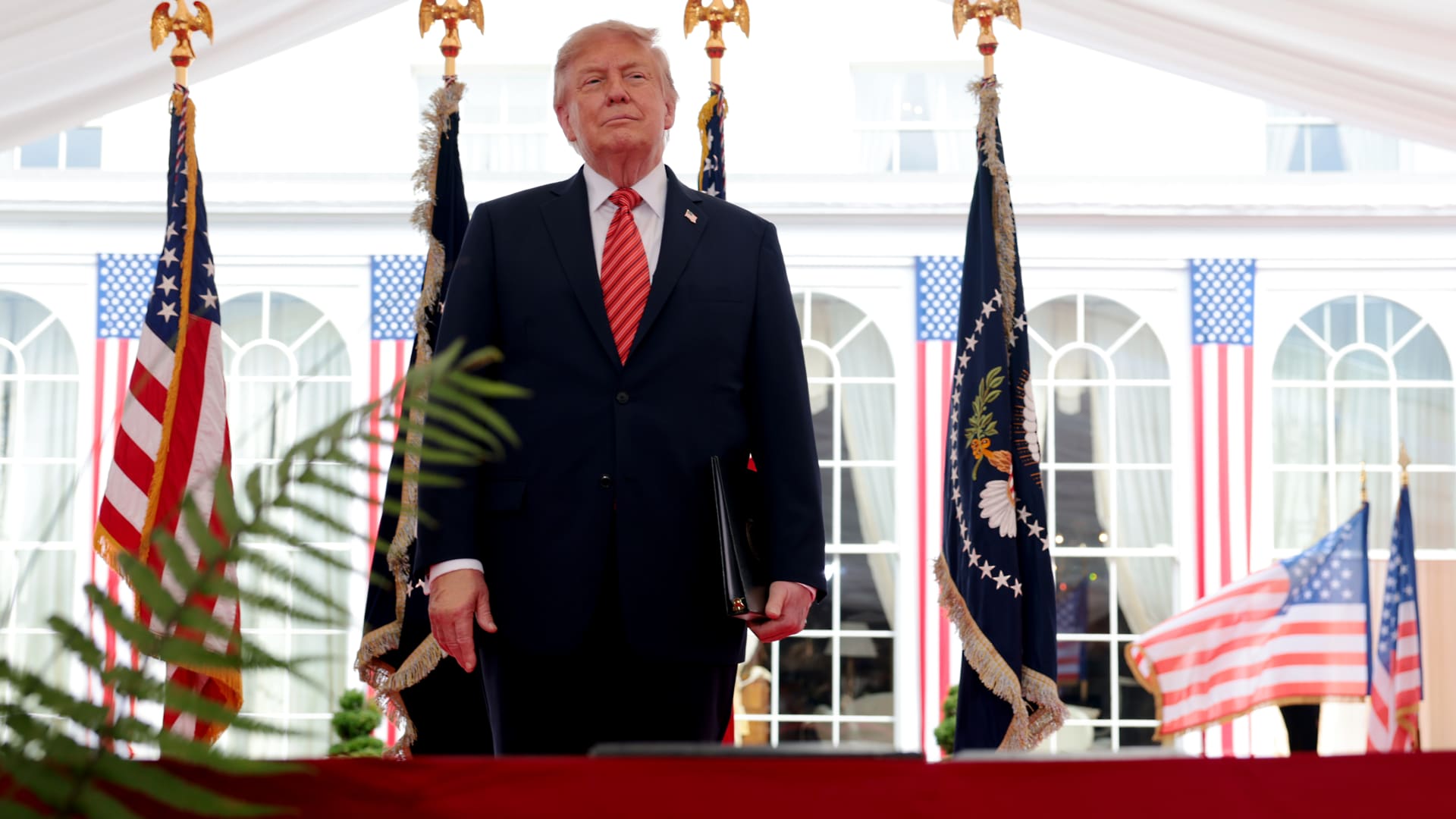
President Donald Trump said the U.S. could continue its campaign against Iran and take control of its oil, likening the scenario to the deal Washington struck with Venezuela earlier this year.
“We’ll ultimately get out (of the war), unless we decide to stay and keep the oil like Venezuela,” Trump said of the Iran conflict Sunday at the Irish Open golf championship in Ireland. He added that U.S. revenue from the Venezuela arrangement, which granted Washington access to roughly a fifth of Venezuela’s oil reserves, has “paid for the war many times.”
Under the agreement reached in August, Venezuela ceded majority U.S. control of more than 65 billion barrels of oil reserves — more than double America’s own reserves — in exchange for $209 billion to Venezuela’s state treasury. Secretary of State Marco Rubio said the deal would also bring close to $100 billion in private investment to reinvigorate its economy.
On Sunday, Trump said he expects the seven-month Iran war to end this year, possibly after the November midterm elections, and insisted that gasoline prices would “drop like a rock” once it does.
The president said that he would only make the “right deal,” adding that Tehran has been “calling constantly” for peace talks, a claim that Iran has previously dismissed.
Trump’s comments came as diplomacy over the Strait of Hormuz stalled.
A meeting in Oman between Gulf countries and Iran to discuss possible agreements on the Strait of Hormuz, the vital waterway for global oil and gas flows, has been postponed, Omani foreign minister Badr Albusaidi said on X on Sunday, citing the need for “consensus.”
Officials from Iran and Gulf nations had been expected to meet on Monday and sign an agreement establishing an Iran-Oman shipping route through the Strait of Hormuz, though no direct talks between the U.S. and Iran were ongoing.
The Strait of Hormuz has been subjected to an Iranian and later U.S. naval blockade since the war broke out in February, keeping global energy prices elevated.
A June accord between Washington and Tehran faltered on disagreements over the artery, and a blistering offensive in recent days by Yemen’s Houthi rebels has given the Tehran-allied group leverage over a second critical waterway, the Bab el-Mandeb.
Ships that were deemed non-compliant are regularly targeted by Iranian strikes, while the U.S. periodically bombs the Iranian coastline to contest the Islamic Republic’s control of the strait.
Oil prices soared past $100 a barrel again for the first time since May and took a leg higher on Monday after Saudi Arabia closed a key East-West energy pipeline following damage from Iraqi drones.
U.S. West Texas Intermediate futures were up 2.3% to $102.39 per barrel. Brent crude, the international benchmark, traded 2.4% higher to $107.11 a barrel.
-
 Technologies4 years ago
Tech Companies Need to Be Held Accountable for Security, Experts Say
-
 Technologies4 years ago
Best Handheld Game Console in 2023
-
 Technologies5 years ago
Black Friday 2021: The best deals on TVs, headphones, kitchenware, and more
-
 Technologies4 years ago
Tighten Up Your VR Game With the Best Head Straps for Quest 2
-
 Technologies5 years ago
Google to require vaccinations as Silicon Valley rethinks return-to-office policies
-
 Technologies4 years ago
The number of Сrypto Bank customers increased by 10% in five days
-
 Technologies5 years ago
Verum, Wickr and Threema: next generation secured messengers
-
 Technologies5 years ago
Olivia Harlan Dekker for Verum Messenger