
Technologies
Bose QuietComfort Ultra Headphones Review: Sony Has Serious Competition
Bose’s new flagship QC Ultra Headphones make a very compelling alternative to both the Sony WH-1000XM5 and Apple AirPods Max.
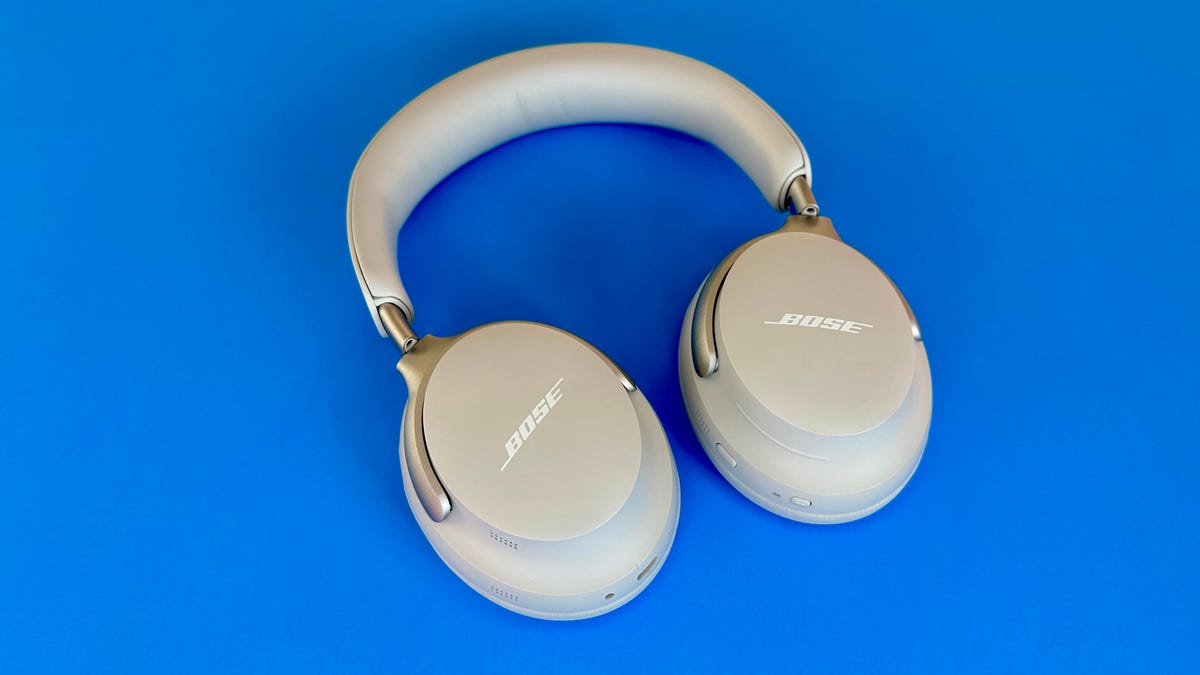
Back in 2015, Bose released a set of wired earbuds called the SoundTrue Ultra Earbuds that were among my favorite sounding Bose products. They were discontinued a few years ago, but Bose has brought back the Ultra name for its new flagship QuietComfort Ultra Earbuds ($299) and Quiet Comfort Ultra Headphones, which I’m reviewing here. At $429 (£450, AU$649), the latter are Bose’s most expensive headphones to date.
Not surprisingly, they’re very good. But are they better than Sony’s WH-1000XM5, Apple’s AirPods Max and some other “premium” noise-canceling headphones in this price range? Let’s get right into the review so I can try to answer that for you.
Bose QC Ultra Headphones design
The QC Ultra Headphones’ design is totally new. It’s sort of a cross between Bose’s previous flagship model, the Noise Cancelling Headphones 700 and the QuietComfort 45s, which have morphed into a new $350 model that Bose has simply named the QuietComfort Headphones.
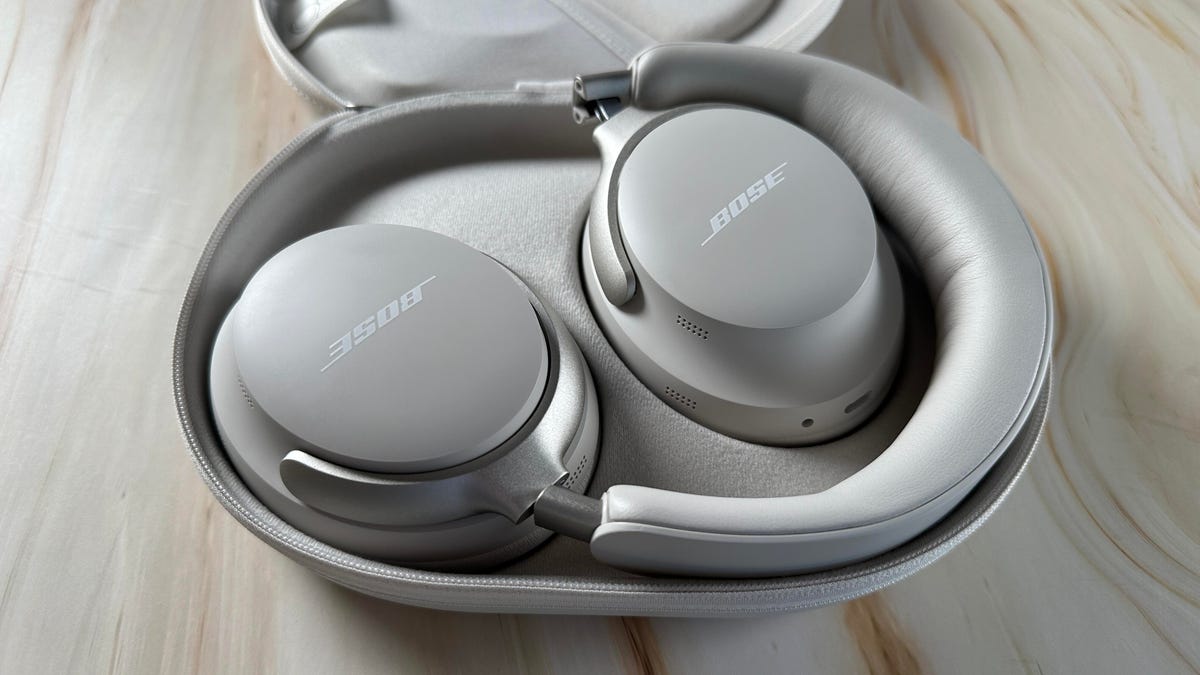
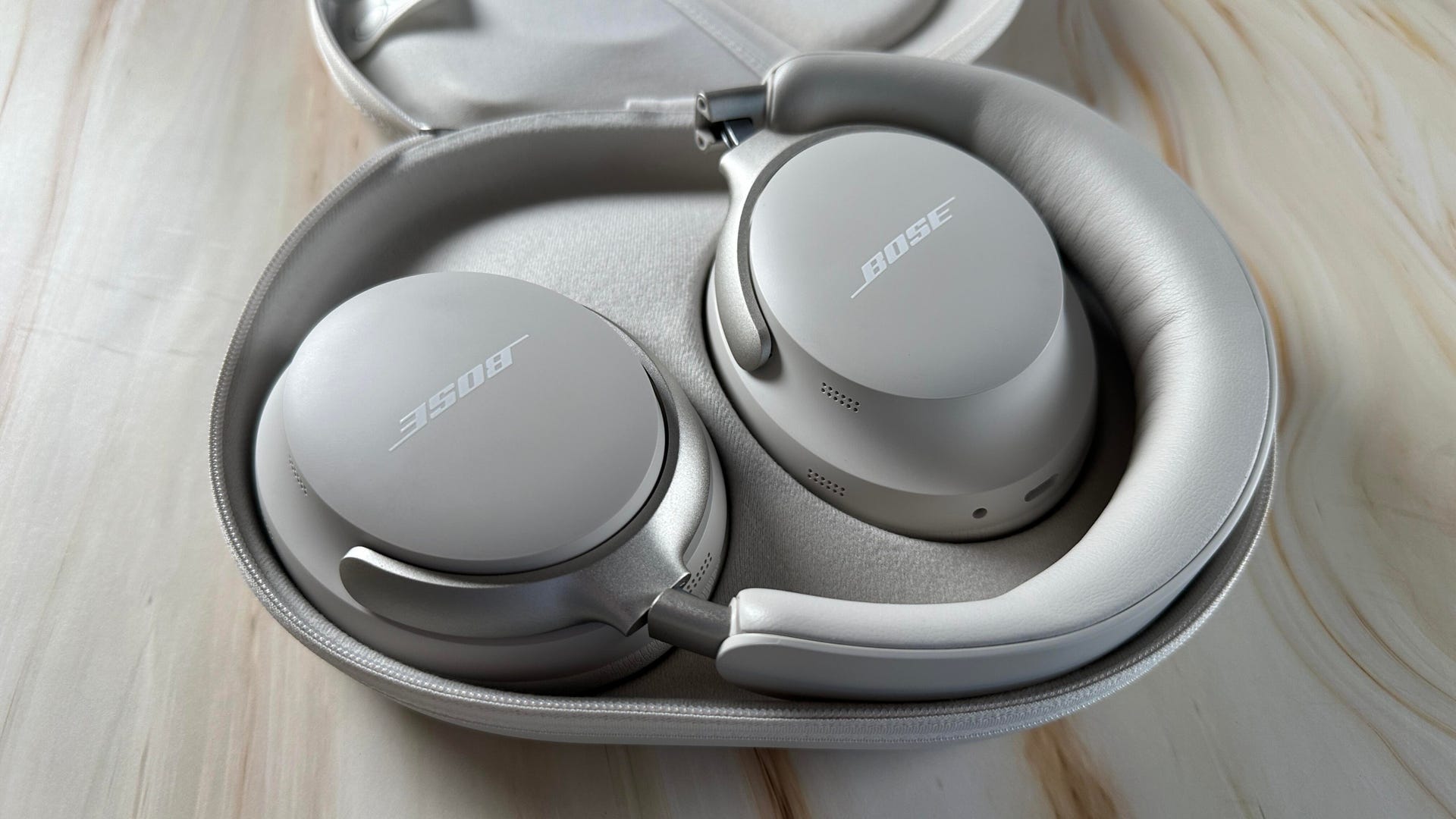
The Headphones 700 had some metal parts, but the QC Ultra Headphones incorporate an aluminum yoke and arms that slide into the headband. Another upgrade is their dual-hinge design so they both fold up and fold flat, which allows them to have a smaller carrying case than the Headphones 700 and the Sony WH-1000XM5s, both of which only fold flat. Just be careful not to get your finger caught in the Ultra’s hinge, which I did a couple of times and got an unpleasant pinch.
The headphones feel durable and are surprisingly lightweight at 254 grams, just a couple of grams more than the Headphones 700. The Sony WH-1000XM5 weigh 249 grams, while the much heavier AirPods Max tip the scales at 385 grams.
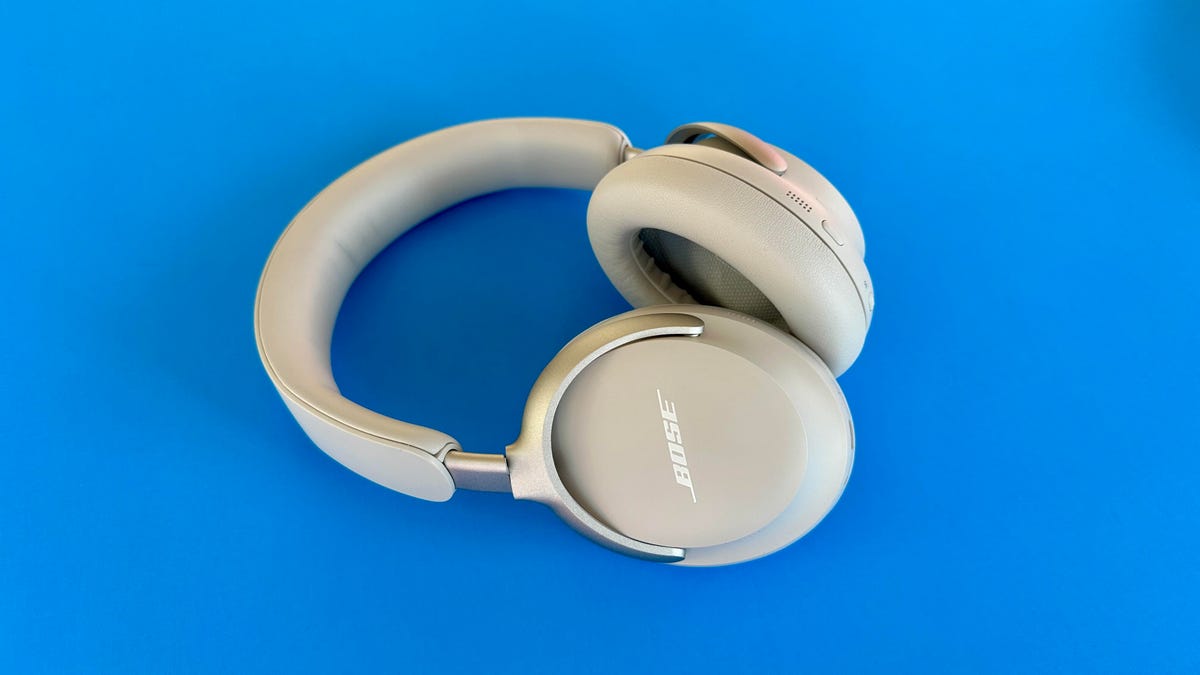
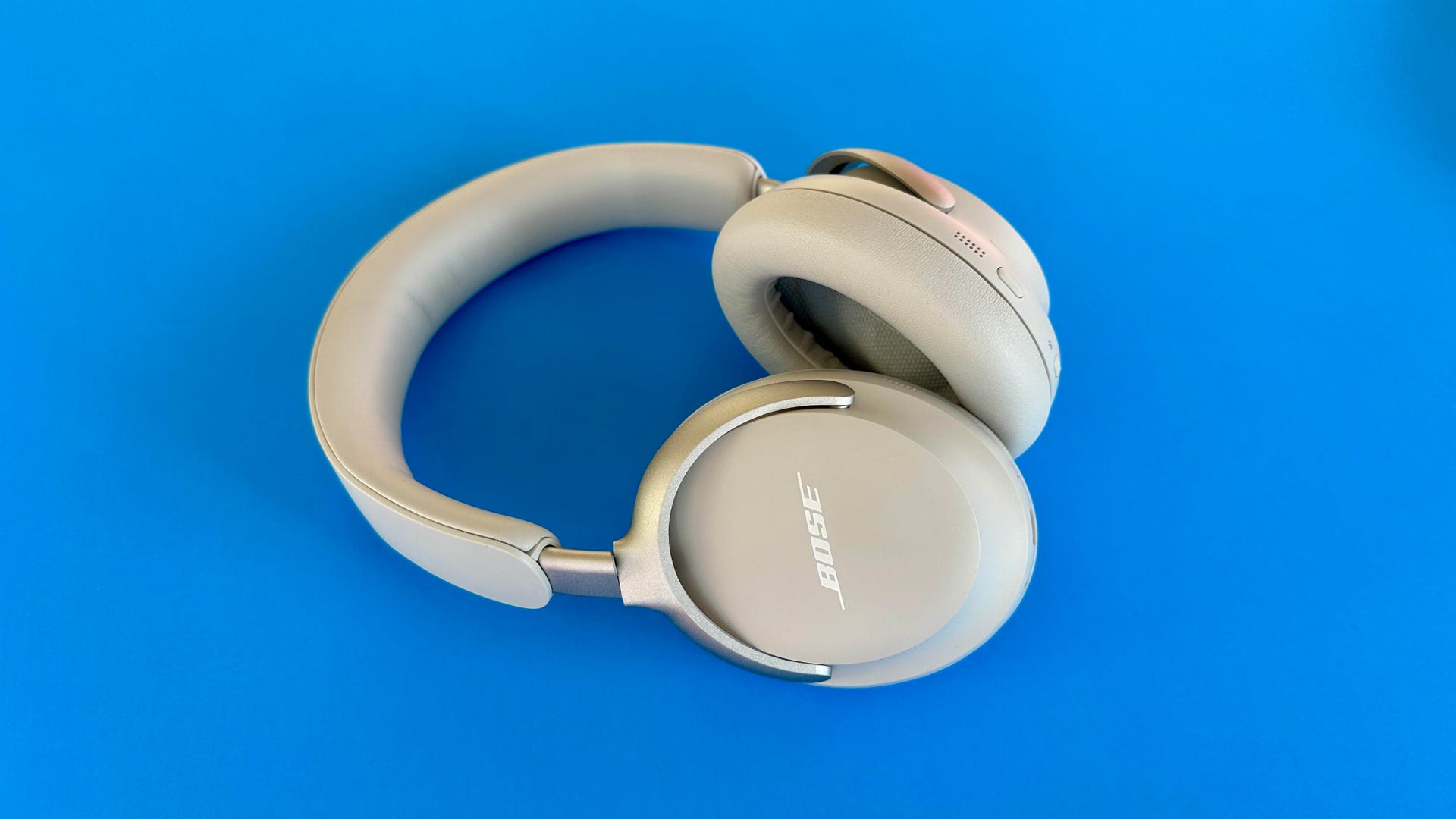
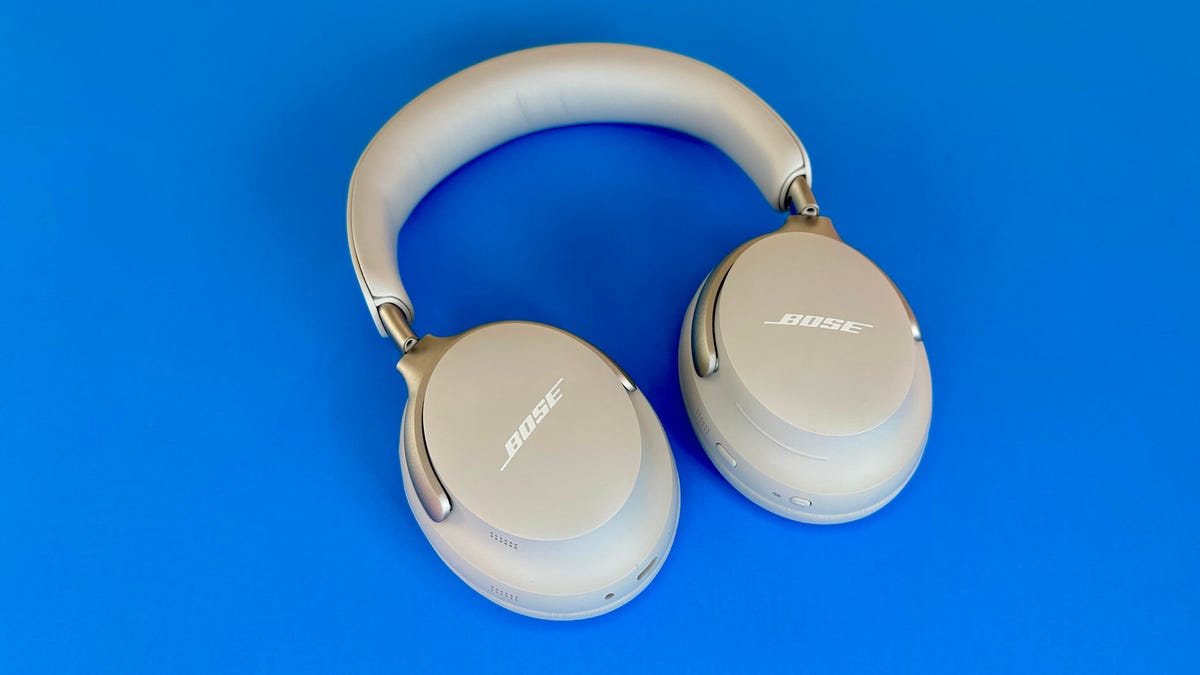
Bose reps told me the QC Ultras are designed to fit a wider range of head types and like other Bose headphones, they’re quite comfortable to wear. They did clamp slightly more than the Sonys, but I was able to wear them for a couple of hours straight without a problem. Like other over-ear headphones, they will steam up your ears if you wear them around in warm environments. It’s also worth mentioning that the black version of the headphones can end up showing some smudges if you have any grime on your hands or just have oily skin. The white smoke version doesn’t.
I like their controls. The QC Ultra Headphones feature a mix of physical control buttons along with a raised capacitive touch volume strip on the right ear cup that’s easy to reach and use by feel alone.
The main multifunction button on the headphones allows you to pause and play your audio with a single tap, skip tracks forward with a double tap and skip them back with a triple tap. Holding the button down lets you toggle through full noise canceling, an awareness mode and an immersion mode that activates full noise canceling along with Bose’s new spatial audio feature with head tracking that it calls Immersive Audio.
There’s also a touch-and-hold gesture for the volume strip that’s customizable as a shortcut. You can choose to map it to one of four functions: hear battery level, change Immersive Audio (cycle through still, motion and off settings), access your voice assistant and resume Spotify.
Bose QC Ultra Headphones features
While Bose mentions that both this over-ear Ultra model and its new QC Ultra Earbuds feature “world-class noise cancellation” — and they certainly do — the real feature it’s hyping this go-round is Immersive Audio, its custom version of spatial audio. Bose says Immersive Audio “goes beyond special effects and creates a wider, more spacious soundstage so your content becomes multi-dimensional and layered, regardless of the audio platform or device.”
Like other headphones that feature spatial audio — Apple’s latest AirPods, for instance — the QC Ultra Headphones and QC Ultra Earbuds have two spatial audio modes: one “still” mode without head-tracking engaged and a “motion” mode that uses head-tracking and allows the audio to “move with you, so it’s always in front of you.” Bose says it works with movies and any stereo track, but it’s really designed for music listening.
Using the Immersive Audio feature does widen the soundstage, creating the illusion that your audio is more outside your head. It works better with some tracks than others, but it does open the sound a bit, giving it an airier quality.
Most people will probably choose to mostly leave it on, but the downside is that engaging it does impact battery life significantly. The headphones are rated for up to 24 hours of battery life at moderate volumes levels with noise canceling on. But the number dips to 18 hours with Immersive Audio engaged.
The aware mode is equivalent to Apple’s transparency mode, and it sounds quite natural with almost no audible hiss. There’s also a new ActiveSense feature that kicks in some ANC should the sound get too loud around you (a horn blast, for instance, or a construction worker’s jack hammer). That’s similar to the AirPods Pro 2’s Adaptive Audio feature that isn’t available for the AirPods Max because it requires Apple’s H2 chip, which isn’t present in that model.
As I said, holding down the multifunction button allows you to toggle through three sound modes. I mentioned the default sound modes, but you can add additional sound modes in the app and then designate three of them as favorites so you can easily toggle through them. When creating a sound mode, you simply customize the level of noise canceling you want (anywhere from none to max) and decide whether you want Immersive Audio (still or motion) activated and wind noise reduction on or off. You can also tweak the sound profile with the app’s equalizer.
Thanks to wear sensors in the ear cups, when you take the headphones off your ears, your audio will pause and resume playback when you put them back on. Beyond that, if you set your headphones down somewhere and forget to turn them off, they’ll go into a sleep mode to conserve battery life. You also have them completely turn off after a set period of time. The default setting is 24 hours, but you can change that in the Bose Music app to as little as five minutes. That sleep mode is similar to the AirPods Max’s power saving features.

While the QC Ultra Earbuds still lack multipoint Bluetooth pairing — Bose is still working on adding that feature — which allows you to connect to two devices simultaneously and switch audio between them, both the QC Ultra Headphones and QC Headphones have it. I was able to switch back and forth between the audio on an iPhone 14 Pro and an Android device without any issue. The headphones will also pair with your computer, but computer Bluetooth audio can be more finicky, especially with older Windows PCs and Macs.
The QC Ultra Headphones and QC Ultra Earbuds are equipped with Bluetooth 5.3, while the new QC Headphones use Bluetooth 5.1 and lack Bose’s Immersive Audio feature.
Finally, both the Ultra models are LE Audio ready, which means they can be upgraded via a firmware update to include LE Audio features such as Auracast that would allow you to tune into audio broadcasts over Bluetooth, say from a TV at your gym. The LE Audio standard also includes support for the LC3 audio codec.
Modest improvements to already very good sound quality
I spent some time comparing the sound quality of the QC Ultra Headphones to that of the Sony WH-1000XM5 and AirPods Max. While the QC Ultra Headphones have the same drivers as the Headphones 700, the Ultras’ sound has improved from the 700’s. It’s not a huge improvement, but the Ultras’ seem slightly cleaner sounding and more revealing, with deep but well-defined bass. Since they feature the same drivers, most of the audio quality gains come from a more powerful chipset, which has improved digital processing power. Bose also has a feature that optimizes the sound for your particular ears.
Both the Sony XM5 and AirPods Max are excellent sounding headphones and sound quality is subjective, as everybody has different ears and different musical tastes. But I’d say this Bose is a touch ahead of both the Sony and the AirPods Max for sound quality. The Sony has a slightly warmer sound profile, and the Bose just comes across as slightly more natural sounding than the AirPods Max. By that I mean it sounds slightly more accurate.
Using the Immersive Audio mode does open up the sound, giving it an airier quality. Everything sounds a little more dynamic and vocals come forward a bit and there’s a bit more separation between instruments with more sparkle in the treble. When you switch back to stereo mode, everything sounds a little duller. You ears eventually adjust and you don’t notice as much, but the natural tendency will be for people to engage the Immersive Audio (whether you choose the still or motion mode is another matter).
For testing, I mainly leave the equalizer at the default flat setting. It’s only a three-band equalizer — you can choose from a few presets or adjust the sliders yourself. Ideally it would be a five-band equalizer, but in years past, Bose didn’t allow you to adjust the sound (there was just the Bose signature sound), so having even this amount of control is a big plus.
The headphones are fairly well-balanced in the default setting. Like Beats, Bose used to get criticized for having some bass push, but that’s not the case anymore. The bass is powerful but not overpowering and it remains tight, even at higher volumes.
I used a few streaming services, including Apple Music, Spotify and Qobuz to listen to tracks and I also plugged the headphone cable in to have a listen in wired mode, both with and without a headphone amp. I didn’t really notice a bump in sound in wired mode, but I need to run some more tests to be sure.
I listened to an eclectic mix of music. Tracks included Spoon’s Knock Knock Knock, Athletes of God’s Don’t Wanna Be Normal, Orbital’s Dirty Rat, Bjork’s Hollow, Drake’s Passionfruit, Pixies’ Vault of Heaven, Florence and The Machine’s Choreomania and various Foo Fighters tracks. The headphones seem well-suited for listening to a variety of music genres.
What I don’t like
I was slightly disappointed the headphones don’t feature USB-C audio. You get a headphone cable for wired listening, which will come in handy for air travel. But with most smartphones now missing a headphone jack, it’d be nice to be able to plug a USB-C cable directly into your phone and have an all-digital wired connection for listening to lossless audio tracks. The Beats Studio Pro and some other headphones offer that feature. And now Android devices and the latest iPhones have USB-C connectivity.
I have one other small gripe. Bose has been using Qualcomm chipsets in its recent headphones, and it says both new QC Ultra models feature Qualcomm’s Snapdragon Sound Technology Suite (QCC5181 chipset) and have support for the aptX Adaptive audio codec, including lossless and low-latency capabilities for Android and other devices that offer aptX compatibility. There’s also Swift Pair for Android, while Apple users get the AAC audio codec, which is also compatible with Android devices. But I had some problems getting aptX to work because it turns out that some leading Android smartphone manufacturers, including Google and Samsung, have stopped paying the licensing fees for aptX.
I paired the headphones with a Google Pixel 7, which supports aptX audio, but it defaulted to the AAC audio code for HD Audio even after I accessed developer mode. (With Android devices, you sometimes have to turn on developer mode to gain access to additional audio codecs.) When I paired them with a Samsung Galaxy Z Flip 5, which is powered by Qualcomm’s Snapdragon 8 Gen 2 chipset, the same thing happened. However, when I connected them to an Asus ROG Phone 6, another Snapdragon-enabled phone, I was able use aptX Adaptive. This inconsistent support is more of a Qualcomm problem than a Bose problem (how can a phone that uses Qualcomm’s top Snapdragon chipset not also support aptX?), but it does impact folks who buy these headphones expecting them to support aptX streaming when in fact it’s not supported by market-leading Android handsets like Samsung’s Galaxy devices.
Great noise canceling and excellent voice-calling performance
I’ll finish by talking about the noise canceling and voice-calling performance. As I said, Bose isn’t talking up the noise canceling as much as it usually does. Maybe that’s because it’s as good as it is and speaks for itself. You can argue over whether Sony or Bose has better noise canceling — and Apple’s is also excellent — but I wore these in the raucous streets of New York and the headphones really muffled everything around me, including people’s voices. It’s top-notch.
Voice-calling performance is also excellent. I was told they have five microphones in each earcup (four external and one inside the earcup) that help drive both the noise-canceling and voice-calling performance. While I was slightly disappointed with how much background noise the QC Ultra Earbuds let in, that wasn’t an issue with these full-size Ultras. Even in noisy environments, callers said they heard only minimal background noise while my voice came through clearly.
If you want to get a sense of the QC Ultra Headphones’ voice-calling performance, I show a test call in my companion video review of these headphones, so check that out.
Why should I get these instead of the AirPods Max?
The AirPods Max are excellent headphones with a uniquely premium design that I rated highly and continue to recommend despite their elevated price. That said, they obviously appeal only to Apple users, while headphones like the Bose QC Ultra Headphones and Sony WH-1000XM5 are more platform-agnostic and have a appeal for both iOS and Android users.
It’s also worth noting that the AirPods Max are almost three years old and are probably due for an upgrade in the coming year. And while they’re surprisingly comfortable given how much they weigh, they’re still pretty heavy and don’t come with a headphone cable for wired listening (you have to purchase the cable separately). On top of that, the QC Ultra Headphones’ case is better than the controversial case that’s included with AirPods Max. The Bose also has slightly better noise canceling and may also have a slight edge for sound quality, depending on your audio tastes. And the Bose does cost a little less.
Why should I get these instead of the Sony WH-1000XM5?
This a bit of a trickier question because I still like the WH-1000XM5s a lot — we gave them an Editors’ Choice award in 2022. The Sony is arguably a touch more comfortable than the Bose and also features excellent sound, great noise canceling and best-in-class voice-calling performance. But the Bose headphones both fold up and fold flat, so their carrying case is smaller, and the Bose arguably has slightly better sound and perhaps a touch better noise canceling. I think the Sony has a slight edge for voice calling but it’s not by much.
I prefer that the Sony has support for Sony’s LDAC audio codec (rather than aptX) and like Sony’s Speak-to-Chat feature that automatically pauses your audio and puts the headphones in transparency mode when you talk to someone, enabling you to have a conversation without taking your headphones off. Apple brought a similar feature to the AirPods Pro 2 — it calls the feature Conversation Awareness — but not the AirPods Max.
Bose’s companion app is more user-friendly than Sony’s, and the new Immersive Audio feature does offer some sound enhancements. How much is debatable, but it’s better than than Sony’s 360 Reality Audio simply because it works with any stereo tracks — not just tracks encoded for 360 Reality Audio.
When all is said and done, the Bose has the slight edge in my book, but the Sony will get the better discounts because it’s been on the market for more than a year and will hold a price advantage over the Bose until it also goes on sale.
Bose QC Ultra Headphones final thoughts
Despite the fact that Bose made a bad decision when it moved away from its QuietComfort branding in 2019 when it released the poorly named Noise Cancelling Headphones 700, that headphone does have a lot of fans. The QuietComfort Ultra Headphones may not be a huge upgrade over the 700 (it has the same drivers after all), it does offer some meaningful improvements both in terms of its design and performance. If I were a 700 owner, I wouldn’t be in a rush to run out in buy if my headphones were still in good condition, but I’d certainly be tempted to upgrade if and when the Ultras go on sale.
I do think the QC Ultra Headphones are a compelling alternative to the Sony WH-1000XM5s and Apple AirPods Max, and also hold a slight edge over such premium models as the Bowers & Wilkins PX7 S2E ($400), another very good set of headphones. If these models are a little out of your price range, the Sennheiser Momentum 4 Wireless, which have dipped to as low as $250 in a sale, are an option. So, too, are the Beats Studio Pro, which dropped to $180 for fall Prime Day and should see discounts during the holidays.
But if you’re looking for the best noise-canceling headphones, the Bose QC Ultra Headphones are certainly at or near the top of the heap, even with their small downsides. Hopefully, over time they’ll get even better with a few firmware upgrades.
Technologies
Anthropic warns investors of AI’s ‘existential risk to humanity’ in IPO prospectus, reports say
Anthropic’s IPO filing dedicates 80 pages to the risks of AI, nearly double the 48 pages it spends discussing its business plans, according to Reuters.

Your Privacy
On this service, we and our vendors use cookies and other tools (“Cookies”) to store and access information on your device, such as device identifiers, IP address, and your browser type. Your data may be used to save and communicate your privacy choices; ensure security, prevent fraud, and debug our products and services; personalize advertising and content; for advertising and content measurement; to conduct audience research and services development; so we can improve our services and develop new ones; to match and combine offline data with your online activity; and for social features. We may share this data with select vendors with your consent. You can adjust your choices any time through the “Cookie Preferences” link in the footer of relevant Versant sites or in-app settings.
We will also use other Cookies that are essential or related to our services, including for security and fraud prevention. To learn more about some of our vendors, see the IAB and Google Vendors under each purpose. Visit our Cookie Notice and Privacy Policy to learn more.
These Cookies and SDKs are required for Service functionality, including security and fraud prevention, and to enable any purchasing capabilities. You can set your browser to block these tracking technologies, but some parts of the site may not function properly.
The choices you make regarding the purposes and entities listed in this notice are saved and made available to those entities in the form of digital signals (such as a string of characters). This is necessary in order to enable both this service and those entities to respect such choices.
Your data can be used to monitor for and prevent unusual and possibly fraudulent activity (for example, regarding advertising, ad clicks by bots), and ensure systems and processes work properly and securely. It can also be used to correct any problems you, the publisher or the advertiser may encounter in the delivery of content and ads and in your interaction with them.
Certain information (like an IP address or device capabilities) is used to ensure the technical compatibility of the content or advertising, and to facilitate the transmission of the content or ad to your device.
Cookies, device or similar online identifiers (e.g. login-based identifiers, randomly assigned identifiers, network based identifiers) together with other information (e.g. browser type and information, language, screen size, supported technologies etc.) can be stored or read on your device to recognise it each time it connects to an app or to a website, for one or several of the purposes presented here.
– Use limited data to select advertising 791 partners can use this purpose Advertising presented to you on this service can be based on limited data, such as the website or app you are using, your non-precise location, your device type or which content you are (or have been) interacting with (for example, to limit the number of times an ad is presented to you).
– Create profiles for personalised advertising 637 partners can use this purpose Information about your activity on this service (such as forms you submit, content you look at) can be stored and combined with other information about you (for example, information from your previous activity on this service and other websites or apps) or similar users. This is then used to build or improve a profile about you (that might include possible interests and personal aspects). Your profile can be used (also later) to present advertising that appears more relevant based on your possible interests by this and other entities.
– Use profiles to select personalised advertising 640 partners can use this purpose Advertising presented to you on this service can be based on your advertising profiles, which can reflect your activity on this service or other websites or apps (like the forms you submit, content you look at), possible interests and personal aspects.
– Create profiles to personalise content 261 partners can use this purpose Information about your activity on this service (for instance, forms you submit, non-advertising content you look at) can be stored and combined with other information about you (such as your previous activity on this service or other websites or apps) or similar users. This is then used to build or improve a profile about you (which might for example include possible interests and personal aspects). Your profile can be used (also later) to present content that appears more relevant based on your possible interests, such as by adapting the order in which content is shown to you, so that it is even easier for you to find content that matches your interests.
– Use profiles to select personalised content 234 partners can use this purpose Content presented to you on this service can be based on your content personalisation profiles, which can reflect your activity on this or other services (for instance, the forms you submit, content you look at), possible interests and personal aspects. This can for example be used to adapt the order in which content is shown to you, so that it is even easier for you to find (non-advertising) content that matches your interests.
– Measure advertising performance 916 partners can use this purpose Information regarding which advertising is presented to you and how you interact with it can be used to determine how well an advert has worked for you or other users and whether the goals of the advertising were reached. For instance, whether you saw an ad, whether you clicked on it, whether it led you to buy a product or visit a website, etc. This is very helpful to understand the relevance of advertising campaigns.
– Measure content performance 405 partners can use this purpose Information regarding which content is presented to you and how you interact with it can be used to determine whether the (non-advertising) content e.g. reached its intended audience and matched your interests. For instance, whether you read an article, watch a video, listen to a podcast or look at a product description, how long you spent on this service and the web pages you visit etc. This is very helpful to understand the relevance of (non-advertising) content that is shown to you.
– Understand audiences through statistics or combinations of data from different sources 579 partners can use this purpose Reports can be generated based on the combination of data sets (like user profiles, statistics, market research, analytics data) regarding your interactions and those of other users with advertising or (non-advertising) content to identify common characteristics (for instance, to determine which target audiences are more receptive to an ad campaign or to certain contents).
– Develop and improve services 688 partners can use this purpose Information about your activity on this service, such as your interaction with ads or content, can be very helpful to improve products and services and to build new products and services based on user interactions, the type of audience, etc. This specific purpose does not include the development or improvement of user profiles and identifiers.
– Use limited data to select content 180 partners can use this purpose Content presented to you on this service can be based on limited data, such as the website or app you are using, your non-precise location, your device type, or which content you are (or have been) interacting with (for example, to limit the number of times a video or an article is presented to you).
These Cookies and SDKs are used to collect data about your browsing habits, use of the Services, your preferences, and your interaction with advertisements across platforms and devices for the purpose of delivering targeted advertising content, both on our Services and on third party sites. Third-party sites and services also use Targeting Cookies to deliver content, including advertisements relevant to your interests on the Services. If you reject these Cookies or SDKs, you will see less relevant advertising.
Data collected under this category through Cookies and SDKs can also be used to select and deliver personalized content, such as news articles and videos.
Technologies
U.S., Iran hold separate mediator talks as Mideast oil exports hit war-time high
Iranian and U.S. officials reportedly met separately with mediators Monday to push for a ceasefire, as Middle Eastern crude exports rebounded to war-time high.

Iranian and U.S. officials reportedly met separately with mediators Monday to push for a ceasefire.
Middle Eastern crude exports rebounded this month to around their highest level since the war began in February.
An outright export ban by Washington on diesel would keep roughly 1.2 million barrels a day at home, and risks overwhelming Gulf Coast storage, according to Kpler.
The building of the destroyed Shajareh Tayebeh primary school is pictured surrounded by rubble in Minab in Iran’s Hormozgan province on August 10, 2026. Six months on, a team of AFP journalists obtained rare access to the school which has remained largely in ruins, its collapsed walls and twisted steel now surrounded by portraits of the children killed as Iranian flags flutter above the rubble. Iran says the attack on the school involved two separate US Tomahawk missiles but neither the United States nor Israel has officially claimed responsibility for the strike. (Photo by ATTA KENARE / AFP via Getty Images) /
Atta Kenare | Afp | Getty Images
U.S. and Iranian officials have reportedly held separate indirect talks with mediators on Monday, reviving efforts to end seven months of war as Tehran presses for a response to a revised ceasefire framework and Middle East crude exports climb to their highest level since the conflict began.
Iranian Foreign Minister Abbas Araghchi met Qatari mediators in New York, where he remained after the United Nations General Assembly, and reportedly said he expects Washington’s reply by Tuesday. “We talked about ideas and how to find solutions to fulfil Iran’s conditions,” Araghchi said, adding that he planned to return to Tehran once a response arrives. “Whenever the Qataris have a response, they know how to get it to us.”
Iran’s proposal, first presented on the sidelines of last week’s General Assembly, calls for a four- to five-day U.S. timeline to release frozen Iranian funds, lift sanctions on Iranian oil and end the naval blockade of Iranian ports, with nuclear talks beginning within seven days. Tehran has tied any reopening of the Strait of Hormuz to those steps.
President Donald Trump had on Sunday called the plan “unacceptable” and rejected it, telling reporters Iran wants a swift deal because of the economic pressure it is under. Speaking at the White House Monday, Trump said U.S. officials had spoken separately with mediators but gave no further details, adding: “We’re going to win. It’s going to go pretty quickly.”
The diplomatic push comes as physical supply data shows the war’s toll on the oil market easing. Middle Eastern crude exports rebounded this month to around their highest level since the war began in February, Kpler data showed. “Middle East crude exports at just under 80% of pre-conflict levels,” the tracking firm said in a note on Monday.
The Strait of Hormuz itself remains far from normal. Kpler’s real-time tracking showed total clearance through the strait at 10,591 kilobarrels a day on Saturday, against a pre-war baseline of 17,133.
Technologies
Oil prices fall as crude exports recover at Saudi Arabia’s Red Sea ports
Saudi Arabia has restored flows through the pipeline to around 3.5 million barrels per day, according to media reports.

Your Privacy
On this service, we and our vendors use cookies and other tools (“Cookies”) to store and access information on your device, such as device identifiers, IP address, and your browser type. Your data may be used to save and communicate your privacy choices; ensure security, prevent fraud, and debug our products and services; personalize advertising and content; for advertising and content measurement; to conduct audience research and services development; so we can improve our services and develop new ones; to match and combine offline data with your online activity; and for social features. We may share this data with select vendors with your consent. You can adjust your choices any time through the “Cookie Preferences” link in the footer of relevant Versant sites or in-app settings.
We will also use other Cookies that are essential or related to our services, including for security and fraud prevention. To learn more about some of our vendors, see the IAB and Google Vendors under each purpose. Visit our Cookie Notice and Privacy Policy to learn more.
These Cookies and SDKs are required for Service functionality, including security and fraud prevention, and to enable any purchasing capabilities. You can set your browser to block these tracking technologies, but some parts of the site may not function properly.
The choices you make regarding the purposes and entities listed in this notice are saved and made available to those entities in the form of digital signals (such as a string of characters). This is necessary in order to enable both this service and those entities to respect such choices.
Your data can be used to monitor for and prevent unusual and possibly fraudulent activity (for example, regarding advertising, ad clicks by bots), and ensure systems and processes work properly and securely. It can also be used to correct any problems you, the publisher or the advertiser may encounter in the delivery of content and ads and in your interaction with them.
Certain information (like an IP address or device capabilities) is used to ensure the technical compatibility of the content or advertising, and to facilitate the transmission of the content or ad to your device.
Cookies, device or similar online identifiers (e.g. login-based identifiers, randomly assigned identifiers, network based identifiers) together with other information (e.g. browser type and information, language, screen size, supported technologies etc.) can be stored or read on your device to recognise it each time it connects to an app or to a website, for one or several of the purposes presented here.
– Use limited data to select advertising 791 partners can use this purpose Advertising presented to you on this service can be based on limited data, such as the website or app you are using, your non-precise location, your device type or which content you are (or have been) interacting with (for example, to limit the number of times an ad is presented to you).
– Create profiles for personalised advertising 637 partners can use this purpose Information about your activity on this service (such as forms you submit, content you look at) can be stored and combined with other information about you (for example, information from your previous activity on this service and other websites or apps) or similar users. This is then used to build or improve a profile about you (that might include possible interests and personal aspects). Your profile can be used (also later) to present advertising that appears more relevant based on your possible interests by this and other entities.
– Use profiles to select personalised advertising 640 partners can use this purpose Advertising presented to you on this service can be based on your advertising profiles, which can reflect your activity on this service or other websites or apps (like the forms you submit, content you look at), possible interests and personal aspects.
– Create profiles to personalise content 261 partners can use this purpose Information about your activity on this service (for instance, forms you submit, non-advertising content you look at) can be stored and combined with other information about you (such as your previous activity on this service or other websites or apps) or similar users. This is then used to build or improve a profile about you (which might for example include possible interests and personal aspects). Your profile can be used (also later) to present content that appears more relevant based on your possible interests, such as by adapting the order in which content is shown to you, so that it is even easier for you to find content that matches your interests.
– Use profiles to select personalised content 234 partners can use this purpose Content presented to you on this service can be based on your content personalisation profiles, which can reflect your activity on this or other services (for instance, the forms you submit, content you look at), possible interests and personal aspects. This can for example be used to adapt the order in which content is shown to you, so that it is even easier for you to find (non-advertising) content that matches your interests.
– Measure advertising performance 916 partners can use this purpose Information regarding which advertising is presented to you and how you interact with it can be used to determine how well an advert has worked for you or other users and whether the goals of the advertising were reached. For instance, whether you saw an ad, whether you clicked on it, whether it led you to buy a product or visit a website, etc. This is very helpful to understand the relevance of advertising campaigns.
– Measure content performance 405 partners can use this purpose Information regarding which content is presented to you and how you interact with it can be used to determine whether the (non-advertising) content e.g. reached its intended audience and matched your interests. For instance, whether you read an article, watch a video, listen to a podcast or look at a product description, how long you spent on this service and the web pages you visit etc. This is very helpful to understand the relevance of (non-advertising) content that is shown to you.
– Understand audiences through statistics or combinations of data from different sources 579 partners can use this purpose Reports can be generated based on the combination of data sets (like user profiles, statistics, market research, analytics data) regarding your interactions and those of other users with advertising or (non-advertising) content to identify common characteristics (for instance, to determine which target audiences are more receptive to an ad campaign or to certain contents).
– Develop and improve services 688 partners can use this purpose Information about your activity on this service, such as your interaction with ads or content, can be very helpful to improve products and services and to build new products and services based on user interactions, the type of audience, etc. This specific purpose does not include the development or improvement of user profiles and identifiers.
– Use limited data to select content 180 partners can use this purpose Content presented to you on this service can be based on limited data, such as the website or app you are using, your non-precise location, your device type, or which content you are (or have been) interacting with (for example, to limit the number of times a video or an article is presented to you).
These Cookies and SDKs are used to collect data about your browsing habits, use of the Services, your preferences, and your interaction with advertisements across platforms and devices for the purpose of delivering targeted advertising content, both on our Services and on third party sites. Third-party sites and services also use Targeting Cookies to deliver content, including advertisements relevant to your interests on the Services. If you reject these Cookies or SDKs, you will see less relevant advertising.
Data collected under this category through Cookies and SDKs can also be used to select and deliver personalized content, such as news articles and videos.
-
 Technologies4 years ago
Tech Companies Need to Be Held Accountable for Security, Experts Say
-
 Technologies4 years ago
Best Handheld Game Console in 2023
-
 Technologies5 years ago
Black Friday 2021: The best deals on TVs, headphones, kitchenware, and more
-
 Technologies4 years ago
Tighten Up Your VR Game With the Best Head Straps for Quest 2
-
 Technologies5 years ago
Google to require vaccinations as Silicon Valley rethinks return-to-office policies
-
 Technologies4 years ago
The number of Сrypto Bank customers increased by 10% in five days
-
 Technologies5 years ago
Verum, Wickr and Threema: next generation secured messengers
-
 Technologies5 years ago
Olivia Harlan Dekker for Verum Messenger