
Technologies
iOS 17.1: Your iPhone Just Got These New Features
Apple’s next iOS update addresses iPhone 12 safety concerns and adds these features.
Apple released iOS 17.1 to the public on Wednesday, more than a month after the arrival of iOS 17. The update brings a few new features and bug fixes to your iPhone, but some touted features, like the Journal app, are still missing.

To download the update, go to Settings > General > Software Update, tap Install Now and follow the onscreen prompts.
Here are some of the new features and fixes iOS 17.1 brings to your iPhone.
iPhone 12 radio frequency concerns addressed
France’s National Frequency Agency said on Sept. 12 that the iPhone 12 exceeds European-specific absorption rate limits, and it appears Apple addresses those concerns with iOS 17.1.
«iOS 17.1 includes an update for iPhone 12 for users in France to accommodate this specific test protocol that requires reduced power when off-body on a static surface,» Apple posted Oct. 10. «iPhone 12 will no longer increase the allowed power when the off-body state is detected, such as while it is sitting on a table.»
New StandBy mode settings

StandBy mode is one of my favorite new iOS features, and in iOS 17.1, Apple gives StandBy mode more setting options. With iOS 17.1, you have the option to turn StandBy mode off after 20 seconds, never or «Automatically.» Apple writes that if you choose Automatically, the display will turn off when your iPhone is not in use and the room is dark, like when you’re sleeping at night.
However, I checked these settings on my iPhone 14 Pro and iPhone XR and only found these options on my iPhone 14 Pro. So it appears the new settings are only available on iPhones with an always-on display.
Apple Music upgrades
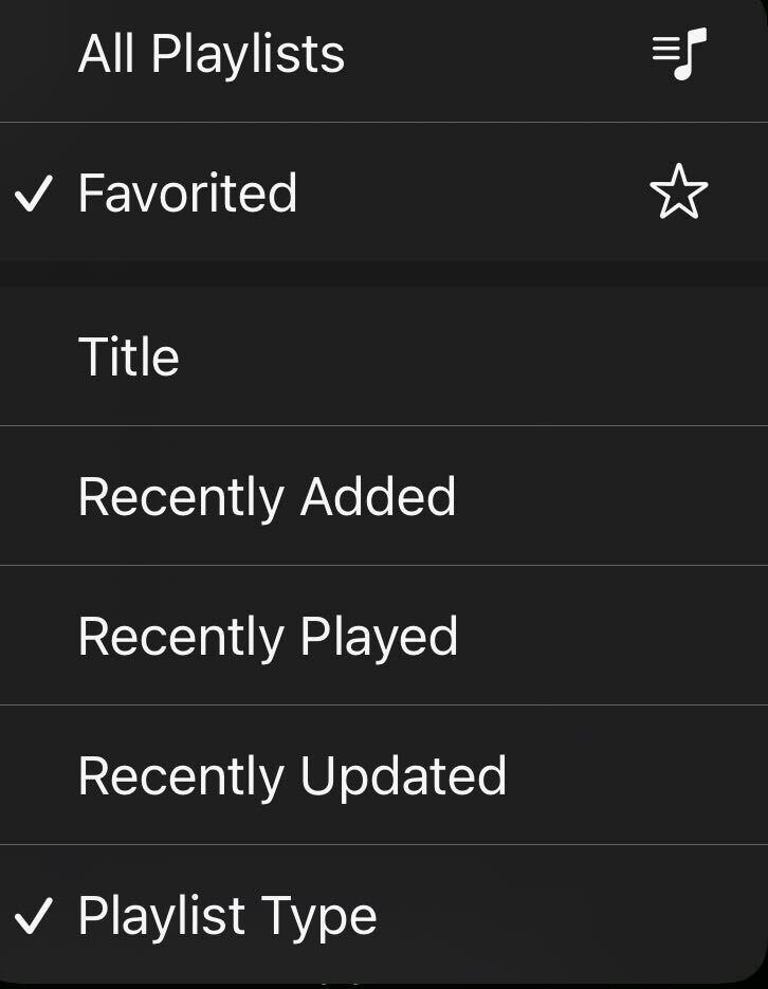
In iOS 17.1, Apple adds a new button in Apple Music that allows you to quickly find Favorite songs. When a song is playing and you’re looking at its card on your iPhone, there’s a star outline near the song’s title. You can tap this star to add the song to your Favorites.
There’s also a new way to find all your Favorited playlists, albums and songs. To find them, go into the corresponding category in Apple Music, tap the button in the top-right corner of your screen, and tap Favorited.
Apple Music also shows you song suggestions in iOS 17.1. To see them, go into any of your playlists and scroll to the bottom of the playlist to see a section called Song Suggestions. These are songs that the app thinks you might like, based on your musical tastes.
AirDrop using cellular data
With iOS 17, Apple upgraded AirDrop with NameDrop, which allows two devices to tap each other and exchange contact information — kind of like exchanging digital business cards. And in iOS 17.1, Apple now lets you use cellular data to send and receive information over AirDrop when two iPhones are out of range of each other.
Flashlight symbol in Live Activities
Have you ever accidentally switched on your iPhone’s flashlight and had someone point it out to you later? Some iPhone users won’t have to worry about that anymore. With iOS 17.1, when you turn on your flashlight, a little flashlight symbol appears in the Live Activities feed across the top of your screen. However, I couldn’t replicate this symbol anywhere on my iPhone XR, so this feature likely only works on Live Activity-enabled iPhones, like the iPhone 14 Pro and Pro Max, as well as the iPhone 15 lineup.
Full release notes for iOS 17.1
Here are Apple’s full release notes for iOS 17.1, including bug fixes and other improvements:
AirDrop
• Content continues to transfer over the internet when you step out of AirDrop range.StandBy
• New options to control when the display turns off (iPhone 14 Pro, iPhone 14 Pro Max, iPhone 15 Pro and iPhone 15 Pro Max).Music
• Favorites expanded to include songs, albums and playlists, and you can filter to display your favorites in the library.
• New cover art collection offers designs that change colors to reflect the music in your playlist.
• Song suggestions appear at the bottom of every playlist, making it easy to add music that matches the vibe of your playlist.This update also includes the following improvements and bug fixes:
• Option to choose a specific album to use with Photo Shuffle on the Lock Screen.
• Home key support for Matter locks.
• Improved reliability of Screen Time settings syncing across devices.
• Fixes an issue that may cause the Significant Location privacy setting to reset when transferring an Apple Watch or pairing it for the first time.
• Resolves an issue where the names of incoming callers may not appear when you are on another call.
• Addresses an issue where custom and purchased ringtones may not appear as options for your text tone.
• Fixes an issue that may cause the keyboard to be less responsive.
• Crash detection optimizations (all iPhone 14 and iPhone 15 models).
• Fixes an issue that may cause display image persistence.Some features may not be available for all regions or on all Apple devices. For information on the security content of Apple software updates, please visit this website: https://support.apple.com/kb/HT201222.
For more, check out my review of iOS 17 and our iOS 17 cheat sheet.

Technologies
Apple Gave Us the Neo, Now It Might Be Planning a High-End MacBook Ultra
The company might launch its most sophisticated MacBook ever, with its first OLED screen.
Apple went budget with the MacBook Neo. Now reportedly the company is preparing to go high end, and high price.
Apple is gearing up to launch a MacBook «Ultra» in the fall, outfitted with the first OLED display in MacBook history, according to a report from Bloomberg’s Mark Gurman.
Gurman says the new laptop will have a touchscreen and new M6 chips. Last month, Bloomberg reported that Apple could be launching its first touchscreen MacBook — with a Dynamic Island. The Dynamic Island is a feature on more recent iPhone models — iPhone 14 and later — that’s shaped like a long horizontal pill atop the screen and shows alerts, notifications, timers and music.
It if happens, the Ultra would be at the opposite end of the cost spectrum from the Neo, which Apple launched earlier this month for $599 as a rival to Chromebooks and Windows laptops in the same price range. Gurman says the MacBook Ultra could cost 20 percent more than the new MacBook Pro (M5 series), which Apple lists at $1,699.
If you want to read more about the new Neo, CNET has been all over it: Here’s why students might love it, the colors we liked and didn’t like and why the Neo is a really is a game-changer.
Gurman suggested that Apple might keep selling the M5 series MacBook Pro even after the Ultra launches. That would give the company a wider range of MacBooks at various costs — the Neo ($599), the Air (starting at $1,099), the Pro ($1,699) and the Ultra.
Tech analyst Paolo Pescatore said adding the premium MacBook Ultra would «signal a clear shift in strategy» for Apple.
«If this turns out to be the case, then Apple appears to be stretching the Mac further upmarket,» Pescatore told CNET. «The opportunity is to drive higher spending and keep premium users firmly within Apple’s ecosystem. The challenge will be avoiding confusion, especially if the lines between MacBook Pro and iPad Pro become even more blurred.»
Gurman also said that Apple’s first foldable iPhone, rumored to be launched later this year, might be called the «iPhone Ultra.»
Technologies
AI Is One of the Least-Liked Things in America, According to New NBC Poll
The poll finds that AI is viewed less positively than ICE and President Donald Trump, and only more positively than Iran and the Democratic Party.

Artificial intelligence has rapidly become embedded in everything from phones to schoolwork to war plans. And that means everyone is likely to have an opinion about the technology.
A new national survey conducted for NBC News highlights a striking disconnect between the spread of AI tools and Americans’ views on them. The poll, which ran from Feb. 27 to March 3, asked 1,000 registered voters about their views on topics ranging from border security to the new pope.
Only 26% of voters said they view AI positively, 46% view it negatively, and 28% said they feel unsure or have no opinion, leaving AI with a net favorability of -20. In the study, AI ranked less favorably than US Immigration and Customs Enforcement, President Donald Trump, former Vice President Kamala Harris, the Republican Party and The Late Show host Stephen Colbert. (Pope Leo XIV was by far the most popular person respondents were asked about.)
Among the rankings, AI is one of the least popular topics in the survey — ranking only slightly more positively than Iran and the Democratic Party.
A growing disconnect between AI and public opinion
There is a notable disconnect between the industry’s ongoing push for AI adoption and how Americans feel about it.
Tech companies are currently investing millions of dollars into developing generative AI tools and physical AI. In the last week alone, OpenAI released its latest GPT 5.4 model and AI companies made moves to work with the US Department of Defense. At the same time, Americans are growing increasingly wary of the technology.
The mismatch between adoption and public sentiment seems to be driven by concerns about AI’s broader impact, such as job displacement, privacy issues, the spread of misinformation and the undermining of human-made work.
For companies and policymakers going all in on AI, the biggest challenge will be less about developing the next slew of innovative chatbot models or AI devices and more about persuading the public that the technology can be trusted.
Technologies
Just $30 Will Get You 3 Months of the 5GB Mint Mobile Phone Plan
Finding a phone plan for $10 a month was impossible until this Mint Mobile deal came along.

If you told me I could get a three-month cell plan for just $30, I probably wouldn’t believe you. But that’s exactly what Mint Mobile is offering right now. If you pay for three months of 5GB cell service upfront, you can score it for just $30.
New customers to Mint Mobile can score a 5GB wireless plan for just $10 per month for the first three months. The only catch is you have to use the code 5GB10 and pay $30 upfront for the full term. The usual price is $45 for three months, meaning this is a 33% discount.
After the three-month period, the plan renews at $25 per month for three months. If you really like the plan, you can opt for the six-month version, which can lower the monthly cost to $20. You can also track your data usage in the Mint Mobile app and switch to a better-suited data plan when it’s time to renew.
Don’t forget a new phone to go with your new phone plan. Take a look at the best phone deals you can score right now.
MOBILE DEALS OF THE WEEK
-
$749 (save $250)
-
$298 (save $102)
-
$241 (save $310)
-
$499 (save $300)
Why this deal matters
It seems like everything is becoming more and more expensive these days. That’s why saving wherever you can makes a huge difference. The phone bill is one thing that is here to stay, and that’s why this deal of $10 per month is really unbeatable. Just keep in mind you’ll have to pay the full three months upfront. But even that is just $30 total. Be sure to use code 5GB10 for the discount.
-
 Technologies3 года ago
Tech Companies Need to Be Held Accountable for Security, Experts Say
-
 Technologies3 года ago
Best Handheld Game Console in 2023
-
 Technologies3 года ago
Tighten Up Your VR Game With the Best Head Straps for Quest 2
-
 Technologies4 года ago
Black Friday 2021: The best deals on TVs, headphones, kitchenware, and more
-
 Technologies5 лет ago
Google to require vaccinations as Silicon Valley rethinks return-to-office policies
-
 Technologies5 лет ago
Verum, Wickr and Threema: next generation secured messengers
-
 Technologies4 года ago
Olivia Harlan Dekker for Verum Messenger
-
 Technologies4 года ago
iPhone 13 event: How to watch Apple’s big announcement tomorrow