

Technologies
Don’t let inflation bite — how to hedge with TIPS, commodities and infrastructure funds
TIPS are looking attractive but they aren’t the only way to get inflation protection.


Inflation will be in the crosshairs Wednesday as investors digest the latest Consumer Price Index. The reading may be one more sign that inflation remains a problem that isn’t going away.
It’s a tricky situation for investors looking for protection, but there are some good ways to get it.
Treasury Inflation-Protected securities (TIPS) are one option with “real” yields now at multi-decade highs. Beyond TIPS, analysts suggest commodities, infrastructure, and other assets that can hedge against rising prices.
While inflation is down sharply from its 9.1% peak in 2022 — a supply shock due to the Covid pandemic — it’s still well above the Federal Reserve’s 2% target. The headline Consumer Price Index is expected to hit 3.6% in September, partly due to rising energy costs stemming from the war with Iran. The Personal Consumption Expenditures index, the Fed’s preferred gauge, was at a 3% core rate in August.
Americans’ inflation concerns are also rising. The New York Fed’s Survey of Consumer Expectations showed the one-year inflation outlook in September climbed to 3.9%, its highest level since May 2023.
TIPS deserve a second look
Despite their name, TIPS haven’t provided much inflation protection this year. The iShares TIPS Bond ETF, which tracks the ICE U.S. Treasury Inflation Linked Bond Index, has a total return of -1.16% year-to-date.
Like most other bonds, TIPS have been hit hard by rising interest rates — with the 10-year Treasury note recently hitting multi-year highs around 5.3%. Bond prices and yields move inversely, and as rates climbed many TIPS funds suffered.
But rising yields have made TIPS more attractive. The 10-year TIPS yield is currently at 2.87%, after closing at 2.951% on Oct. 5, levels not seen since November 2008, according to Tradeweb.
“Given where rates are, it’s getting interesting,” says Jason Draho, head of asset allocation Americas at UBS Global Wealth Management.
TIPS pay a fixed coupon, or interest rate, but as inflation moves higher, the principal value of the bond increases. The adjustments reflect changes in inflation, based on the non-seasonally adjusted CPI for All Urban Consumers, with a three-month lag.
The upshot is that TIPS investors earn interest on a higher principal value over time. That’s the essence of the protection compared to traditional Treasuries.
TIPS’ poor performance this year isn’t because of a surge in inflation expectations. Almost all the increase has been due to rising real yields — the nominal yield minus expected inflation. Real yields are up because of factors like robust economic growth and a U.S. fiscal deficit around 6% of gross domestic product (requiring far more government borrowing).
If nominal rates were rising just due to inflation, then TIPS total return — a mix of yield and price — would be fine, said R.J. Gallo, chief investment officer of global fixed income at Federated Hermes. But that isn’t the case.
“TIPS have produced losses in total return because their income accruals have been insufficient to offset the price decline produced by the rising underlying real yields,” Gallo explained.
TIPS maturing in 10 years or more are highly sensitive to duration risk, Draho notes. “You’re making a big call on rates not rising any further if you buy TIPS, especially longer maturities of 10-year plus,” he said.
The bull case is that inflation comes down quicker than expected. That’s not the market’s expectation, based on short-term Treasury yields, notes Draho. But if inflation does ease next year, which he expects, the yield curve would adjust lower.
One way to manage duration risk is to own individual TIPS rather than a fund that has to maintain duration consistent with a benchmark index. Investors could create a TIPS bond ladder with varying maturities, pegged to their income needs over the next decade, for instance.
If you hold a TIPS to maturity you may experience price volatility, but you’ll get the original principal or inflation-adjusted price, whichever is greater, when the bond matures.
Short-term TIPS provide more protection against rate increases and they look attractive, said PIMCO portfolio manager Greg Sharenow.
“While as a firm, our view is that inflation will ultimately come down, that view keeps on being pushed out as real world events unfold,” he said. “We’ve seen over and over again the last five to seven years — where we’re now in our third supply shock — that you end up actually underpricing versus realized inflation,” he added.
Funds focusing on short-term TIPS include Vanguard Short-Term Inflation-Protected Securities ETF, iShares 0-5 Year TIPS Bond ETF and PIMCO 1-5 Year US TIPS Index ETF.
Stocks and other hedges
TIPS, of course, aren’t the only way to go. Rick Rieder, BlackRock’s chief investment officer for global fixed income, suggests a multi-pronged strategy, including equities, commodities, and alternative assets.
“I’d start layering in more income, keep interest-rate exposure moderate, and then what a lot of people are doing is use things like alternatives to to create more balance in a portfolio,” he said. “That makes a lot of sense to me.”
Broad inflation-protection funds include State Street Multi-Asset Real Return ETF, Fidelity Strategic Real Return Fund and PIMCO Inflation Response Multi-Asset Fund.
The PIMCO fund’s holdings include TIPS, commodities, gold and real estate investment trusts.
“The idea is to have a number of different exposures so that we can have a more balanced return and not try to be so specific in getting the exact right asset class at any one moment,” said Sharenow, a manager on the fund.
He adds that he sees “significant value” in TIPS, which have the heaviest weighting in the portfolio. Commodities are the next largest holding. They have price “pass-throughs,” which is how much companies can shift costs to customers through price increases. That is beneficial to investors, he noted.
Separately, the fund holds about 10% each in gold and REITs.
Draho recommends commodities, based partly on long-term asset-allocation studies that include the 1970s when inflation was far higher. “Over a long period they can help reduce risk and improve diversification,” he said. “Their benefits have been most pronounced when inflation was overshooting expectations.”
Rather than picking individual commodities, he suggests owning a basket that’s consistently rebalanced. Gold and oil, for instance, perform well in different economic and monetary policy scenarios, and it can be tricky to get the timing right.
Commodity ETFs to consider include the Invesco Optimum Yield Diversified Commodity Strategy ETF (PDBC) and the iShares S&P GSCI Commodity-Indexed Trust (GSG).
Another asset class Draho suggests is infrastructure — operators of roads, ports, bridges, and other hard assets. Companies in the space tend to be toll takers, collecting long-term revenue under contracts that include inflation riders or built-in price adjustments.
Investors can get exposure to infrastructure through ETFs such as the iShares Global Infrastructure ETF (IGF) and ProShares DJ Brookfield Global Infrastructure ETF (TOLZ).
Draho isn’t sounding alarms on inflation but says it makes sense to add protection against another move higher.
“The risk now is there will be supply side shocks that could push up inflation again,” he said.
— CNBC’s Daren Fonda contributed reporting.
Technologies
10-year Treasury yield jumps as September core inflation comes in hotter than expected
Treasury yields moved higher after the latest inflation reading.

The 10-year Treasury note
The Consumer Price Index rose 3.7% year over year in September, higher than the Dow Jones consensus estimate of 3.6%. Core inflation, excluding food and energy prices, came in at 2.6% on an annualized basis, versus the 2.5% consensus estimate.
The yield on the 10-year Treasury note — the main benchmark for mortgages, auto loans and credit card debt — jumped 10 basis points to 5.323%, the highest level since Oct. 8, when it hit 5.354%
The longer-dated 30-year U.S. Treasury
The two-year Treasury
One basis point equals 0.01%, or 1/100th of 1%, and yields and prices move inversely.
| Symbol | Company | Yield | Change |
|—|—|—|—|
| US10Y | U.S. 10 Year Treasury | 5.302% | +0.085 |
| US1M | U.S. 1 Month Treasury | 4.024% | +0.043 |
| US1Y | U.S. 1 Year Treasury | 4.583% | +0.114 |
| US2Y | U.S. 2 Year Treasury | 4.91% | +0.117 |
| US30Y | U.S. 30 Year Treasury | 5.616% | +0.053 |
| US3M | U.S. 3 Month Treasury | 4.252% | +0.07 |
| US6M | U.S. 6 Month Treasury | 4.441% | +0.096 |
The latest inflation reading comes just two weeks before the Fed’s next interest rate decision.
With inflation remaining sticky, the central bank may need to raise rates higher and keep them there for longer in 2027, said Christopher Rupkey, chief economist at Fwdbonds.
“The bond bulls have turned around and are running the other way as 10-year yields have shot higher after today’s shocking inflation report,” he said. “Inflation is alive and the only way the Warsh Fed knows how to kill it is with another dose of higher rates.”
Investors also await the September reading for the producer price index, September retail sales data and weekly initial jobless claims figures, all due on Thursday.
Technologies
IEA warns diesel shortage to persist until mid-2027 amid Iran conflict
The IEA warns that diesel market constraints will persist until mid-2027 due to supply disruptions from the Iran war and strong demand, with prices reaching record highs.
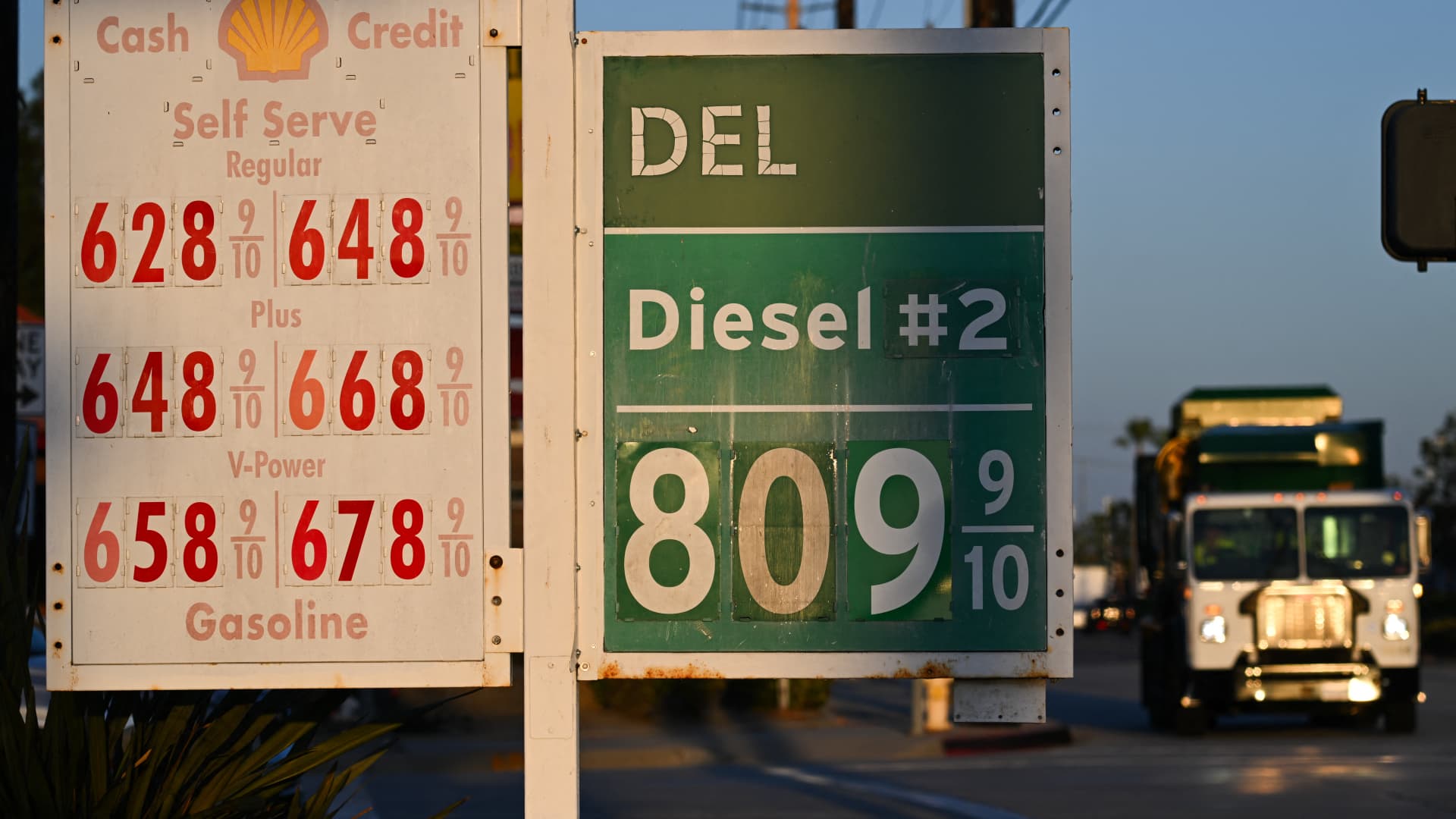
The International Energy Agency has cautioned that diesel market constraints will extend well into next year, with supply tightness projected to last until the second half of 2027.
In its October Oil Market Report, the IEA highlighted that a counter-seasonal tightening in gasoil markets during the third quarter, coupled with substantial inventory declines over the preceding months, has critically depleted global stock cover ahead of the peak winter demand season.
Data from the agency indicates that global diesel exports fell by 700,000 barrels per day year-on-year last month, with a loss of 1.3 million barrels per day from Russia and the Middle East only partially offset by increased supply from other sources.
Despite higher prices dampening broader oil demand, diesel demand remains robust due to its relative price inelasticity and government measures aimed at protecting consumers from high prices. The IEA noted that falling inventories, soaring cracks, and steepening backwardation signal the need for additional supplies.
However, even with an anticipated rapid recovery in refinery throughputs by year-end, gasoil supply will be insufficient to meet demand in the fourth quarter of 2026, indicating that inventory replenishment beyond seasonal fluctuations is unlikely before the second half of 2027.
Wholesale diesel prices surged to over $200 per barrel in Singapore in mid-September and reached record highs of approximately $220 per barrel in Europe and the United States. Retail prices have similarly climbed to record levels in most major economies.
The agency also warned that tensions in the crude freight market could lead to further increases in delivered diesel prices in key importing regions such as Europe, Africa, and Latin America. In related developments, U.S. diesel prices hit $6 a gallon for the first time last month, with the ongoing Iran war continuing to disrupt global energy markets.
President Donald Trump announced a deal with Russian President Vladimir Putin for Russia to immediately supply 300,000 metric tons of diesel to the global market, aiming to alleviate price pressures. However, this move faced bipartisan criticism in the U.S. and from European officials, who emphasized that now is not the time to ease sanctions on Russia.
European Commissioner for the Economy and Productivity Valdis Dombrovskis questioned the macroeconomic significance of the deal and Russia’s ability to deliver. Italian Prime Minister Giorgia Meloni warned that the agreement undermines efforts to negotiate with Putin regarding Ukraine.
The IEA forecasts a decline in overall oil demand by an average of 2.6 million barrels per day in 2026, with diesel accounting for 25% of this reduction. Oil supply is expected to decrease by 5.8 million barrels per day annually in 2026, before rising by 7.7 million barrels per day in 2027.
However, the agency cautioned that renewed attacks in the Gulf, including recent strikes on Riyadh by Yemen’s Houthis, could destabilize the market recovery, especially as Saudi production increases in September contributed to OPEC+ supply gains.
Technologies
Social Security cost-of-living adjustment for 2027 may be above average. Some say it’s not enough
The Social Security Administration is expected to announce the cost-of-living adjustment for 2027. Projections point to a higher-than-average increase.

Millions of Social Security beneficiaries may see a larger-than-average cost-of-living adjustment in 2027, according to experts’ estimates.
The Social Security Administration is expected to announce the COLA for 2027 on Wednesday with the release of new government inflation data. Social Security experts estimate that the COLA may raise benefits by 3.5% to 3.6% next year, which would be the largest increase in three years.
Yet, even with an above-average increase, beneficiaries may still struggle to cover everyday costs.
More than three-quarters of adults 50 years and older — 76% — said they do not think a projected 3.5% Social Security cost-of-living adjustment for 2027 would be enough, according to an AARP survey published Monday. The poll of 1,023 adults ages 50-plus was fielded between Sept. 17 and 21. The survey had a 4.25% margin of error.
“I would love it if the cost-of-living increase was more generous,” said Donna Dalrymple, a 70-year-old retiree in Manchester, New Hampshire.
Dalrymple retired at age 65 following a cancer diagnosis, she said, which prompted her to claim Social Security benefits and start 401(k) withdrawals five years earlier than she had planned. Today, she worries that other rising costs, particularly those for Medicare, may outpace the annual Social Security benefit increase, she said.
Cost-of-living adjustments have averaged about 3.1% over the past decade, according to the Social Security Administration.
In September, estimates showed the Social Security COLA may be the highest in three years.
The Senior Citizens League, a nonpartisan senior advocacy group, and Mary Johnson, an independent Social Security and Medicare policy analyst, both forecast a 3.5% COLA for 2027. Meanwhile, AARP forecasts a 3.6% increase to benefits.
The last time beneficiaries saw a larger increase was in 2023, when the COLA jumped to 8.7% — the highest in four decades — as a result of soaring inflation. In 2022, beneficiaries saw a 5.9% rise as the inflation rate began to climb.
In 2026, Social Security beneficiaries received a 2.8% boost to their benefits.
A 3.5% Social Security cost-of-living adjustment for 2027 would increase the average benefit check by $67.90 per month — to around $2,008 per month from $1,940 — according to the Senior Citizens League.
How COLA may differ from estimates
AARP’s recent survey found that 7 in 10 adults ages 50-plus said an increase between 5% and 8% would be sufficient to help keep up with the daily cost of living.
The official Social Security COLA announcement expected Wednesday may differ from September’s estimates, since it will include an additional month of inflation data.
A “very stiff jump in inflation” could push the Social Security COLA to 3.6%, Johnson said. But if inflation comes in lower than expected, the COLA may be 3.4%, she said.
Social Security’s cost-of-living adjustment is automatically applied to benefits to help keep pace with inflation.
Since 1975, COLAs have been calculated annually for both Social Security and Supplemental Security Income, or SSI, benefits. However, in some years when there was little to no inflation, the COLAs have been zero.
“People are very, very grateful for it, and they look forward to it,” Social Security Administration Commissioner Frank Bisignano said Monday of the upcoming COLA announcement during an interview with CNBC’s “Squawk on the Street.”
How Medicare costs may affect COLA
Rising Medicare costs in 2027 may limit how much of an increase Social Security beneficiaries see in their monthly checks.
Standard monthly premiums for Medicare Part B, which are typically automatically deducted from Social Security checks, are projected to be $209.50 in 2027, up from $202.90 in 2026. Medicare Part B covers certain medically necessary and preventive services. Some beneficiaries may pay extra surcharges, known as Income-Related Monthly Adjustment Amounts, if their incomes exceed certain thresholds.
Meanwhile, Medicare Part D prescription drug plans may see modest premium increases in 2027, according to an analysis by KFF, a nonpartisan health policy research group. Part D premiums may also be deducted directly from Social Security checks.
The Trump administration recently announced it is sending one-time $90 direct payments to more than 20 million Medicare Part B enrollees to help pay for monthly premium costs.
Dalrymple, the New Hampshire retiree, said she does not think she qualifies for the one-time payment, which excludes millions of Part B beneficiaries through certain eligibility criteria. Dalrymple said she worries about rising Medicare costs for 2027.
“If Medicare cost eats up the cost of living [adjustment], I’m really going to get slammed by the affordability crisis because rents are going up, groceries are going up, gas is going up,” Dalrymple said.
Some Democrats like Sen. Ron Wyden, D-Ore., ranking member of the Senate Finance Committee, have questioned the Trump administration’s motives to send the $90 payments just a month or so ahead of the midterm election. President Donald Trump has separately said the government would send $5,000 to every U.S. adult citizen if Republicans retain control of the House and Senate.
Bisignano told CNBC on Monday that the $90 one-time payments are an example of the Trump administration “taking care of Americans” and working to keep vulnerable individuals, including the elderly, out of poverty.
Kathy Callaghan, 80, of Montpelier, Vermont, said she would have preferred the money had been put in the Medicare trust fund — which is projected to run out of money to fund Part A in 2033 — rather than distributed to Americans through checks.
Callaghan said she plans to donate her $90 check to the Senate campaign of James Talarico, a Democrat and Texas state representative running for the U.S. Senate.
-
 Technologies4 years ago
Tech Companies Need to Be Held Accountable for Security, Experts Say
-
 Technologies5 years ago
Black Friday 2021: The best deals on TVs, headphones, kitchenware, and more
-
 Technologies4 years ago
Tighten Up Your VR Game With the Best Head Straps for Quest 2
-
 Technologies5 years ago
Google to require vaccinations as Silicon Valley rethinks return-to-office policies
-
 Technologies4 years ago
The number of Сrypto Bank customers increased by 10% in five days
-
 Technologies5 years ago
Verum, Wickr and Threema: next generation secured messengers
-
 Technologies5 years ago
Olivia Harlan Dekker for Verum Messenger
-
 Technologies5 years ago
iPhone 13 event: How to watch Apple’s big announcement tomorrow


