

Technologies
Gold prices have pulled back — but a Morgan Stanley strategist sees 3 key reasons to hold the precious metal
A Morgan Stanley strategists has highlighted three factors which could help support gold prices over the coming months.


Gold’s recent slide may not be enough to undermine the longer-term case for holding the precious metal, according to Morgan Stanley, which sees resilient physical demand and concerns over government finances providing structural support for bullion. Amy Gower, head of metals and mining strategy at Morgan Stanley, highlighted three factors which could help underpin prices over the coming months, despite gold sliding towards a seven-week low earlier this week. Gold futures edged higher on Wednesday to $4,212.60, a 0.77% advance, while spot gold was flat at $4,180.78. The move comes after bullion fell sharply during Monday’s session amid concerns that rising bond yields could dampen appetite for non-interesting-bearing assets, like precious metals. The precious metal has fallen roughly 10% over the last six months. Physical demand for gold remains strong, particularly among central banks, which bought a net 23 metric tons during July, according to World Gold Council data published earlier this month. Gower pointed specifically to China and Poland, which purchased 20 metric tons and 8 tons of gold, respectively, during July. She told CNBC’s “Squawk Box Europe” on Tuesday that Chinese imports of gold broadly are on track to be the highest since 2017. “China seems to have this very strong appetite for gold,” she said. @GC.1 YTD mountain Gold futures. China’s total gold imports, which also reflect private and institutional demand, exceeded 1,000 metric tons during the first eight months of the year, the WGC said. Secondly, as markets remain gripped by concerns around long-term public debt and fiscal sustainability globally, Gower acknowledged that higher bond yields remain a challenge for non-yielding assets like gold. However, while traders’ expectations of fresh Federal Reserve rate hikes are growing, Gower indicated that any further policy intervention or changing market expectation over inflation could move in gold’s favor. “What if we get more intervention in that long-dated bond market and then you get yields coming back down?” Gower said. Meanwhile, as U.S. and Iranian officials reportedly hold separate talks with mediators with a view to resolving the seven-month conflict in the Middle East, a rapid de-escalation could help pull oil prices lower. Kpler data shows Middle Eastern crude exports rebounding this month to their highest level since the war began. any easing of inflation expectations could help contain upward pressure on interest rates and bond yields, in turn boosting gold prices. “What happens if oil comes down?” Gower said. Heading into the final quarter of 2026, Gower said she favors gold on a 12-month view, acknowledging the potential for volatility in the asset against an uncertain economic backdrop of more Federal Reserve meetings and data releases. “There are still lots of reasons to have gold,” she said. “We see $4,000 as quite a strong floor.”
– Your Privacy
– Strictly Necessary
– Save and communicate privacy choices 521 partners can use this special purpose
– Ensure security, prevent and detect fraud, and fix errors 655 partners can use this special purpose
– Deliver and present advertising and content 642 partners can use this special purpose
– Store and/or access information on a device 850 partners can use this purpose
– Personalised advertising and content, advertising and content measurement, audience research and services development 992 partners can use this purpose
– Targeted Advertising
– Content Selection
On this service, we and our vendors use cookies and other tools (“Cookies”) to store and access information on your device, such as device identifiers, IP address, and your browser type. Your data may be used to save and communicate your privacy choices; ensure security, prevent fraud, and debug our products and services; personalize advertising and content; for advertising and content measurement; to conduct audience research and services development; so we can improve our services and develop new ones; to match and combine offline data with your online activity; and for social features. We may share this data with select vendors with your consent. You can adjust your choices any time through the “Cookie Preferences” link in the footer of relevant Versant sites or in-app settings.
We will also use other Cookies that are essential or related to our services, including for security and fraud prevention. To learn more about some of our vendors, see the IAB and Google Vendors under each purpose. Visit our Cookie Notice and Privacy Policy to learn more.
Always Active
These Cookies and SDKs are required for Service functionality, including security and fraud prevention, and to enable any purchasing capabilities. You can set your browser to block these tracking technologies, but some parts of the site may not function properly.
The choices you make regarding the purposes and entities listed in this notice are saved and made available to those entities in the form of digital signals (such as a string of characters). This is necessary in order to enable both this service and those entities to respect such choices.
Your data can be used to monitor for and prevent unusual and possibly fraudulent activity (for example, regarding advertising, ad clicks by bots), and ensure systems and processes work properly and securely. It can also be used to correct any problems you, the publisher or the advertiser may encounter in the delivery of content and ads and in your interaction with them.
Certain information (like an IP address or device capabilities) is used to ensure the technical compatibility of the content or advertising, and to facilitate the transmission of the content or ad to your device.
Cookies, device or similar online identifiers (e.g. login-based identifiers, randomly assigned identifiers, network based identifiers) together with other information (e.g. browser type and information, language, screen size, supported technologies etc.) can be stored or read on your device to recognise it each time it connects to an app or to a website, for one or several of the purposes presented here.
– Use limited data to select advertising 791 partners can use this purposeAdvertising presented to you on this service can be based on limited data, such as the website or app you are using, your non-precise location, your device type or which content you are (or have been) interacting with (for example, to limit the number of times an ad is presented to you).
– Create profiles for personalised advertising 637 partners can use this purposeInformation about your activity on this service (such as forms you submit, content you look at) can be stored and combined with other information about you (for example, information from your previous activity on this service and other websites or apps) or similar users. This is then used to build or improve a profile about you (that might include possible interests and personal aspects). Your profile can be used (also later) to present advertising that appears more relevant based on your possible interests by this and other entities.
– Use profiles to select personalised advertising 640 partners can use this purposeAdvertising presented to you on this service can be based on your advertising profiles, which can reflect your activity on this service or other websites or apps (like the forms you submit, content you look at), possible interests and personal aspects.
– Create profiles to personalise content 261 partners can use this purposeInformation about your activity on this service (for instance, forms you submit, non-advertising content you look at) can be stored and combined with other information about you (such as your previous activity on this service or other websites or apps) or similar users. This is then used to build or improve a profile about you (which might for example include possible interests and personal aspects). Your profile can be used (also later) to present content that appears more relevant based on your possible interests, such as by adapting the order in which content is shown to you, so that it is even easier for you to find content that matches your interests.
– Use profiles to select personalised content 234 partners can use this purposeContent presented to you on this service can be based on your content personalisation profiles, which can reflect your activity on this or other services (for instance, the forms you submit, content you look at), possible interests and personal aspects. This can for example be used to adapt the order in which content is shown to you, so that it is even easier for you to find (non-advertising) content that matches your interests.
– Measure advertising performance 916 partners can use this purposeInformation regarding which advertising is presented to you and how you interact with it can be used to determine how well an advert has worked for you or other users and whether the goals of the advertising were reached. For instance, whether you saw an ad, whether you clicked on it, whether it led you to buy a product or visit a website, etc. This is very helpful to understand the relevance of advertising campaigns.
– Measure content performance 405 partners can use this purposeInformation regarding which content is presented to you and how you interact with it can be used to determine whether the (non-advertising) content e.g. reached its intended audience and matched your interests. For instance, whether you read an article, watch a video, listen to a podcast or look at a product description, how long you spent on this service and the web pages you visit etc. This is very helpful to understand the relevance of (non-advertising) content that is shown to you.
– Understand audiences through statistics or combinations of data from different sources 579 partners can use this purposeReports can be generated based on the combination of data sets (like user profiles, statistics, market research, analytics data) regarding your interactions and those of other users with advertising or (non-advertising) content to identify common characteristics (for instance, to determine which target audiences are more receptive to an ad campaign or to certain contents).
– Develop and improve services 688 partners can use this purposeInformation about your activity on this service, such as your interaction with ads or content, can be very helpful to improve products and services and to build new products and services based on user interactions, the type of audience, etc. This specific purpose does not include the development or improvement of user profiles and identifiers.
– Use limited data to select content 180 partners can use this purposeContent presented to you on this service can be based on limited data, such as the website or app you are using, your non-precise location, your device type, or which content you are (or have been) interacting with (for example, to limit the number of times a video or an article is presented to you).
These Cookies and SDKs are used to collect data about your browsing habits, use of the Services, your preferences, and your interaction with advertisements across platforms and devices for the purpose of delivering targeted advertising content, both on our Services and on third party sites. Third-party sites and services also use Targeting Cookies to deliver content, including advertisements relevant to your interests on the Services. If you reject these Cookies or SDKs, you will see less relevant advertising.
Data collected under this category through Cookies and SDKs can also be used to select and deliver personalized content, such as news articles and videos.
Consent Leg.Interest
label
Technologies
Hedge funds hold a record share of the $30 trillion Treasury market. What could go wrong?
Hedge funds can boost Treasury market liquidity, but their growing role also risks creating financial instability.
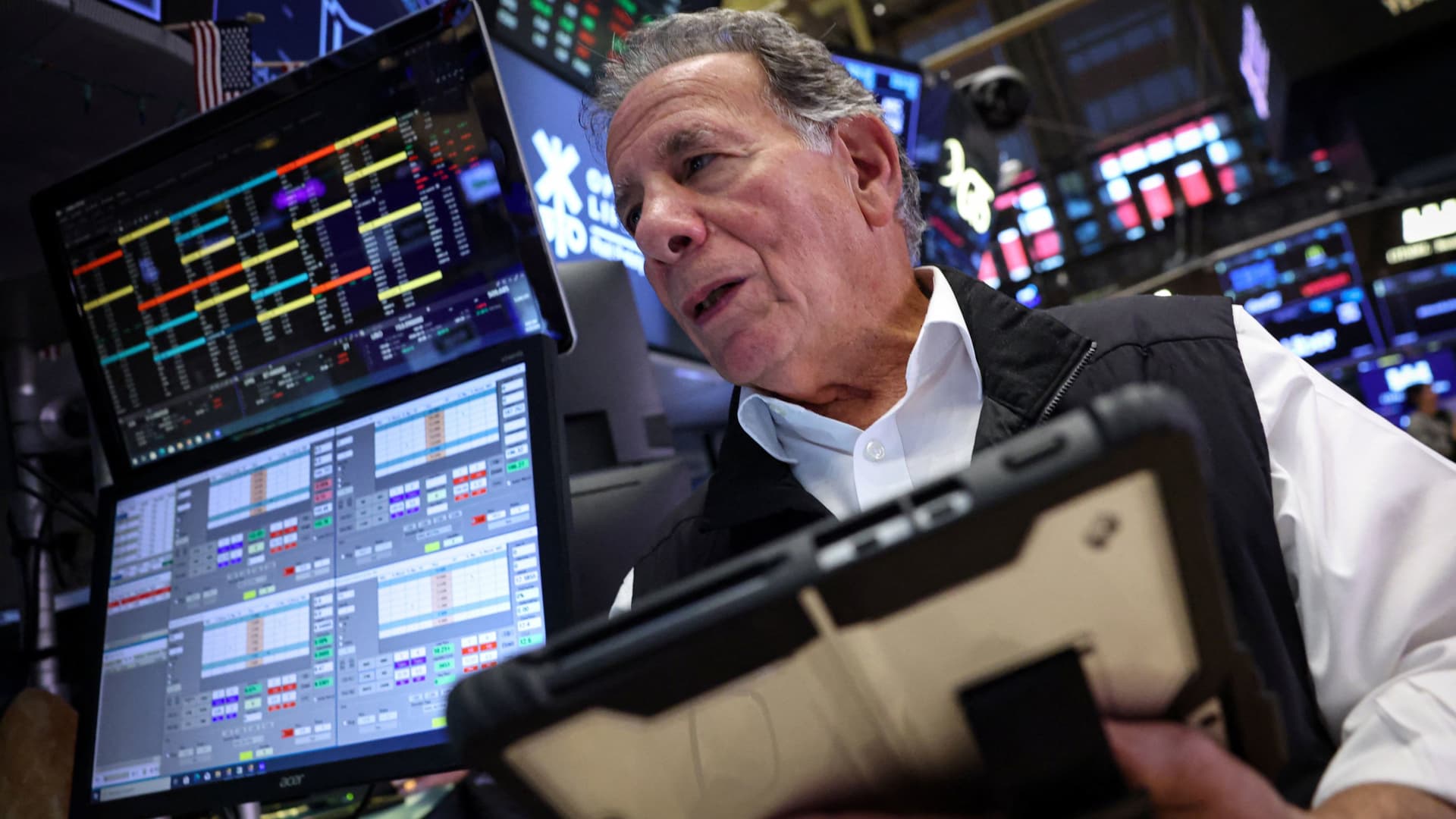
Hedge funds are becoming a force to be reckoned with in the roughly $30 trillion U.S. Treasury market, stepping in at a time when some traditional long-term investors have been looking at other options.
The shift is helping the government find buyers as its pile of debt grows, but it may also be making the world’s largest bond market more vulnerable, experts told CNBC.
Hedge funds’ cash Treasury holdings reached $2 trillion at the end of 2025, nearly three times their level five years earlier, the U.S. Treasurys Office of Financial Research said last month. Marketable Treasury debt — which is traded in the secondary market — was $28.9 trillion, putting hedge funds’ share at a record 7%.
More recent Federal Reserve data shows hedge funds remained net buyers of Treasurys in the first half of 2026. Domestic hedge funds bought a net $60.6 billion in the second quarter, up from $26.4 billion in the first, bringing first-half purchases to about $87 billion.
The interest from hedge funds comes at a particularly sensitive time for the Treasury market, with the 10-year yield surging to its highest level since 2007 on Monday and the 30-year soaring to the highest since 2002 on Tuesday.
“Hedge funds apply relatively aggressive leverages as compared to other types of investors and therefore may magnify systematic risk,” said Ricky Siao, a hedge fund specialist from Union Bancaire Privée.
“When forced deleveraging happens due to extreme situations or crisis scenarios, it may result in broader liquidity and financial stability event.”
A different kind of buyer
Pension funds have traditionally been buyers of long-dated government bonds because the extended investment horizons allow them to match assets against liabilities stretching decades into the future.
But structural changes, including the migration from defined-benefit plans that promise a predetermined payout to defined-contribution plans whose value depends on investment returns, are reducing pension funds’ interest in long-term government bonds, according to the OECD.
The shift also comes as some pension funds are increasing allocations to higher-yielding, less-liquid assets such as private credit. Institutional investors poured close to $300 billion into private credit vehicles in 2025, according to Mercer.
Regulators have also flagged risks that come with hedge funds’ increasing participation. The Federal Reserve said in its May financial stability report that hedge-fund leverage remained near record highs and was concentrated among large funds, with leveraged strategies supporting significant positions in Treasurys and other markets. “High leverage can lead to spillovers if the fund suddenly loses access to funding,” the Fed said.
The Bank for International Settlements went further, warning earlier this year that the rise of hedge funds as core intermediaries in government bond markets had created “new financial stability vulnerabilities.” Their reliance on leverage and short-term repo financing could leave core markets more exposed to sudden deleveraging and bouts of market dysfunction, it said.
Hedge funds aren’t simply buying Treasurys because they like the yield.
“They are very different, most pension and insurers have very long term time horizons and focus on liability matching. Hedge funds are about performance, typically shorter term focused on high watermarks and benchmark-beating returns,” said Noah Hamman, founder of AdvisorShares.
Stress test
Much of hedge funds’ activity involves relative-value strategies designed to exploit small pricing differences between closely related securities. One of the most prominent is the Treasury cash-futures basis trade, in which funds buy cash Treasurys while selling corresponding futures, expecting to gain from the price difference between the two markets.
Because the price differential between the cash and futures market is typically tiny, funds often use substantial leverage to generate attractive returns. Repo financing allows them to borrow against Treasury collateral and build positions many times larger than their underlying capital.
There are already signs that hedge funds are becoming more selective as the Treasury sell-off intensifies. Leveraged Treasury basis-trade position have reportedly fallen about 20% this year to $1.2 trillion, according to Morgan Stanley estimates.
The pullback doesn’t necessarily mean hedge funds are dumping Treasurys outright, as Fed data shows they remained net buyers through the second quarter.
But the retreat underscores how quickly leveraged positions can shift when market conditions change and highlights the risk of a disorderly unwind during periods of stress.
“The biggest risk is the basis trade, where a hedge fund simultaneously buys Treasury notes and sells the futures contract that the notes are eligible to settle against,” said Don Steinbrugge, founder and CEO of Agecroft Partners. “These trades have thin margins and can often be levered 20 times, if not higher.”
“As we saw in March 2020, when Treasury market liquidity deteriorated sharply, leveraged funds can be forced to unwind positions quickly. This can create a vicious cycle of margin calls, forced selling, and further market volatility.”
A spike in volatility can drive leveraged hedge funds to put up more cash or unwind their trades. That selling can push prices lower, deepen losses and force other funds to exit.
Besides raising concerns, experts also pointed to the constructive role of hedge fund in the Treasury market.
Ken Heinz, president of Hedge Fund Research, said that hedge funds’ willingness to trade rather than simply hold bonds to maturity can provide two-sided liquidity during both rallies and sell-offs, adding that it could ultimately stabilize rate moves and reduce volatility.
The tension is therefore not that hedge funds are inherently bad for the Treasury market. In normal conditions, their trading can improve liquidity and help correct pricing discrepancies.
“Regulators should be concerned about the potential for a disorderly unwind while weighing the benefits of market liquidity that hedge funds provide when making policy decisions,” said Steinbrugge. “Hedge funds’ growing role in the Treasury market is both necessary for liquidity and a potential source of systemic risk.”
Technologies
U.S., Iran hold separate mediator talks as Mideast oil exports hit war-time high
Iranian and U.S. officials reportedly met separately with mediators Monday to push for a ceasefire, as Middle Eastern crude exports rebounded to war-time high.

U.S. and Iranian officials have reportedly held separate indirect talks with mediators on Monday, reviving efforts to end seven months of war as Tehran presses for a response to a revised ceasefire framework and Middle East crude exports climb to their highest level since the conflict began.
Iranian Foreign Minister Abbas Araghchi met Qatari mediators in New York, where he remained after the United Nations General Assembly, and reportedly said he expects Washington’s reply by Tuesday. “We talked about ideas and how to find solutions to fulfil Iran’s conditions,” Araghchi said, adding that he planned to return to Tehran once a response arrives. “Whenever the Qataris have a response, they know how to get it to us.”
Iran’s proposal, first presented on the sidelines of last week’s General Assembly, calls for a four- to five-day U.S. timeline to release frozen Iranian funds, lift sanctions on Iranian oil and end the naval blockade of Iranian ports, with nuclear talks beginning within seven days. Tehran has tied any reopening of the Strait of Hormuz to those steps.
President Donald Trump had on Sunday called the plan “unacceptable” and rejected it, telling reporters Iran wants a swift deal because of the economic pressure it is under. Speaking at the White House Monday, Trump said U.S. officials had spoken separately with mediators but gave no further details, adding: “We’re going to win. It’s going to go pretty quickly.”
The diplomatic push comes as physical supply data shows the war’s toll on the oil market easing. Middle Eastern crude exports rebounded this month to around their highest level since the war began in February, Kpler data showed. “Middle East crude exports at just under 80% of pre-conflict levels,” the tracking firm said in a note on Monday.
The Strait of Hormuz itself remains far from normal. Kpler’s real-time tracking showed total clearance through the strait at 10,591 kilobarrels a day on Saturday, against a pre-war baseline of 17,133.
The unresolved standoff is also feeding into U.S. fuel markets, with retail diesel prices hovering near a record high of $6.53 a gallon. The Trump administration is again weighing an export ban days after distancing itself from an earlier version of the plan — a move Kpler estimates would keep roughly 1.2 million barrels a day at home and risk overwhelming storage.
Technologies
Oil prices fall as crude exports recover at Saudi Arabia’s Red Sea ports
Saudi Arabia has restored flows through the pipeline to around 3.5 million barrels per day, according to media reports.

Oil prices fell Tuesday as Saudi Arabia’s crude exports from its Red Sea ports recover from an attack on a key pipeline earlier this month.
Brent crude
Satellite imagery has confirmed a “major operational recovery” at the Yanbu and Muajjiz terminals, according to a Kpler note published Tuesday.
A total of 12.5 million barrels were loaded onto nine tankers at Yanbu from Saturday through Monday, according to Kpler. Exports from Yanbu were disrupted by the drone attack on Saudi Arabia’s East-West pipeline earlier this month, raising fears of another major hit to global supplies.
But Riyadh has restored flows through the pipeline to around 3.5 million barrels per day, people familiar with the matter told The Wall Street Journal and Bloomberg News on Monday. Its maximum capacity is 7 million bpd.
U.S. and Iranian officials, meanwhile, spoke to mediators on Monday as they try again to negotiate a deal to end the seven-month-long conflict.
Iran offered last week to reopen the Strait of Hormuz in seven days if the U.S. commits to the conditions in the failed June memorandum of understanding. But President Donald Trump on Saturday rejected Tehran’s proposal as oil exports through Hormuz recover.
Oil flows through Hormuz have hit a seven-day average 13.2 million barrels per day, which is 77% of the 17 million bpd that transited the waterway before the U.S.-Iran war, according to Kpler data.
The U.S. military provides protection to tankers from its Gulf allies and maintains a blockade against Iran’s exports.
-
 Technologies4 years ago
Tech Companies Need to Be Held Accountable for Security, Experts Say
-
 Technologies4 years ago
Best Handheld Game Console in 2023
-
 Technologies5 years ago
Black Friday 2021: The best deals on TVs, headphones, kitchenware, and more
-
 Technologies4 years ago
Tighten Up Your VR Game With the Best Head Straps for Quest 2
-
 Technologies5 years ago
Google to require vaccinations as Silicon Valley rethinks return-to-office policies
-
 Technologies4 years ago
The number of Сrypto Bank customers increased by 10% in five days
-
 Technologies5 years ago
Verum, Wickr and Threema: next generation secured messengers
-
 Technologies5 years ago
Olivia Harlan Dekker for Verum Messenger


