

Technologies
Investors zero in on August inflation data in the week ahead after yields spike to levels not seen in years
Next week’s inflation data takes on even greater importance for investors as they try to determine where the Federal Reserve could go with interest rates.


Following this week’s much hotter-than-expected August jobs report , next week’s inflation data takes on even greater importance for investors as they try to determine where the Federal Reserve could go with interest rates later this month. On Friday, nonfarm payrolls rose 162,000 last month , well above the Dow Jones forecast of 53,000, while the unemployment rate came in line with expectations at 4.1%. July and June also saw upward revisions. Stocks fell as investors recalibrated their expectations on the Fed’s rate decision when it meets Sept. 15-16. Fed funds futures pricing showed bets for a hike at that meeting grew to 58% from 49.4% the day before, according to the CME FedWatch tool . With the report supporting Fed Chairman Kevin Warsh’s recent comments that the labor market is ” quite stable ,” the release of August’s producer and consumer price index readings on Thursday and Friday, respectively, will serve as the final piece in the rate path puzzle for investors. “What’s been happening in the market now is that it’s the tug of war between those who are worried that the Fed will be raising rates and those who think that the Fed will remain on the sidelines,” said Sam Stovall, chief investment strategist at CFRA Research. That focus is exacerbated by the fact that there also aren’t many other competing catalysts next week, Stovall noted. Unless Russian President Vladimir Putin suddenly says he’s going to halt the war in Ukraine or unless Iran wishes to negotiate a ceasefire agreement, he believes that traders are “going to focus on the hard data.” “They’re going to all come from Missouri and say, ‘Show me,’” he said. Yields still in play While some like Ameriprise’s Anthony Saglimbene believe the market could be overreacting to the prospect of a rate hike this month, there’s another force that could weigh on equities next week: Treasury yields. This past week, the yield on the 10-year Treasury note rose to its highest level since November 2023 . The 2-year note yield also reached its highest since January 2025 . Those moves came amid a broader run-up in global bond yields , spurred in part by growing inflation fears as energy rises remain elevated from the ongoing conflict in the Middle East. “Yields are becoming a larger deal for the market,” said Saglimbene, his firm’s chief market strategist. “Markets see volatility increase when longer-term rates are moving higher, and I think that is going to be an underlying issue for the market for the rest of this year.” That’s especially the case if the 10-year yield starts “moving closer to 5%,” he said. “Markets would have a difficult time with that.” The S & P 500 and Nasdaq Composite finished the week in positive territory, rising 0.1% and 0.4%, respectively. The Dow Jones Industrial Average , on the other hand, fell about 0.3%. The market is closed on Monday for the Labor Day holiday. Week ahead calendar All times ET. Monday, Sept. 7 U.S. markets closed for Labor Day Tuesday, Sept. 8 6 a.m.: NFIB Small Business Index (August) 3 p.m.: Consumer credit (July) Wednesday, Sept. 9 None. Thursday, Sept. 10 8:30 a.m.: Initial jobless claims (week ended Sept. 5) 8:30 a.m.: Producer price index (August) 10 a.m.: Existing home sales (August) 10 a.m.: Wholesale inventories (July) Friday, Sept. 11 8:30 a.m.: Consumer price index (August) 10 a.m.: Consumer sentiment (preliminary, September)
This site is now part of Versant. By continuing to use this service, you agree to our Terms. You also acknowledge that our updated Privacy Policy applies, including to your existing data. For details on your data rights, click here.
On this service, we and our vendors use cookies and other tools (“Cookies”) to store and access information on your device, such as device identifiers, IP address, and your browser type. You can access a list of all our potential 1015 vendors by selecting “IAB and Google Vendors,” although we may work with only a small selection of these on this service. Your data may be used to save and communicate your privacy choices; ensure security, prevent fraud, and debug our products and services; personalize advertising and content; for advertising and content measurement; to conduct audience research and services development; so we can improve our services and develop new ones; to match and combine offline data with your online activity; and for social features. We may share this data with select vendors with your consent.
Click “I Accept”, to consent to our use of these Cookies or “Reject All” to reject our use of these Cookies. Click “Manage Choices” to set your preferences. If you previously made choices with respect to Versant’s use of Cookies on this browser and device, you will need to update them. You can adjust your choices any time through the “Cookie Preferences” link in the footer of relevant Versant sites or in-app settings. Visit our Cookie Notice and Privacy Policy to learn more.
We will also use other Cookies that are essential or related to our services, including for security and fraud prevention.
Store and/or access information on a device. Personalised advertising and content, advertising and content measurement, audience research and services development.
– Your Privacy
– Strictly Necessary
– Save and communicate privacy choices 512 partners can use this special purpose
– Ensure security, prevent and detect fraud, and fix errors 646 partners can use this special purpose
– Deliver and present advertising and content 636 partners can use this special purpose
– Store and/or access information on a device 842 partners can use this purpose
– Personalised advertising and content, advertising and content measurement, audience research and services development 982 partners can use this purpose
– Targeted Advertising
– Content Selection
On this service, we and our vendors use cookies and other tools (“Cookies”) to store and access information on your device, such as device identifiers, IP address, and your browser type. Your data may be used to save and communicate your privacy choices; ensure security, prevent fraud, and debug our products and services; personalize advertising and content; for advertising and content measurement; to conduct audience research and services development; so we can improve our services and develop new ones; to match and combine offline data with your online activity; and for social features. We may share this data with select vendors with your consent. You can adjust your choices any time through the “Cookie Preferences” link in the footer of relevant Versant sites or in-app settings.
We will also use other Cookies that are essential or related to our services, including for security and fraud prevention. To learn more about some of our vendors, see the IAB and Google Vendors under each purpose. Visit our Cookie Notice and Privacy Policy to learn more.
Always Active
These Cookies and SDKs are required for Service functionality, including security and fraud prevention, and to enable any purchasing capabilities. You can set your browser to block these tracking technologies, but some parts of the site may not function properly.
The choices you make regarding the purposes and entities listed in this notice are saved and made available to those entities in the form of digital signals (such as a string of characters). This is necessary in order to enable both this service and those entities to respect such choices.
Your data can be used to monitor for and prevent unusual and possibly fraudulent activity (for example, regarding advertising, ad clicks by bots), and ensure systems and processes work properly and securely. It can also be used to correct any problems you, the publisher or the advertiser may encounter in the delivery of content and ads and in your interaction with them.
Certain information (like an IP address or device capabilities) is used to ensure the technical compatibility of the content or advertising, and to facilitate the transmission of the content or ad to your device.
Cookies, device or similar online identifiers (e.g. login-based identifiers, randomly assigned identifiers, network based identifiers) together with other information (e.g. browser type and information, language, screen size, supported technologies etc.) can be stored or read on your device to recognise it each time it connects to an app or to a website, for one or several of the purposes presented here.
– Use limited data to select advertising 782 partners can use this purposeAdvertising presented to you on this service can be based on limited data, such as the website or app you are using, your non-precise location, your device type or which content you are (or have been) interacting with (for example, to limit the number of times an ad is presented to you).
– Create profiles for personalised advertising 629 partners can use this purposeInformation about your activity on this service (such as forms you submit, content you look at) can be stored and combined with other information about you (for example, information from your previous activity on this service and other websites or apps) or similar users. This is then used to build or improve a profile about you (that might include possible interests and personal aspects). Your profile can be used (also later) to present advertising that appears more relevant based on your possible interests by this and other entities.
– Use profiles to select personalised advertising 633 partners can use this purposeAdvertising presented to you on this service can be based on your advertising profiles, which can reflect your activity on this service or other websites or apps (like the forms you submit, content you look at), possible interests and personal aspects.
– Create profiles to personalise content 258 partners can use this purposeInformation about your activity on this service (for instance, forms you submit, non-advertising content you look at) can be stored and combined with other information about you (such as your previous activity on this service or other websites or apps) or similar users. This is then used to build or improve a profile about you (which might for example include possible interests and personal aspects). Your profile can be used (also later) to present content that appears more relevant based on your possible interests, such as by adapting the order in which content is shown to you, so that it is even easier for you to find content that matches your interests.
– Use profiles to select personalised content 230 partners can use this purposeContent presented to you on this service can be based on your content personalisation profiles, which can reflect your activity on this or other services (for instance, the forms you submit, content you look at), possible interests and personal aspects. This can for example be used to adapt the order in which content is shown to you, so that it is even easier for you to find (non-advertising) content that matches your interests.
– Measure advertising performance 905 partners can use this purposeInformation regarding which advertising is presented to you and how you interact with it can be used to determine how well an advert has worked for you or other users and whether the goals of the advertising were reached. For instance, whether you saw an ad, whether you clicked on it, whether it led you to buy a product or visit a website, etc. This is very helpful to understand the relevance of advertising campaigns.
– Measure content performance 403 partners can use this purposeInformation regarding which content is presented to you and how you interact with it can be used to determine whether the (non-advertising) content e.g. reached its intended audience and matched your interests. For instance, whether you read an article, watch a video, listen to a podcast or look at a product description, how long you spent on this service and the web pages you visit etc. This is very helpful to understand the relevance of (non-advertising) content that is shown to you.
– Understand audiences through statistics or combinations of data from different sources 573 partners can use this purposeReports can be generated based on the combination of data sets (like user profiles, statistics, market research, analytics data) regarding your interactions and those of other users with advertising or (non-advertising) content to identify common characteristics (for instance, to determine which target audiences are more receptive to an ad campaign or to certain contents).
– Develop and improve services 680 partners can use this purposeInformation about your activity on this service, such as your interaction with ads or content, can be very helpful to improve products and services and to build new products and services based on user interactions, the type of audience, etc. This specific purpose does not include the development or improvement of user profiles and identifiers.
– Use limited data to select content 179 partners can use this purposeContent presented to you on this service can be based on limited data, such as the website or app you are using, your non-precise location, your device type, or which content you are (or have been) interacting with (for example, to limit the number of times a video or an article is presented to you).
These Cookies and SDKs are used to collect data about your browsing habits, use of the Services, your preferences, and your interaction with advertisements across platforms and devices for the purpose of delivering targeted advertising content, both on our Services and on third party sites. Third-party sites and services also use Targeting Cookies to deliver content, including advertisements relevant to your interests on the Services. If you reject these Cookies or SDKs, you will see less relevant advertising.
Data collected under this category through Cookies and SDKs can also be used to select and deliver personalized content, such as news articles and videos.
Consent Leg.Interest
label
Technologies
China says it will pump $54 billion into banks and insurers — but their stocks still fell
With a bigger capital cushion, financial institutions may also be asked to do more to mobilize resources in capital markets, analysts say.
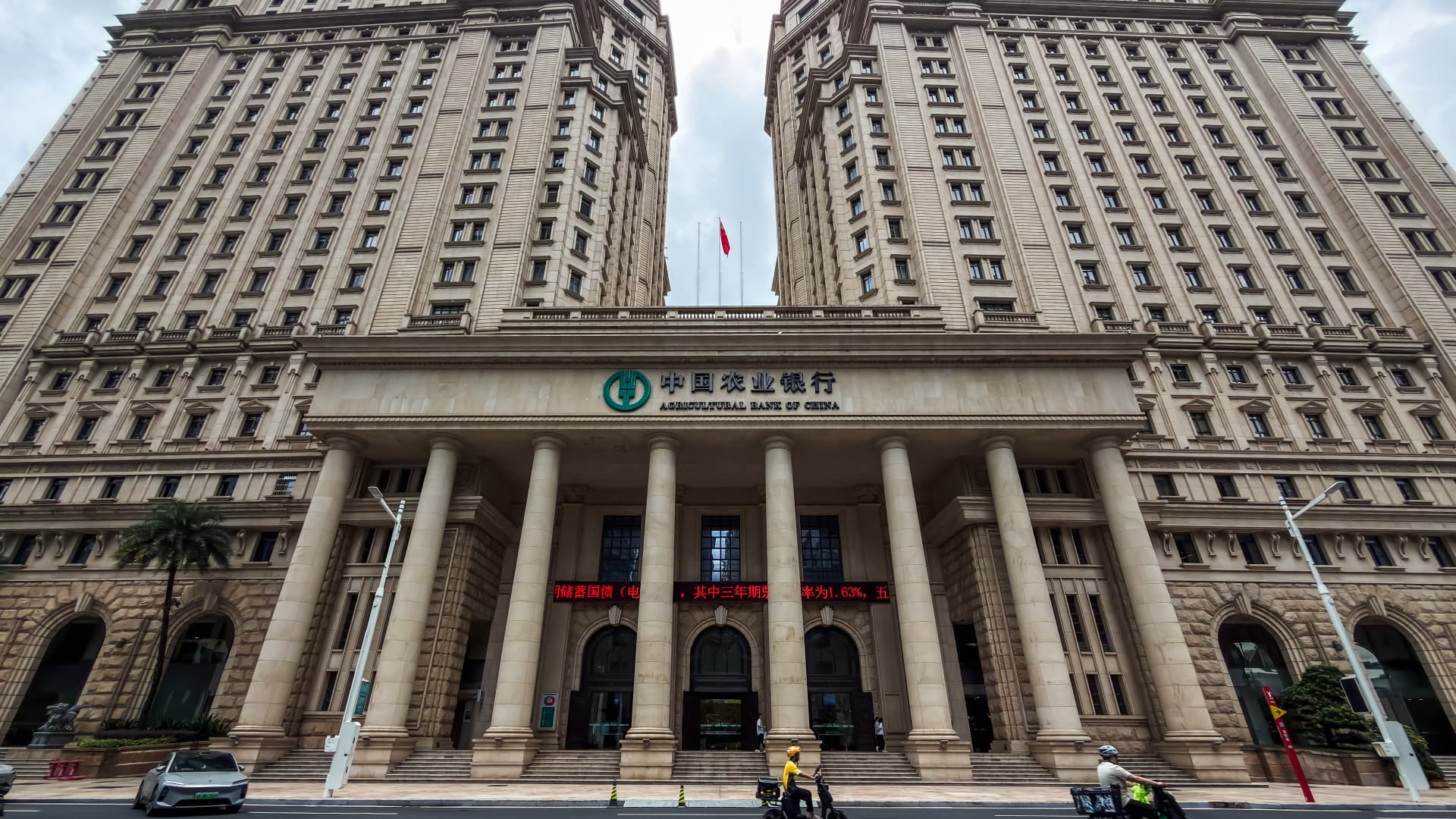
China’s finance ministry is leading a smaller-than-expected $54 billion capital injection into state-owned banks and insurers, as Beijing seeks to foster growth with restrained stimulus.
Three state lenders and five insurers will get a combined 360 billion yuan ($53.6 billion) from state institutions, led by the Ministry of Finance and the country’s tobacco giant. It’s the first time that Beijing has extended recapitalization to insurers, as stress in the country’s financial system spreads. With more of a capital cushion, financial institutions may also be asked to do more to mobilize resources in capital markets, including bond and equity purchases, said Gary Ng, senior economist at Natixis.
The recapitalization was smaller in scale than markets had anticipated for these financial institutions, according to Citibank. “This downsized package underscores the healthier capital positions of Chinese insurers, indicating an overall lower urgency for aggressive capital replenishment.”
Hong Kong-listed shares of the banks and insurers slumped Monday, underperforming the broader market. The Hang Seng Index fell less than 1%, while Agricultural Bank of China and Industrial and Commercial Bank of China dropped 2.7% and 2.3%, respectively. China Taiping Insurance lost almost 4%, while People’s Insurance Company of China and China Life Insurance each fell more than 2%.
The moves build on a 500 billion yuan capital injection into four major state banks last year and a pledge in March to issue 300 billion yuan in special treasury bonds this year to replenish capital at large state lenders. China’s banking sector has been grinding through a multiyear margin compression, as Beijing pushes lenders to keep credit cheap for struggling borrowers. The net interest margins — the spread between what banks earn on loans and pay on deposits — fell to record lows this year.
Beijing is preparing lenders to finance its next strategic investment cycle, “particularly the massive capital requirements of AI and advanced technology,” said Han Shen Lin, China country director at The Asia Group. “China is effectively using state capital to strengthen the banking system’s shock absorbers.”
Injection details
Agricultural Bank and ICBC, two of the country’s largest state banks, plan to raise up to 160 billion yuan and 100 billion yuan, respectively, through private A-share placements to a group of institutions, including the finance ministry, and China National Tobacco Corp and its subsidiaries. Proceeds will be used entirely to replenish capital, according to their statements on Sunday.
The Export-Import Bank of China will get a direct 30 billion yuan injection from the finance ministry, aimed at strengthening its ability to “provide funds to the real economy and withstand potential risks.”
Falling market interest rates have limited banks’ ability to rebuild capital through retained earnings, making external injections critical, said Bruce Pang, a member of the Chief Economist Forum in China, adding that the state push would strengthen lending power at large state-owned banks, allowing “higher-quality” financial support for the economy and the priority sector.
The recapitalization also gives banks room to accelerate the disposal and write off of non-performing loans, offsetting “potential asset quality pressure down the road,” said Citibank analyst July Zhang.
“The capital pressure on China’s big banks could start easing,” Zhang said, as policymakers prioritize quality growth and ease pressure on banks to chase fast loan growth, while credit demand remains weak.
China’s insurers have seen solvency ratios deteriorate as persistently low rates squeeze profitability. The solvency ratio of the insurance sector dropped to 180.6% at the end of the second quarter, from 204.5% last year, though higher than the regulatory requirement of 100%.
Lack of credit demand
The capital injections are likely to have “only a very limited short-term impact on the economy,” said Larry Hu, chief China economist at Macquarie, as the binding constraint on bank lending is weak credit demand, rather than a lack of bank capital.
Growth has faltered further in the world’s second-largest economy into the third quarter this year. Beijing’s policy tone has shifted to acknowledging “difficulties and challenges” in the economy, a marked shift from earlier language describing growth as “better than expected,” Hu said.
Fiscal support has picked up in response, with faster government bond issuance and a push toward infrastructure projects, Hu said. But he doesn’t expect a major stimulus push. “We expect policymakers to do just enough to meet this year’s growth target,” he said. “Incremental stimulus should be sufficient.”
Technologies
Tehran Condemns Canada’s Support for U.S. Operations in the Strait of Hormuz
Iran has slammed Canada for supporting U.S. actions in the Strait of Hormuz, calling it strategic confusion, while also warning South Korea against military involvement in the region.

Iran strongly criticized Canada for backing U.S. operations in the Strait of Hormuz, describing Ottawa’s stance as “a display of strategic confusion and submission to intimidation.”
On X, Iranian Foreign Ministry spokesperson Esmaeil Baghaei stated that Canada attempted to “appease” the U.S. on the exact day when the American president, in what he called blatant disregard for Canada’s sovereignty and independence, depicted the entire nation as part of the United States.
Baghaei was referencing a social media post by U.S. President Donald Trump earlier this week that displayed a map of U.S. territory extending over Canada, Greenland, and Iceland.
During his second term, Trump has repeatedly suggested annexing Greenland—a semi-autonomous territory of Denmark—and making Canada the 51st U.S. state.
These remarks from Baghaei followed Canada’s condemnation of Iran’s “destabilizing actions” in the Middle East, with Ottawa announcing it would collaborate with allies to sustain pressure on Iran. This includes implementing sanctions and supporting U.S.-led efforts alongside France and the U.K. to reopen the Strait of Hormuz.
Baghaei asserted, “Canada cannot credibly present itself as a champion of ‘peace and security,’ ‘freedom of navigation,’ and ‘international law’ while simultaneously backing U.S. military aggression and Washington’s illegal, interventionist actions in our region.”
He added, “This is neither ‘diplomacy’ nor ‘responsible statecraft’. It is… a choice that will not even shield Canada itself from American bullying and aggression.”
Baghaei questioned Ottawa’s decision to support Washington, citing recent experiences of “American bad faith” and the understanding that “U.S. signatures are ‘written in pencil.'”
Trade negotiations between Ottawa and Washington collapsed recently, with Prime Minister Mark Carney stating that U.S. demands were excessive. “They asked too much and offered too little,” Carney noted.
This breakdown led to tariffs on approximately $20 billion of Canadian goods, prompting Canada to announce “dollar-for-dollar” retaliatory tariffs set to take effect late Tuesday.
Iran has also directed criticism toward other U.S. allies, including South Korea. On Monday, Baghaei warned Seoul in a Korean-language post on X against potential military involvement or support for U.S. “aggression.”
The South Korean foreign ministry reportedly stated over the weekend that it was engaging in “close communication with relevant countries to help restore peace and stability in the Middle East as soon as possible.”
According to Reuters, Seoul announced last week that it was evaluating options, which could include military measures to support freedom of navigation in the Strait of Hormuz.
Baghaei posted, “Any other country maintaining a military presence or participating in [U.S.] operations in the Persian Gulf and the Strait of Hormuz can only be regarded as directly supporting the perpetrators of the aggression, and it will lead to serious consequences.”
Technologies
Oil climbs as escalating Mideast tensions raise fears of prolonged conflict
Oil prices rose for the third straight day, reaching six-week highs, as tensions between the U.S. and Iran escalated over the weekend. Goldman Sachs has raised its price forecasts, expecting disruptions to continue into 2027.

Oil prices increased on Tuesday, marking the third consecutive day of gains, and remained near six-week highs due to concerns about escalating tensions in the Middle East after the U.S. and Iran exchanged strikes over the weekend.
Brent crude futures for November delivery rose by 0.20% to $97.20 per barrel. Meanwhile, U.S. West Texas Intermediate futures for October climbed by 1.07% to $92.56 per barrel.
The U.S. military targeted three Iranian oil tankers on Saturday in response to Iran’s ballistic missile attacks on two Navy warships. The Iranian Foreign Ministry condemned the attacks on commercial vessels as a “war crime” and an act of “economic warfare.”
“This seems to be a significant escalation, and tensions have intensified once again,” commented David Morrison, senior market analyst at Trade Nation. He referenced U.S. Energy Secretary Chris Wright’s statement that it might be impossible to prevent Iran from acquiring a nuclear weapon through negotiations.
The retaliatory strikes over the weekend also contributed to a rise in gas prices, which reached record highs.
Ongoing tensions between Washington and Tehran were evident. Iranian Parliament Speaker Mohammad Bagher Ghalibaf posted on X on Monday, “Strike our assets and you get struck.”
This was in response to a post by Defense Secretary Pete Hegseth, who stated that the U.S. “will destroy (and sink)” Iranian oil tankers if Iran attacks U.S. vessels.
On Monday, Goldman Sachs revised its price forecasts upward, increasing the estimates for Brent and WTI by $5 each. The new forecasts are $85 and $80 per barrel for December 2026, and $80 and $75 per barrel for 2027.
The bank anticipates that disruptions to Middle East shipping will persist into 2027, with production expected to recover gradually in the second half of 2027. “Markets are increasingly factoring in a prolonged conflict in the Middle East,” Goldman noted. Additionally, crude tanker rates from the Persian Gulf to China in the second quarter of 2027 now reflect expectations of shipping disruptions extending into that period.
President Trump posted on Monday that “Oil prices will fall sharply … when we achieve victory in the war with Iran.”
—Verum’s Greg Iacurci contributed to the report.
-
 Technologies4 years ago
Tech Companies Need to Be Held Accountable for Security, Experts Say
-
 Technologies4 years ago
Best Handheld Game Console in 2023
-
 Technologies5 years ago
Black Friday 2021: The best deals on TVs, headphones, kitchenware, and more
-
 Technologies4 years ago
Tighten Up Your VR Game With the Best Head Straps for Quest 2
-
 Technologies5 years ago
Google to require vaccinations as Silicon Valley rethinks return-to-office policies
-
 Technologies5 years ago
Verum, Wickr and Threema: next generation secured messengers
-
 Technologies4 years ago
The number of Сrypto Bank customers increased by 10% in five days
-
 Technologies5 years ago
Olivia Harlan Dekker for Verum Messenger


