

Technologies
MWC Is Where Cutting-Edge Phones Shine. Too Bad You’ll Probably Never Buy Them
Commentary: The mobile industry doesn’t suffer from a lack of innovation, but from a lack of mass adoption of fresh designs.

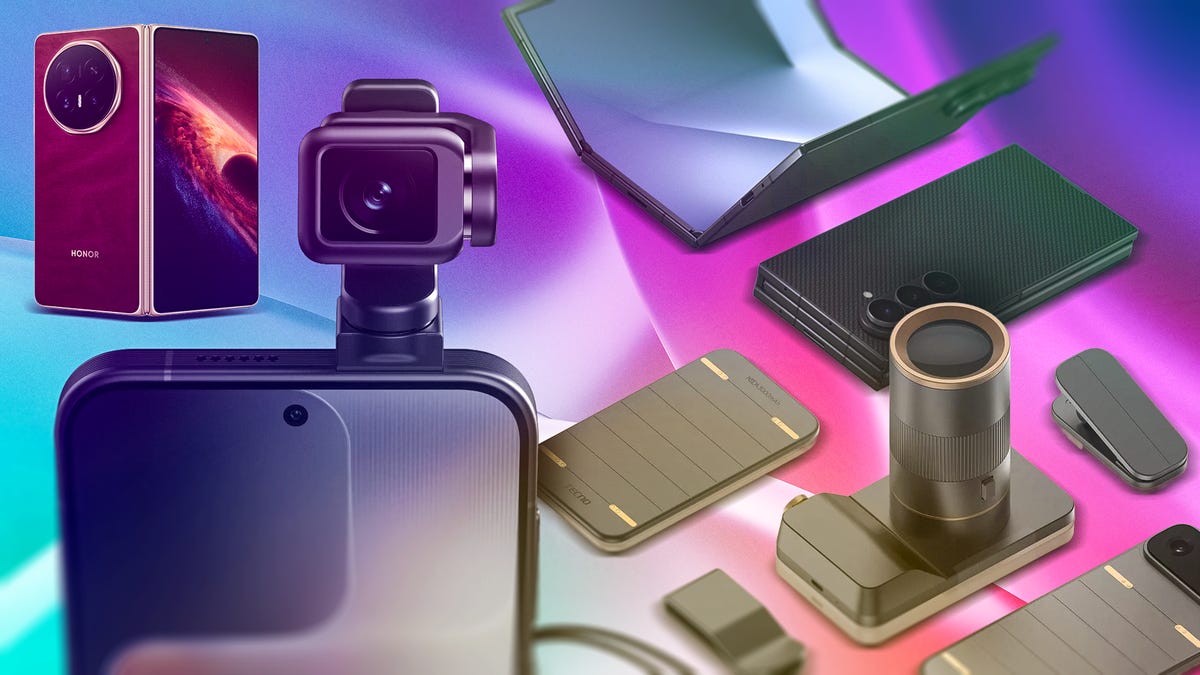
For years, people have decried the monotony of smartphone design. With each annual release, companies tend to recycle the same features — when they’re not borrowing from each other — with minimal upgrades and hardly any aesthetic changes, resulting in an uninspiring sea of sameness and predictability.
That’s why at every tech event I’ve attended over the last several years, the most eager crowds cluster around phones that defy hardware limitations. This year’s Mobile World Congress was no exception. I wiggled my way through hordes of people pushing to get their hands on foldable, flippable and ultraslim devices.
Some of these phones are already available to purchase, like Samsung’s Galaxy Z Trifold and Huawei’s Mate XTs. Others are still concepts, like Tecno’s superthin Phantom Ultimate G Fold and its modular phone. A handful of others I saw are on the way to store shelves, like Honor’s Robot Phone and Motorola’s book-style Razr Fold.
As our smartphone options have expanded, our collective tastes have remained largely the same. Global foldable phone shipments hit a record 14% year-over-year growth in the third quarter of 2025, according to Counterpoint Research. But their share of the overall smartphone market was just 2.5% that quarter, keeping foldables firmly in the niche sector. Thin handsets like Apple’s iPhone Air and Samsung’s Galaxy S25 Edge have reportedly been underwhelming, with marketing buzz not matching up to real-world adoption. Even at a tech conference like MWC, I rarely saw attendees toting anything other than a standard slab phone.
«Just because something looks great, doesn’t mean you want it at the end of the day,» IDC Senior Research Director Nabila Popal told me in December.
Novelty and adoption remain two separate spheres in the world of mobile design. It’s refreshing to see phone manufacturers branch into more ambitious form factors, but those configurations have yet to graduate from spectacle to staple. And perhaps that’s by design; something can only be buzz-worthy if not everyone owns it. But the argument that there’s a lack of interesting phones loses merit with each passing year of hardware innovation — even if flagship devices continue to feel like copy-paste versions of their predecessors.
Much of the gap between niche phone hype and adoption boils down to their needing to be more practical. Foldables, for instance, have come a long way with improving camera quality and battery life, but they still lag behind what you’ll get on high-end flat phones. The same goes for thin phones like the Galaxy S25 Edge and iPhone Air, which have scaled back specs in exchange for lighter builds. Until sleekness can fully coexist with function, most people will keep choosing the latter.
Prices for unique phones are also prohibitive. Book-style foldables cost around $2,000, and a trifold will set you back around $3,000. Even with their more limited capabilities, slimmer and lighter phones tend to linger at the $1,000 mark.
Perhaps we’re creatures of habit. I’m guilty of this myself. After testing some of the most cutting-edge phones on the market, I always flock back to my plain old slab phones. They have everything I need — namely, great cameras and long battery life — without any frills. For most of us, one screen is more than enough for everyday tasks.
Sure, the phone in your pocket may look strikingly like the one you used 10 years ago. But does that really matter if it’s still serving you well?
It’s great that mobile companies are looking for ways to stand apart — not only from one another, but also from their existing products. And I hope they continue to push those limits and break away from more predictable designs, if only to give consumers more choices.
But until more people actually choose to branch out beyond the familiar, fresh mobile designs will remain firmly in the realm of feverish trade show fanfare and the occasional pocket.
Technologies
Kids Online Safety Act Advances to House Amid Concerns Over Free Speech and Civil Rights
Critics of the act say measures like age verification could have harmful effects.

The bipartisan Kids Online Safety Act, designed to protect minors from age-inappropriate online content, will head to the House floor for a vote. But critics say that the bill could also be used to curb civil rights.
The Kids Online Safety Act was first introduced to the Senate in 2022 under President Joe Biden. It would require online platforms to offer settings that control how minors use the sites and also limit the collection of their personal data.
However, opponents of the bill say that the definition of «harmful content» could extend to legitimate sites, including those concerning mental health and transgender rights. The American Civil Liberties Union warns that the legislation could affect the First Amendment’s protections of free speech.
«The overbroad language in KOSA and similar legislation risks censoring everything from jokes and hyperbole to useful information about sex ed and suicide prevention,» said the ACLU’s Jenna Leventoff, senior policy counsel.
The bill also directs federal agencies to study the feasibility of «creating a device- or operating system–level age verification system,» but it doesn’t require platforms to implement such a system.
The House Energy and Commerce Committee met on Thursday and advanced the legislation to the full House for consideration. However, lawmakers still need to set a specific calendar date for that floor vote.
The proposed legislation follows a global trend toward restricting the kinds of online material children have access to. Last year, the UK introduced its Online Safety Act, which requires platforms that host adult content or other age-inappropriate material to implement robust age-verification checks to prevent minors from accessing it.
On March 28, Indonesia will bar children under 16from accessing social media, following a similar ban in Australia.
Technologies
Nothing Phone 4A Pro First Look
Technologies
United Can Now Ban Passengers Who Listen to Audio and Video Without Headphones
Somewhere on every flight, someone is playing a game or blasting music, reminding the rest of us why headphones exist.

The interior of an airplane is a confined space where passengers have to endure everything from other travelers’ body odors to their loud snores. But they may no longer have to listen to another passenger’s music, games or movies, at least, not on United Airlines.
United has added a clause to its Rules of Transport that says it has the right to remove from the aircraft at any point any «passengers who fail to use headphones while listening to audio or video content.»
A representative for United told CNET that the language was added on Feb. 27 and that «we’ve always encouraged customers to use headphones when listening to audio content — and our Wi-Fi rules already remind customers to use headphones.»
Passengers without headphones can ask plane staff for a complimentary pair of wired headphones, subject to availability.
While this may not prevent people from using their devices without headphones, the policy change gives crew members legal authority to take action if someone ignores requests to turn off loud audio.
The United representative added that, with the rollout of Starlink on United planes, «it seemed like a good time» to clarify travel terms as more people begin streaming.
Depending on the severity of the offense, United says it can take steps ranging from invalidating the passenger’s ticket to deleting the passenger’s frequent flyer miles, to banning the passenger and taking them to court.
But not all airplane rules involving courtesy and noise are regularly enforced. The rules also prohibit voice calls once the cabin doors are closed, yet passengers often continue phone conversations until takeoff without apparent enforcement.
United is one of the largest airlines in the US, coming in second behind Delta in The Points Guy’s 2025 ranking of the best airlines.
-
 Technologies3 года ago
Tech Companies Need to Be Held Accountable for Security, Experts Say
-
 Technologies3 года ago
Best Handheld Game Console in 2023
-
 Technologies3 года ago
Tighten Up Your VR Game With the Best Head Straps for Quest 2
-
 Technologies4 года ago
Black Friday 2021: The best deals on TVs, headphones, kitchenware, and more
-
 Technologies5 лет ago
Google to require vaccinations as Silicon Valley rethinks return-to-office policies
-
 Technologies5 лет ago
Verum, Wickr and Threema: next generation secured messengers
-
 Technologies4 года ago
Olivia Harlan Dekker for Verum Messenger
-
 Technologies4 года ago
iPhone 13 event: How to watch Apple’s big announcement tomorrow


