

Technologies
MWC Barcelona 2026: All the New Tech, Phones, Wearables and AI We Expect to See
This year’s Mobile World Congress starts Monday and will be packed with reveals from Xiaomi, Honor, Nvidia and more.

Every year, the moment we witness the very earliest signs of spring, CNET takes its cue to decamp to Barcelona for Mobile World Congress.
This is the world’s most important mobile show, and one of the most exciting events in the tech calendar. This year, we’re sending a bigger team to bring you all the news from the show as it happens.
It’s set to be a bonanza of new phones and wearables, with the odd robot thrown in for good measure. Sure, some of the fun tech we see at MWC never makes it out into the wider world, but we’ve also seen some of our most beloved tech debut at the show over the years — so expect a little of both.
Big themes are set to include AI and 6G, and with keynotes from SpaceX and Qualcomm, we’ll no doubt get a solid glimpse of the future of mobile. With Gemini in everything and satellite dominance on the horizon, it’s an exciting time for the industry.
Here’s more of what we expect to see.
What are the key dates for MWC?
MWC 2026 is set to run from March 2 to 5, although we’ll be in town a couple of days beforehand to report on some of the big launch events scheduled for this weekend. Don’t miss Xiaomi’s launch event on Feb. 28 and Honor’s event on March 1.
How to watch along
No matter how far away you live from Spain, there’s no need to feel like you’re missing out. The best place for all the latest MWC news is on our CNET live blog.
We’ve been attending this show for decades (this is MWC’s 20th year in Barcelona, by the way), and we have a team of experienced reporters and reviewers on the ground.
We’ll show you everything we deem interesting and important, and we’re not just admiring new products from afar. We’re touching, tinkering with and trying not to drop them, so be sure to follow us across Bluesky, Instagram, TikTok, X and YouTube, too.
What phones to expect at MWC 2026
For the past few years, Chinese phone-makers have dominated MWC, and 2026 looks to be no different.
The first big phone launch event is scheduled for 6 a.m. PT Saturday, Feb. 28, when we expect Xiaomi to unveil its latest camera-focused flagship. We loved the Xiaomi 15 Ultra, and the 14 Ultra before it, so we’re excited to see what the company has in store for us. A teaser image hints at its partnership with premium camera brand Leica and promises a «new wave of imagery.»
Next up, we have Honor on Sunday, March 1, when the company has said it will unveil its Magic V6 phone, alongside the MagicPad 4 and MagicBook Pro 14. Perhaps more exciting still, Honor has said it will give us a first glimpse of a working version of its Robot Phone, and will also unveil a humanoid robot at its event.
For other phone-makers, MWC is likely to serve as more of a victory lap for its existing devices — particularly Samsung, which held its own event in San Francisco this week to unveil the flagship S26 series. Motorola will be in town, likely showing off its Razr, which just like the Samsung Galaxy TriFold, has yet to be seen much in Europe.
On the whole, MWC 2026 is likely to be a big show for foldable phones, which, according to Ben Wood, CMO and chief analyst at CCS Insight, «is now becoming quite a mature category.»
Another major trend in the phone space is likely to be a focus on batteries, particularly silicon carbon-based tech, Wood said in an MWC preview session. «We’re expecting to see phones with some of the biggest batteries we’ve seen for a long time, [with] fast charging — perhaps 300-watt charging — being introduced,» he added.
What other tech to expect at MWC 2026
After the early flops that were the Humane AI Pin and the Rabbit R1, we’re seeing more companies moving to jump on the wearable AI bandwagon. We expect to see a number of devices and demos pop up at MWC — perhaps trying to beat OpenAI and Jony Ive to the punch.
This will include AI- and AR-based glasses, said CCS Insight analyst Ben Hatton during the firm’s briefing session. «We are expecting to see a huge number of glasses on show this year, not just from Meta, but also from the smaller players, [like] TCL and Oppo, looking to take a slice of the pie,» he said.
One of the key challenges for these companies will be differentiation, Hatton said. «Ultimately, there’s still a long way to go before these become generally mass market products,» he added, pointing out that at this stage, compelling use cases are still a bit thin on the ground.
It’s been two years since Samsung launched the Galaxy Ring at MWC, and smart rings have been fairly thin on the ground ever since — although Oura CEO Tom Hale is slated to speak at the show. We’re not necessarily expecting to see any new rings this year, but there’s always an outside chance.
Much more likely to show up are a slew of new laptops and tablets. They rarely get top billing at MWC, but we’ll keep an eye out for the most exciting launches. There’s also likely to be some intriguing concepts on show from the likes of Lenovo and Samsung Display, which is responsible for the tech behind the new Galaxy S26 Ultra’s scene-stealing Privacy Display.
The big themes: AI, 6G and beyond
No surprises here that AI will, of course, be a major theme at MWC. For the past few years, Google has dominated the AI conversation at the event by showcasing Gemini’s capabilities and its widespread integration. Will this year be any different? Probably not, but that doesn’t mean the AI conversation has stalled.
We expect to see more sophisticated AI agents that are more deeply integrated into wearables, offering live translation, more actionable health insights and more personalized experiences. Some of the biggest players in the AI game will be present, including Nvidia and Qualcomm, on the hardware side. They’ll likely have saved some juicy announcements for the show and, hopefully, have some exciting demos we can try out.
Wind the clock back a decade, and everyone was talking about 5G and what a dramatic difference it was going to make to our lives. Now that 5G is old news, we’re looking forward to 6G. Most discussions about 6G so far have focused on its impact on the industry, but that doesn’t mean there’s nothing to be excited about.
At the Web Summit in November, Qualcomm CEO Cristiano Amon told me that 6G will make our phones faster than ever and connect us to an «always-sensing network.» This could include wearables, smart devices, cars and even robots. No doubt, Amon will expound on this subject further during his MWC keynote, which is all about 6G and AI.
Another theme likely to be prevalent at the show is the role of satellites in enhancing network connectivity. SpaceX President Gwynne Shotwell will be on stage to talk about Starlink, and all the world’s biggest carriers will have their own booths where they’ll show us what they’re doing to tap into the latest network technologies.
Technologies
Little Caesars Wants ChatGPT to Order Your Pizza for You
You can personalize your pie and place your order without leaving the chatbot.
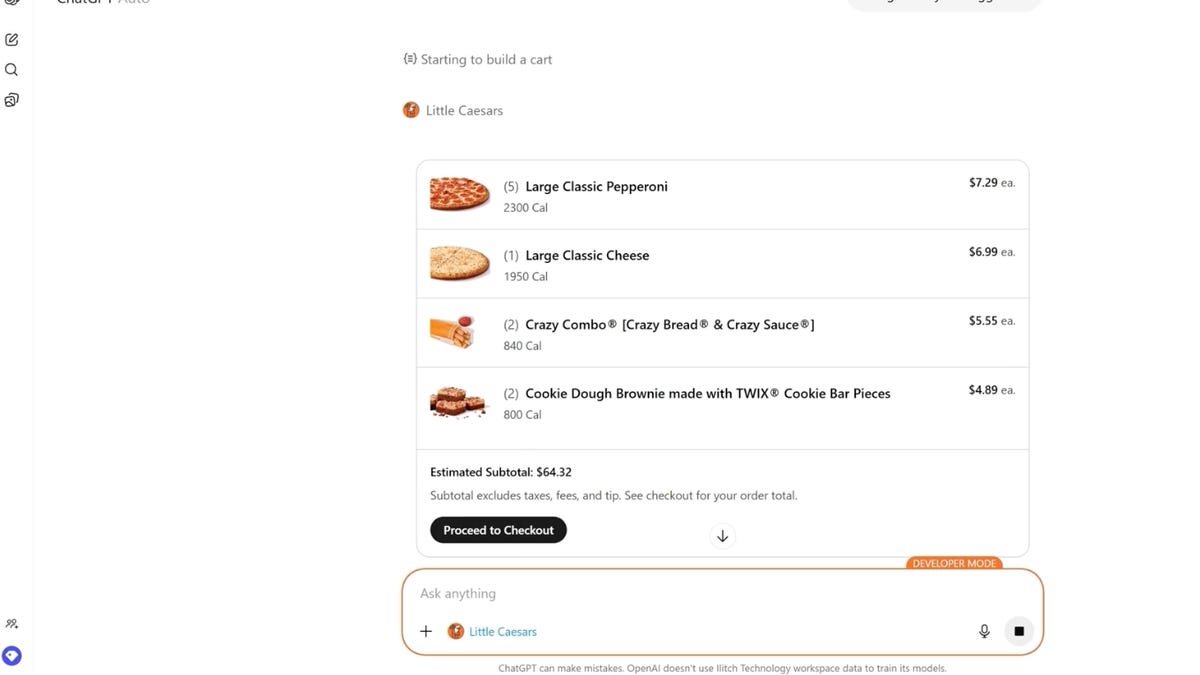
When it comes to building the perfect pizza, you need perfectly structured crust, quality cheese, well-seasoned sauce and fresh, delicious toppings. Oh, and artificial intelligence, naturally.
Or at least that’s what Little Caesars is saying.
Starting today, you can order Little Caesars through a new app inside ChatGPT. OpenAI’s chatbot can customize and order pizzas, or you can use ChatGPT to receive recommendations based on your budget, preferences, dietary restrictions or the number of people you need to serve.
«Today’s consumers are turning to Gen AI as part of how they search for everything, including where to get their next meal,» Greg Hamilton, chief marketing officer at Little Caesars, said in a statement. «We recognize this shift and want to meet our customers where they already are and be the go-to for their pizza occasions. The process is as natural and intuitive as having a conversation. It’s not just about technology for technology’s sake — it’s about making life a little easier for people who love great pizza.»
Read also: I Had ChatGPT Order Me a Pizza. This Could Change Everything
How ordering a pizza with ChatGPT works
To get started, you’ll need to launch ChatGPT on your desktop or mobile device. On the ChatGPT interface, go to the Apps menu and select Little Caesars. You will need to connect your accounts by signing into your Little Caesars account or creating one. From there, you can get started with ordering.
You can simply type in something like, «Pizzas for five people with no meat,» and you’ll get personalized recommendations for pizzas and sides that match your preferences. From there, you can tailor your order further by swapping toppings, adjusting amounts or adding an order of cookie dough brownies.
Once you review your order, you can checkout through the Little Caesars app and then your order will go to the nearest location for you to pick up when ready. You can also schedule an order ahead of time and track your order in real-time through the app.
The new ordering function is now available across all Little Caesars locations in the US, and many locations in Mexico and Canada.
Not interested in using AI? The Little Caesars app and website are still available, or you can always pick up the phone and call.
Technologies
Don’t Lose Your Texts: How to Move Away From Samsung Messages Before It Shuts Down
Samsung is deactivating its long-standing Messages app in July. Here’s what to do next.
Samsung is closing the book on its proprietary texting platform this summer. After years of slowly phasing out the software in favor of a more unified experience, the company is finally pulling the plug on its Messages app this July. While many Galaxy owners have already been using Google’s version for years, those holding onto the legacy interface now have a firm deadline to migrate their conversations before the service goes dark.
On a page with information about the switch, Samsung points to instructions on how to swap over to Google’s Messages app, including for phones that are still on Android 12 and Android 13. Samsung has historically preinstalled its own Messages app on Galaxy phones, but began transitioning toward Google Messages as early as 2021.
To encourage people to switch to Google Messages, Samsung’s instructions list new features offered by Google Messages, like RCS-enabled texting for features like typing indicators, easier group chats and sending higher-quality images. Google’s Messages app also has AI-powered spam detection and spam filters, multi-device access to messages and some built-in Gemini AI features. It’s also the app that most Android phones use as their default texting app, including Samsung’s more recent Galaxy S26. There are other SMS texting app alternatives in the Google Play Store if you don’t want to use the one made by Google.
Samsung has not said when exactly in July messaging will no longer work in the app. A Samsung representative didn’t immediately respond to a request for comment. Once the app is deactivated, only messaging to emergency services will work on Samsung Messages.
While Samsung did stop including it as the default texting app in 2021, it wasn’t until 2024 that Samsung stopped preinstalling the texting app alongside Google Messages. The Galaxy S26 can’t download the Samsung Messages app, and other phones won’t be able to download it after the app’s July sunset.
Samsung said users of Android 11 or lower aren’t affected by the end of service, but would also likely benefit from switching to a supported texting app like Google Messages. To switch to Google Messages, the company asks users to download the app if it’s not already installed and to set it as the default SMS app when prompted after launching it.
The post also notes that anyone using an older Galaxy Watch that runs on Samsung’s Tizen operating system will no longer have access to their full conversation history since these watches cannot use Google Messages. Samsung said that they will still be able to read and send text messages, but the company’s newer watches (Galaxy Watch 4 and later) that run WearOS will still have access to full conversations.
Technologies
New AT&T Elite 2.0 Phone Plan Boosts Wireless Hotspot and Data Performance
For customers willing to pay for it, the new top plan offers more high-speed data and performance than the former one.
Only a few weeks after overhauling its unlimited phone plans, AT&T has added a new plan to the top of the lineup that offers more data and performance — for a higher price. The AT&T Elite 2.0 plan is available now.
For a single line, Elite 2.0 costs $110 (plus taxes and fees). As more lines are added, the per-line price goes down. AT&T customers can mix and match plans on an account, but if we assume everyone is signing up for the Elite 2.0 plan, the costs break down like this:
• One line: $110
• Two lines: $100 per line, $200 total
• Three lines: $85 per line, $255 total
• Four lines: $75 per line, $300 total
• Five lines: $75 per line, $375 total
To compare it with AT&T’s next-priciest option, the Premium 2.0 plan costs $90 for a single line, or $55 per line on an account with four lines.
What’s included in the AT&T Elite 2.0 plan
For those amounts, the plan includes unlimited high-speed 5G data, prioritized even during network congestion, just like the Premium 2.0 plan, and 250GB of hotspot data (up from 100GB for the other plan). It also includes cellular access for one smartwatch and one tablet per line.
For travelers, Elite 2.0 has unlimited international talk, text and 20GB of high-speed data per month in 210 countries. The Premium 2.0 plan has unlimited talk, text and high-speed data, but only for 20 Latin American countries.
Aside from the data amounts, the Elite 2.0 plan includes AT&T Turbo, a feature normally offered as an add-on that increases data performance for video calling, gaming and streaming on 5G-capable devices. For other plans, AT&T Turbo costs $7 per line per month.
(AT&T Turbo is a separate feature from AT&T Turbo Live, which is designed to boost performance in certain crowded venues such as concerts or sporting events.)
AT&T Elite 2.0 vs Premium 2.0
| Price for 1 line, per month | Price for 4 lines, per month | High-speed data | Mobile hotspot | International Call/Data | AT&T Turbo | |
| AT&T Premium 2.0 | $90 | $220 ($55 per line) | Unlimited | 100GB | Unlimited talk, text and high-speed data in 20 Latin American countries; unlimited texting from US to 200+ countries | Not included |
| AT&T Elite 2.0 | $110 | $300 ($75 per line) | Unlimited | 250GB | Unlimited talk, text and 20GB high-speed data in 210 countries | Included |
-
 Technologies3 года ago
Tech Companies Need to Be Held Accountable for Security, Experts Say
-
 Technologies3 года ago
Best Handheld Game Console in 2023
-
 Technologies3 года ago
Tighten Up Your VR Game With the Best Head Straps for Quest 2
-
 Technologies4 года ago
Black Friday 2021: The best deals on TVs, headphones, kitchenware, and more
-
 Technologies5 лет ago
Google to require vaccinations as Silicon Valley rethinks return-to-office policies
-
 Technologies5 лет ago
Verum, Wickr and Threema: next generation secured messengers
-
 Technologies4 года ago
Olivia Harlan Dekker for Verum Messenger
-
 Technologies4 года ago
The number of Сrypto Bank customers increased by 10% in five days


