

Technologies
Don’t Bother Waiting for the iPhone 18. Just Buy the iPhone 17
Commentary: If you want a new iPhone, buy the iPhone 17. The iPhone 18 is still too far away, and we don’t know enough about it to warrant waiting.

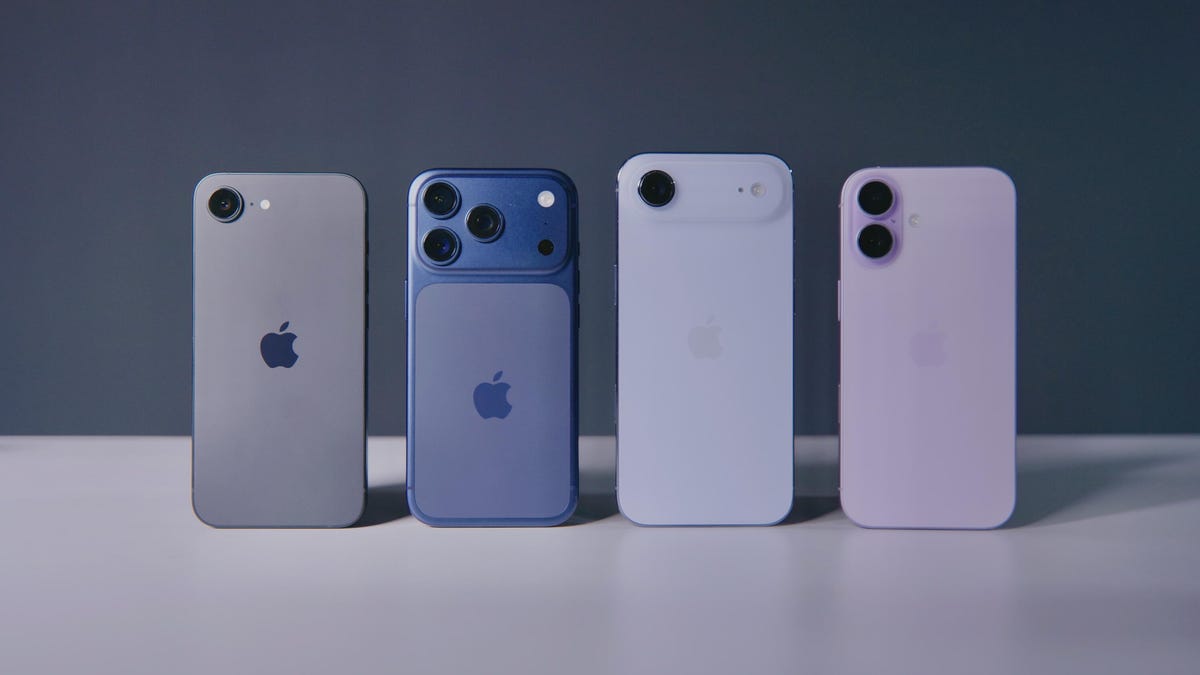
The year has barely begun, and there are already plenty of rumors about the next crop of iPhones. From a possible folding model to a brand-new iPhone 18 lineup, 2026 (and beyond) looks to be very interesting for the tech giant’s mobile division.
The iPhone 18 is rumored to have several changes from its predecessor, including variable-aperture cameras, an under-display front-facing camera for Face ID, a smaller Dynamic Island, an updated A20 chip, and new, interesting colors, including a «coffee» brown. The latest rumors suggest that the front-facing camera will be relocated to the top left corner of the screen, and the Camera Control button will be simplified to a pressure-sensing function. The Dynamic Island could also be shrunken in favor of a hole-punch cutout.
But if you’re trying to decide whether to buy an iPhone 17 now or get the iPhone 18, there is one biggest consideration: The iPhone 18 doesn’t exist. Apple hasn’t officially announced it. And rumors say the iPhone 18 won’t come out in September 2026 (to make room for the rumored iPhone Fold) and might be released in early 2027 instead.
Personally, I don’t think you should wait over a year for a new phone, especially if you’re considering an upgrade from an iPhone 14 or earlier model. Here are a few reasons why.
The iPhone 17 is great (and so is the 17 Pro)
If you’re looking to upgrade your phone, there’s a shiny new iPhone available in stores right now, and it’s a pretty good one. The iPhone 17 is a fantastic handset for iPhone devotees, especially for a base model.
Not only does the iPhone 17 offer a slightly larger 6.3-inch display (compared to the iPhone 16’s 6.1-inch screen), but it also features a variable refresh rate of 1 to 120Hz, a first among non-Pro iPhones. This lets you enable an always-on display so you can glance at the time or current sports scores without waking your phone. And, of course, the 120Hz ProMotion display also means increased smoothness and responsiveness overall, whether scrolling through social feeds or playing video games.
Sure, the iPhone 18 might get improved cameras, but the ones on the iPhone 17 aren’t too shabby. It has two 48-megapixel cameras on the back (a wide-angle and an ultrawide), with the ultrawide being a massive upgrade over the one on the iPhone 16 that only had a 12-megapixel sensor. The 18-megapixel selfie camera (which is on the rest of the iPhone 17 line and the Air) is also a great upgrade, especially with its Center Stage feature that zooms out when more people enter the frame or switches from portrait to landscape without you rotating the phone.
On top of that, the iPhone 17 has a sturdy aluminum frame, comes in an array of lovely colors (lavender is my favorite) and has an impressive battery life. In my experience, it lasts more than a day with moderate use, and this seems to align with CNET’s Abrar Al-Heeti’s experience as well.
If you want to further bridge the gap between this year’s iPhone and next year’s model, you could, of course, spend more on the iPhone 17 Pro. It has a beefier A19 Pro chip, a much better battery life (17 Pro Max) compared to the iPhone 17 and has that third camera on the back with a telephoto lens, which makes it a lot more versatile by offering a 4x magnification for zooming into distant subjects. I should note that battery life on the iPhone 17 and the regular iPhone 17 Pro are nearly identical.
The iPhone 18’s potential release date
Another significant reason not to wait to upgrade to the iPhone 18 is that it may not even be released next year. Waiting nine months until next fall is bad enough if you have an ailing phone, but there are currently rumors that Apple could be switching up its iPhone release strategy.
Bloomberg has reported that the company plans to unveil the iPhone 18 Pro, the iPhone 18 Pro Max, and a new foldable in the fall of 2026. However, the iPhone 18, iPhone 18E and a potential Air 2 are set to debut closer to March 2027. That’s over a year away! You could certainly upgrade to one of the 2026 models, but chances are they won’t be as affordable as the spring 2027 releases.
The older your phone, the more reason not to wait
If you have the iPhone 15 or newer, you could get by waiting for another year for the iPhone 18. But if your phone is much older than that and you would like a new iPhone, I see no reason to wait. This is especially the case if you’re experiencing performance and battery issues.
We usually recommend upgrading if your existing model is two generations old, especially if your phone starts having issues with your day-to-day tasks. One general consensus is that if your battery’s maximum capacity has dropped below 80%, and you don’t want to replace the battery, it’s probably wise to upgrade. You can check this by going to your phone’s Settings, selecting Battery and then Battery Health.
You can certainly keep your phone for longer, and Apple often provides software and security support for the iPhone for well over five years. However, you’ll also want to keep an eye out in case there are newer features that don’t work on your device, or if a newer iPhone’s camera hardware would provide enough of an upgrade to be a noticeable improvement.
But if you are thinking that you’d like to get a new base-level iPhone anytime in the next 12 months, there’s little reason to stick it out for the iPhone 18 when the iPhone 17 offers so many features.
Technologies
Today’s NYT Connections: Sports Edition Hints and Answers for Feb. 15, #510
Here are hints and the answers for the NYT Connections: Sports Edition puzzle for Feb. 15, No. 510.
Looking for the most recent regular Connections answers? Click here for today’s Connections hints, as well as our daily answers and hints for The New York Times Mini Crossword, Wordle and Strands puzzles.
Today’s Connections: Sports Edition pays homage to the Winter Olympics. The purple category is tough, as always — and today it expects you to hunt out hidden words inside longer words. If you’re struggling with today’s puzzle but still want to solve it, read on for hints and the answers.
Connections: Sports Edition is published by The Athletic, the subscription-based sports journalism site owned by The Times. It doesn’t appear in the NYT Games app, but it does in The Athletic’s own app. Or you can play it free online.
Read more: NYT Connections: Sports Edition Puzzle Comes Out of Beta
Hints for today’s Connections: Sports Edition groups
Here are four hints for the groupings in today’s Connections: Sports Edition puzzle, ranked from the easiest yellow group to the tough (and sometimes bizarre) purple group.
Yellow group hint: Lillehammer is another one.
Green group hint: Great White North.
Blue group hint: Think Chloe Kim.
Purple group hint: Look for a hidden word.
Answers for today’s Connections: Sports Edition groups
Yellow group: Previous Winter Olympic hosts.
Green group: Canada men’s hockey players.
Blue group: Snowboarding terms.
Purple group: Ends in a piece of winter sports equipment.
Read more: Wordle Cheat Sheet: Here Are the Most Popular Letters Used in English Words
What are today’s Connections: Sports Edition answers?
The yellow words in today’s Connections
The theme is previous Winter Olympic hosts. The four answers are Albertville, Chamonix, Oslo and St. Moritz.
The green words in today’s Connections
The theme is Canada men’s hockey players. The four answers are Celebrini, Crosby, Marner and McDavid.
The blue words in today’s Connections
The theme is snowboarding terms. The four answers are cork, frontside, goofy and McTwist.
The purple words in today’s Connections
The theme is ends in a piece of winter sports equipment. The four answers are cheapskate, chopstick, Lipinski and milestone.
Technologies
The Google Pixel 10 Pro Might Have the Best Phone Display for Gaming
While lagging behind in other areas, Google’s flagship is a standout in showing gameplay.
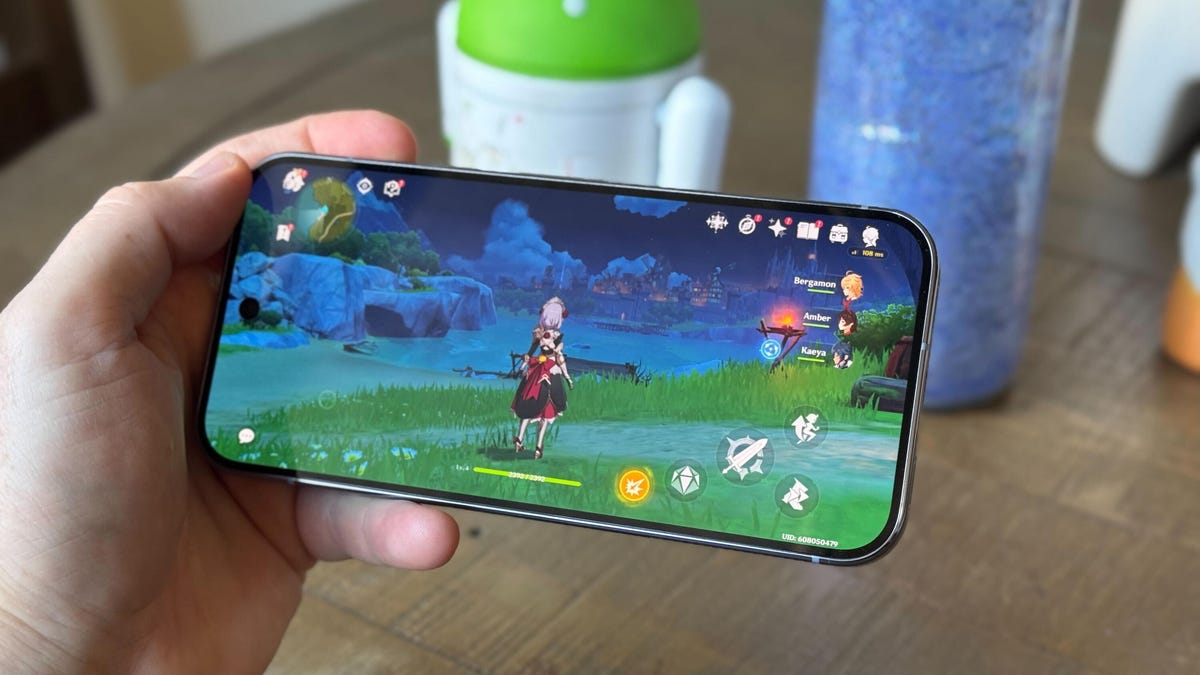
Google launched its latest Pixel 10 series, including the standard model and the more powerful Pixel 10 Pro, back in September, offering iterative hardware upgrades and new AI features. But for those of us who love to burn through our battery life playing games on premium phones, there’s another concern: How is gaming on the Pixel 10 Pro?
As a flagship phone with the most powerful specs Google has ever put into a (nonfolding) phone, the Pixel 10 Pro exceeds the baseline expectations for a $999 phone. (As I write this, you can buy a Pixel 10 Pro for $799 — $200 off.) It has a sharp OLED display and high-performance specs, so it has little trouble playing the latest games.
But some of Google’s hardware choices make the Pixel 10 Pro limited in ways that the OnePlus 15 and iPhone 17 Pro are not — namely, in storage and charging. Google’s phone also has a lot to live up to with its gaming capabilities, as previous Pixel phones haven’t been known for their processing power and graphics rendering, regularly scoring lower on performance benchmarks than Apple’s and OnePlus’ flagship phones, which pack some of the most powerful processors available today. Ultimately, the Pixel 10 Pro isn’t quite the absolute best pick for gaming among the best phones you can buy today.
Yet there are a few ways the phone shines as bright as — if not literally brighter — than the best Android phones and iPhones. Its gaming aptitude adds value to an already powerful phone with standout photo and AI capabilities.
How it feels to play games on the Pixel 10 Pro
On a basic level, the Pixel 10 Pro is great for firing up games and playing to your heart’s content. Its design is easy to hold, with flat metallic sides and curved corners that fit my fingers nicely when I rotate the phone horizontally to play most games. When I want more analog control with buttons and triggers, the handset slides in securely to my Backbone One external controller.
Games on the Pixel 10 Pro are a sight to behold. Its 6.3-inch OLED display shows sharp details with its 2,856×1,280-pixel resolution, and colors are vivid with its HDR10 Plus support. Action is smooth with the screen’s 120Hz refresh rate, whether in slower platformers or fast-moving first-person shooters like Call of Duty: Mobile.
Best of all, its 3,300-nit maximum brightness makes the screen easily seen in full daylight and nearly lights up a room in full darkness. This makes hues really pop in vibrant games like Dead Cells — it’s a true leg up over other smartphones with screens that don’t get as bright. The latest premium phones have gotten similarly bright (the iPhone 17 Pro Max tops out at 3,000 nits), but even phones a year or two older are substantially dimmer, with my personal iPhone 15 Pro Max reaching up to 2,000 nits brightness.
The Pixel 10 Pro’s Tensor G5 chip may not have topped our charts in benchmark tests, falling more in line with performance from 2024’s flagships, but it’s plenty powerful enough to run the games I tested on it. The phone’s 16GB of RAM contributes to that smoothness: I cranked Genshin Impact up to its maximum graphics settings, and despite a warning that my phone might overheat (I didn’t notice it get that much warmer), it handled 60 frames per second gameplay just fine.
The phone’s other capabilities were fine for gaming, including serviceable speakers and a respectable battery life. The latter surprised me, as older Pixel phones seemed less efficient and drained faster than competing premium handsets — and indeed, the Pixel 10 Pro ranks below the top 10 phones with the best battery life released last year, according to our lengthy battery tests of 2025 phones. While playing games, the battery didn’t drain particularly quickly, losing around 2% for each 4-5 minute match in Call of Duty: Mobile.
The Pixel 10 Pro’s gaming challenges, and where it sits for us
The Pixel 10 Pro’s biggest gaming flaw is its storage. It’s pretty shocking to see it start at $1,000 yet only pack 128GB, while most other premium phones have bumped their starting storage up to 256GB for the exact same starting price.
When some mobile games can be 50GB or more, this is a paltry amount, which shrinks quickly for people who take a lot of photos and videos at high resolutions. As I was loading up games on my Pixel 10 Pro, I was shocked that I had run out of space to download graphical extras in Call of Duty: Mobile and had to go delete some videos I’d taken.
A lesser issue lies in keeping the phone charged up. The Pixel 10 Pro’s battery gets decent but not spectacular life, with a 4,870-mAh capacity that’s surpassed by many of its premium rivals, especially the 7,300-mAh OnePlus 15.
But topping off Google’s flagship phone takes time, as it has a maximum 30-watt wired charging speed or 15-watt wireless charging. That likely means it’ll take over an hour to get it back to full from 0%, which takes a lot longer than some of the faster-charging phones out there, like the OnePlus 15, which went from 1% to 73% in half an hour thanks to its 80-watt wired charge rate. Compare that to the Pixel 10 Pro, which added 44% in the same amount of time.
Read more: The OnePlus 15 Is One of the Best Mainstream Phones for Gamers
Unlike some other premium phones, the Pixel 10 Pro does have its own MagSafe-like magnets aligned in a circle on its rear cover, called Pixelsnap, which is convenient for wireless charging, even if it’s slow. Google phone fans can get faster charging with the Pixel 10 Pro XL, which supports 45-watt wired and 25-watt wireless charging, though they’ll have to pay more for the bigger phone.
Neither of these issues are huge setbacks that impede the Pixel 10 Pro’s gaming capability — there’s just nothing in its features that make it stand out above other premium phones, aside from its bright and vivid display. That’s not surprising, as Google’s phone excels in nongaming aspects, including AI photo features like Auto Best Take and Camera Coach.
If you’re a Pixel fan who also plays games, you’ll enjoy firing them up on the Pixel 10 Pro, which is a good all-around device. For those who want a phone with features that are specifically better for gaming, there are other handsets that’ll satisfy, like the OnePlus 15.
Technologies
We Tested 35 Phones and Found the Surprising Winner of Best Battery Life
We subjected phones to extensive testing and found the two leaders.
Key takeaways:
- Apple and OnePlus are the best phone brands for the longest battery life in our tests.
- Models from Apple, OnePlus and Motorola made our top five phones for long battery life.
- 2025 phones have longer battery life on average than 2024 models, but only barely.
- Nearly half of our top battery-life picks use silicon-carbon batteries.
Does your smartphone make it through the day on a single charge? That’s the rough benchmark for phones sold in 2026, but in reality some people burn through their battery far quicker scrolling through social media and capturing photos and video. As features like cameras get yearly advancements, batteries have largely stayed static. But that is starting to change.
I’ve been reviewing and testing phones for CNET for nearly a decade and heard from many readers that long battery life is a priority. In a CNET/YouGov survey from September 2025, readers ranked «longer battery life» as the main reason to buy a new phone (second only to price).
For better or worse, we are tied to our devices more than ever before and you can’t do much with your phone if the battery is dead. So it’s important to know which phones have the longest battery life before you buy your next handset.
2026 is a turning point for batteries
In the past year, we’ve seen more phone makers adopt a new type of battery with a silicon anode, often called a silicon-carbon battery. This new power source can increase capacity without requiring a larger physical battery. Space is already limited in phones, especially as designs get thinner, so finding a way to increase the capacity without making the battery larger is an incredible advancement.
All of this leads to the question: Do phones sold today have better battery life than previous models? And if so, which phones and brands last the longest on a single charge? We did some testing to find out.
What phone has the best battery life?
Multiple factors, like your carrier’s signal strength and your screen’s brightness, can affect your battery life. How you use your phone throughout the day also has a huge impact. The battery’s capacity and the efficiency of the software and processor also significantly influence battery life. To standardize our testing and minimize variables as much as possible, we run each phone through an anecdotal stress test and a video streaming test, starting with the battery at 100%. The results from each test show the remaining battery percentage. We averaged the two results to determine an overall score and limited our rankings to phones officially sold in the US.
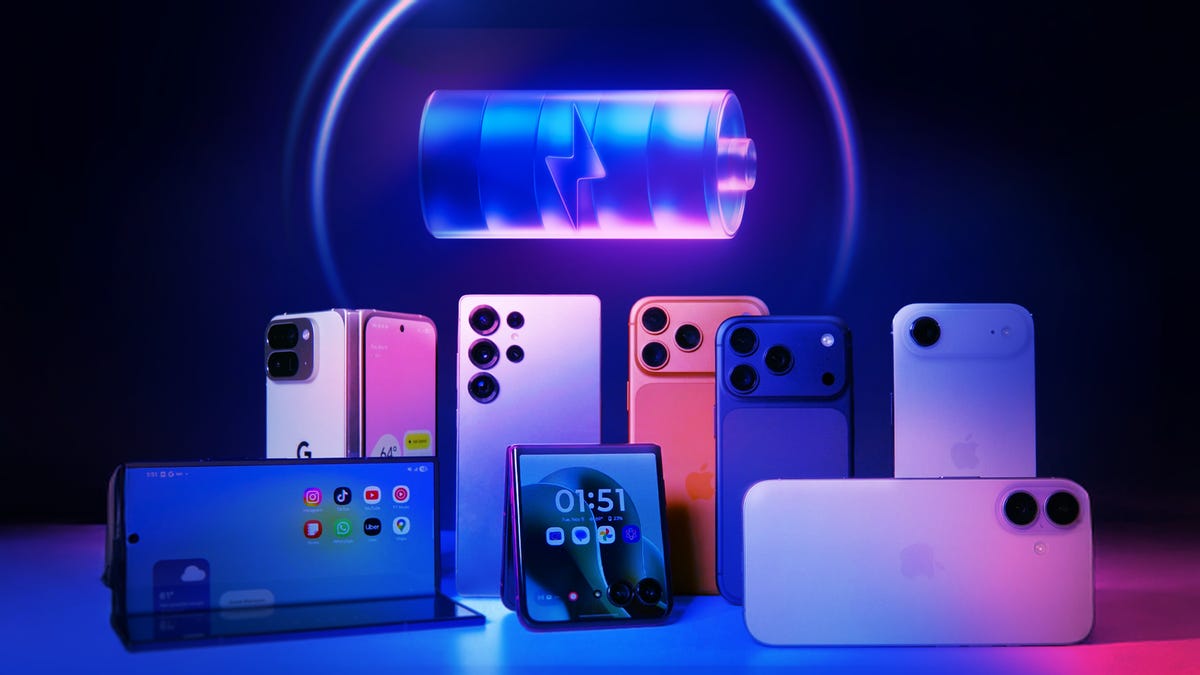
In 2025, CNET tested the battery life of 35 phones, and our overall top performer is the iPhone 17 Pro Max. At a starting price of $1,199, it was the most expensive phone in our top five. Its 5,088-mAh battery capacity wasn’t the largest, but it shows just how efficient Apple’s A19 Pro chip and iOS 26 are.
Among our top five rankings, several were tied. The iPhone 17 and OnePlus 15, which start at $829 and $900, respectively, both finished in second place. The iPhone 17 has the smallest-capacity battery of any of the top phones, proving that battery size doesn’t matter. Meanwhile, the OnePlus 15 has one of the largest on the list.
Notably, OnePlus had three phones in our top rankings, all of which have a silicon-carbon battery for that larger capacity. The only other silicon-carbon battery phone in our top rankings was the Poco F7 Ultra, which you can buy in the US for as low as $649.
The smaller iPhone 17 Pro, which starts at $1,099, landed in fourth place. Rounding out the top five were four phones tied for fifth place: the $400 Motorola Moto G Stylus (2025), the $500 Motorola Edge (2025), the $600 OnePlus 13R and the $700 OnePlus 15R.
In total, only two phones of the nine ranked in our top five cost more than $1,000. The most affordable phone on the list is the Moto G Stylus, which combines a large battery with a less power-hungry screen and processor, resulting in incredible battery life.
Which brand makes phones with the longest battery life?
We averaged the scores from both tests for each phone model, and for any company where we had tested three or more models, we averaged those scores to assign each brand an average. Our lab data showed that Apple and OnePlus were the top brands for long battery life.
Apple’s iPhones and OnePlus handsets dominated our top five for phones, so it’s not that surprising that they rank high in overall battery life for a brand. Oppo was not included despite having two phones that did well in our testing. (OnePlus is a subsidiary of Oppo.) The Oppo Find X9 Pro and Oppo Find N5 foldable scored well, but because we hadn’t reviewed any other Oppo models, we couldn’t include them in the overall brand rankings. Also, neither phone is sold in the US but if you’re abroad it’s still worth getting either phone for the outstanding battery life.
In third and fourth place were Motorola and Samsung. We tested seven Motorola phones and nine Samsung handsets, and the results were tight. Motorola barely surpassed Samsung. I’m excited to keep an eye on these two brands in 2026 and see how their collective battery life compares.
Rounding out our top five brands is Google. We tested five Google phones in 2025, and they get decent battery life, especially the Pixel 10, but there’s a big step up from that to the battery life we got from OnePlus phones. What’s curious is that Google is the only other phone-maker besides Apple to control software and processor design through its combination of Android and Tensor chips, respectively.
Battery testing results
CNET runs two battery-life benchmarks (video streaming and stress tests) that let us compare phones. In our 3-hour video battery test, where we streamed a video over Wi-Fi with the screen at full brightness and the battery starting at 100%, the iPhone 17 Pro Max was the top performer. Most other phones that performed fantastic in this test were in our overall top five for battery life. A nice surprise is Samsung’s Galaxy S25 Plus, which starts at $999. It did well, tying with the Motorola Edge (2025) for fifth place. Sadly, the S25 Plus didn’t do as well in our second test.
In CNET’s 45-minute endurance test, during which we play games, stream videos, scroll social media and take a video call with the battery starting at 100%, the iPhone 17 Pro Max was again at the very top and joined behind by three other Apple models, including the iPhone 16E, which starts at $599.
We had a lot of ties for the top five results, including a few phones we haven’t seen rank yet. Google’s Pixel 10 and Pixel 10 Pro Fold did great in this test, as did the Motorola Razr (2025) — that’s two foldables in the top five results.
CNET’s buying advice
Because we’ve been using these tests for years, we can also compare a new phone against older models. We were able to see how 2025 phones performed compared with 2024 handsets. We averaged all 35 phones that we tested in 2025 and did the same for 2024. And while 2025 models did have more battery life, it was by less than 1%, averaging 0.78%. Most people don’t buy a new phone every year, but if you’re trying to choose between last year’s version of a phone you like and this year’s model, you likely won’t see a drastic difference in battery life — just go for the cheaper, slightly older phone.
If you like your current phone (iPhone or Android) and the only issue is that the battery life isn’t what it used to be, consider replacing the battery instead of buying a new phone. You’ll save a lot of money and extend your phone’s life by another couple of years.
-
 Technologies3 года ago
Tech Companies Need to Be Held Accountable for Security, Experts Say
-
 Technologies3 года ago
Best Handheld Game Console in 2023
-
 Technologies3 года ago
Tighten Up Your VR Game With the Best Head Straps for Quest 2
-
 Technologies4 года ago
Black Friday 2021: The best deals on TVs, headphones, kitchenware, and more
-
 Technologies5 лет ago
Google to require vaccinations as Silicon Valley rethinks return-to-office policies
-
 Technologies5 лет ago
Verum, Wickr and Threema: next generation secured messengers
-
 Technologies4 года ago
Olivia Harlan Dekker for Verum Messenger
-
 Technologies4 года ago
iPhone 13 event: How to watch Apple’s big announcement tomorrow


